

Wisconsin Association of Equal Opportunity
                                              2008 Annual Conference


          Emotional Intelligence in the
                  Workplace
                       Competencies for Enhancing Your
                     Effectiveness by Building Healthy and
                       Productive Relationships at Work

                                               With Jeff Russell
                                            Russell Consulting, Inc.
Photograph © 2007, Jeffrey Russell
The opposite of love is not hate, it is indifference.
  The opposite of art is not ugliness, it is
  indifference. The opposite of faith is not heresy,
  it is indifference. And the opposite of life is not
  death, it is indifference.
                     --  Elie Wiesel
                         Nobel Laureate
                         Holocaust survivor


Photograph © 2007, Jeffrey Russell
Emotional Intelligence
Emotional intelligence is the ability to
understand one’s emotional make-up and
the emotional make-up of others and to
use insight from this knowledge to
effectively manage and regulate one’s
own emotions to make good decisions and
to act effectively.


      © 2008, Russell Consulting, Inc. — www.RussellConsultingInc.com
Why It Matters . . .
Technical proficiency and intellectual ability
contribute little to working productively with
others
EI twice as important as technical skills
Leadership failure due to inflexibility and
inability to manage relationships with others
90% of difference between “Star” and average
performers due to emotional intelligence
50-70% of an organization’s climate due to
leader’s influence — and climate accounts for
20-30% of organization’s performance
Effective CEOs . . . EI behaviors 2 to 7 times
more often than those passed over . . .


      © 2008, Russell Consulting, Inc. — www.RussellConsultingInc.com
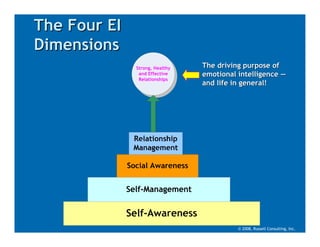
The Four EI
Dimensions
                Strong, Healthy   The driving purpose of
                 and Effective    emotional intelligence —
                 Relationships
                                  and life in general!


              Self-Management


                                            © 2008, Russell Consulting, Inc.
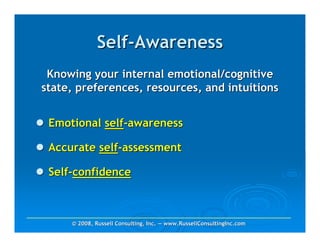
Self-Awareness
 Knowing your internal emotional/cognitive
state, preferences, resources, and intuitions


 Emotional self-awareness

 Accurate self-assessment

 Self-confidence


     © 2008, Russell Consulting, Inc. — www.RussellConsultingInc.com
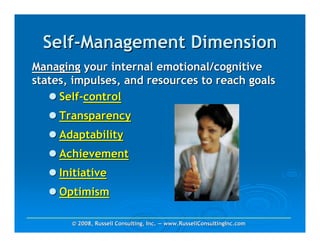
Self-Management Dimension
Managing your internal emotional/cognitive
states, impulses, and resources to reach goals
     Self-control
     Transparency
     Adaptability
     Achievement
     Initiative
     Optimism

       © 2008, Russell Consulting, Inc. — www.RussellConsultingInc.com
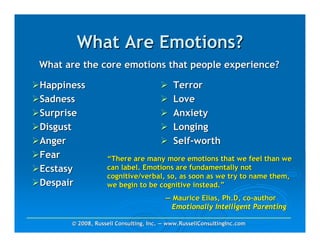
What Are Emotions?
What are the core emotions that people experience?

Happiness                                 Terror
Sadness                                   Love
Surprise                                  Anxiety
Disgust                                   Longing
Anger                                     Self-worth
Fear              “There are many more emotions that we feel than we
Ecstasy           can label. Emotions are fundamentally not
                  cognitive/verbal, so, as soon as we try to name them,
Despair           we begin to be cognitive instead.”
                                       — Maurice Elias, Ph.D, co-author
                                         Emotionally Intelligent Parenting

      © 2008, Russell Consulting, Inc. — www.RussellConsultingInc.com
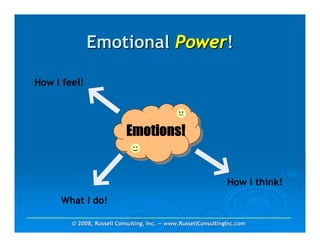
Emotional Power!


What I do!

  © 2008, Russell Consulting, Inc. — www.RussellConsultingInc.com
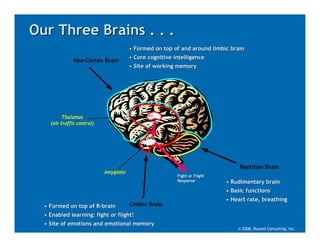
Our Three Brains . . .
                                   • Formed on top of and around limbic brain
                                   • Core cognitive intelligence
             Neo-Cortex Brain
                                   • Site of working memory


                                                     Fight or Flight
                                                     Response          • Rudimentary brain
                                                                       • Basic functions
                                                                       • Heart rate, breathing
  • Formed on top of R-brain
  • Enabled learning: fight or flight!
  • Site of emotions and emotional memory
                                                                           © 2008, Russell Consulting, Inc.
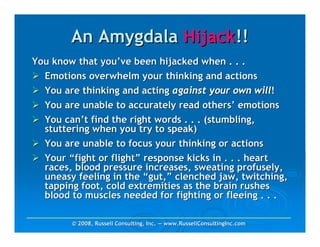
An Amygdala Hijack!!
You know that you’ve been hijacked when . . .
  Emotions overwhelm your thinking and actions
  You are thinking and acting against your own will!
  You are unable to accurately read others’ emotions
  You can’t find the right words . . . (stumbling,
  stuttering when you try to speak)
  You are unable to focus your thinking or actions
  Your “fight or flight” response kicks in . . . heart
  races, blood pressure increases, sweating profusely,
  uneasy feeling in the “gut,” clenched jaw, twitching,
  tapping foot, cold extremities as the brain rushes
  blood to muscles needed for fighting or fleeing . . .

        © 2008, Russell Consulting, Inc. — www.RussellConsultingInc.com
Implications?
What are the implications for being
hijacking by our Amygdalla?
What can we do about it?


    © 2008, Russell Consulting, Inc. — www.RussellConsultingInc.com
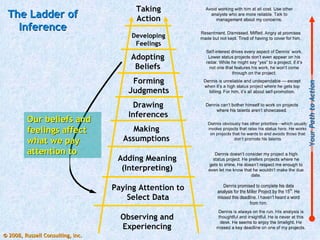
The Ladder of
   Inference


                                   Your Path to Action
         Our beliefs and
         feelings affect
         what we pay
         attention to


© 2008, Russell Consulting, Inc.
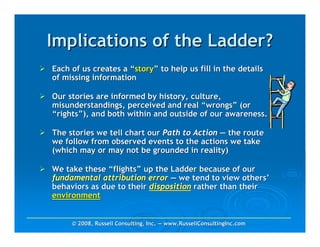
Implications of the Ladder?
Each of us creates a “story” to help us fill in the details
of missing information

Our stories are informed by history, culture,
misunderstandings, perceived and real “wrongs” (or
“rights”), and both within and outside of our awareness.

The stories we tell chart our Path to Action — the route
we follow from observed events to the actions we take
(which may or may not be grounded in reality)

We take these “flights” up the Ladder because of our
fundamental attribution error — we tend to view others’
behaviors as due to their disposition rather than their
environment


     © 2008, Russell Consulting, Inc. — www.RussellConsultingInc.com
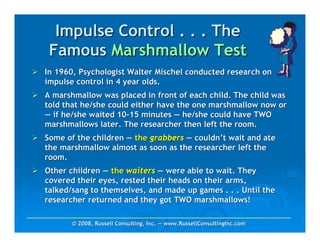
Impulse Control . . . The
 Famous Marshmallow Test
In 1960, Psychologist Walter Mischel conducted research on
impulse control in 4 year olds.
A marshmallow was placed in front of each child. The child was
told that he/she could either have the one marshmallow now or
— if he/she waited 10-15 minutes — he/she could have TWO
marshmallows later. The researcher then left the room.
Some of the children — the grabbers — couldn’t wait and ate
the marshmallow almost as soon as the researcher left the
room.
Other children — the waiters — were able to wait. They
covered their eyes, rested their heads on their arms,
talked/sang to themselves, and made up games . . . Until the
researcher returned and they got TWO marshmallows!

       © 2008, Russell Consulting, Inc. — www.RussellConsultingInc.com
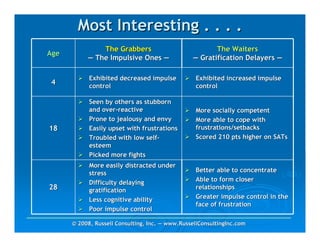
Most Interesting . . . .
               The Grabbers                             The Waiters
Age
           — The Impulsive Ones —                — Gratification Delayers —

            Exhibited decreased impulse           Exhibited increased impulse
4
            control                               control

            Seen by others as stubborn
            and over-reactive                     More socially competent
            Prone to jealousy and envy            More able to cope with
18          Easily upset with frustrations        frustrations/setbacks
            Troubled with low self-               Scored 210 pts higher on SATs
            esteem
            Picked more fights
            More easily distracted under
            stress                                Better able to concentrate
            Difficulty delaying                   Able to form closer
28          gratification                         relationships
            Less cognitive ability                Greater impulse control in the
                                                  face of frustration
            Poor impulse control

      © 2008, Russell Consulting, Inc. — www.RussellConsultingInc.com
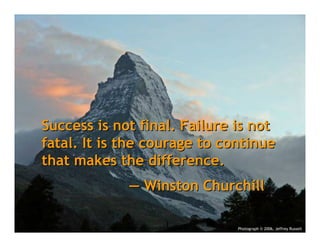
Success is not final. Failure is not
fatal. It is the courage to continue
that makes the difference.
             — Winston Churchill

                              Photograph © 2006, Jeffrey Russell
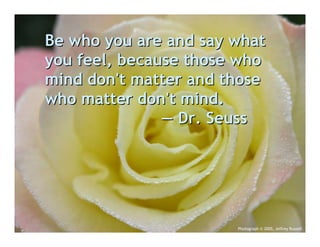
Be who you are and say what
you feel, because those who
mind don't matter and those
who matter don't mind.
               — Dr. Seuss


                       Photograph © 2005, Jeffrey Russell
Social Awareness Dimension
  Your awareness of others’ feelings,
         needs, and concerns


 Empathy

 Organizational awareness

 Service orientation


   © 2008, Russell Consulting, Inc. — www.RussellConsultingInc.com
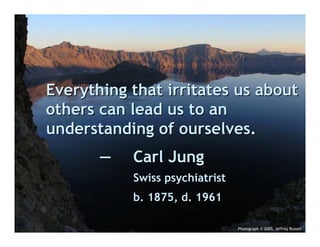
Everything that irritates us about
others can lead us to an
understanding of ourselves.
       —   Carl Jung
           Swiss psychiatrist
           b. 1875, d. 1961

                                Photograph © 2005, Jeffrey Russell
Empathy
The ability to “understand, be aware
of, be sensitive to, and vicariously
experience the feelings, thoughts, and
experiences of another.”
Demonstrating understanding of:
  The meaning of what was said
  The feeling that you sense that the person
  was experiencing


    © 2008, Russell Consulting, Inc. — www.RussellConsultingInc.com
Developing Empathy
What can we do to enhance our
empathy for others?
How can we feel empathy for people
for whom we have no sympathy (people
who, we believe, don’t deserve our
empathy)?
  Is it possible to feel empathy for a racist?
  For a child molester?
  For a terrorist?
    © 2008, Russell Consulting, Inc. — www.RussellConsultingInc.com
Developing Empathy
Put yourself in the other person’s shoes — try to see the
world from his or her’s perspective
Seek to understand the pressures, responsibilities,
expectations, and demands placed upon the other person
Inquire. If the other person says something that sounds
“off” or confusing, say “I’d like to know more about
that.”
Explore his or her reasoning. Behind every “position” and
argument is a set of thoughts and feelings that are the
underpinning of the position. By seeking to understand
the other person’s reasoning, it builds a bridge to
understanding


      © 2008, Russell Consulting, Inc. — www.RussellConsultingInc.com
Empathic Listening
Drawing Out — discovering new information
Clarifying — rooting out confusing,
conflicting, or ambiguous data
Reflecting/Mirroring — holding a mirror up to
the other person (e.g., “I sense that you’re
pretty angry about this. Am I right?”)
Paraphrasing — repeating back what you
heard — and asking “Is this what you said?
Did I get it right?”

     © 2008, Russell Consulting, Inc. — www.RussellConsultingInc.com
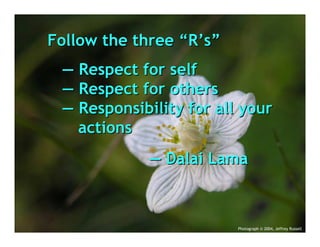
Follow the three “R’s”
 — Respect for self
 — Respect for others
 — Responsibility for all your
   actions
            — Dalai Lama


                         Photograph © 2004, Jeffrey Russell
Relationship Management Dimension

      Adeptness at inducing desirable
              responses in others
   Inspiration
   Influence
   Developing others
   Change catalyst
   Conflict management
   Teamwork and collaboration
     © 2008, Russell Consulting, Inc. — www.RussellConsultingInc.com
© 2007, Photograph by Jeff Russell
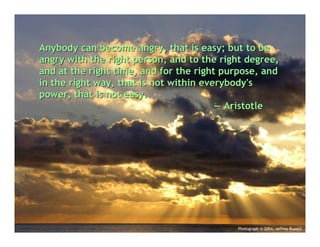
Anybody can become angry, that is easy; but to be
angry with the right person, and to the right degree,
and at the right time, and for the right purpose, and
in the right way, that is not within everybody's
power, that is not easy.
                                        — Aristotle


                                           Photograph © 2004, Jeffrey Russell
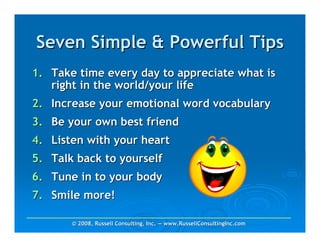
Seven Simple & Powerful Tips
1. Take time every day to appreciate what is
   right in the world/your life
2. Increase your emotional word vocabulary
3. Be your own best friend
4. Listen with your heart
5. Talk back to yourself
6. Tune in to your body
7. Smile more!

       © 2008, Russell Consulting, Inc. — www.RussellConsultingInc.com
EI and Leadership
The emotionally intelligent leader . . .
1. Commits to co-creating an organization in
   which individuals can be and do their best
   to achieve shared goals.
2. Shares authority and accountability with
   others.
3. Encourages people to work
   interdependently to achieve a shared goal.


       © 2008, Russell Consulting, Inc. — www.RussellConsultingInc.com
EI and Leadership
4. Creates a climate in which people respect
   each other, believe in their own self-worth,
   and value authenticity.
5. Creates mechanisms so that meaningful and
   whole-hearted participation can happen.
6. Exercises his/her personal power ensuring
   that the best decisions are made yet
   refusing to be treated as or to regard
   him/herself as a heroic leader.


       © 2008, Russell Consulting, Inc. — www.RussellConsultingInc.com
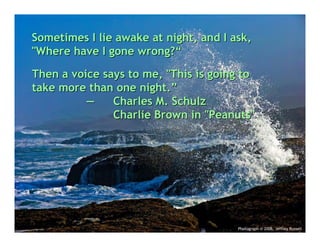
Sometimes I lie awake at night, and I ask,
"Where have I gone wrong?“

Then a voice says to me, "This is going to
take more than one night.”
          —    Charles M. Schulz
               Charlie Brown in "Peanuts"


                                       Photograph © 2006, Jeffrey Russell
Somebody has to do
something . . .
and it's just incredibly
pathetic that it has to be us.
       — the late Jerry Garcia
         (of the Grateful Dead)


                           Photograph © 2006, Jeffrey Russell
Thank You!

                          Good luck in developing and
                         strengthening your emotional
                                 intelligence!


      For a copy of today’s
      PowerPoint presentation, go to:
      www.RussellConsultingInc.com
Photograph © 2006, Jeffrey Russell

Emotional Intelligence

  • 1.
    Wisconsin Association ofEqual Opportunity 2008 Annual Conference Emotional Intelligence in the Workplace Competencies for Enhancing Your Effectiveness by Building Healthy and Productive Relationships at Work With Jeff Russell Russell Consulting, Inc. Photograph © 2007, Jeffrey Russell
  • 2.
    The opposite oflove is not hate, it is indifference. The opposite of art is not ugliness, it is indifference. The opposite of faith is not heresy, it is indifference. And the opposite of life is not death, it is indifference. -- Elie Wiesel Nobel Laureate Holocaust survivor Photograph © 2007, Jeffrey Russell
  • 3.
    Emotional Intelligence Emotional intelligenceis the ability to understand one’s emotional make-up and the emotional make-up of others and to use insight from this knowledge to effectively manage and regulate one’s own emotions to make good decisions and to act effectively. © 2008, Russell Consulting, Inc. — www.RussellConsultingInc.com
  • 4.
    Why It Matters. . . Technical proficiency and intellectual ability contribute little to working productively with others EI twice as important as technical skills Leadership failure due to inflexibility and inability to manage relationships with others 90% of difference between “Star” and average performers due to emotional intelligence 50-70% of an organization’s climate due to leader’s influence — and climate accounts for 20-30% of organization’s performance Effective CEOs . . . EI behaviors 2 to 7 times more often than those passed over . . . © 2008, Russell Consulting, Inc. — www.RussellConsultingInc.com
  • 5.
    The Four EI Dimensions Strong, Healthy The driving purpose of and Effective emotional intelligence — Relationships and life in general! Self-Management © 2008, Russell Consulting, Inc.
  • 6.
    Self-Awareness Knowing yourinternal emotional/cognitive state, preferences, resources, and intuitions Emotional self-awareness Accurate self-assessment Self-confidence © 2008, Russell Consulting, Inc. — www.RussellConsultingInc.com
  • 7.
    Self-Management Dimension Managing yourinternal emotional/cognitive states, impulses, and resources to reach goals Self-control Transparency Adaptability Achievement Initiative Optimism © 2008, Russell Consulting, Inc. — www.RussellConsultingInc.com
  • 8.
    What Are Emotions? Whatare the core emotions that people experience? Happiness Terror Sadness Love Surprise Anxiety Disgust Longing Anger Self-worth Fear “There are many more emotions that we feel than we Ecstasy can label. Emotions are fundamentally not cognitive/verbal, so, as soon as we try to name them, Despair we begin to be cognitive instead.” — Maurice Elias, Ph.D, co-author Emotionally Intelligent Parenting © 2008, Russell Consulting, Inc. — www.RussellConsultingInc.com
  • 9.
    Emotional Power! What Ido! © 2008, Russell Consulting, Inc. — www.RussellConsultingInc.com
  • 10.
    Our Three Brains. . . • Formed on top of and around limbic brain • Core cognitive intelligence Neo-Cortex Brain • Site of working memory Fight or Flight Response • Rudimentary brain • Basic functions • Heart rate, breathing • Formed on top of R-brain • Enabled learning: fight or flight! • Site of emotions and emotional memory © 2008, Russell Consulting, Inc.
  • 11.
    An Amygdala Hijack!! Youknow that you’ve been hijacked when . . . Emotions overwhelm your thinking and actions You are thinking and acting against your own will! You are unable to accurately read others’ emotions You can’t find the right words . . . (stumbling, stuttering when you try to speak) You are unable to focus your thinking or actions Your “fight or flight” response kicks in . . . heart races, blood pressure increases, sweating profusely, uneasy feeling in the “gut,” clenched jaw, twitching, tapping foot, cold extremities as the brain rushes blood to muscles needed for fighting or fleeing . . . © 2008, Russell Consulting, Inc. — www.RussellConsultingInc.com
  • 12.
    Implications? What are theimplications for being hijacking by our Amygdalla? What can we do about it? © 2008, Russell Consulting, Inc. — www.RussellConsultingInc.com
  • 13.
    The Ladder of Inference Your Path to Action Our beliefs and feelings affect what we pay attention to © 2008, Russell Consulting, Inc.
  • 14.
    Implications of theLadder? Each of us creates a “story” to help us fill in the details of missing information Our stories are informed by history, culture, misunderstandings, perceived and real “wrongs” (or “rights”), and both within and outside of our awareness. The stories we tell chart our Path to Action — the route we follow from observed events to the actions we take (which may or may not be grounded in reality) We take these “flights” up the Ladder because of our fundamental attribution error — we tend to view others’ behaviors as due to their disposition rather than their environment © 2008, Russell Consulting, Inc. — www.RussellConsultingInc.com
  • 15.
    Impulse Control .. . The Famous Marshmallow Test In 1960, Psychologist Walter Mischel conducted research on impulse control in 4 year olds. A marshmallow was placed in front of each child. The child was told that he/she could either have the one marshmallow now or — if he/she waited 10-15 minutes — he/she could have TWO marshmallows later. The researcher then left the room. Some of the children — the grabbers — couldn’t wait and ate the marshmallow almost as soon as the researcher left the room. Other children — the waiters — were able to wait. They covered their eyes, rested their heads on their arms, talked/sang to themselves, and made up games . . . Until the researcher returned and they got TWO marshmallows! © 2008, Russell Consulting, Inc. — www.RussellConsultingInc.com
  • 16.
    Most Interesting .. . . The Grabbers The Waiters Age — The Impulsive Ones — — Gratification Delayers — Exhibited decreased impulse Exhibited increased impulse 4 control control Seen by others as stubborn and over-reactive More socially competent Prone to jealousy and envy More able to cope with 18 Easily upset with frustrations frustrations/setbacks Troubled with low self- Scored 210 pts higher on SATs esteem Picked more fights More easily distracted under stress Better able to concentrate Difficulty delaying Able to form closer 28 gratification relationships Less cognitive ability Greater impulse control in the face of frustration Poor impulse control © 2008, Russell Consulting, Inc. — www.RussellConsultingInc.com
  • 17.
    Success is notfinal. Failure is not fatal. It is the courage to continue that makes the difference. — Winston Churchill Photograph © 2006, Jeffrey Russell
  • 18.
    Be who youare and say what you feel, because those who mind don't matter and those who matter don't mind. — Dr. Seuss Photograph © 2005, Jeffrey Russell
  • 19.
    Social Awareness Dimension Your awareness of others’ feelings, needs, and concerns Empathy Organizational awareness Service orientation © 2008, Russell Consulting, Inc. — www.RussellConsultingInc.com
  • 20.
    Everything that irritatesus about others can lead us to an understanding of ourselves. — Carl Jung Swiss psychiatrist b. 1875, d. 1961 Photograph © 2005, Jeffrey Russell
  • 21.
    Empathy The ability to“understand, be aware of, be sensitive to, and vicariously experience the feelings, thoughts, and experiences of another.” Demonstrating understanding of: The meaning of what was said The feeling that you sense that the person was experiencing © 2008, Russell Consulting, Inc. — www.RussellConsultingInc.com
  • 22.
    Developing Empathy What canwe do to enhance our empathy for others? How can we feel empathy for people for whom we have no sympathy (people who, we believe, don’t deserve our empathy)? Is it possible to feel empathy for a racist? For a child molester? For a terrorist? © 2008, Russell Consulting, Inc. — www.RussellConsultingInc.com
  • 23.
    Developing Empathy Put yourselfin the other person’s shoes — try to see the world from his or her’s perspective Seek to understand the pressures, responsibilities, expectations, and demands placed upon the other person Inquire. If the other person says something that sounds “off” or confusing, say “I’d like to know more about that.” Explore his or her reasoning. Behind every “position” and argument is a set of thoughts and feelings that are the underpinning of the position. By seeking to understand the other person’s reasoning, it builds a bridge to understanding © 2008, Russell Consulting, Inc. — www.RussellConsultingInc.com
  • 24.
    Empathic Listening Drawing Out— discovering new information Clarifying — rooting out confusing, conflicting, or ambiguous data Reflecting/Mirroring — holding a mirror up to the other person (e.g., “I sense that you’re pretty angry about this. Am I right?”) Paraphrasing — repeating back what you heard — and asking “Is this what you said? Did I get it right?” © 2008, Russell Consulting, Inc. — www.RussellConsultingInc.com
  • 25.
    Follow the three“R’s” — Respect for self — Respect for others — Responsibility for all your actions — Dalai Lama Photograph © 2004, Jeffrey Russell
  • 26.
    Relationship Management Dimension Adeptness at inducing desirable responses in others Inspiration Influence Developing others Change catalyst Conflict management Teamwork and collaboration © 2008, Russell Consulting, Inc. — www.RussellConsultingInc.com
  • 27.
    © 2007, Photographby Jeff Russell
  • 28.
    Anybody can becomeangry, that is easy; but to be angry with the right person, and to the right degree, and at the right time, and for the right purpose, and in the right way, that is not within everybody's power, that is not easy. — Aristotle Photograph © 2004, Jeffrey Russell
  • 29.
    Seven Simple &Powerful Tips 1. Take time every day to appreciate what is right in the world/your life 2. Increase your emotional word vocabulary 3. Be your own best friend 4. Listen with your heart 5. Talk back to yourself 6. Tune in to your body 7. Smile more! © 2008, Russell Consulting, Inc. — www.RussellConsultingInc.com
  • 30.
    EI and Leadership Theemotionally intelligent leader . . . 1. Commits to co-creating an organization in which individuals can be and do their best to achieve shared goals. 2. Shares authority and accountability with others. 3. Encourages people to work interdependently to achieve a shared goal. © 2008, Russell Consulting, Inc. — www.RussellConsultingInc.com
  • 31.
    EI and Leadership 4.Creates a climate in which people respect each other, believe in their own self-worth, and value authenticity. 5. Creates mechanisms so that meaningful and whole-hearted participation can happen. 6. Exercises his/her personal power ensuring that the best decisions are made yet refusing to be treated as or to regard him/herself as a heroic leader. © 2008, Russell Consulting, Inc. — www.RussellConsultingInc.com
  • 32.
    Sometimes I lieawake at night, and I ask, "Where have I gone wrong?“ Then a voice says to me, "This is going to take more than one night.” — Charles M. Schulz Charlie Brown in "Peanuts" Photograph © 2006, Jeffrey Russell
  • 33.
    Somebody has todo something . . . and it's just incredibly pathetic that it has to be us. — the late Jerry Garcia (of the Grateful Dead) Photograph © 2006, Jeffrey Russell
  • 34.
    Thank You! Good luck in developing and strengthening your emotional intelligence! For a copy of today’s PowerPoint presentation, go to: www.RussellConsultingInc.com Photograph © 2006, Jeffrey Russell