CIPD Annual HR Conference PPMA National Public Service Debate Beverly Alimo-Metcalfe  CPsychol. FBPsS Emeritus Professor of Leadership Studies, University of Leeds Professor of Leadership, University of Bradford School of Management Chief Executive, Real World Group November 10 th  2011 © Real World Group 2011 www.realworld-group.com
What form of leadership creates high engagement?
Key leadership / organisational challenges Increase effectiveness Sustain motivation Maintain wellbeing Create teams with high ‘readiness for change’ Create the conditions that encourage, facilitate, and sustain  innovation, exploitation of ideas  and  collective learning
A few words about… Stress   The bad news… The good news…
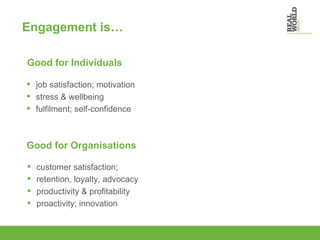
Engagement is… Engagement job satisfaction; motivation  stress & wellbeing fulfilment; self-confidence customer satisfaction;  retention, loyalty, advocacy productivity & profitability proactivity; innovation Good for Individuals Good for Organisations
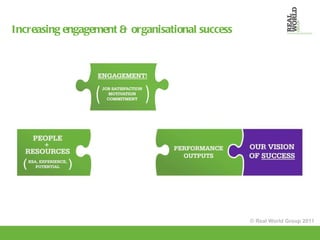
Increasing engagement & organisational success © Real World Group 2011
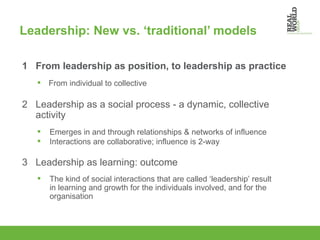
Leadership: New vs. ‘traditional’ models   1  From leadership as position, to leadership as practice 2  Leadership as a social process - a dynamic, collective  activity 3  Leadership as learning: outcome From individual to collective Emerges in and through relationships & networks of influence  Interactions are collaborative; influence is 2-way The kind of social interactions that are called ‘leadership’ result in learning and growth for the individuals involved, and for the organisation
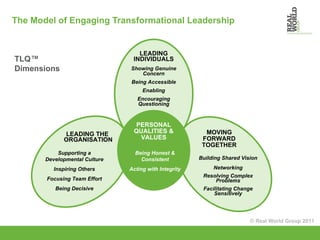
The Model of Engaging Transformational Leadership TLQ ™  Dimensions © Real World Group 2011 LEADING INDIVIDUALS PERSONAL QUALITIES & VALUES Being Honest & Consistent Acting with Integrity Showing Genuine Concern Being Accessible Enabling Encouraging Questioning LEADING THE  ORGANISATION Supporting a Developmental Culture Inspiring Others Focusing Team Effort Being Decisive MOVING FORWARD TOGETHER Building Shared Vision Networking Resolving Complex Problems Facilitating Change Sensitively
Does it work? Yes!
What’s the evidence? Behaviours proven to increase engagement Managers rated more engaging by staff Organisations have shifted from bottom to top in staff surveys – become  ST ‘Best Employer’ Staff’s ideas created new services Organisation demonstrated savings of £millions Embedded in teams – predicts their productivity and morale and wellbeing
Leadership, culture and ‘readiness for change’ Building capacity for sustainability
Characteristics of teams with high ‘readiness for change’ 1   Open to change 2  Generate range of solutions 3   Successful in implementing
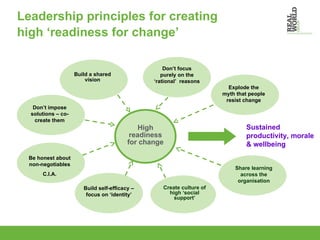
Leadership principles for creating  high ‘readiness for change’ High readiness for change Sustained productivity, morale & wellbeing Create culture of high ‘social support’ Build self-efficacy – focus on ‘identity’ Be honest about non-negotiables C.I.A. Don’t impose solutions – co-create them Build a shared vision Don’t focus purely on the ‘rational’  reasons Explode the myth that people resist change Share learning across the organisation
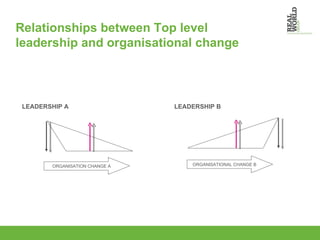
Relationships between Top level  leadership and organisational change LEADERSHIP A ORGANISATION CHANGE A LEADERSHIP B  ORGANISATIONAL CHANGE B
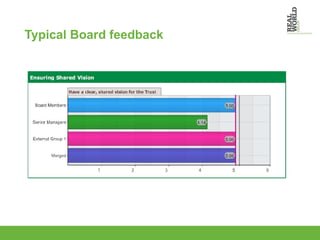
Typical Board feedback
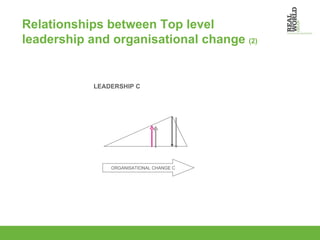
Relationships between Top level  leadership and organisational change  (2) LEADERSHIP C  ORGANISATIONAL CHANGE C
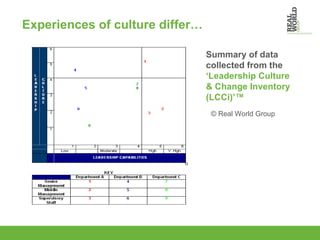
Experiences of culture differ… Summary of data collected from the  ‘Leadership Culture & Change Inventory (LCCi)’™ © Real World Group
10 lessons from supporting  cultural transformation Top management active commitment is crucial Transparency - Engage the whole organisation Diagnose what interventions required where Relate everything to the organisation’s vision, goals & values Focus on individual, team, & organisational outcomes Support middle managers  Build human capital & social capital Ensure all HR processes consistent with the aims Evaluate ROI – share learning Celebrate success & publicise it!
Background reading: Research Insight report for CIPD Authors: Alimo-Metcalfe, B. & Alban-Metcalfe, J. (2008) Available free from  www.realworld-group.com
Other suggested readings Alimo-Metcalfe, B. & Alban-Metcalfe, Juliette. (2011). 'Leadership in public and 3 rd  sector organisations'. In J. Storey (ed.).(2 nd  edn)  Leadership in Organisations: Current Issues & Key Trends,   . London: Routledge.  Alimo-Metcalfe, B. & Alban-Metcalfe, Juliette. (2011). ' The ‘need to get more for less’:  A new model of ‘engaging leadership’ and evidence of its effect on team productivity, and staff morale and wellbeing at work’. Paper submitted to the Chartered Management Institute; available from their website. Alimo-Metcalfe, B., Alban-Metcalfe, J., Bradley, M., Mariathasan , J. &  Samele, C.  (2008).  ‘The impact of engaging leadership on performance, attitudes to work and well-being at work: a longitudinal study’.  The Journal of Health Organization &  Management, 22,   6 ,  586-598. Alimo-Metcalfe, B. & Bradley, M. (2009). ‘Darzi and leadership – it’s too important to get wrong this time’. In  Clinical Leadership Journal, 2 , 1, 3-11. Alimo-Metcalfe, B. & Bradley, M. (2008). ‘Cast in a new light’.  People Management,  January 24 th , 38-41.

Beverley Alimo-Metcalfe - PPMA National Public Service Debate at CIPD Conf - 10 Nov 2011

  • 1.
    CIPD Annual HRConference PPMA National Public Service Debate Beverly Alimo-Metcalfe CPsychol. FBPsS Emeritus Professor of Leadership Studies, University of Leeds Professor of Leadership, University of Bradford School of Management Chief Executive, Real World Group November 10 th 2011 © Real World Group 2011 www.realworld-group.com
  • 2.
    What form ofleadership creates high engagement?
  • 3.
    Key leadership /organisational challenges Increase effectiveness Sustain motivation Maintain wellbeing Create teams with high ‘readiness for change’ Create the conditions that encourage, facilitate, and sustain innovation, exploitation of ideas and collective learning
  • 4.
    A few wordsabout… Stress The bad news… The good news…
  • 5.
    Engagement is… Engagementjob satisfaction; motivation stress & wellbeing fulfilment; self-confidence customer satisfaction; retention, loyalty, advocacy productivity & profitability proactivity; innovation Good for Individuals Good for Organisations
  • 6.
    Increasing engagement &organisational success © Real World Group 2011
  • 7.
    Leadership: New vs.‘traditional’ models 1 From leadership as position, to leadership as practice 2 Leadership as a social process - a dynamic, collective activity 3 Leadership as learning: outcome From individual to collective Emerges in and through relationships & networks of influence Interactions are collaborative; influence is 2-way The kind of social interactions that are called ‘leadership’ result in learning and growth for the individuals involved, and for the organisation
  • 8.
    The Model ofEngaging Transformational Leadership TLQ ™ Dimensions © Real World Group 2011 LEADING INDIVIDUALS PERSONAL QUALITIES & VALUES Being Honest & Consistent Acting with Integrity Showing Genuine Concern Being Accessible Enabling Encouraging Questioning LEADING THE ORGANISATION Supporting a Developmental Culture Inspiring Others Focusing Team Effort Being Decisive MOVING FORWARD TOGETHER Building Shared Vision Networking Resolving Complex Problems Facilitating Change Sensitively
  • 9.
  • 10.
    What’s the evidence?Behaviours proven to increase engagement Managers rated more engaging by staff Organisations have shifted from bottom to top in staff surveys – become ST ‘Best Employer’ Staff’s ideas created new services Organisation demonstrated savings of £millions Embedded in teams – predicts their productivity and morale and wellbeing
  • 11.
    Leadership, culture and‘readiness for change’ Building capacity for sustainability
  • 12.
    Characteristics of teamswith high ‘readiness for change’ 1 Open to change 2 Generate range of solutions 3 Successful in implementing
  • 13.
    Leadership principles forcreating high ‘readiness for change’ High readiness for change Sustained productivity, morale & wellbeing Create culture of high ‘social support’ Build self-efficacy – focus on ‘identity’ Be honest about non-negotiables C.I.A. Don’t impose solutions – co-create them Build a shared vision Don’t focus purely on the ‘rational’ reasons Explode the myth that people resist change Share learning across the organisation
  • 14.
    Relationships between Toplevel leadership and organisational change LEADERSHIP A ORGANISATION CHANGE A LEADERSHIP B ORGANISATIONAL CHANGE B
  • 15.
  • 16.
    Relationships between Toplevel leadership and organisational change (2) LEADERSHIP C ORGANISATIONAL CHANGE C
  • 17.
    Experiences of culturediffer… Summary of data collected from the ‘Leadership Culture & Change Inventory (LCCi)’™ © Real World Group
  • 18.
    10 lessons fromsupporting cultural transformation Top management active commitment is crucial Transparency - Engage the whole organisation Diagnose what interventions required where Relate everything to the organisation’s vision, goals & values Focus on individual, team, & organisational outcomes Support middle managers Build human capital & social capital Ensure all HR processes consistent with the aims Evaluate ROI – share learning Celebrate success & publicise it!
  • 19.
    Background reading: ResearchInsight report for CIPD Authors: Alimo-Metcalfe, B. & Alban-Metcalfe, J. (2008) Available free from www.realworld-group.com
  • 20.
    Other suggested readingsAlimo-Metcalfe, B. & Alban-Metcalfe, Juliette. (2011). 'Leadership in public and 3 rd sector organisations'. In J. Storey (ed.).(2 nd edn) Leadership in Organisations: Current Issues & Key Trends, . London: Routledge. Alimo-Metcalfe, B. & Alban-Metcalfe, Juliette. (2011). ' The ‘need to get more for less’: A new model of ‘engaging leadership’ and evidence of its effect on team productivity, and staff morale and wellbeing at work’. Paper submitted to the Chartered Management Institute; available from their website. Alimo-Metcalfe, B., Alban-Metcalfe, J., Bradley, M., Mariathasan , J. & Samele, C. (2008). ‘The impact of engaging leadership on performance, attitudes to work and well-being at work: a longitudinal study’. The Journal of Health Organization & Management, 22, 6 , 586-598. Alimo-Metcalfe, B. & Bradley, M. (2009). ‘Darzi and leadership – it’s too important to get wrong this time’. In Clinical Leadership Journal, 2 , 1, 3-11. Alimo-Metcalfe, B. & Bradley, M. (2008). ‘Cast in a new light’. People Management, January 24 th , 38-41.