Motivational Interviewing Scott Peters, M.A., LPC-S
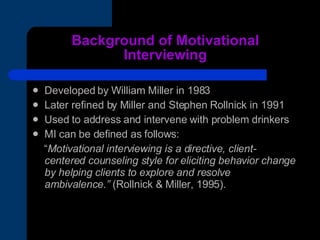
Background of Motivational Interviewing Developed by William Miller in 1983 Later refined by Miller and Stephen Rollnick in 1991 Used to address and intervene with problem drinkers MI can be defined as follows:  “ Motivational interviewing is a directive, client-centered counseling style for eliciting behavior change by helping clients to explore and resolve ambivalence.”  (Rollnick & Miller, 1995).
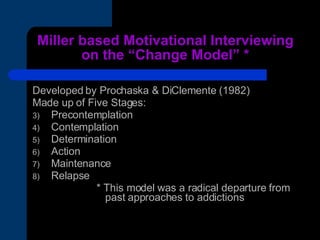
Miller based Motivational Interviewing on the “Change Model” * Developed by Prochaska & DiClemente (1982) Made up of Five Stages: Precontemplation  Contemplation Determination Action Maintenance Relapse * This model was a radical departure from    past approaches to addictions
Change Model- Stages Precontemplation - One is told there may be a problem. Needs information on the problem behavior. Not really considering change. Contemplation - One begins to consider that there may be a problem. Sitting on the fence. Determination - One now concludes that they need to do something. This is a dynamic stage. (Sometimes called the “ Preparation ” stage)
Change Model- Stages Action-  One makes steps to address the problem behavior. One is practicing new behaviors. Maintenance - One continues to implement what one has learned in order to maintain healthy behaviors. They begin to find more intrinsic rewards. Relapse - Resumption of old behaviors/patterns. (Some research suggests that this is a normal and expected stage)
Key Concepts of Motivational Interviewing To understand how the client sees the problem Counselor uses active listening and reflection to facilitate this process Counselor asks questions to elicit information Central focus is to examine and resolve ambivalence Counselor points out discrepancies Client-Counselor relationship is a partnership
Key Concepts of Motivational Interviewing Motivation to change is elicited from the client, not imposed by the counselor It is the client’s task, not the counselor’s to state and resolve the ambivalence Direct persuasion is not effective Counselor’s approach is generally quiet and eliciting one The counselor is directive in assisting the client  Readiness to change is not static, but fluctuating
Key Concepts of Motivational Interviewing Resistance and denial are seen as a product of environmental factors, not a character trait Motivational level over the course of treatment is more important that initial motivation (or lack thereof) Priority is given to resolving ambivalence The MI counselor is persuasive, but not coercive; at times challenging, but never argumentative
Motivational Interviewing  is … An interpersonal style A subtle balance of directive and client-centered components Affirming the client’s freedom of choice and self-direction Self-empowering
Strategies of Motivational Interviewing Express empathy Promote self-efficacy because the belief that one can change is a powerful motivator Encourage the client to develop their own solutions to the problems that  they  themselves have identified Assist the client is seeing how some of their current ways to doing things may lead them away from their eventual goals
Caveats to Consider in Motivational Interviewing Avoid arguing with the client Ensure that any resistance to change is not generated by “jumping ahead” of the client Stay away from labeling, blaming, being the expert, confrontation Pressing client to change may increase resistance
Caveats to Consider in Motivational Interviewing Don’t use an authoritarian stance, leaving the client in a passive role Don’t offer direct advice without direct permission to do so Avoid the question-answer-question (leads to a hierarchical relationship)
A final thought… The basic approach to interactions in motivational interviewing is captured by the acronym OARS:  (1) Open-ended questions (2) Affirmations  (3) Reflective listening (4) Summaries (Miller & Rollnick, 1991)

Motivational Interviewing

  • 1.
  • 2.
    Background of MotivationalInterviewing Developed by William Miller in 1983 Later refined by Miller and Stephen Rollnick in 1991 Used to address and intervene with problem drinkers MI can be defined as follows: “ Motivational interviewing is a directive, client-centered counseling style for eliciting behavior change by helping clients to explore and resolve ambivalence.” (Rollnick & Miller, 1995).
  • 3.
    Miller based MotivationalInterviewing on the “Change Model” * Developed by Prochaska & DiClemente (1982) Made up of Five Stages: Precontemplation Contemplation Determination Action Maintenance Relapse * This model was a radical departure from past approaches to addictions
  • 4.
    Change Model- StagesPrecontemplation - One is told there may be a problem. Needs information on the problem behavior. Not really considering change. Contemplation - One begins to consider that there may be a problem. Sitting on the fence. Determination - One now concludes that they need to do something. This is a dynamic stage. (Sometimes called the “ Preparation ” stage)
  • 5.
    Change Model- StagesAction- One makes steps to address the problem behavior. One is practicing new behaviors. Maintenance - One continues to implement what one has learned in order to maintain healthy behaviors. They begin to find more intrinsic rewards. Relapse - Resumption of old behaviors/patterns. (Some research suggests that this is a normal and expected stage)
  • 6.
    Key Concepts ofMotivational Interviewing To understand how the client sees the problem Counselor uses active listening and reflection to facilitate this process Counselor asks questions to elicit information Central focus is to examine and resolve ambivalence Counselor points out discrepancies Client-Counselor relationship is a partnership
  • 7.
    Key Concepts ofMotivational Interviewing Motivation to change is elicited from the client, not imposed by the counselor It is the client’s task, not the counselor’s to state and resolve the ambivalence Direct persuasion is not effective Counselor’s approach is generally quiet and eliciting one The counselor is directive in assisting the client Readiness to change is not static, but fluctuating
  • 8.
    Key Concepts ofMotivational Interviewing Resistance and denial are seen as a product of environmental factors, not a character trait Motivational level over the course of treatment is more important that initial motivation (or lack thereof) Priority is given to resolving ambivalence The MI counselor is persuasive, but not coercive; at times challenging, but never argumentative
  • 9.
    Motivational Interviewing is … An interpersonal style A subtle balance of directive and client-centered components Affirming the client’s freedom of choice and self-direction Self-empowering
  • 10.
    Strategies of MotivationalInterviewing Express empathy Promote self-efficacy because the belief that one can change is a powerful motivator Encourage the client to develop their own solutions to the problems that they themselves have identified Assist the client is seeing how some of their current ways to doing things may lead them away from their eventual goals
  • 11.
    Caveats to Considerin Motivational Interviewing Avoid arguing with the client Ensure that any resistance to change is not generated by “jumping ahead” of the client Stay away from labeling, blaming, being the expert, confrontation Pressing client to change may increase resistance
  • 12.
    Caveats to Considerin Motivational Interviewing Don’t use an authoritarian stance, leaving the client in a passive role Don’t offer direct advice without direct permission to do so Avoid the question-answer-question (leads to a hierarchical relationship)
  • 13.
    A final thought…The basic approach to interactions in motivational interviewing is captured by the acronym OARS: (1) Open-ended questions (2) Affirmations (3) Reflective listening (4) Summaries (Miller & Rollnick, 1991)