People are better persuaded by
the reasons they themselves
discovered than those that come
into the minds of others
Blaise Pascal
1623-1662
French mathematician, physicist, inventor,
writer and Christian philosopher
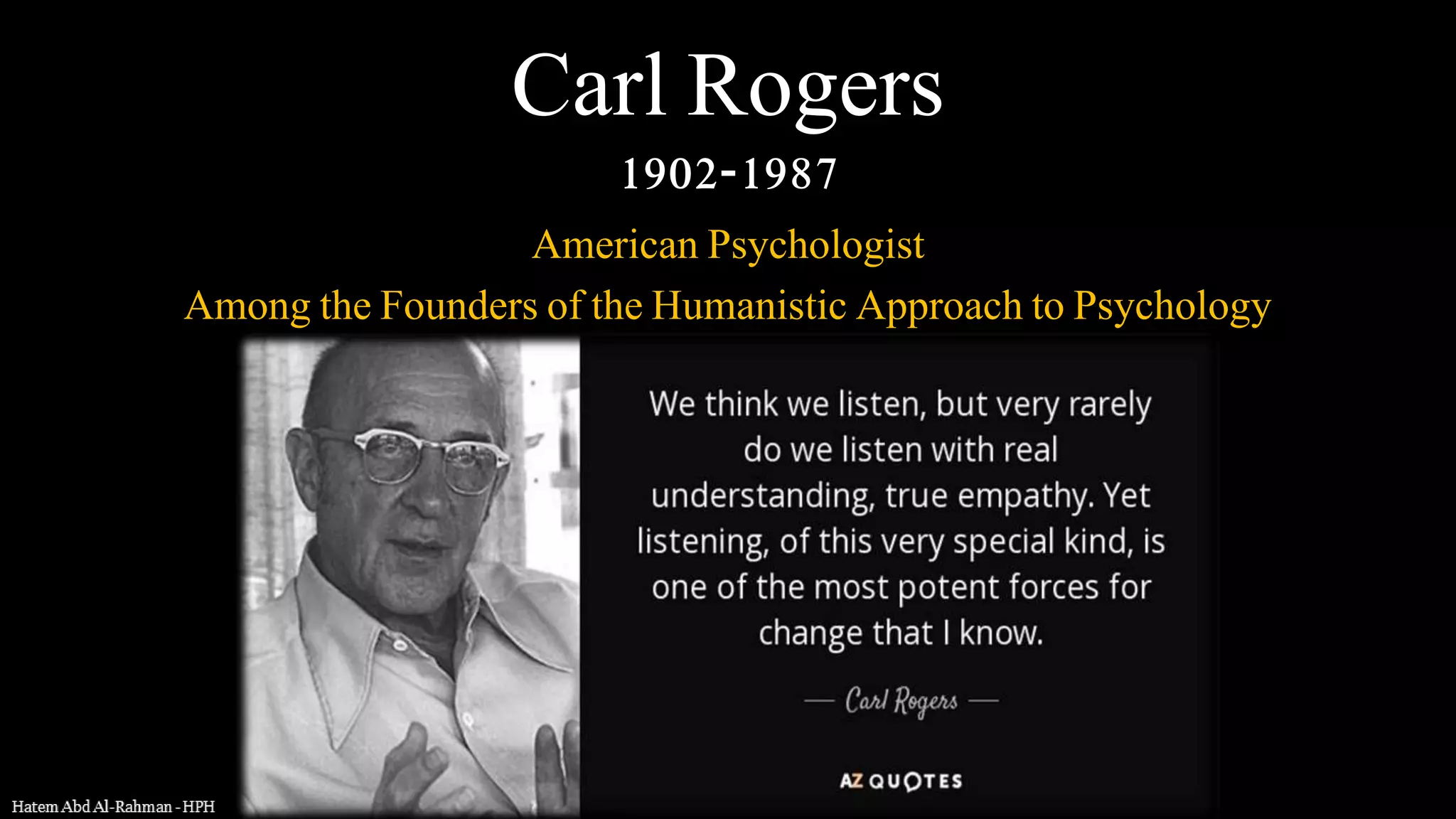
Carl Rogers
1902-1987
American Psychologist
Among the Founders of the Humanistic Approach to Psychology
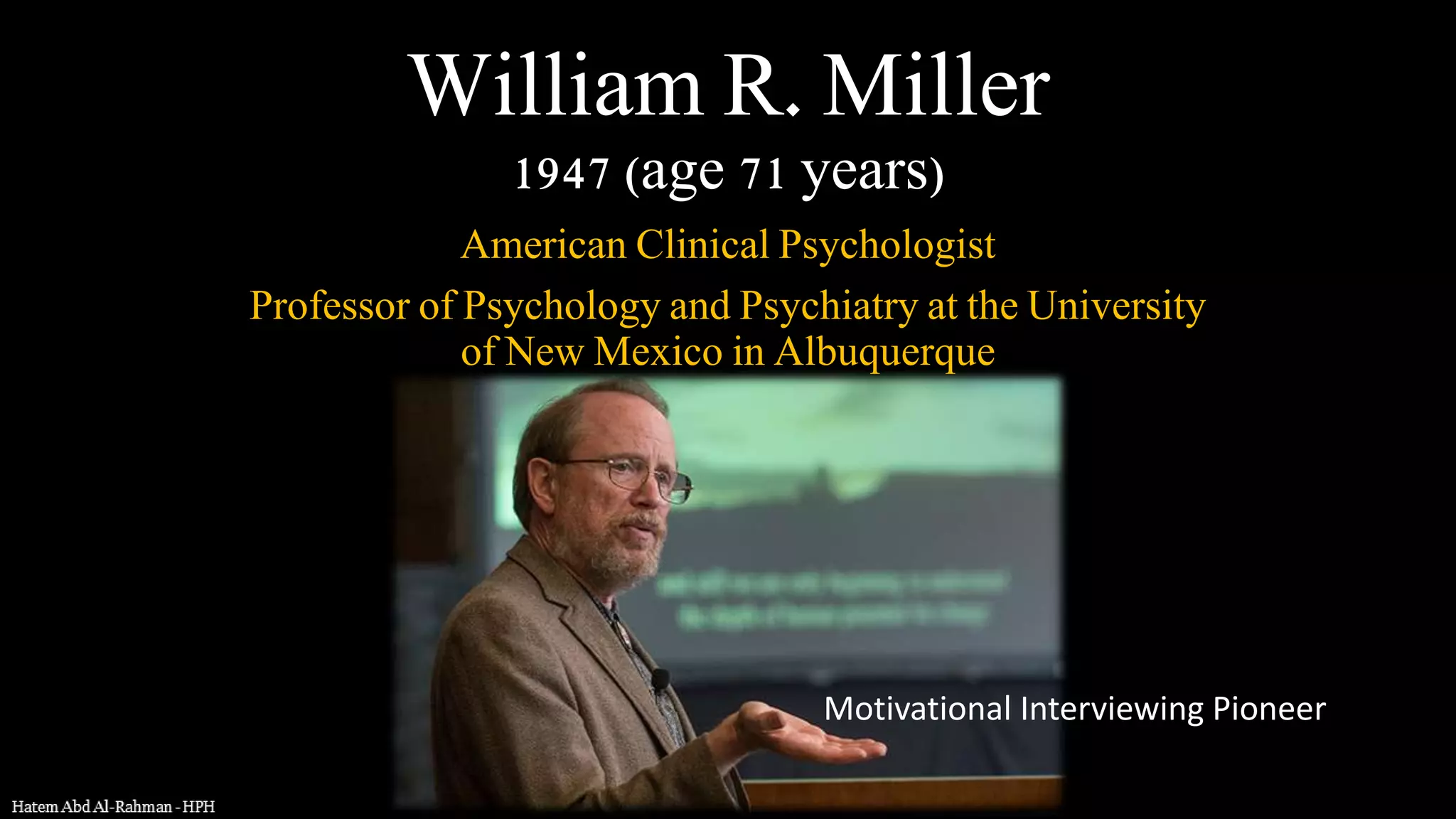
William R. Miller
1947 (age 71 years)
American Clinical Psychologist
Professor of Psychology and Psychiatry at the University
of New Mexico in Albuquerque
Motivational Interviewing Pioneer
Stephen Rollnick
1952 (age 66 years)
Professor of Clinical Psychology at
Cardiff University
Motivational
Interviewing
Pioneer
5
What are we talking about?
What does
“Increasing Motivation”
mean to you?
• Change is motivated by discomfort.
• If you can make people feel bad enough, they will
change.
• People have to “hit bottom” to be ready for change
• People don’t change if they haven’t suffered enough
The Stick
Traditional Approach (1)
• Someone who continues to use is “in denial.”
• The best way to “break through” the denial is
direct confrontation
Traditional Approach (2)
The Stick
• People are ambivalent about change
• People continue their drug use because of their
ambivalence
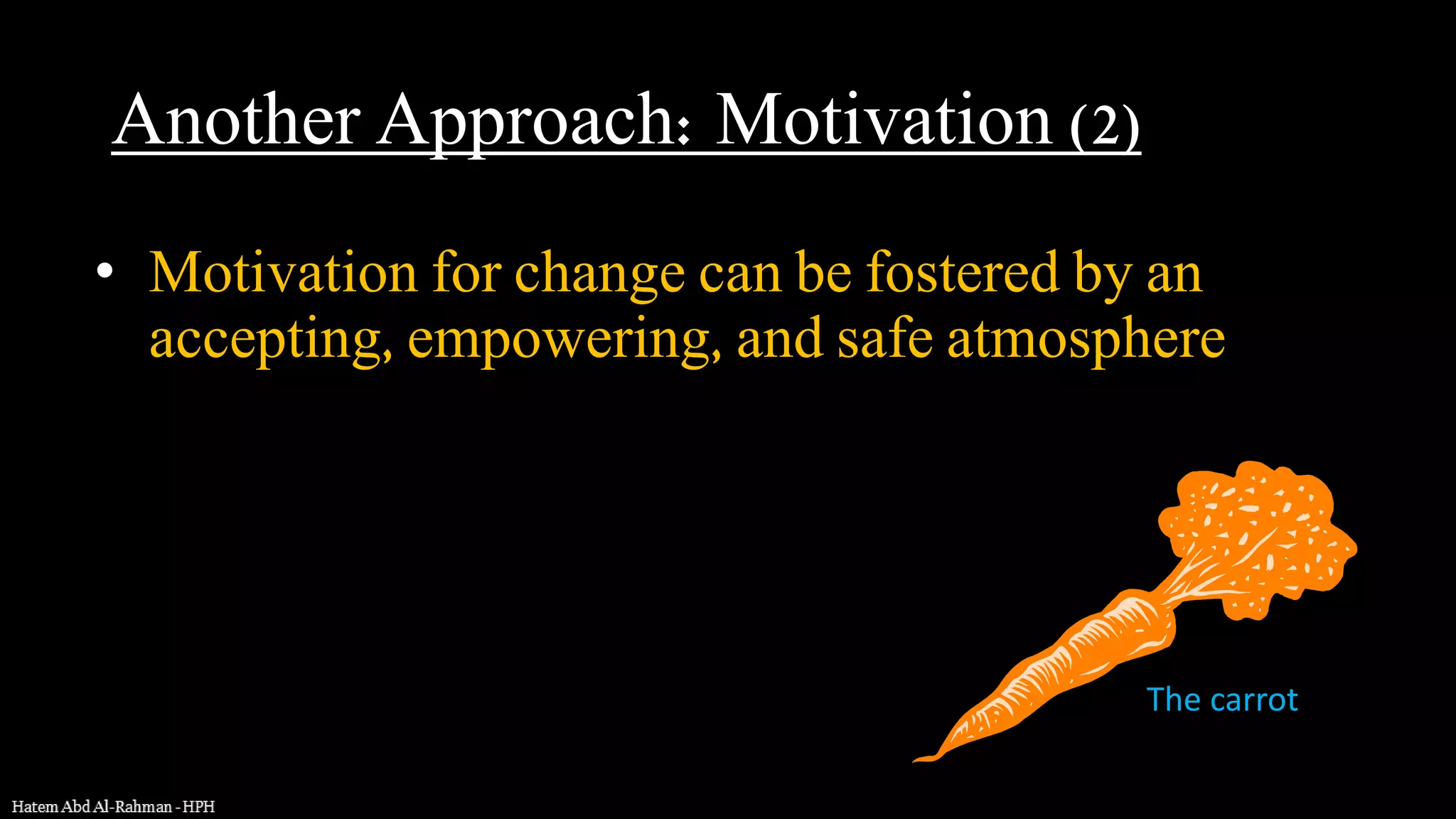
Another Approach: Motivation (1)
The carrot
• Motivation for change can be fostered by an
accepting, empowering, and safe atmosphere
The carrot
Another Approach: Motivation (2)
This Lecture: Motivational Interviewing
(MI)
• MI Definitions
• MI Principles
• 8 Stages to learn MI
• FRAMES Approach
Sources:
• Motivational Interviewing : Preparing People for Change
William R. Miller, Stephen Rollnick. 2nd ed. 2002
• Treatment Improvement Protocol (TIP 35) Enhancing Motivation for Change in Substance Abuse Treatment
• Quick Guide for Clinicians based on TIP 35
U.S. DEPARTMENT OF HEALTH AND HUMAN SERVICES
Public Health Service
Substance Abuse and Mental Health Services Administration (SAMHSA)
Center for Substance Abuse Treatment (CSAT) 2008
• Motivating Clients for Treatment and Addressing Resistance
International Network of Drug Dependence, Treatment and Rehabilitation Resource Centers (TREATNET)
United Nations Office on Drugs and Crime (UNODC)
Treatnet Training Volume B (Psychosocial elements of treatment) - Module 2 – 2008
• Eight Stages in learning Motivational Interviewing
Miller, W.R. & Moyers, T.B. Journal of Teaching in the Addictions. 2007
• Motivational Interviewing Training New Trainers (TNT) Manual, 2014
Motivational Interviewing Network of Trainers (MINT) 2014
Definition of
Motivational Interviewing
Lay person’s Definition:
A Collaborative conversation to strengthen a person’s own motivation
for and commitment to change
William R. Miller and Theresa B. Moyers 2006 Definition:
A clinical method for helping a person to resolve ambivalence about
change by evoking intrinsic motivation and commitment
Treatnet Definition 2008:
A directive, client-centred style of interaction aimed at helping people
explore and resolve their ambivalence about their substance use and
begin to make positive changes
A pragmatic practitioner’s definition (Why would I use it?):
A person‐centered counseling method for addressing the common
problem of ambivalence about change
A technical therapeutic definition (How does It work?):
A collaborative, goal‐oriented method of communication with particular
attention to the language of change. It is designed to strengthen an
individual’s motivation for and movement toward a specific goal by
eliciting and exploring the person’s own arguments for change
Most recent definition (2009):
A collaborative, person‐centered form of guiding to elicit and strengthen
motivation for change
Principles of
Motivational Interviewing
• Express Empathy
Acceptance – Listening – Understanding client’s Perspective – No Labelling
• Develop Discrepancy
Clarify Goals – Explore Behaviours Consequences – Create & Amplify
Discrepancy
• Roll with Resistance
Avoid Arguing – Find Another Way – Avoid Confrontation – Shift Perceptions
• Support Self Efficacy
Belief in Client’s Ability to Change – Ensure the Client is Responsible for
Change – Provide Hope
8 Stages to Learn
Motivational Interviewing
1. The spirit of MI
• Assuming that “health is waiting inside” each person, and your role is to help it
emerge (Humanistic Psychology)
• Spirit of MI is necessary for expert use, but not to begin learning MI
• Contrasted with the model that the patient is flawed
• Components:
• Collaboration
• Evocation
• Respect for person’s Autonomy
8 Stages to Learn
Motivational Interviewing
2. Using client-centered skills (OARS)
•Open ended questions
•Affirmation
•Reflective listening
•Summarizing
8 Stages to Learn
Motivational Interviewing
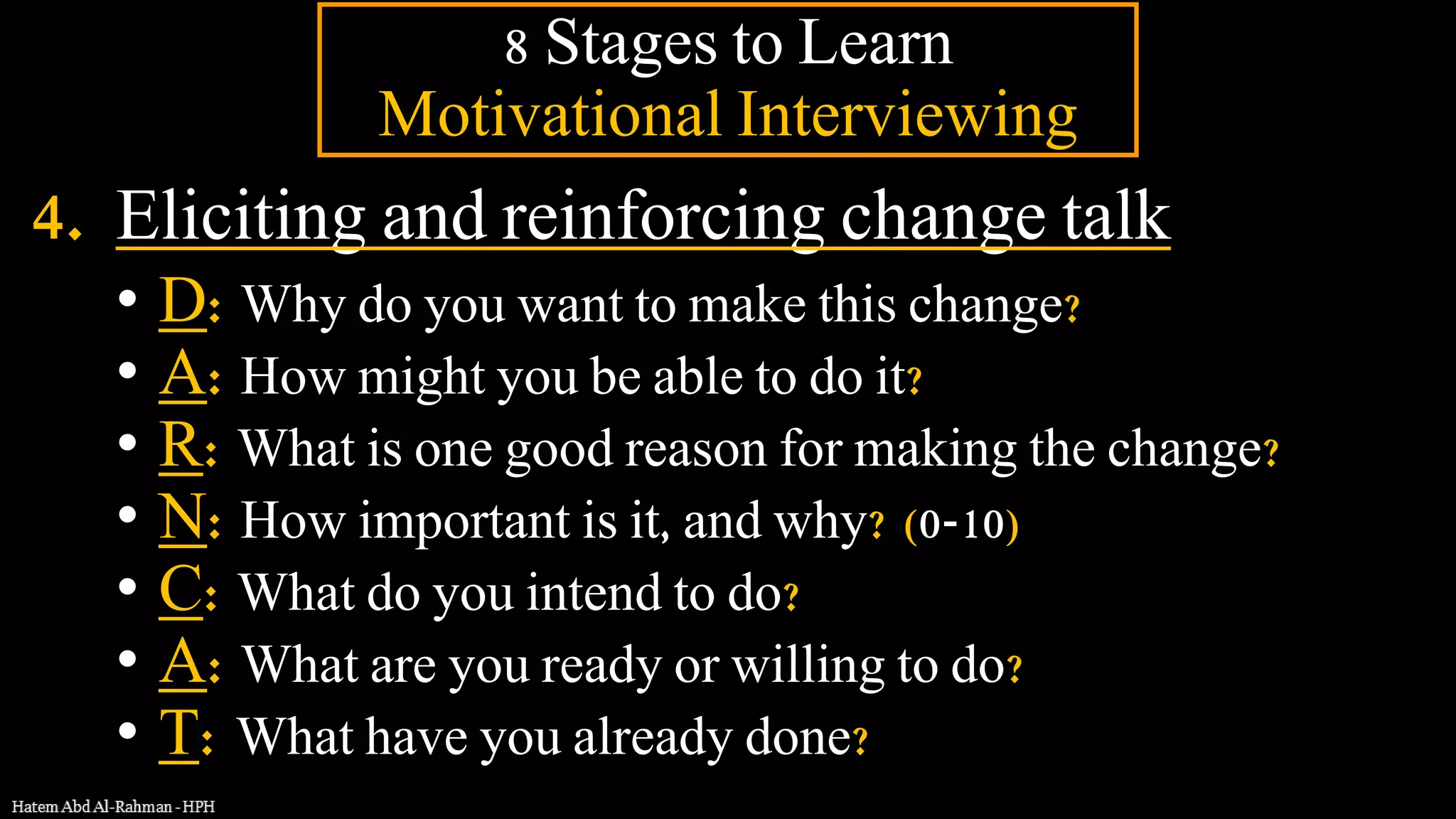
3. Recognizing change talk (DARN-CAT)
• DESIREto change (want, like, wish . . )
• ABILITYto change (can, could . . )
• REASONSto change (if . . then)
• NEEDto change (need, have to, got to . .)
• COMMITMENT(intention, decision, promise . .)
• ACTIVATION(willing, ready, preparing . .)
• TAKING STEPS (i did, i changed . .)
8 Stages to Learn
Motivational Interviewing
4. Eliciting and reinforcing change talk
• D: Why do you want to make this change?
• A: How might you be able to do it?
• R: What is one good reason for making the change?
• N: How important is it, and why? (0-10)
• C: What do you intend to do?
• A: What are you ready or willing to do?
• T: What have you already done?
8 Stages to Learn
Motivational Interviewing
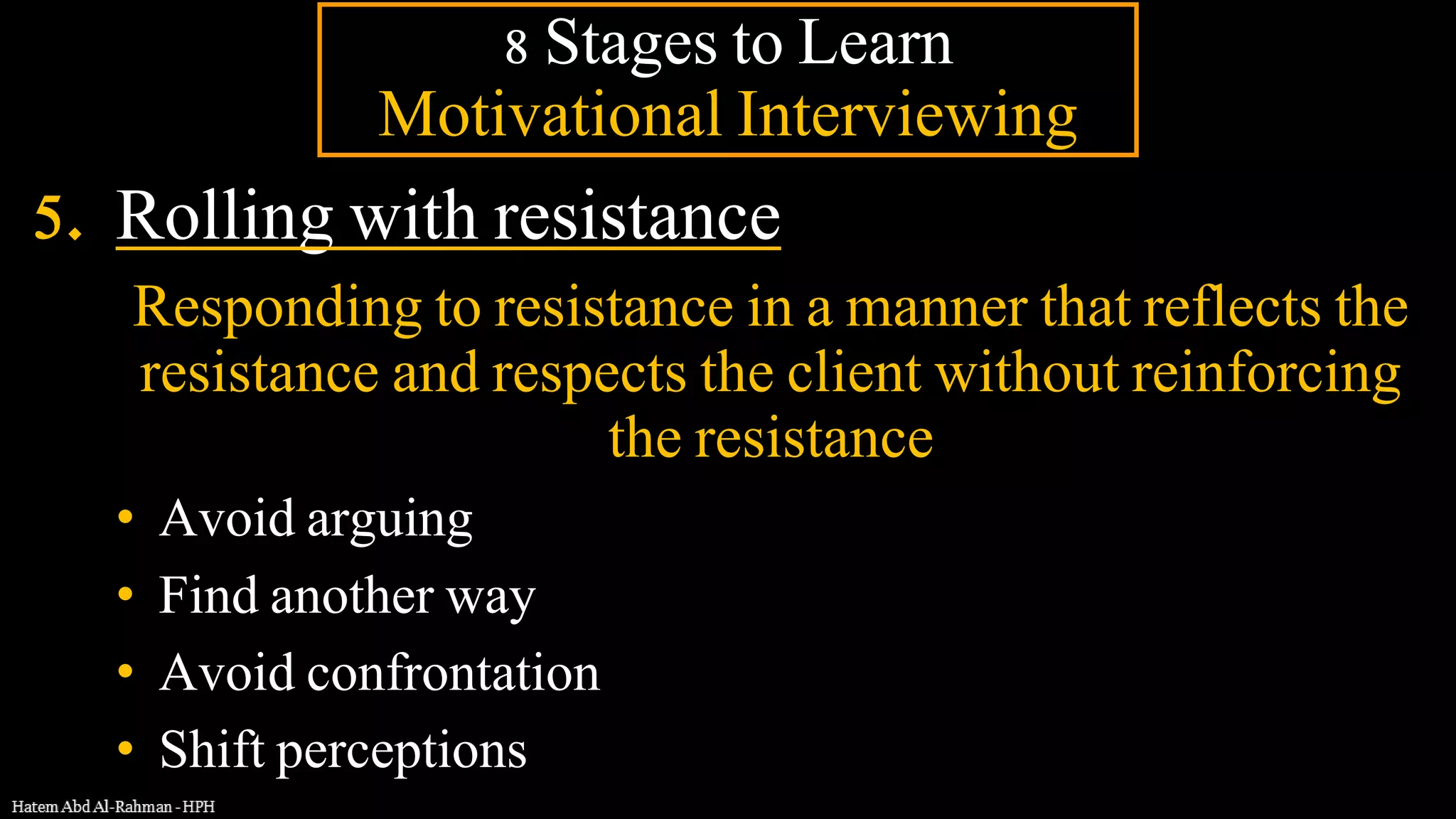
5. Rolling with resistance
Responding to resistance in a manner that reflects the
resistance and respects the client without reinforcing
the resistance
• Avoid arguing
• Find another way
• Avoid confrontation
• Shift perceptions
8 Stages to Learn
Motivational Interviewing
6. Developing a change plan
The ability to:
• Recognize client readiness
• Negotiate a specific change plan that is acceptable and
appropriate to the client
• Involve timing as well as negotiation
8 Stages to Learn
Motivational Interviewing
7. Consolidating client commitment
The ability to elicit and increase the strength of
client’s commitment to change, and to specific
implementation intentions
8 Stages to Learn
Motivational Interviewing
8. Integrating MI with other intervention
methods
The ability to:
• Blend MI style with the other intervention methods
• Switch flexibly between MI and other approaches
8 Stages to Learn
Motivational Interviewing
People often say that motivation
doesn’t last
Neither does bathing
That’s why we recommend it daily
Zig Ziglar
1926-2012
American author, salesman, and motivational speaker
F R A M E S
approach to
Motivational Interviewing
•Feedback regarding personal risk
or impairment is given to the client
following assessment of substance
use patterns and associated
behaviors or problems
F R A M E S
•Responsibility for change is
placed squarely and explicitly on
the client (with respect for the
client's right to make choices for
himself).
F R A M E S
•Advice about change, either in
substance use patterns or associated
behaviors is clearly given to the
client in a nonjudgmental manner
F R A M E S
•Menus of self-directed
change options and treatment
alternatives are offered to the
client
F R A M E S
•Empathetic counseling
showing warmth, respect, and
understanding
F R A M E S
•Support self-efficacy and
empower the client to
encourage change
F R A M E S
There is no such thing as
teaching; only learning
Monty Roberts
1935 (age 81 years)
American Horse Trainer
Thank you for your time
Hatem Abd Al-Rahman

Motivational Interviewing - Dr Hatem Abd Al-Rahman

  • 1.
    People are betterpersuaded by the reasons they themselves discovered than those that come into the minds of others Blaise Pascal 1623-1662 French mathematician, physicist, inventor, writer and Christian philosopher
  • 2.
    Carl Rogers 1902-1987 American Psychologist Amongthe Founders of the Humanistic Approach to Psychology
  • 3.
    William R. Miller 1947(age 71 years) American Clinical Psychologist Professor of Psychology and Psychiatry at the University of New Mexico in Albuquerque Motivational Interviewing Pioneer
  • 4.
    Stephen Rollnick 1952 (age66 years) Professor of Clinical Psychology at Cardiff University Motivational Interviewing Pioneer
  • 5.
    5 What are wetalking about? What does “Increasing Motivation” mean to you?
  • 6.
    • Change ismotivated by discomfort. • If you can make people feel bad enough, they will change. • People have to “hit bottom” to be ready for change • People don’t change if they haven’t suffered enough The Stick Traditional Approach (1)
  • 7.
    • Someone whocontinues to use is “in denial.” • The best way to “break through” the denial is direct confrontation Traditional Approach (2) The Stick
  • 8.
    • People areambivalent about change • People continue their drug use because of their ambivalence Another Approach: Motivation (1) The carrot
  • 9.
    • Motivation forchange can be fostered by an accepting, empowering, and safe atmosphere The carrot Another Approach: Motivation (2)
  • 10.
    This Lecture: MotivationalInterviewing (MI) • MI Definitions • MI Principles • 8 Stages to learn MI • FRAMES Approach
  • 11.
    Sources: • Motivational Interviewing: Preparing People for Change William R. Miller, Stephen Rollnick. 2nd ed. 2002 • Treatment Improvement Protocol (TIP 35) Enhancing Motivation for Change in Substance Abuse Treatment • Quick Guide for Clinicians based on TIP 35 U.S. DEPARTMENT OF HEALTH AND HUMAN SERVICES Public Health Service Substance Abuse and Mental Health Services Administration (SAMHSA) Center for Substance Abuse Treatment (CSAT) 2008 • Motivating Clients for Treatment and Addressing Resistance International Network of Drug Dependence, Treatment and Rehabilitation Resource Centers (TREATNET) United Nations Office on Drugs and Crime (UNODC) Treatnet Training Volume B (Psychosocial elements of treatment) - Module 2 – 2008 • Eight Stages in learning Motivational Interviewing Miller, W.R. & Moyers, T.B. Journal of Teaching in the Addictions. 2007 • Motivational Interviewing Training New Trainers (TNT) Manual, 2014 Motivational Interviewing Network of Trainers (MINT) 2014
  • 12.
  • 13.
    Lay person’s Definition: ACollaborative conversation to strengthen a person’s own motivation for and commitment to change William R. Miller and Theresa B. Moyers 2006 Definition: A clinical method for helping a person to resolve ambivalence about change by evoking intrinsic motivation and commitment Treatnet Definition 2008: A directive, client-centred style of interaction aimed at helping people explore and resolve their ambivalence about their substance use and begin to make positive changes
  • 14.
    A pragmatic practitioner’sdefinition (Why would I use it?): A person‐centered counseling method for addressing the common problem of ambivalence about change A technical therapeutic definition (How does It work?): A collaborative, goal‐oriented method of communication with particular attention to the language of change. It is designed to strengthen an individual’s motivation for and movement toward a specific goal by eliciting and exploring the person’s own arguments for change Most recent definition (2009): A collaborative, person‐centered form of guiding to elicit and strengthen motivation for change
  • 15.
  • 16.
    • Express Empathy Acceptance– Listening – Understanding client’s Perspective – No Labelling • Develop Discrepancy Clarify Goals – Explore Behaviours Consequences – Create & Amplify Discrepancy • Roll with Resistance Avoid Arguing – Find Another Way – Avoid Confrontation – Shift Perceptions • Support Self Efficacy Belief in Client’s Ability to Change – Ensure the Client is Responsible for Change – Provide Hope
  • 17.
    8 Stages toLearn Motivational Interviewing
  • 18.
    1. The spiritof MI • Assuming that “health is waiting inside” each person, and your role is to help it emerge (Humanistic Psychology) • Spirit of MI is necessary for expert use, but not to begin learning MI • Contrasted with the model that the patient is flawed • Components: • Collaboration • Evocation • Respect for person’s Autonomy 8 Stages to Learn Motivational Interviewing
  • 19.
    2. Using client-centeredskills (OARS) •Open ended questions •Affirmation •Reflective listening •Summarizing 8 Stages to Learn Motivational Interviewing
  • 20.
    3. Recognizing changetalk (DARN-CAT) • DESIREto change (want, like, wish . . ) • ABILITYto change (can, could . . ) • REASONSto change (if . . then) • NEEDto change (need, have to, got to . .) • COMMITMENT(intention, decision, promise . .) • ACTIVATION(willing, ready, preparing . .) • TAKING STEPS (i did, i changed . .) 8 Stages to Learn Motivational Interviewing
  • 21.
    4. Eliciting andreinforcing change talk • D: Why do you want to make this change? • A: How might you be able to do it? • R: What is one good reason for making the change? • N: How important is it, and why? (0-10) • C: What do you intend to do? • A: What are you ready or willing to do? • T: What have you already done? 8 Stages to Learn Motivational Interviewing
  • 22.
    5. Rolling withresistance Responding to resistance in a manner that reflects the resistance and respects the client without reinforcing the resistance • Avoid arguing • Find another way • Avoid confrontation • Shift perceptions 8 Stages to Learn Motivational Interviewing
  • 23.
    6. Developing achange plan The ability to: • Recognize client readiness • Negotiate a specific change plan that is acceptable and appropriate to the client • Involve timing as well as negotiation 8 Stages to Learn Motivational Interviewing
  • 24.
    7. Consolidating clientcommitment The ability to elicit and increase the strength of client’s commitment to change, and to specific implementation intentions 8 Stages to Learn Motivational Interviewing
  • 25.
    8. Integrating MIwith other intervention methods The ability to: • Blend MI style with the other intervention methods • Switch flexibly between MI and other approaches 8 Stages to Learn Motivational Interviewing
  • 26.
    People often saythat motivation doesn’t last Neither does bathing That’s why we recommend it daily Zig Ziglar 1926-2012 American author, salesman, and motivational speaker
  • 27.
    F R AM E S approach to Motivational Interviewing
  • 28.
    •Feedback regarding personalrisk or impairment is given to the client following assessment of substance use patterns and associated behaviors or problems F R A M E S
  • 29.
    •Responsibility for changeis placed squarely and explicitly on the client (with respect for the client's right to make choices for himself). F R A M E S
  • 30.
    •Advice about change,either in substance use patterns or associated behaviors is clearly given to the client in a nonjudgmental manner F R A M E S
  • 31.
    •Menus of self-directed changeoptions and treatment alternatives are offered to the client F R A M E S
  • 32.
    •Empathetic counseling showing warmth,respect, and understanding F R A M E S
  • 33.
    •Support self-efficacy and empowerthe client to encourage change F R A M E S
  • 34.
    There is nosuch thing as teaching; only learning Monty Roberts 1935 (age 81 years) American Horse Trainer Thank you for your time Hatem Abd Al-Rahman