Facilitating Behavior Change:The Transtheoretical Model of Behavior Change andMotivational InterviewingBarbara Chase, MSN, ANP-C, CDE Sandra O’Keefe, CWC
Learning Objectives-Part IAt the conclusion of this presentation, attendees will be able to:Define the 5 stages of the Transtheoretical Model (TTM) for behavior changeAssess patients’ current stage of behavior change using TTMIdentify the 10 processes of how to progress through TTM stages Define Motivational Interviewing (MI)Describe skills, styles and strategies used in MIUnderstand how to use MI tools to assess readiness to change
Continuing Education StatementMassachusetts General Hospital (OH-239/10-01-11) is an approved provider of continuing nursing education by the Ohio Nurses Association (OBN-001-91), an accredited approver by the American Nurses Credentialing Center’s Commission on Accreditation.Criteria for successful completion include attendance at the entire event and submission of a complete evaluation form.Barbara Chase, MSN, NP, CDE has no conflicts of interest to disclose.Sandra O’Keefe, CWC has no conflicts of interest to disclose.
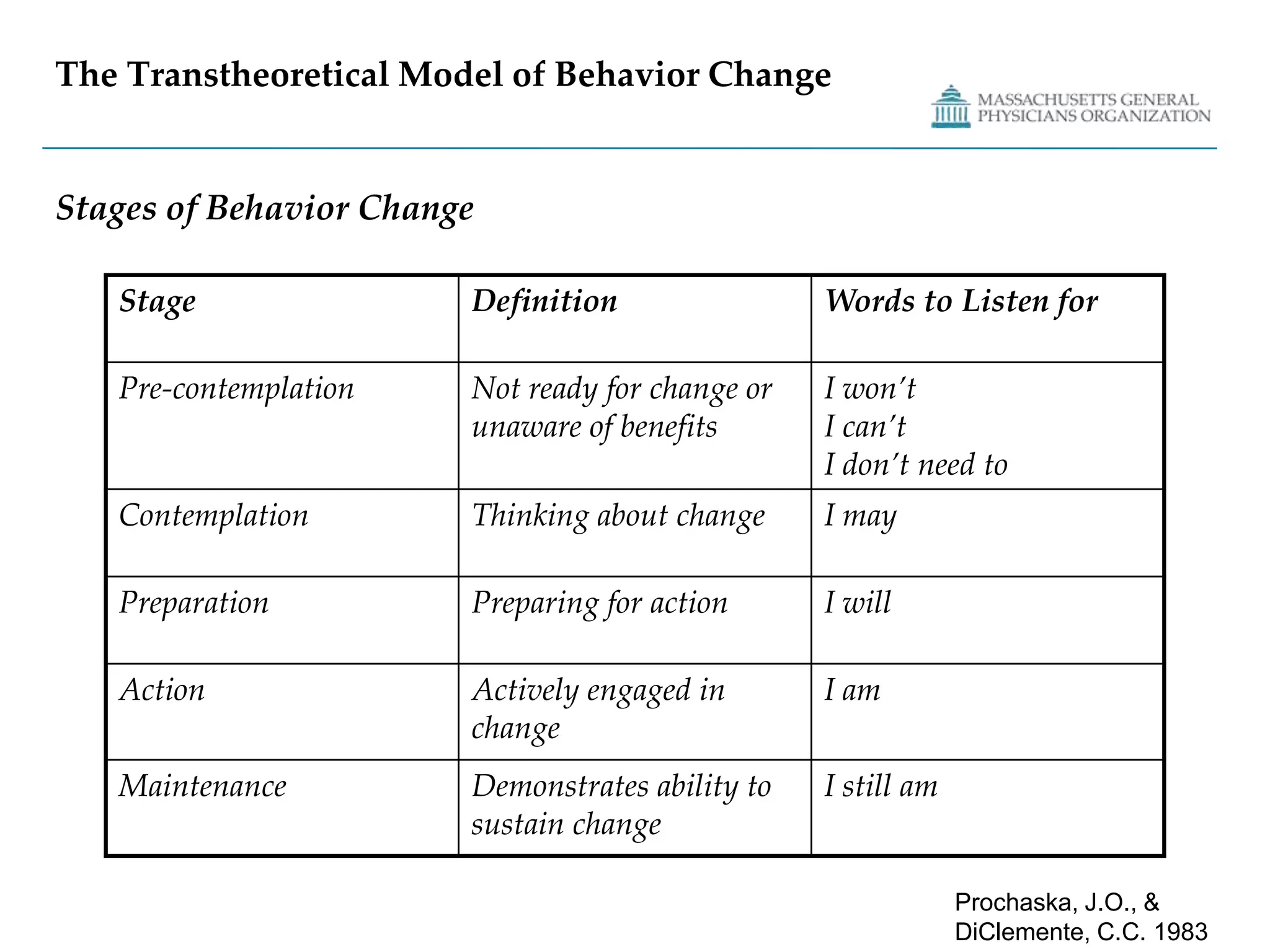
The Transtheoretical Model of Behavior Change Stages of Behavior ChangeProchaska, J.O., & DiClemente, C.C. 1983
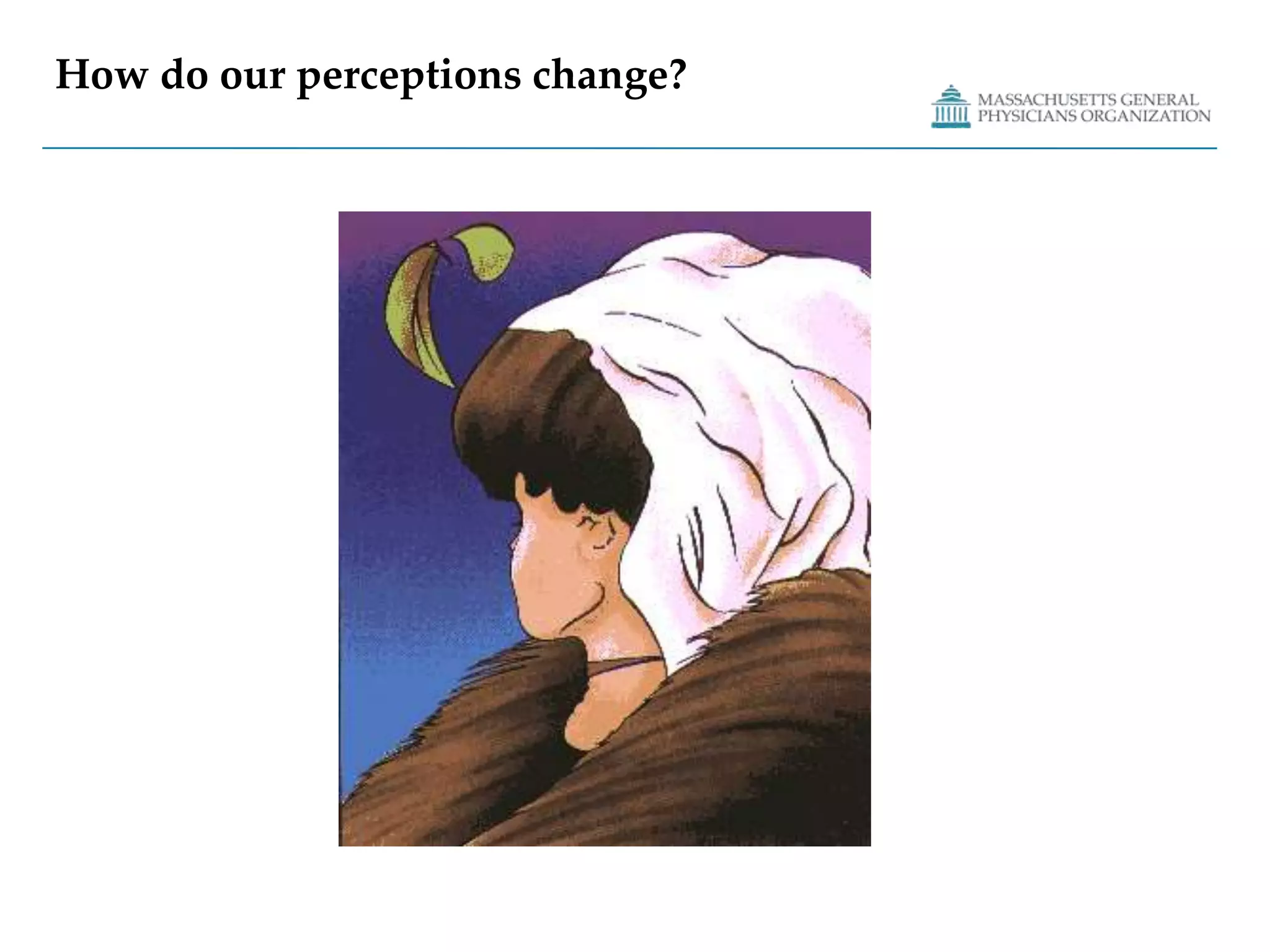
How do our perceptions change?
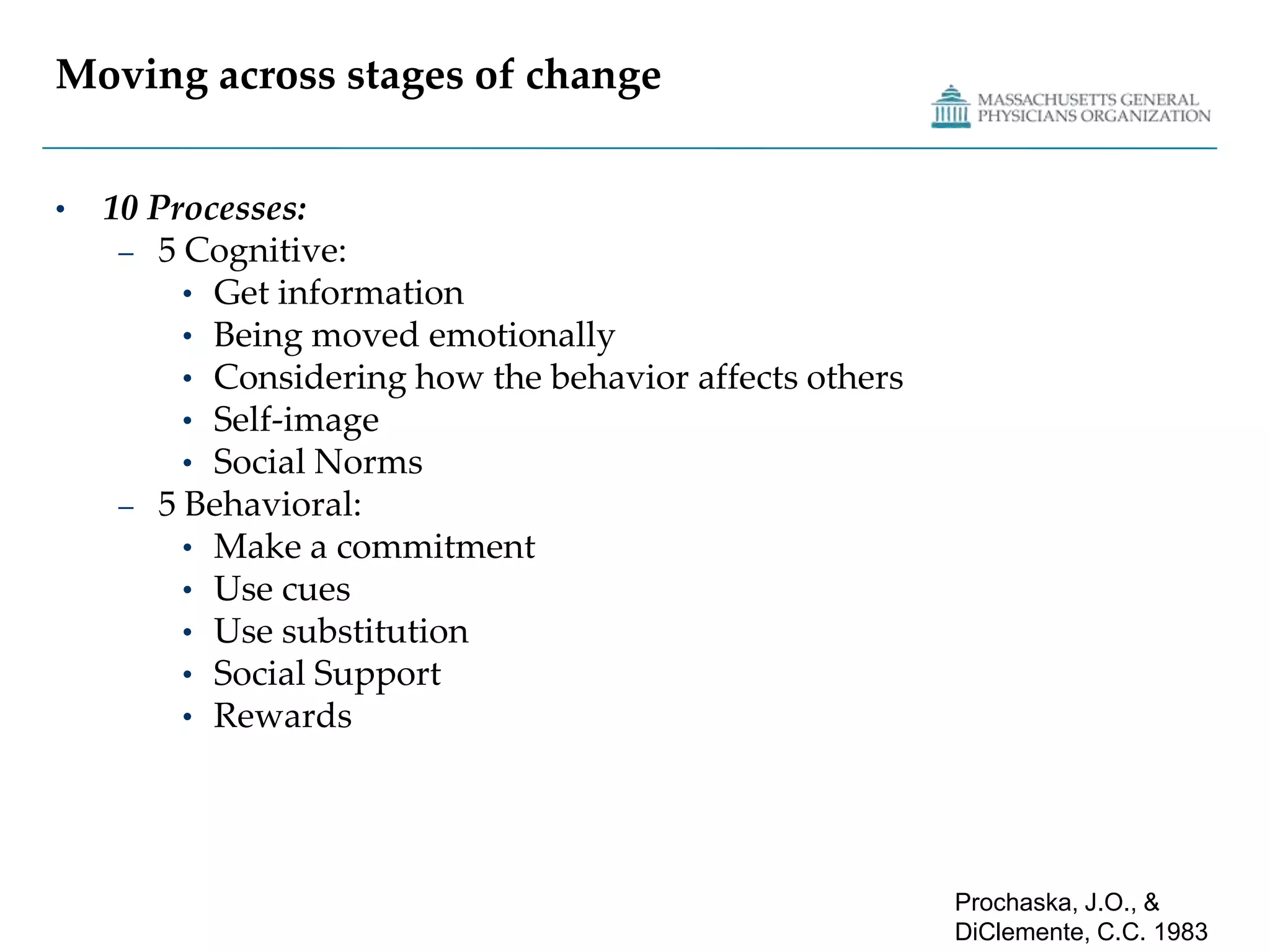
Moving across stages of change10 Processes:5 Cognitive:Get informationBeing moved emotionallyConsidering how the behavior affects othersSelf-imageSocial Norms5 Behavioral:Make a commitmentUse cuesUse substitutionSocial SupportRewardsProchaska, J.O., & DiClemente, C.C. 1983
Behavior ChangeMotivational Interviewing:A client-centered, directive method for motivating change by exploring and resolving ambivalence. Encourages change talkDiscourage resistance talkMiller and Rollnick, 1991
Motivational InterviewingCollaborative approach to help people change their behavior
Patient-centered skills, styles, strategies can be learned by many members of the care team
Promotes change from within not from without
The patient finds the answers, the patient finds the answers, the patient finds the answers!Miller and Rollnick, 19918
Motivational InterviewingIdentifies, explores, resolves ambivalence
Uncovers patient motivation
Enhances conviction
Stimulates readiness for change
Creates a partnership instead of expert/recipient rolesMiller and Rollnick, 1991
Guiding Principles:Express EmpathyAvoid ArgumentDevelop DiscrepancyRoll with ResistanceSupport Self-Efficacy Motivational InterviewingMiller and Rollnick, 1991
Motivational Interviewing: Empathy	Empathy IS: the act of understanding, being aware of, being sensitive to and vicariously experiencing the feelings of another.Empathyis NOT:.Pity: a sorrow for one suffering, distressed or unhappy Sympathy: an affinity, association or relationship between persons or things wherein whatever affects one similarly affects the other.
Motivational Interviewing: EmpathyDo these statements express empathy, sympathy or pity?“I feel sorry for you.”“I respect your pain.”“I feel your pain/joy.”
Motivational Interviewing: EmpathyHow to do it:Unconditional positive regard:Every situation may not be acceptable, but every person is.Express feelings, not thoughts:Thought: “I feel like a failure.”Feeling: “I feel sad.”Identify needs, not strategies:Strategy: “You need to lose weight.”Need: “You are going to lose weight so that your need for physical well-being is met”Relay observations, not evaluationsEvaluation: “You failed to exercise last week.”Observation: “You went to the gym one time last week”
Motivational Interviewing: Develop DiscrepancyDetermine if current behavior aligns with long-term goals/motivatorsEncourage discontent/discomfortSitting in the “muck” will foster changeOpen ended-questions (OEQ)More than 50% of all questions using MI should be OEQs.Examples:What is the best experience you have had with (future desired behavior)?What concerns you about your current behavior?What values do you seek to represent in your life?What changes would you like to make in your routine?
Reflective ListeningRatio of OEQs to reflections: 1:2Four types:Simple Reflection:Patient: “I don’t have time to exercise.”Educator: “I hear you saying you don’t have time to exercise.”Amplified Reflection:Patient: “I don’t have time to exercise.”Educator: “It is impossible for you to fit exercise into your schedule.”Motivational Interviewing: Develop Discrepancy
Double-Sided Reflection:Patient: “I don’t have time to exercise.”Educator:“I hear you saying you don’t have time to exercise. But I have also heard you say that exercise makes you feel better and that regular exercise would be good for your energy and health.”Shifted-Focus Reflection:Patient: “I don’t have time to exercise.”Educator: “Since you don’t have time to exercise, let’s talk about the dance class that you started with your friend. I remember you saying you enjoyed the class.Motivational Interviewing: Develop Discrepancy

Mi ttm%20 presentation_draft4_20_11_test

  • 1.
    Facilitating Behavior Change:TheTranstheoretical Model of Behavior Change andMotivational InterviewingBarbara Chase, MSN, ANP-C, CDE Sandra O’Keefe, CWC
  • 2.
    Learning Objectives-Part IAtthe conclusion of this presentation, attendees will be able to:Define the 5 stages of the Transtheoretical Model (TTM) for behavior changeAssess patients’ current stage of behavior change using TTMIdentify the 10 processes of how to progress through TTM stages Define Motivational Interviewing (MI)Describe skills, styles and strategies used in MIUnderstand how to use MI tools to assess readiness to change
  • 3.
    Continuing Education StatementMassachusettsGeneral Hospital (OH-239/10-01-11) is an approved provider of continuing nursing education by the Ohio Nurses Association (OBN-001-91), an accredited approver by the American Nurses Credentialing Center’s Commission on Accreditation.Criteria for successful completion include attendance at the entire event and submission of a complete evaluation form.Barbara Chase, MSN, NP, CDE has no conflicts of interest to disclose.Sandra O’Keefe, CWC has no conflicts of interest to disclose.
  • 4.
    The Transtheoretical Modelof Behavior Change Stages of Behavior ChangeProchaska, J.O., & DiClemente, C.C. 1983
  • 5.
    How do ourperceptions change?
  • 6.
    Moving across stagesof change10 Processes:5 Cognitive:Get informationBeing moved emotionallyConsidering how the behavior affects othersSelf-imageSocial Norms5 Behavioral:Make a commitmentUse cuesUse substitutionSocial SupportRewardsProchaska, J.O., & DiClemente, C.C. 1983
  • 7.
    Behavior ChangeMotivational Interviewing:Aclient-centered, directive method for motivating change by exploring and resolving ambivalence. Encourages change talkDiscourage resistance talkMiller and Rollnick, 1991
  • 8.
    Motivational InterviewingCollaborative approachto help people change their behavior
  • 9.
    Patient-centered skills, styles,strategies can be learned by many members of the care team
  • 10.
    Promotes change fromwithin not from without
  • 11.
    The patient findsthe answers, the patient finds the answers, the patient finds the answers!Miller and Rollnick, 19918
  • 12.
  • 13.
  • 14.
  • 15.
  • 16.
    Creates a partnershipinstead of expert/recipient rolesMiller and Rollnick, 1991
  • 17.
    Guiding Principles:Express EmpathyAvoidArgumentDevelop DiscrepancyRoll with ResistanceSupport Self-Efficacy Motivational InterviewingMiller and Rollnick, 1991
  • 18.
    Motivational Interviewing: Empathy EmpathyIS: the act of understanding, being aware of, being sensitive to and vicariously experiencing the feelings of another.Empathyis NOT:.Pity: a sorrow for one suffering, distressed or unhappy Sympathy: an affinity, association or relationship between persons or things wherein whatever affects one similarly affects the other.
  • 19.
    Motivational Interviewing: EmpathyDothese statements express empathy, sympathy or pity?“I feel sorry for you.”“I respect your pain.”“I feel your pain/joy.”
  • 20.
    Motivational Interviewing: EmpathyHowto do it:Unconditional positive regard:Every situation may not be acceptable, but every person is.Express feelings, not thoughts:Thought: “I feel like a failure.”Feeling: “I feel sad.”Identify needs, not strategies:Strategy: “You need to lose weight.”Need: “You are going to lose weight so that your need for physical well-being is met”Relay observations, not evaluationsEvaluation: “You failed to exercise last week.”Observation: “You went to the gym one time last week”
  • 21.
    Motivational Interviewing: DevelopDiscrepancyDetermine if current behavior aligns with long-term goals/motivatorsEncourage discontent/discomfortSitting in the “muck” will foster changeOpen ended-questions (OEQ)More than 50% of all questions using MI should be OEQs.Examples:What is the best experience you have had with (future desired behavior)?What concerns you about your current behavior?What values do you seek to represent in your life?What changes would you like to make in your routine?
  • 22.
    Reflective ListeningRatio ofOEQs to reflections: 1:2Four types:Simple Reflection:Patient: “I don’t have time to exercise.”Educator: “I hear you saying you don’t have time to exercise.”Amplified Reflection:Patient: “I don’t have time to exercise.”Educator: “It is impossible for you to fit exercise into your schedule.”Motivational Interviewing: Develop Discrepancy
  • 23.
    Double-Sided Reflection:Patient: “Idon’t have time to exercise.”Educator:“I hear you saying you don’t have time to exercise. But I have also heard you say that exercise makes you feel better and that regular exercise would be good for your energy and health.”Shifted-Focus Reflection:Patient: “I don’t have time to exercise.”Educator: “Since you don’t have time to exercise, let’s talk about the dance class that you started with your friend. I remember you saying you enjoyed the class.Motivational Interviewing: Develop Discrepancy
  • 24.
  • 25.
  • 26.
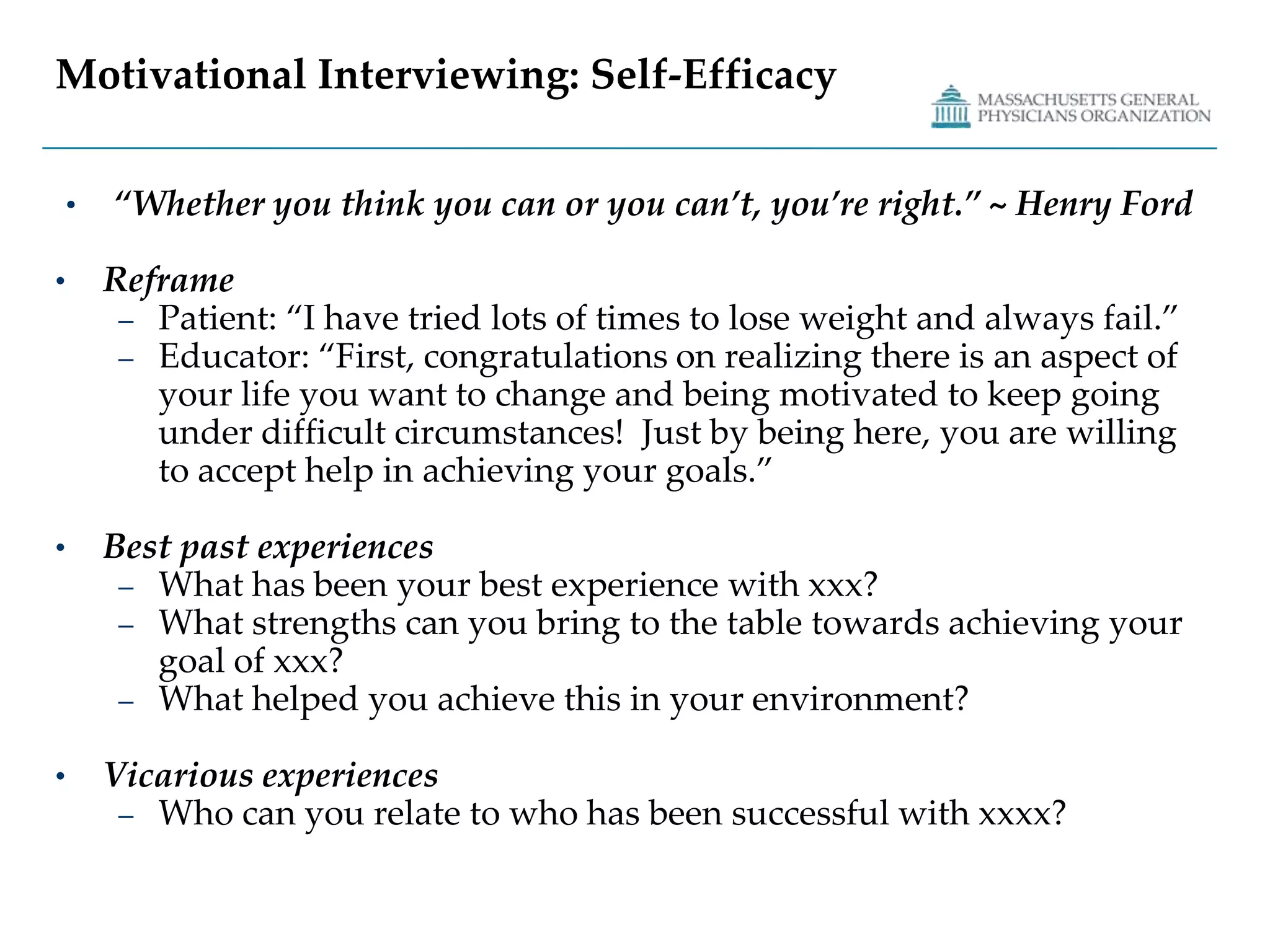
    Motivational Interviewing: Self-Efficacy“Whetheryou think you can or you can’t, you’re right.” ~ Henry FordReframePatient: “I have tried lots of times to lose weight and always fail.”Educator: “First, congratulations on realizing there is an aspect of your life you want to change and being motivated to keep going under difficult circumstances! Just by being here, you are willing to accept help in achieving your goals.” Best past experiencesWhat has been your best experience with xxx?What strengths can you bring to the table towards achieving your goal of xxx?What helped you achieve this in your environment?Vicarious experiencesWho can you relate to who has been successful with xxxx?
  • 27.
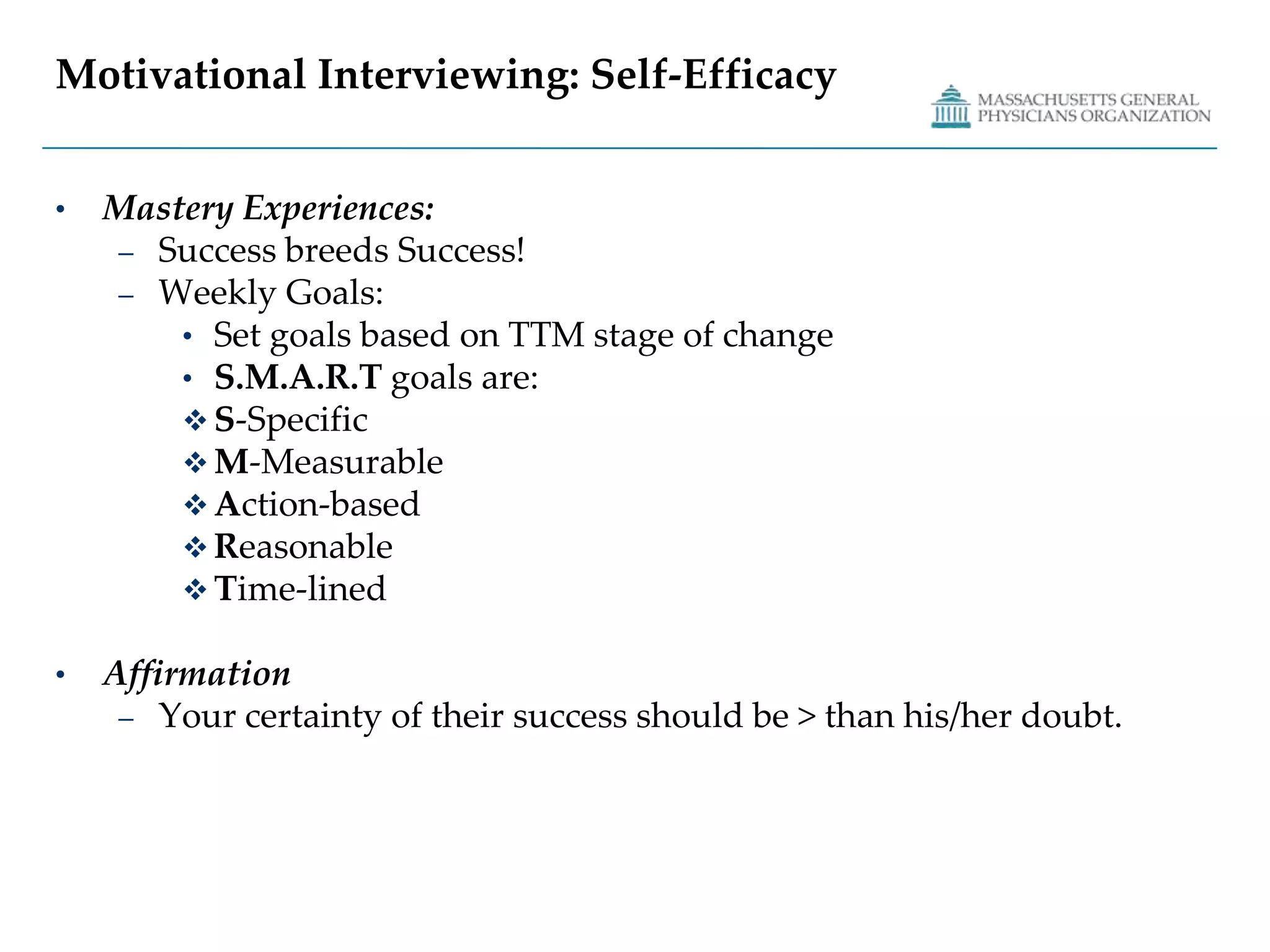
    Mastery Experiences:Success breedsSuccess!Weekly Goals:Set goals based on TTM stage of changeS.M.A.R.T goals are:S-Specific
  • 28.
  • 29.
  • 30.
  • 31.
    Time-linedAffirmationYour certainty oftheir success should be > than his/her doubt.Motivational Interviewing: Self-Efficacy
  • 32.
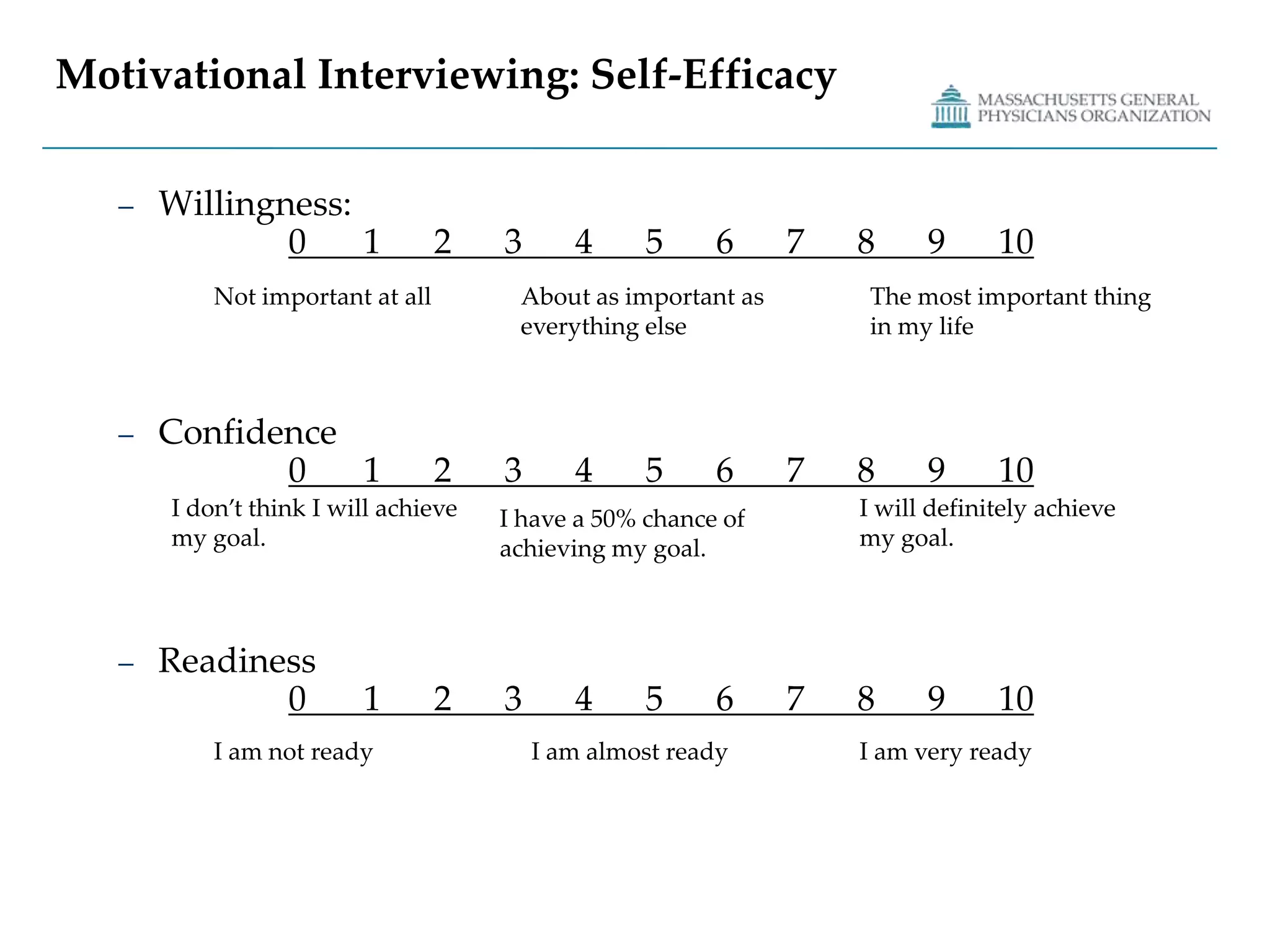
    Willingness:0 1 2 3 4 5 6 7 8 9 10Confidence0 1 2 3 4 5 6 7 8 9 10Readiness0 1 2 3 4 5 6 7 8 9 10Motivational Interviewing: Self-EfficacyNot important at allAbout as important as everything elseThe most important thing in my lifeI don’t think I will achieve my goal.I will definitely achieve my goal.I have a 50% chance of achieving my goal.I am very readyI am almost readyI am not ready
  • 33.
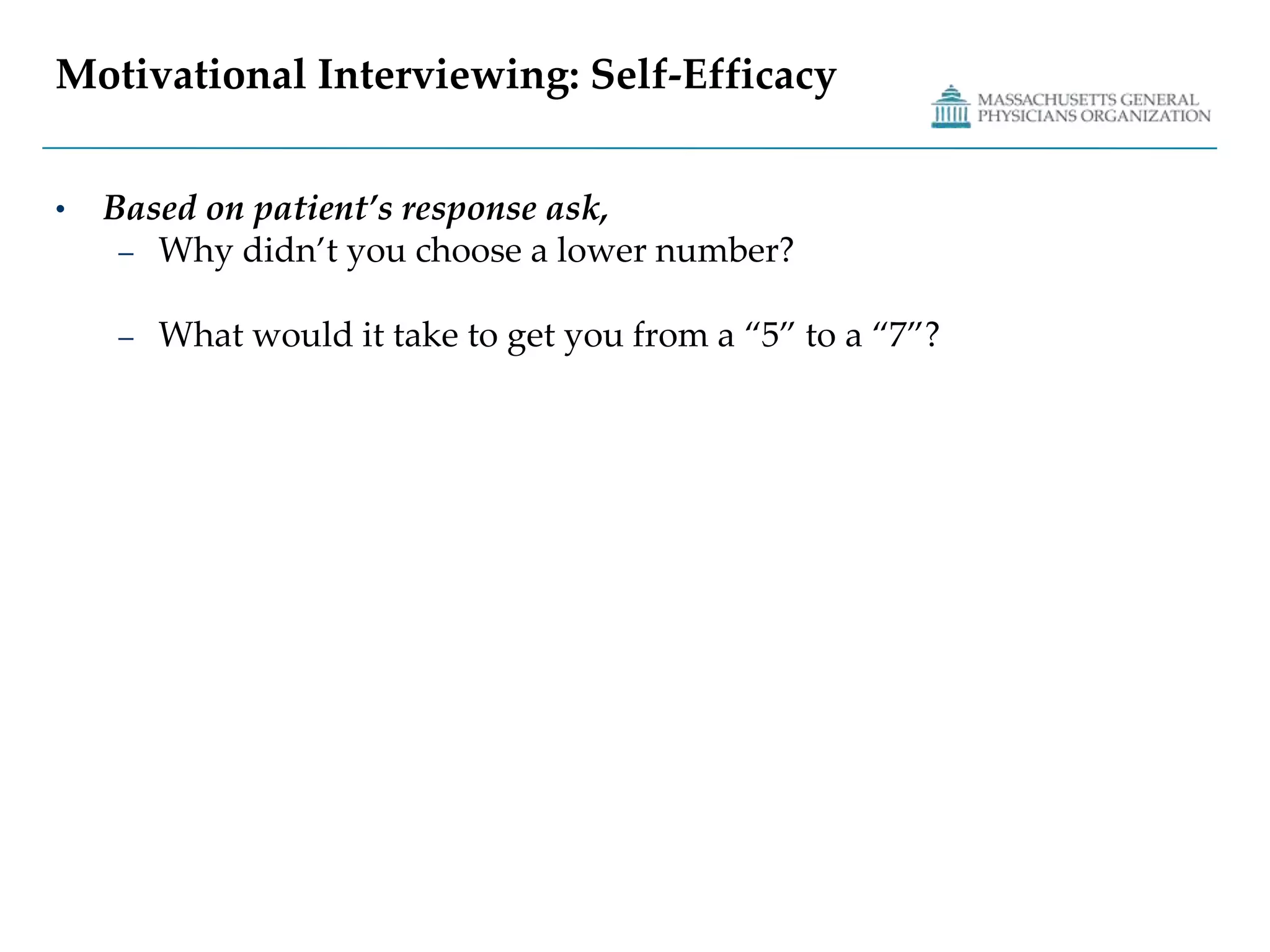
    Based on patient’sresponse ask, Why didn’t you choose a lower number?What would it take to get you from a “5” to a “7”?Motivational Interviewing: Self-Efficacy
  • 34.
    ReferencesProchaska, J. O.,& DiClemente, C. C. (1983). Stages and processes of self-change of smoking: Toward an integrative model of change.Journal of Consulting and Clinical Psychology, 51, 390-395.Miller, W.R., Rollnick, S. Motivational Interviewing. London: Guilford Press, 1991Botelho, R. (2004). Motivate healthy habits: Stepping stones to lasting change. Rochester, NY: MHH Publications.