Motivational Interviewing Stages
and Communication Styles
Claire Staniland Nov 2015
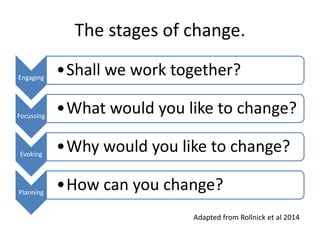
The stages of change.
Engaging
โ€ขShall we work together?
Focussing
โ€ขWhat would you like to change?
Evoking
โ€ขWhy would you like to change?
Planning
โ€ขHow can you change?
Adapted from Rollnick et al 2014
Stages of change
โ€ข Although the steps appear in an order, a
conversation may not go exactly like that. You
may move up and down with the person, and
they may spend different amounts of time at
each stage (Miller and Rollnick 2013).
โ€ข This may depend how ready they are to make
a change.
Communications Styles
In Motivational Interviewing (MI), there are 5
communication styles which we will use:
1. Asking open questions
2. Affirming
3. Reflective listening
4. Summarising
5. Informing and advising
Engaging
โ€ข This is the stage where the relationship begins to
develop and you attempt to make a connection. It may
involve open questions which are looking to find out
what a person is looking to change or how they feel
about a change (Rollnick et al 2014). An open question
should allow the person to open up a little and speak
to you. Examples might be:
โ€ข โ€œWhat would you like to change about your lifestyle?โ€
โ€ข โ€œHow do you feel about working less in the evenings?โ€
Engaging cont...
โ€ข Listening is a two step process involving hearing what someone has
said and then showing them that you understand what you heard.
Reflective listening is a skill used in MI where you listen to what
someone says, then reflect back to them what they said in a short
sentence. It should be a statement and not a question (Rollnick et al
2014). It doesnโ€™t matter if you donโ€™t quite get it right as the person
will correct you and this in itself can develop the relationship
between you.
โ€ข An example might be:
Client- โ€I really want to lose weight but nothing I try seems to workโ€
MI Therapist-โ€So you would like to lose weight but you canโ€™t find a way
that works for youโ€
Engaging/Reflective Listening
โ€ข Reflective listening is a skill and it is quite
difficult at first not to raise your voice at the
end of the sentence as you would in a
question.
โ€ข It is really helpful in showing the client that
you understand them (Rollnick et al 2014).
โ€ข Hearing your own thoughts reflected back can
be really powerful.
โ€ข It is really useful when a client is angry or
upset to help them to calm down.
Focussing
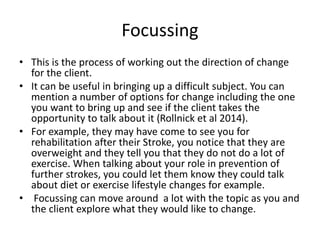
โ€ข This is the process of working out the direction of change
for the client.
โ€ข It can be useful in bringing up a difficult subject. You can
mention a number of options for change including the one
you want to bring up and see if the client takes the
opportunity to talk about it (Rollnick et al 2014).
โ€ข For example, they may have come to see you for
rehabilitation after their Stroke, you notice that they are
overweight and they tell you that they do not do a lot of
exercise. When talking about your role in prevention of
further strokes, you could let them know they could talk
about diet or exercise lifestyle changes for example.
โ€ข Focussing can move around a lot with the topic as you and
the client explore what they would like to change.
Evoking
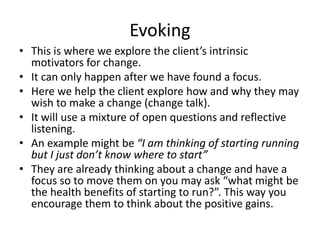
โ€ข This is where we explore the clientโ€™s intrinsic
motivators for change.
โ€ข It can only happen after we have found a focus.
โ€ข Here we help the client explore how and why they may
wish to make a change (change talk).
โ€ข It will use a mixture of open questions and reflective
listening.
โ€ข An example might be โ€œI am thinking of starting running
but I just donโ€™t know where to startโ€
โ€ข They are already thinking about a change and have a
focus so to move them on you may ask โ€œwhat might be
the health benefits of starting to run?โ€. This way you
encourage them to think about the positive gains.
Planning
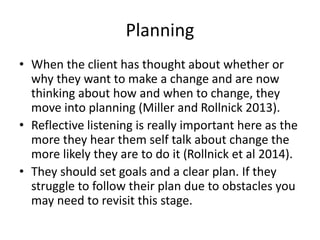
โ€ข When the client has thought about whether or
why they want to make a change and are now
thinking about how and when to change, they
move into planning (Miller and Rollnick 2013).
โ€ข Reflective listening is really important here as the
more they hear them self talk about change the
more likely they are to do it (Rollnick et al 2014).
โ€ข They should set goals and a clear plan. If they
struggle to follow their plan due to obstacles you
may need to revisit this stage.
Summarising
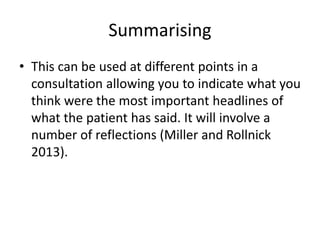
โ€ข This can be used at different points in a
consultation allowing you to indicate what you
think were the most important headlines of
what the patient has said. It will involve a
number of reflections (Miller and Rollnick
2013).
Summary
โ€ข Affirmation involves recognising and commenting on
the patientโ€™s strengths and abilities and can also be
really useful in eliciting change talk.
โ€ข It may be something you use to recognise that they are
ready for change this time. Maybe they are wanting to
improve their health by exercising more and have
already been making changes to their diet.
โ€ข You are trying to strengthen their confidence in their
ability to make a change so your affirmations need to
be around this (Rollnick et al 2014)
Tips on Informing and Advising
โ€ข There is still a role for giving information and
advice, but it is about timing. They might ask
for it or it may be spontaneous if you have
good engagement.
โ€ข It is useful to ask permission before giving
advice.
โ€ข Offer a number of options to allow choice.
โ€ข Let them know that it is their decision to act
on the information (Rollnick et al 2014)
References
โ€ข MILLER, William R. and ROLLNICK, Stephen, (2013).
Motivational interviewing : helping people change. 3rd
ed.. ed., New York ; London, Guilford.
โ€ข ROLLNICK, stephen, GOBAT, Nina and BATSON,
Jacqueline (sept 2014). Motivational Interviewing in
brief interventions-online module funded and
developed with Public Health England. [online].
http://learning.bmj.com/learning/module-
intro/motivational-
interviewing.html?locale=en_GB&moduleId=10051582

Motivational interviewing stages and communication styles

  • 1.
    Motivational Interviewing Stages andCommunication Styles Claire Staniland Nov 2015
  • 2.
    The stages ofchange. Engaging โ€ขShall we work together? Focussing โ€ขWhat would you like to change? Evoking โ€ขWhy would you like to change? Planning โ€ขHow can you change? Adapted from Rollnick et al 2014
  • 3.
    Stages of change โ€ขAlthough the steps appear in an order, a conversation may not go exactly like that. You may move up and down with the person, and they may spend different amounts of time at each stage (Miller and Rollnick 2013). โ€ข This may depend how ready they are to make a change.
  • 4.
    Communications Styles In MotivationalInterviewing (MI), there are 5 communication styles which we will use: 1. Asking open questions 2. Affirming 3. Reflective listening 4. Summarising 5. Informing and advising
  • 5.
    Engaging โ€ข This isthe stage where the relationship begins to develop and you attempt to make a connection. It may involve open questions which are looking to find out what a person is looking to change or how they feel about a change (Rollnick et al 2014). An open question should allow the person to open up a little and speak to you. Examples might be: โ€ข โ€œWhat would you like to change about your lifestyle?โ€ โ€ข โ€œHow do you feel about working less in the evenings?โ€
  • 6.
    Engaging cont... โ€ข Listeningis a two step process involving hearing what someone has said and then showing them that you understand what you heard. Reflective listening is a skill used in MI where you listen to what someone says, then reflect back to them what they said in a short sentence. It should be a statement and not a question (Rollnick et al 2014). It doesnโ€™t matter if you donโ€™t quite get it right as the person will correct you and this in itself can develop the relationship between you. โ€ข An example might be: Client- โ€I really want to lose weight but nothing I try seems to workโ€ MI Therapist-โ€So you would like to lose weight but you canโ€™t find a way that works for youโ€
  • 7.
    Engaging/Reflective Listening โ€ข Reflectivelistening is a skill and it is quite difficult at first not to raise your voice at the end of the sentence as you would in a question. โ€ข It is really helpful in showing the client that you understand them (Rollnick et al 2014). โ€ข Hearing your own thoughts reflected back can be really powerful. โ€ข It is really useful when a client is angry or upset to help them to calm down.
  • 8.
    Focussing โ€ข This isthe process of working out the direction of change for the client. โ€ข It can be useful in bringing up a difficult subject. You can mention a number of options for change including the one you want to bring up and see if the client takes the opportunity to talk about it (Rollnick et al 2014). โ€ข For example, they may have come to see you for rehabilitation after their Stroke, you notice that they are overweight and they tell you that they do not do a lot of exercise. When talking about your role in prevention of further strokes, you could let them know they could talk about diet or exercise lifestyle changes for example. โ€ข Focussing can move around a lot with the topic as you and the client explore what they would like to change.
  • 9.
    Evoking โ€ข This iswhere we explore the clientโ€™s intrinsic motivators for change. โ€ข It can only happen after we have found a focus. โ€ข Here we help the client explore how and why they may wish to make a change (change talk). โ€ข It will use a mixture of open questions and reflective listening. โ€ข An example might be โ€œI am thinking of starting running but I just donโ€™t know where to startโ€ โ€ข They are already thinking about a change and have a focus so to move them on you may ask โ€œwhat might be the health benefits of starting to run?โ€. This way you encourage them to think about the positive gains.
  • 10.
    Planning โ€ข When theclient has thought about whether or why they want to make a change and are now thinking about how and when to change, they move into planning (Miller and Rollnick 2013). โ€ข Reflective listening is really important here as the more they hear them self talk about change the more likely they are to do it (Rollnick et al 2014). โ€ข They should set goals and a clear plan. If they struggle to follow their plan due to obstacles you may need to revisit this stage.
  • 11.
    Summarising โ€ข This canbe used at different points in a consultation allowing you to indicate what you think were the most important headlines of what the patient has said. It will involve a number of reflections (Miller and Rollnick 2013).
  • 12.
    Summary โ€ข Affirmation involvesrecognising and commenting on the patientโ€™s strengths and abilities and can also be really useful in eliciting change talk. โ€ข It may be something you use to recognise that they are ready for change this time. Maybe they are wanting to improve their health by exercising more and have already been making changes to their diet. โ€ข You are trying to strengthen their confidence in their ability to make a change so your affirmations need to be around this (Rollnick et al 2014)
  • 13.
    Tips on Informingand Advising โ€ข There is still a role for giving information and advice, but it is about timing. They might ask for it or it may be spontaneous if you have good engagement. โ€ข It is useful to ask permission before giving advice. โ€ข Offer a number of options to allow choice. โ€ข Let them know that it is their decision to act on the information (Rollnick et al 2014)
  • 14.
    References โ€ข MILLER, WilliamR. and ROLLNICK, Stephen, (2013). Motivational interviewing : helping people change. 3rd ed.. ed., New York ; London, Guilford. โ€ข ROLLNICK, stephen, GOBAT, Nina and BATSON, Jacqueline (sept 2014). Motivational Interviewing in brief interventions-online module funded and developed with Public Health England. [online]. http://learning.bmj.com/learning/module- intro/motivational- interviewing.html?locale=en_GB&moduleId=10051582