Rolling with Resistance
Using Motivational Interviewing with
              Probationary Students

     Sarah McKay, M.Ed; Academic Advisor for UGS
Discussion Goals
 History and techniques of Motivational Interviewing (M.I.)

 Discuss stages of change for probationary students

 Discuss potential application of M.I. style
Reflection Time
 Think of one situation in your life that you’re
considering changing, but haven’t taken action
              yet (write it down)
    (Don’t worry, you’re not being asked to share!)


   What worries you about your current situation?
Forced Behavior Change
 Students placed on probation are being told by UT Austin that
  the need to change in a limited amount of time/credit hours

 Factors contributing to academic difficulty:
   Adjustment to UT expectations
   Home/family issues
   Study skills
   Lack of effective time mangement
   Lacking academic goals or future plans
   Physical/mental illness
   Inadequate finances
   Many more!
M.I.: What is it?
A “directive, client-centered, counseling style for eliciting
behavior change by helping clients explore and resolve
ambivalence”


“Motivational interviewing has one leading in a way that is
subtle, gentle, responsive, and imaginative.”

  (Miller and Rollnick, 1991 & 2002)
General Principles of M.I.
1. Express empathy and active listening: use of open-
   ended questions, assess readiness to change

2. Develop discrepancy: allow students to provide
   arguments for change, use affirmation, transitional
   summary, and key questions

3. Roll with resistance: avoid arguing for change; use
   reflective listening and provide information

4. Support self-efficacy: work on belief for change, use
   summaries and work on negotiating a change plan
The Spirit of M.I.
 Collaboration
   Partnership, asking permission from student

 Evocation
   “Intrinsic motivation for change is enhanced by drawing on
    the [student’s] own perceptions, goals, and values” (Miller
    and Rollnick, 2002)

 Autonomy
   Student has the right to make decisions (regardless of the
    advisor’s opinions)
M.I. Research and Application
 Historically, M.I. has been researched and used in health
  behavior change programs:
     Smoking cessation
     Weight loss
     Addiction and substance abuse
     Disease management/adherence to treatment
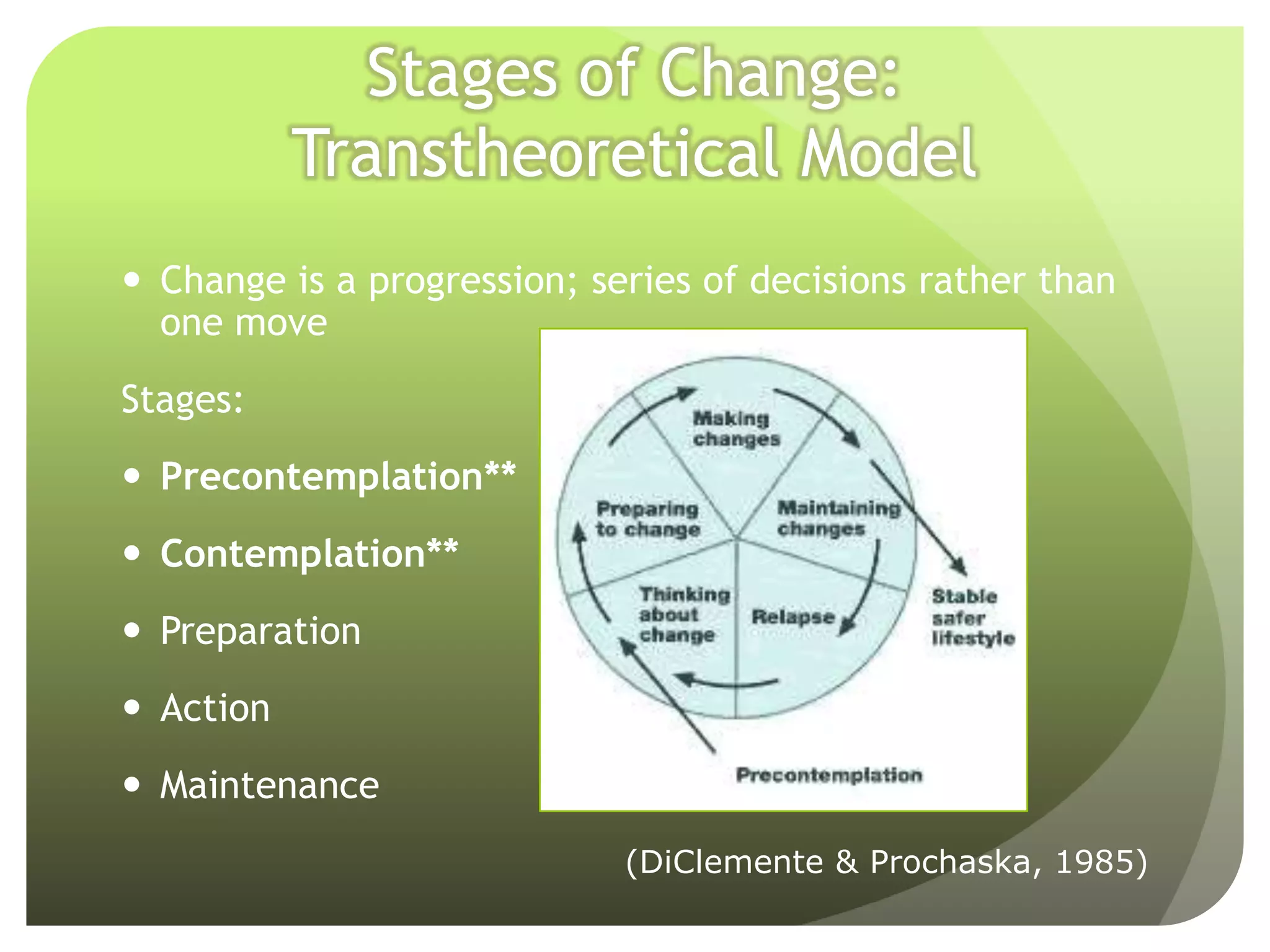
Stages of Change:
           Transtheoretical Model
 Change is a progression; series of decisions rather than
  one move
Stages:
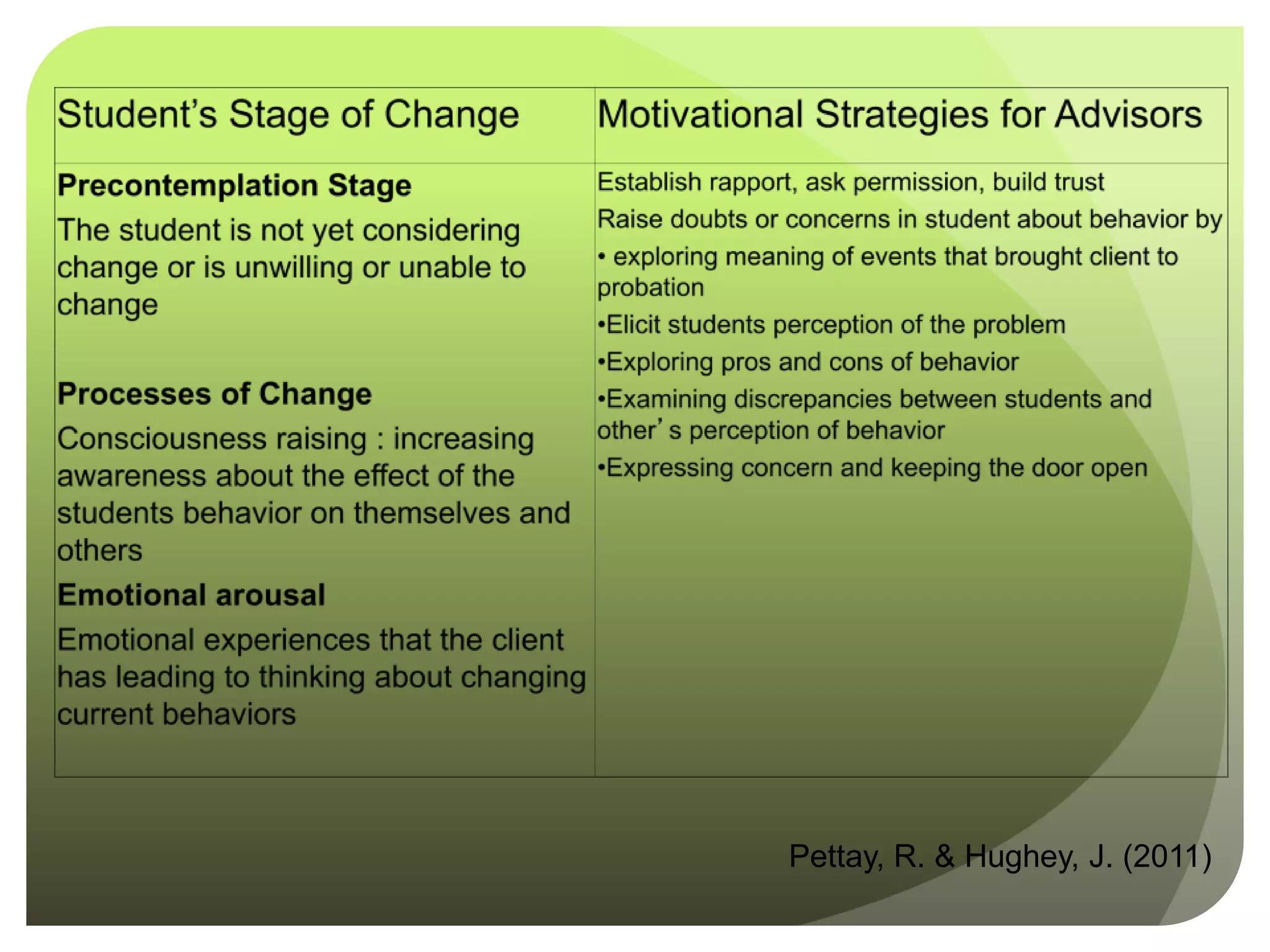
 Precontemplation**
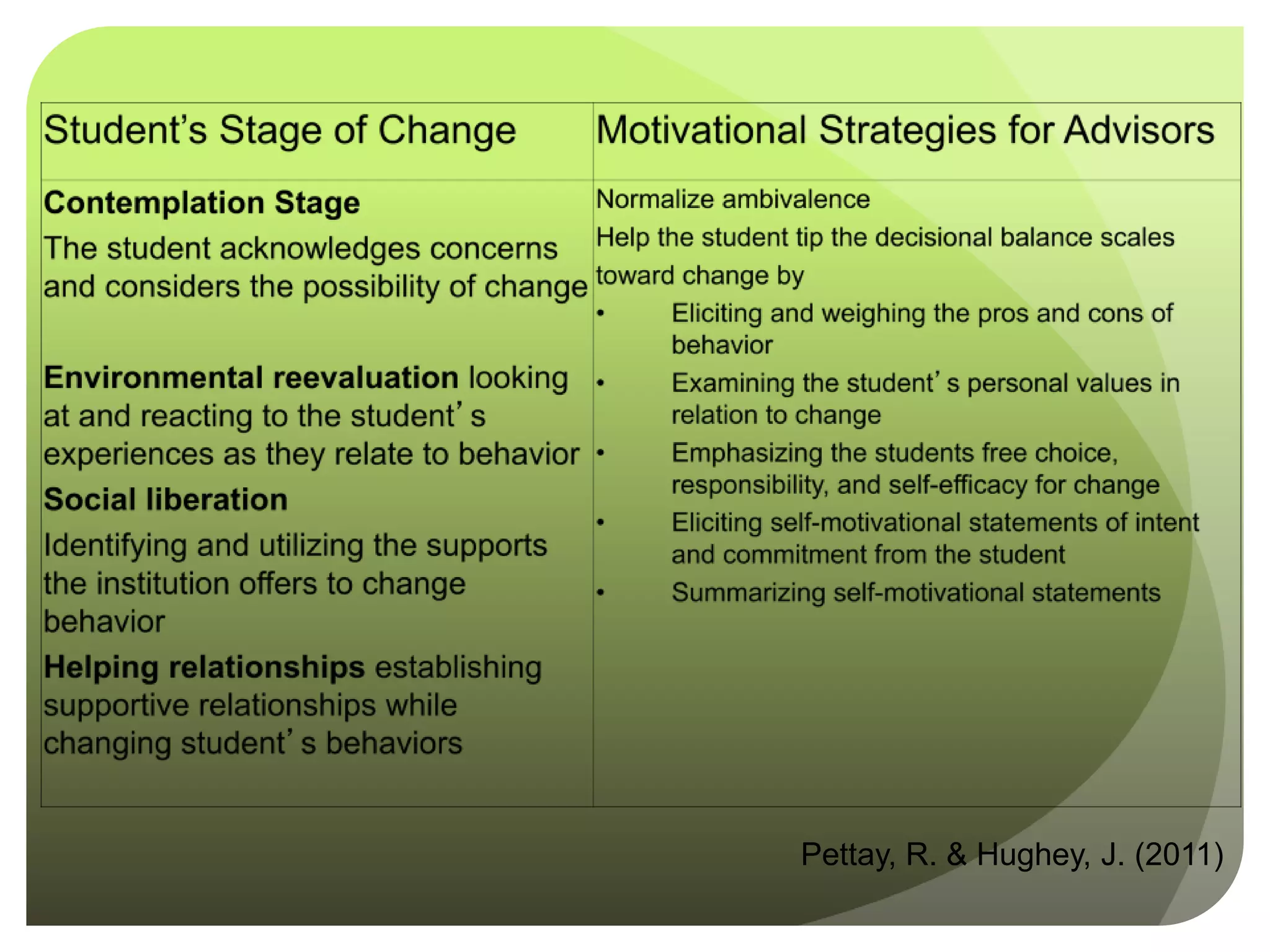
 Contemplation**
 Preparation
 Action
 Maintenance
                             (DiClemente & Prochaska, 1985)
Reflection Time
  What would be the advantages of making a change?

If you could magically fix the problem immediately, how
             might things be better for you?


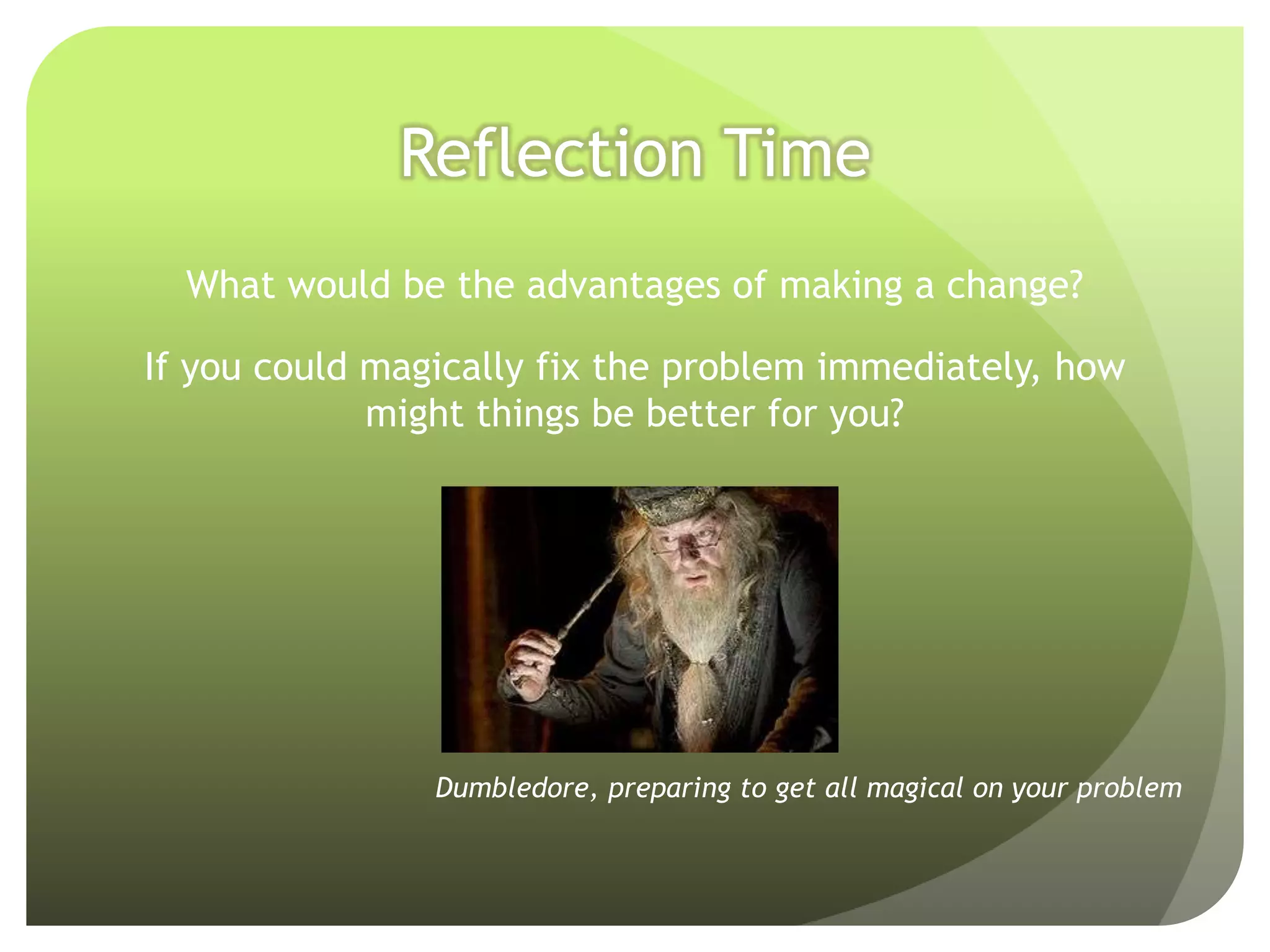
                Dumbledore, preparing to get all magical on your problem
Ambivalence
     “I want to change, and I don’t want to change.”

 Ambivalence is normal, but it keeps us stuck!


Tools: Decisional balance sheet
   Weighs the benefits/costs of status quo, costs/benefits of
    change
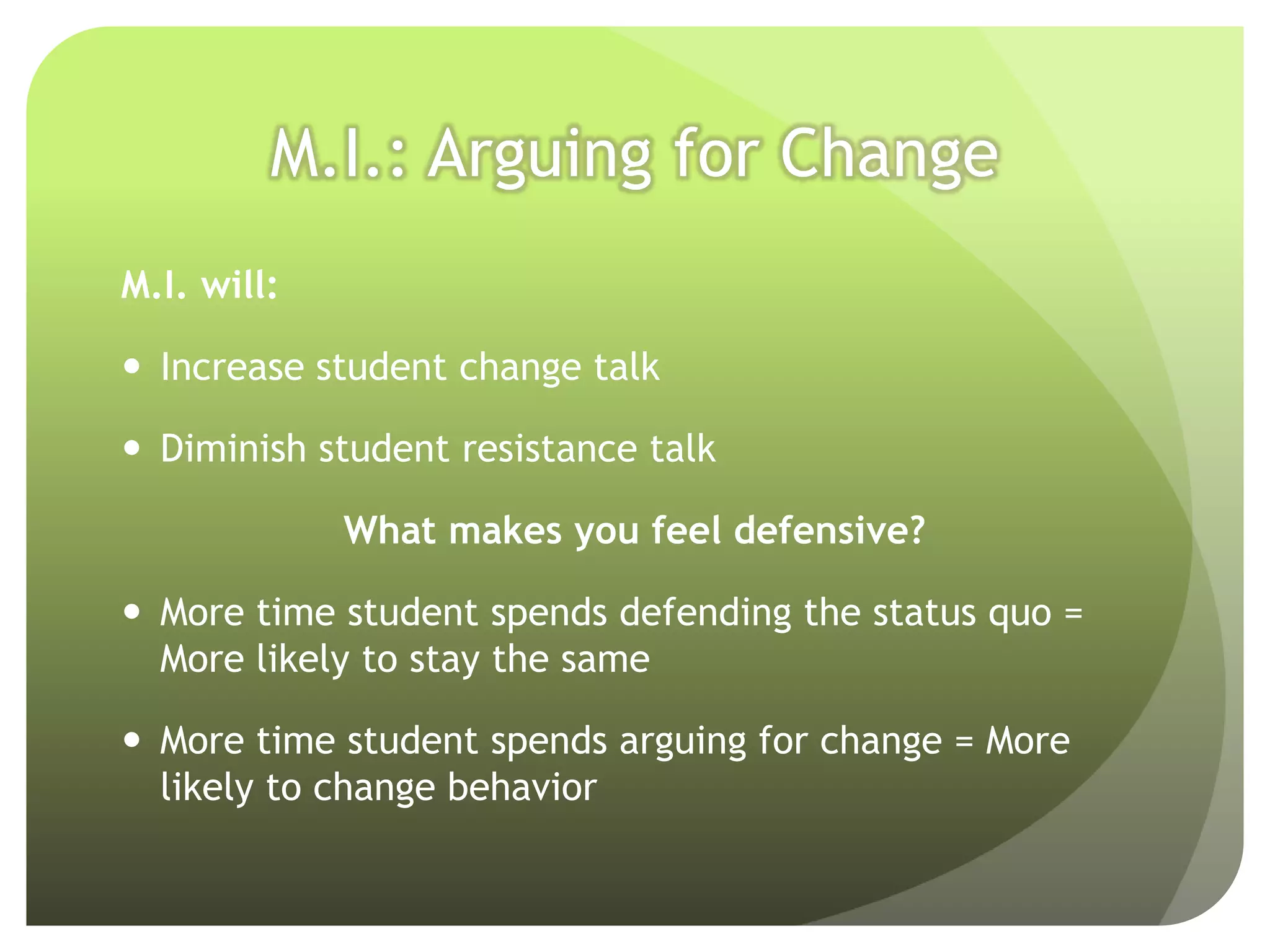
M.I.: Arguing for Change
M.I. will:

 Increase student change talk

 Diminish student resistance talk

             What makes you feel defensive?

 More time student spends defending the status quo =
  More likely to stay the same

 More time student spends arguing for change = More
  likely to change behavior
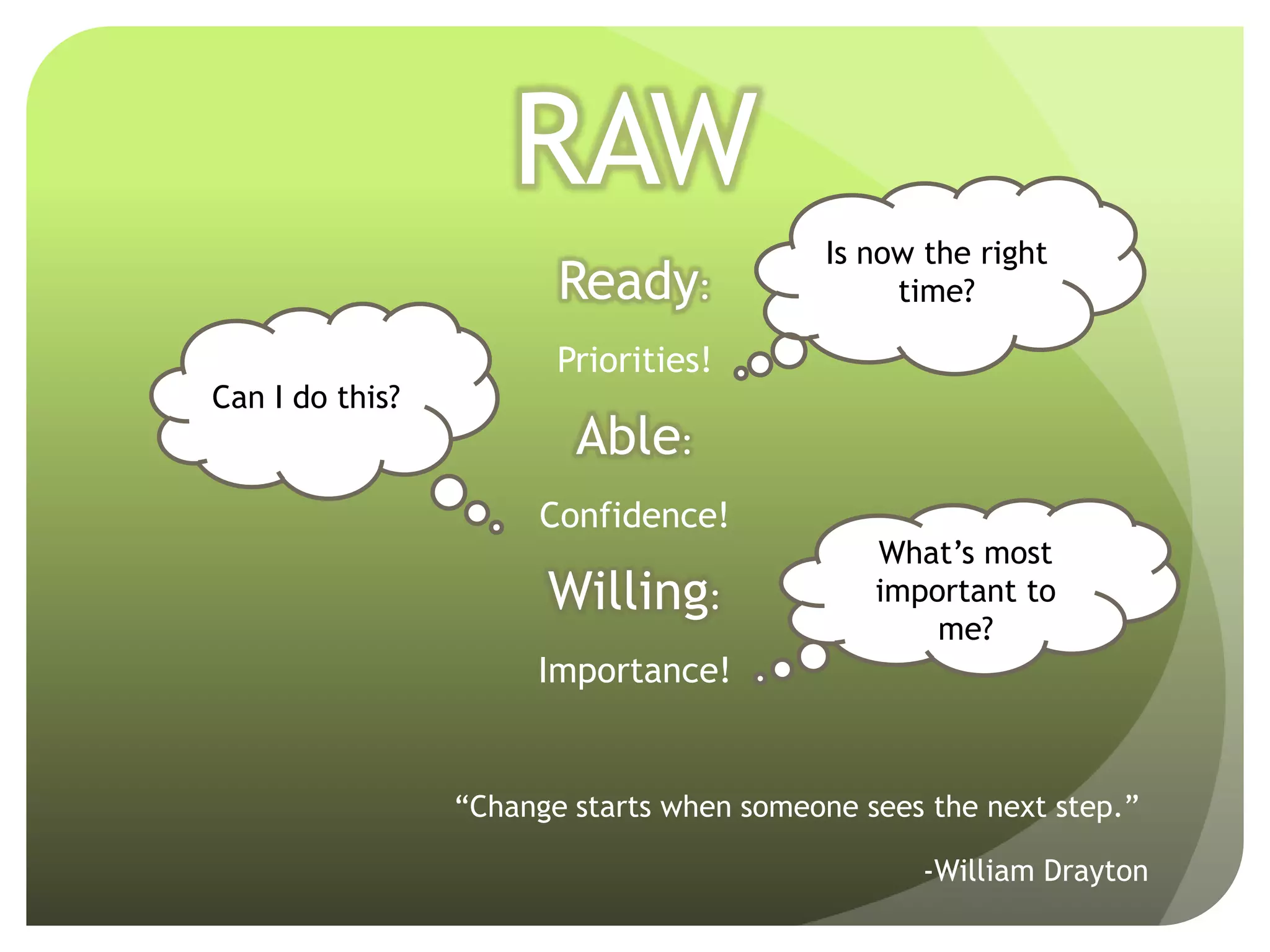
RAW
                                           Is now the right
                        Ready:                  time?

                        Priorities!
Can I do this?
                         Able:
                      Confidence!
                                              What’s most
                       Willing:               important to
                                                  me?
                      Importance!


                 “Change starts when someone sees the next step.”

                                                  -William Drayton
Clarifying Goals and Values
 Identifying issues important to the student

 Highlighting intrinsic motivation rather than extrinsic

 Change more likely to happen if it comes from inside

 Tool: Importance Ruler


                 “Change will not come if we wait for some
                 other person, or if we wait for some other time.
                 We are the ones we've been waiting for. We are
                 the change that we seek.” ― Barack Obama
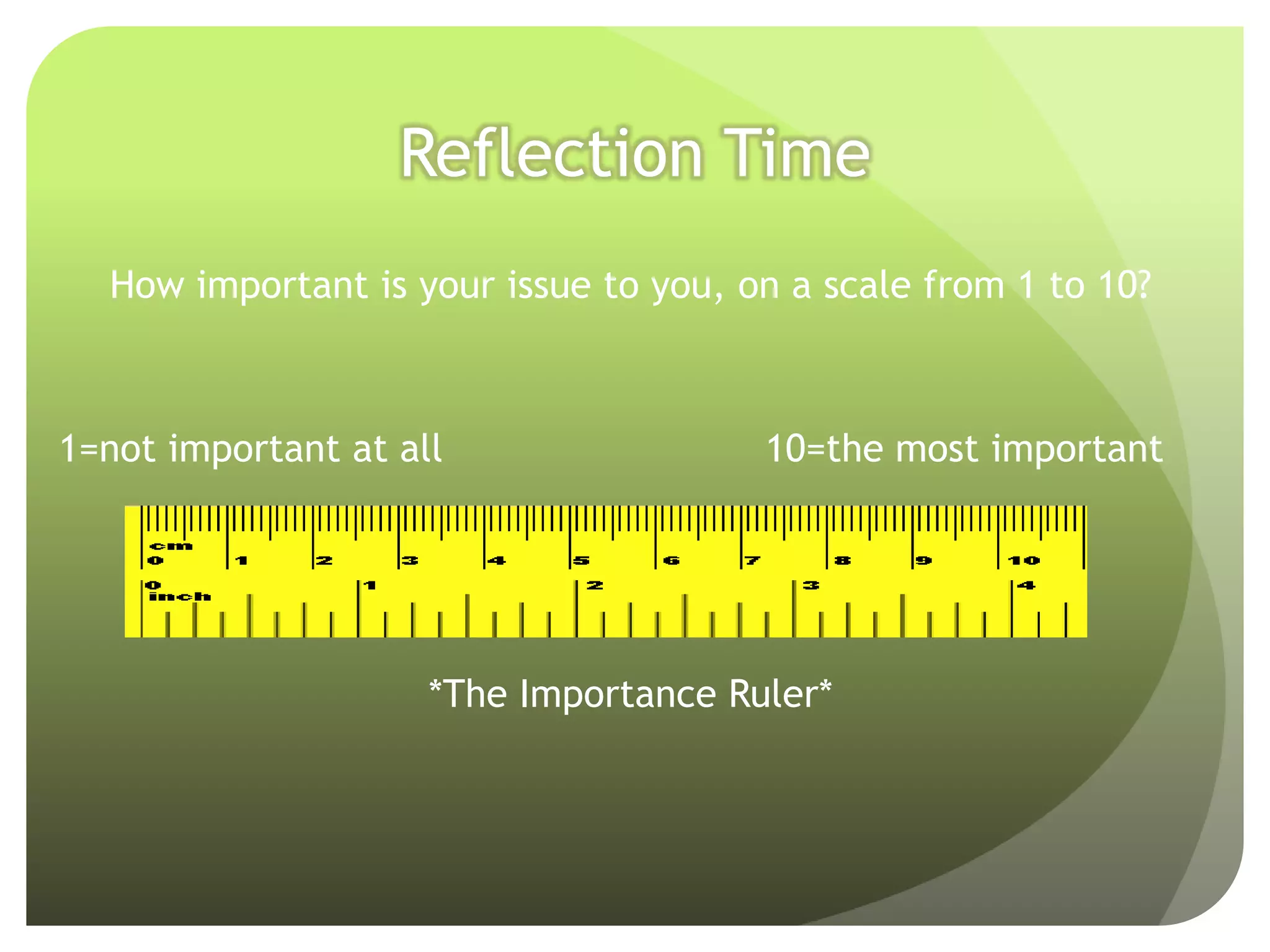
Reflection Time
  How important is your issue to you, on a scale from 1 to 10?


1=not important at all                 10=the most important


                     *The Importance Ruler*
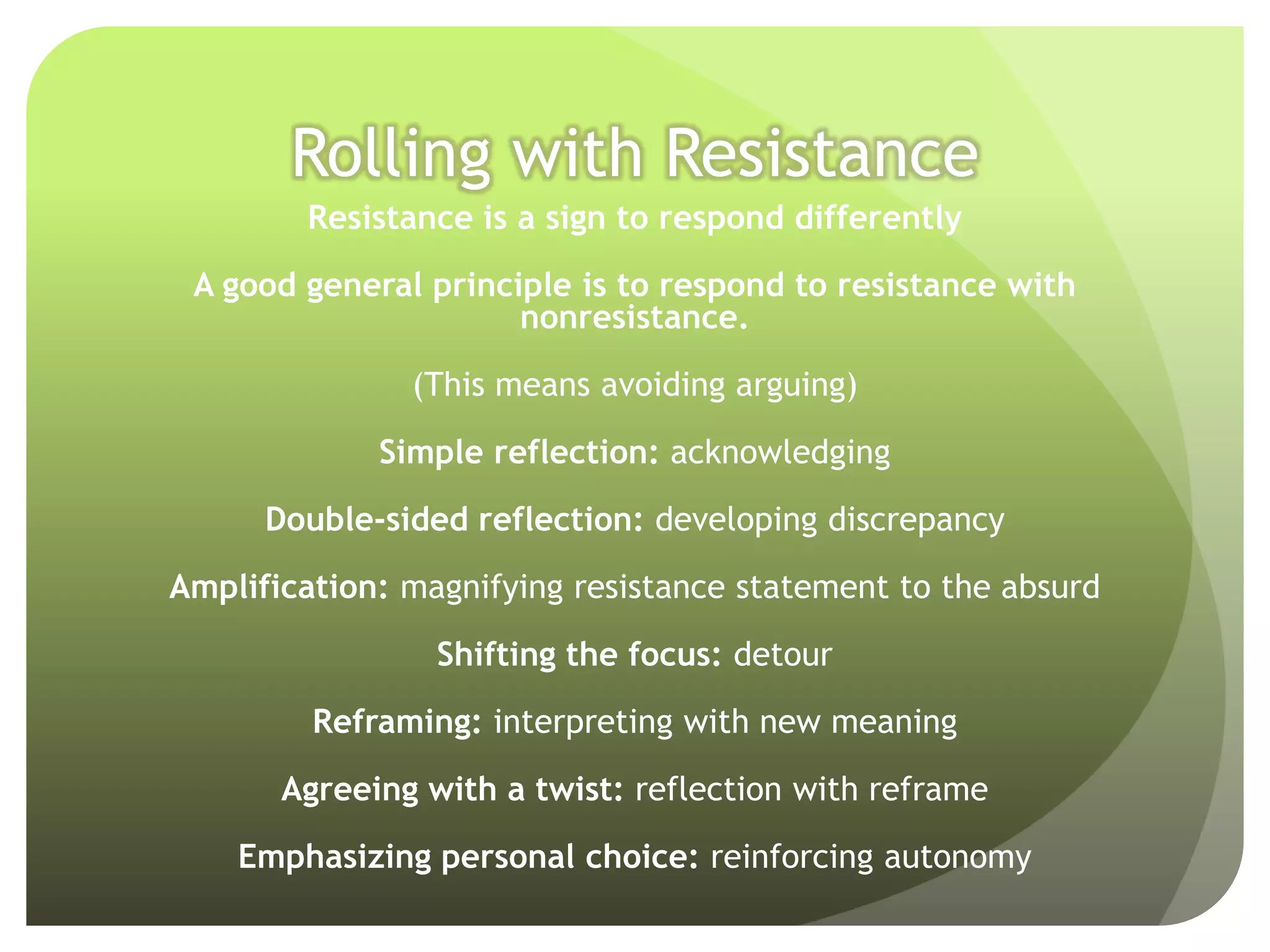
Rolling with Resistance
        Resistance is a sign to respond differently

 A good general principle is to respond to resistance with
                      nonresistance.

               (This means avoiding arguing)

             Simple reflection: acknowledging

      Double-sided reflection: developing discrepancy

Amplification: magnifying resistance statement to the absurd

                 Shifting the focus: detour

         Reframing: interpreting with new meaning

       Agreeing with a twist: reflection with reframe

    Emphasizing personal choice: reinforcing autonomy
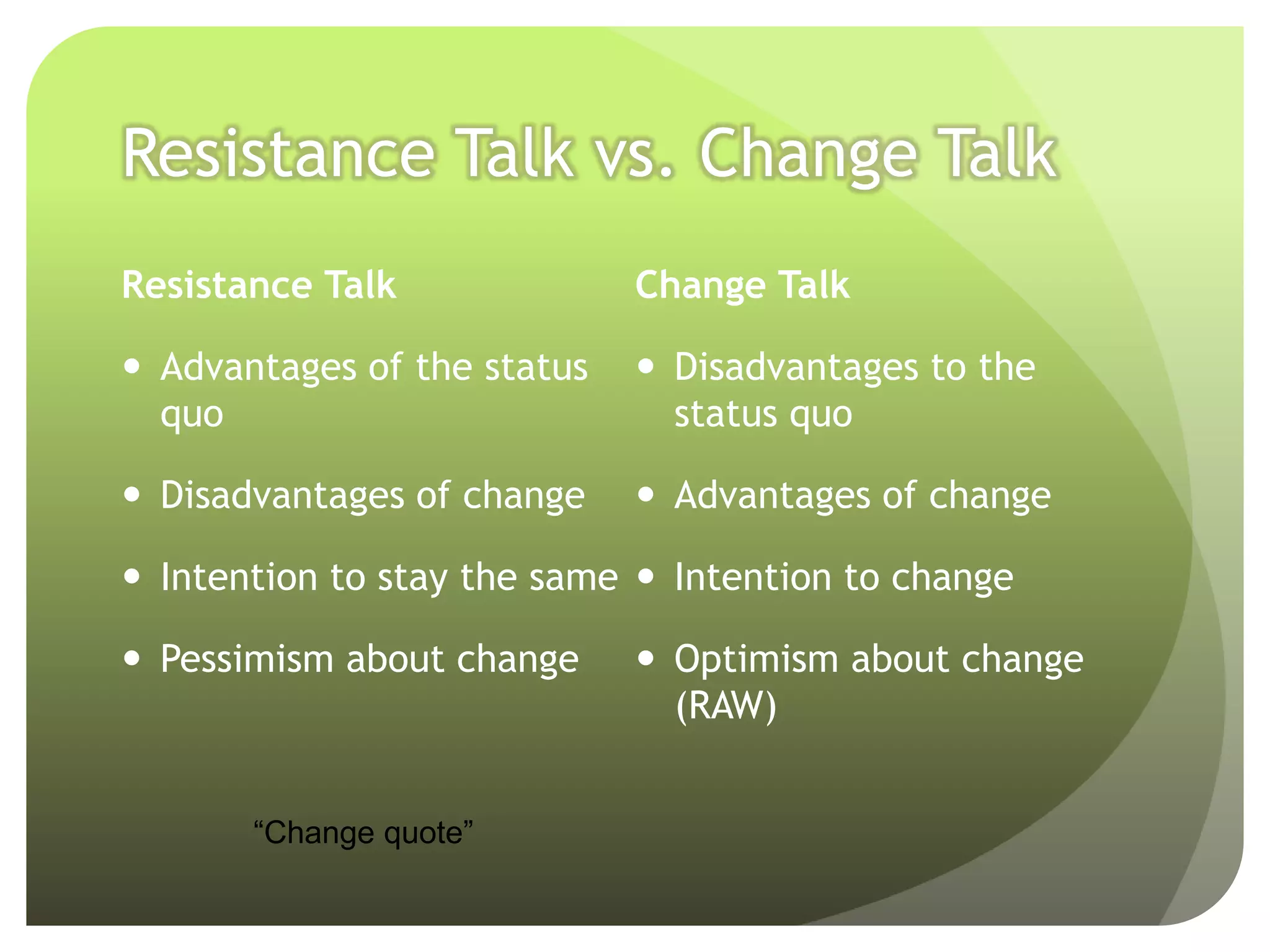
Resistance Talk vs. Change Talk
Resistance Talk              Change Talk

 Advantages of the status    Disadvantages to the
  quo                          status quo

 Disadvantages of change     Advantages of change

 Intention to stay the same  Intention to change

 Pessimism about change      Optimism about change
                               (RAW)


       “Change quote”
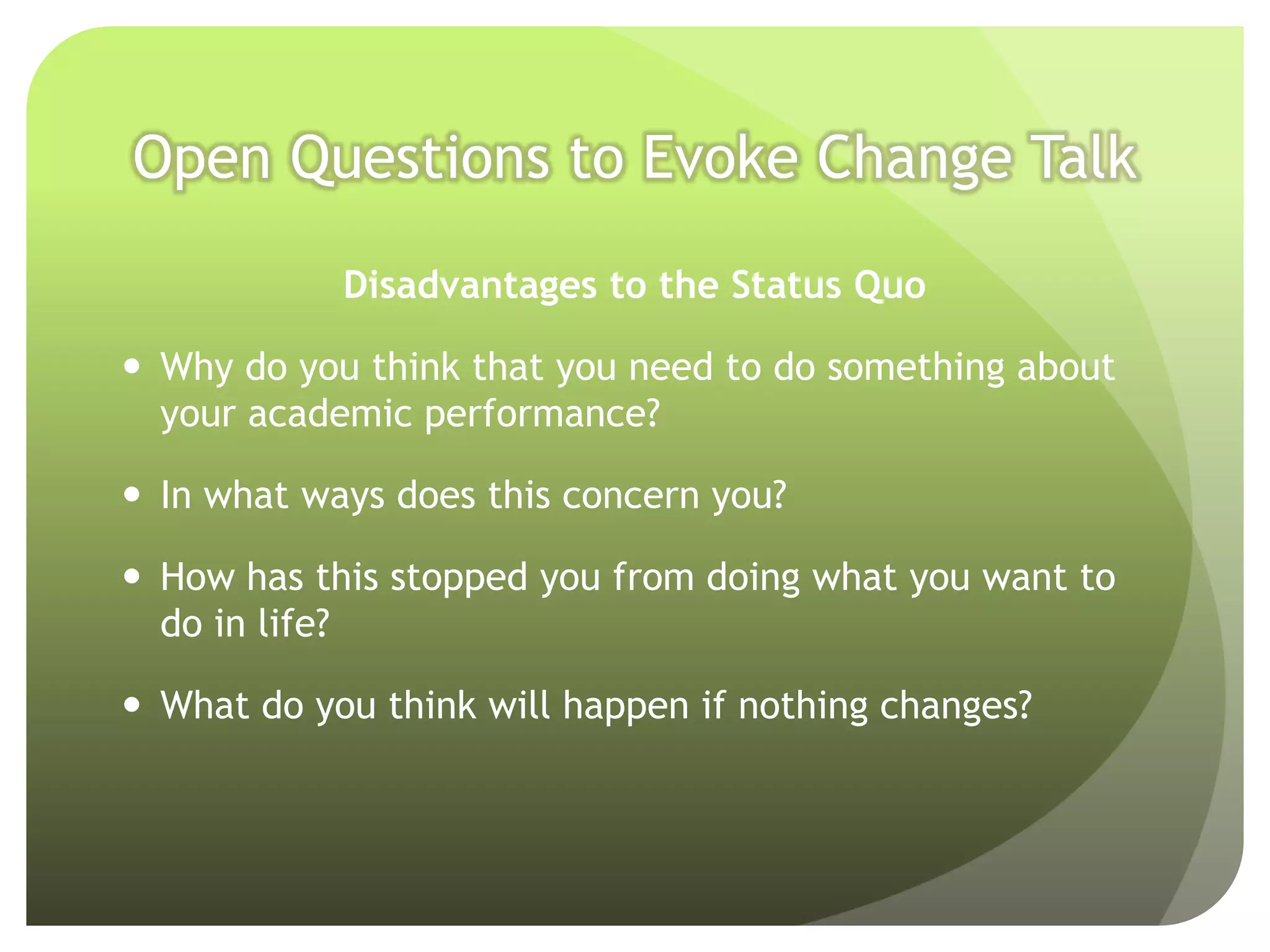
Open Questions to Evoke Change Talk

            Disadvantages to the Status Quo

 Why do you think that you need to do something about
  your academic performance?

 In what ways does this concern you?

 How has this stopped you from doing what you want to
  do in life?

 What do you think will happen if nothing changes?
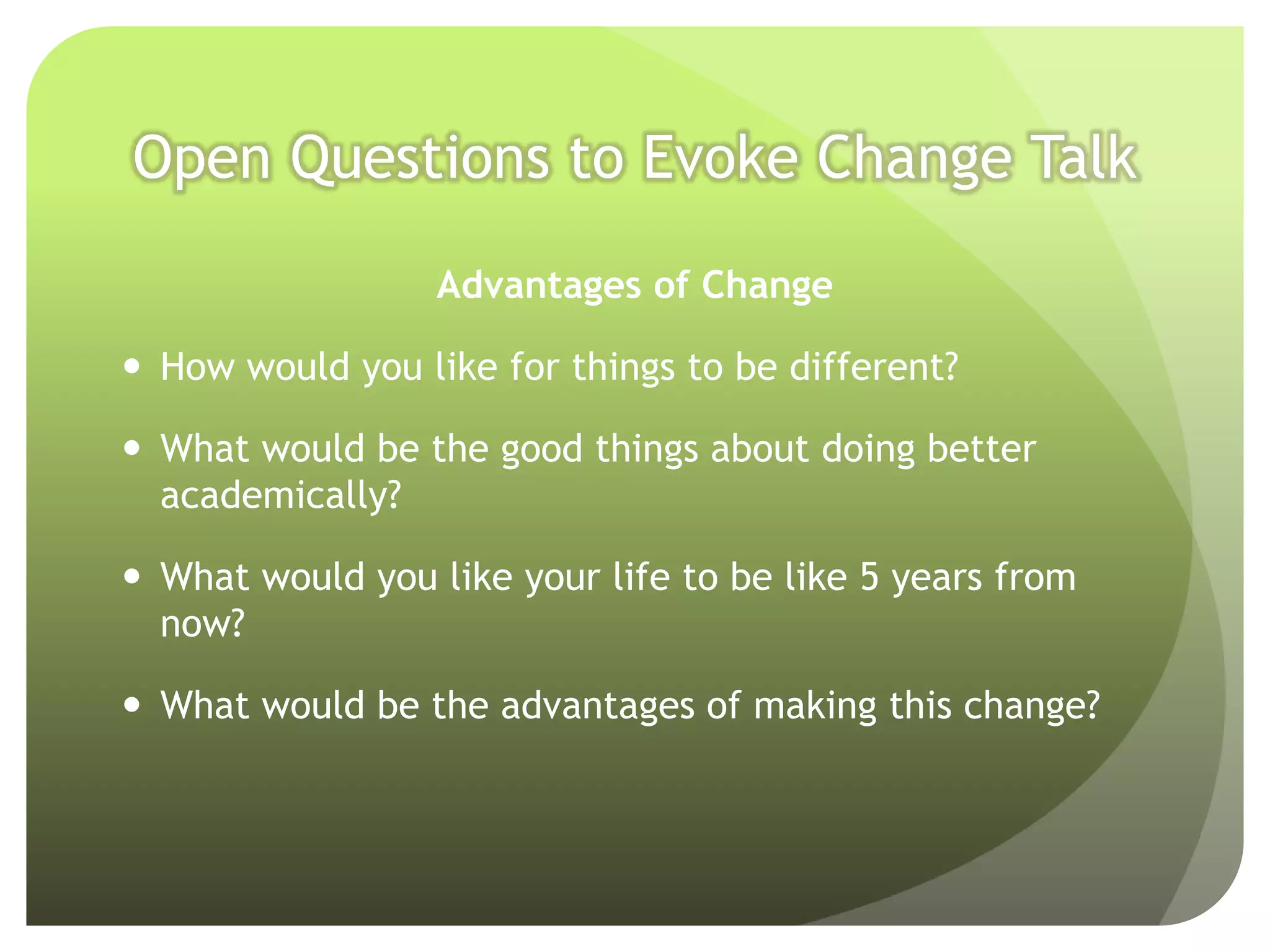
Open Questions to Evoke Change Talk

                  Advantages of Change

 How would you like for things to be different?

 What would be the good things about doing better
  academically?

 What would you like your life to be like 5 years from
  now?

 What would be the advantages of making this change?
Open Questions to Evoke Change Talk

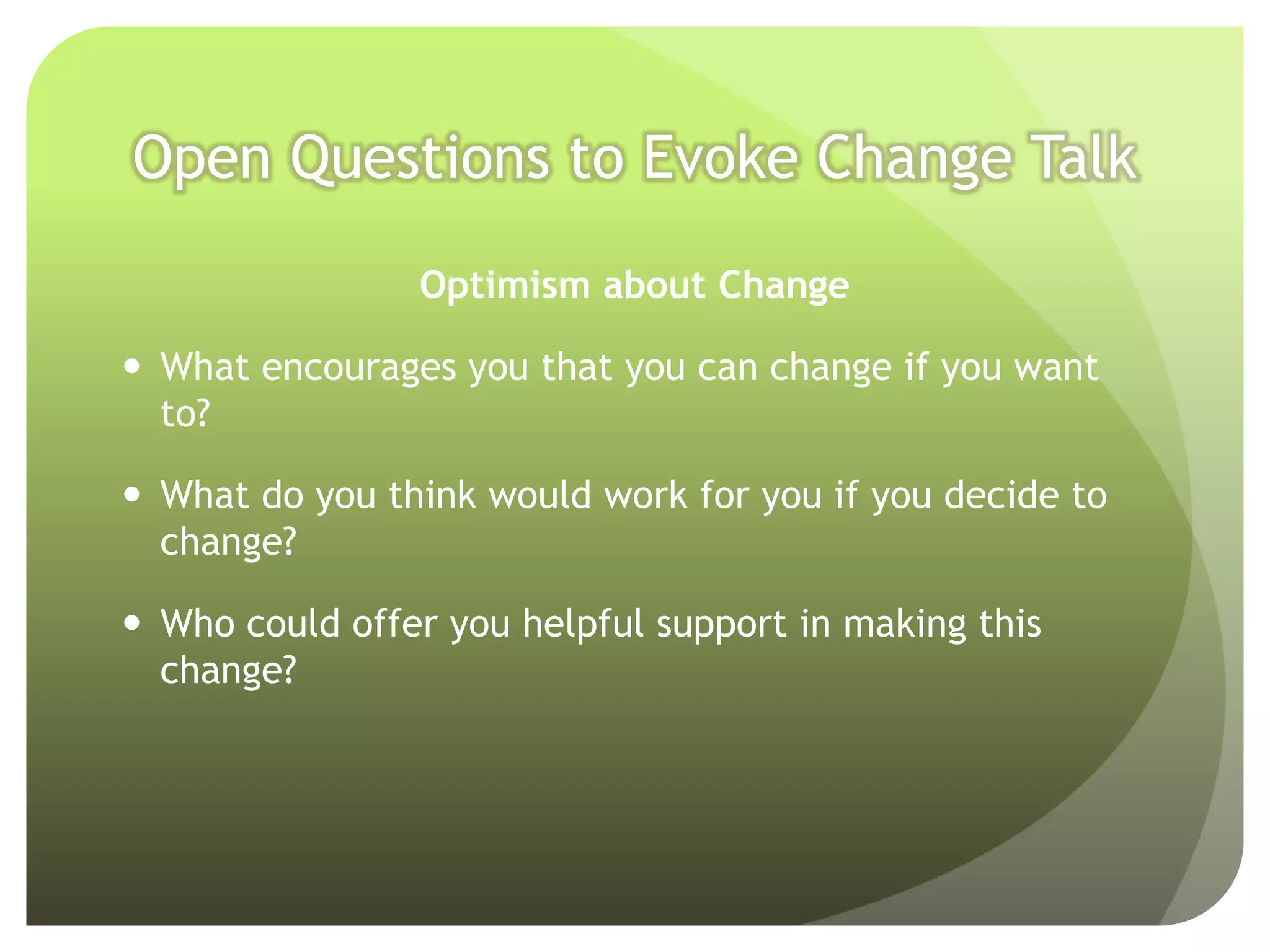
                Optimism about Change

 What encourages you that you can change if you want
  to?

 What do you think would work for you if you decide to
  change?

 Who could offer you helpful support in making this
  change?
Open Questions to Evoke Change Talk
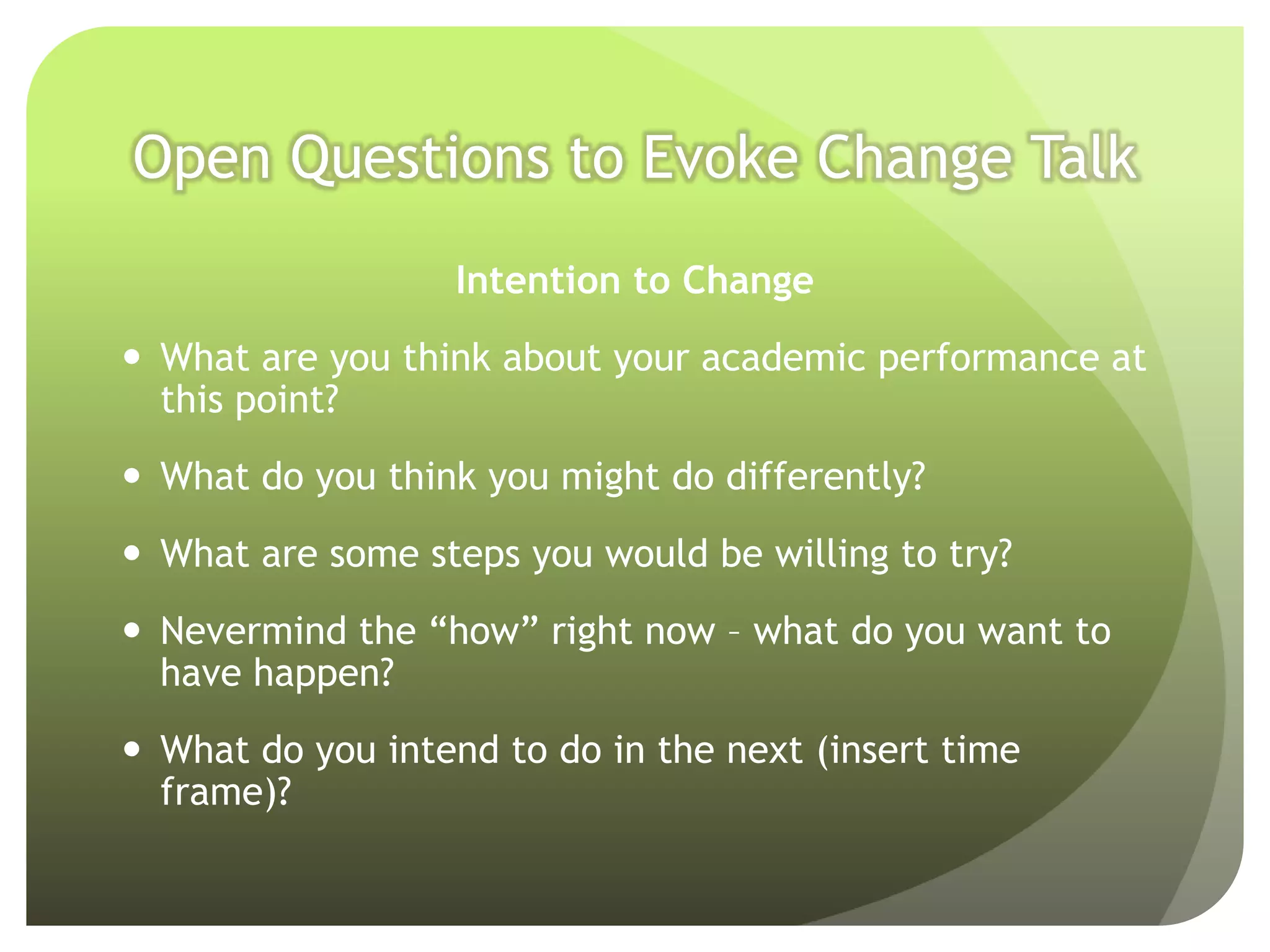
                  Intention to Change
 What are you think about your academic performance at
  this point?
 What do you think you might do differently?
 What are some steps you would be willing to try?
 Nevermind the “how” right now – what do you want to
  have happen?
 What do you intend to do in the next (insert time
  frame)?
Reflection Time
 How confident are you that you can make a change?

What personal strengths do you have that will help you
                      succeed?
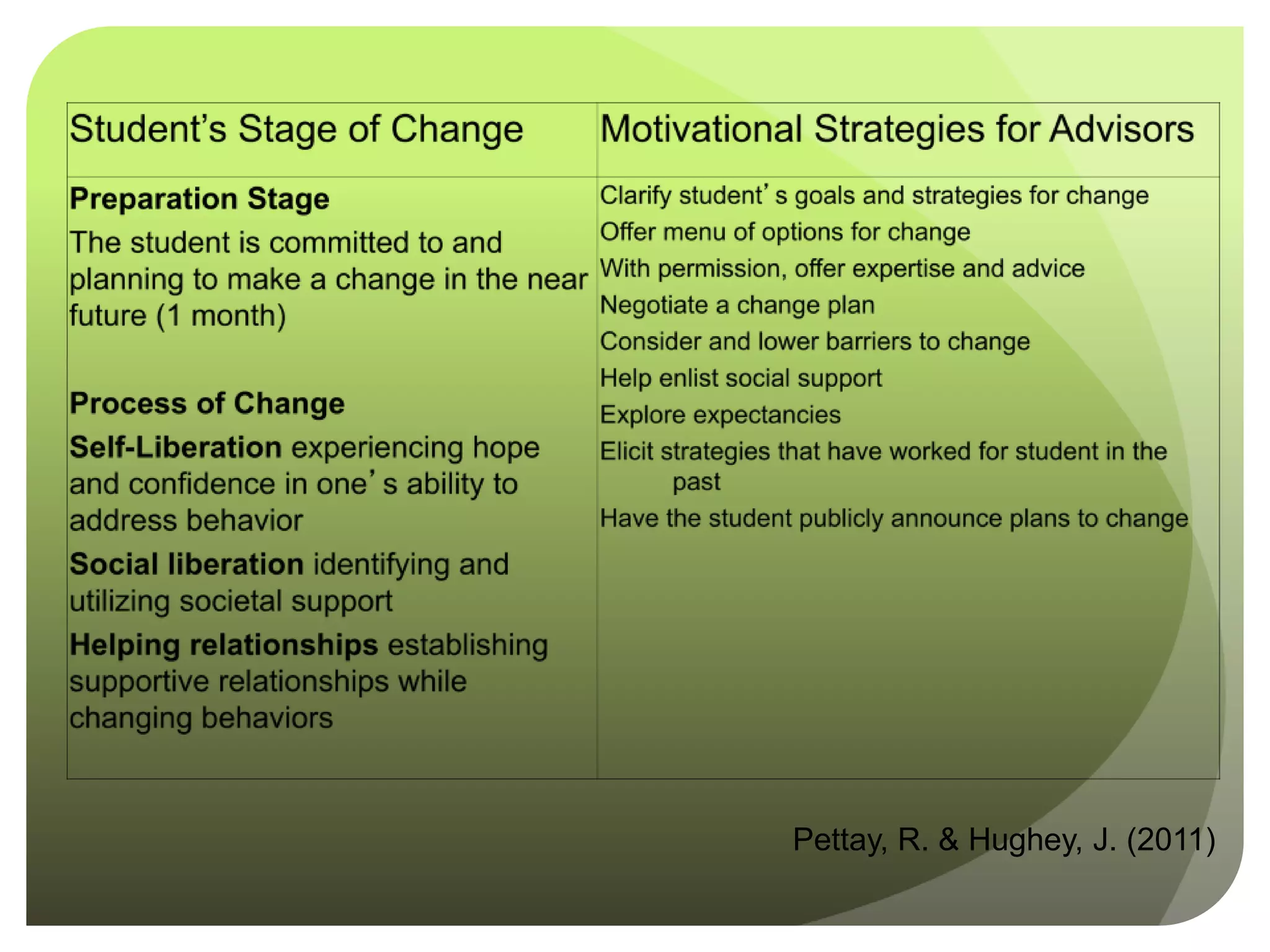
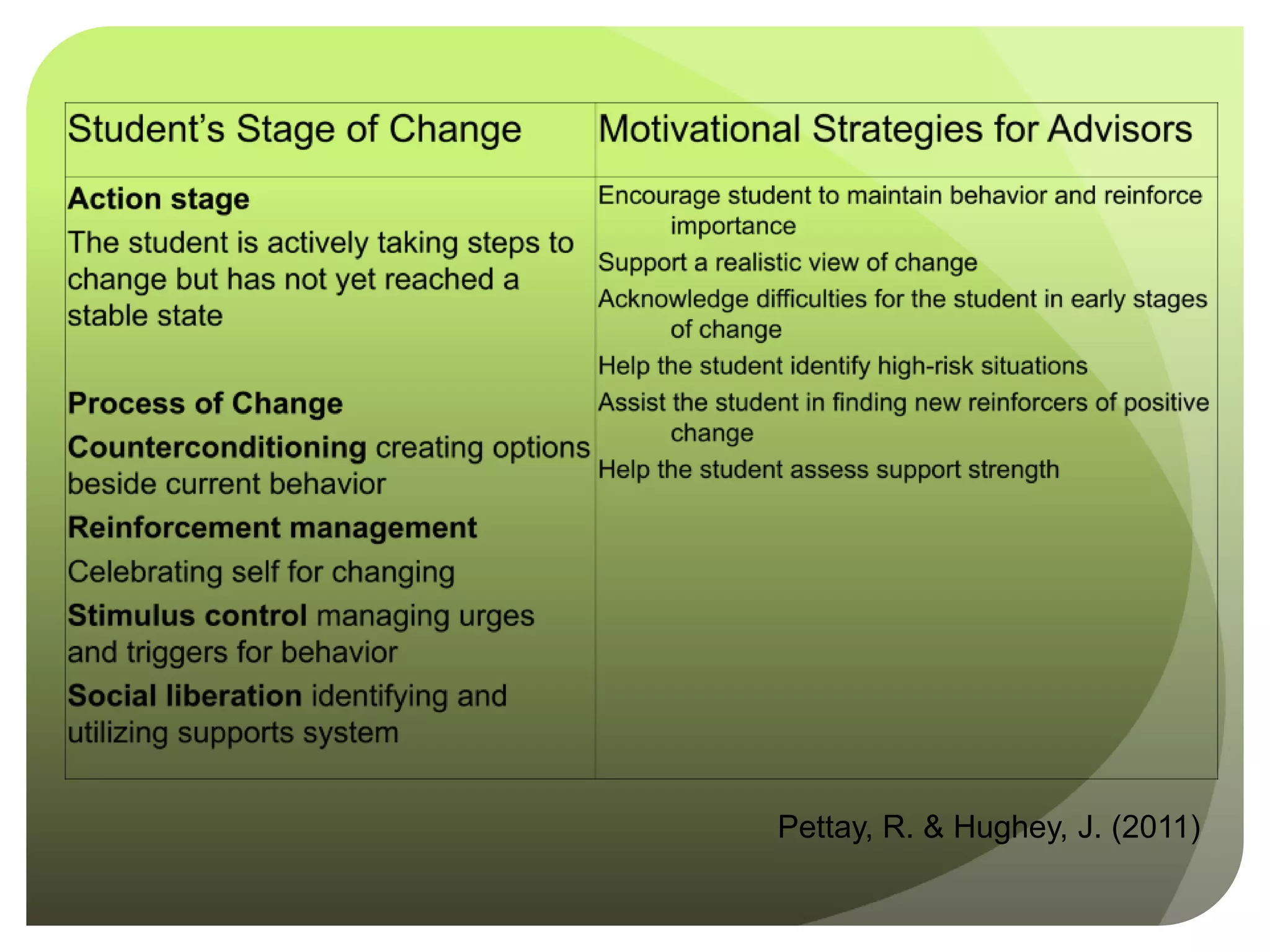
Pettay, R. & Hughey, J. (2011)
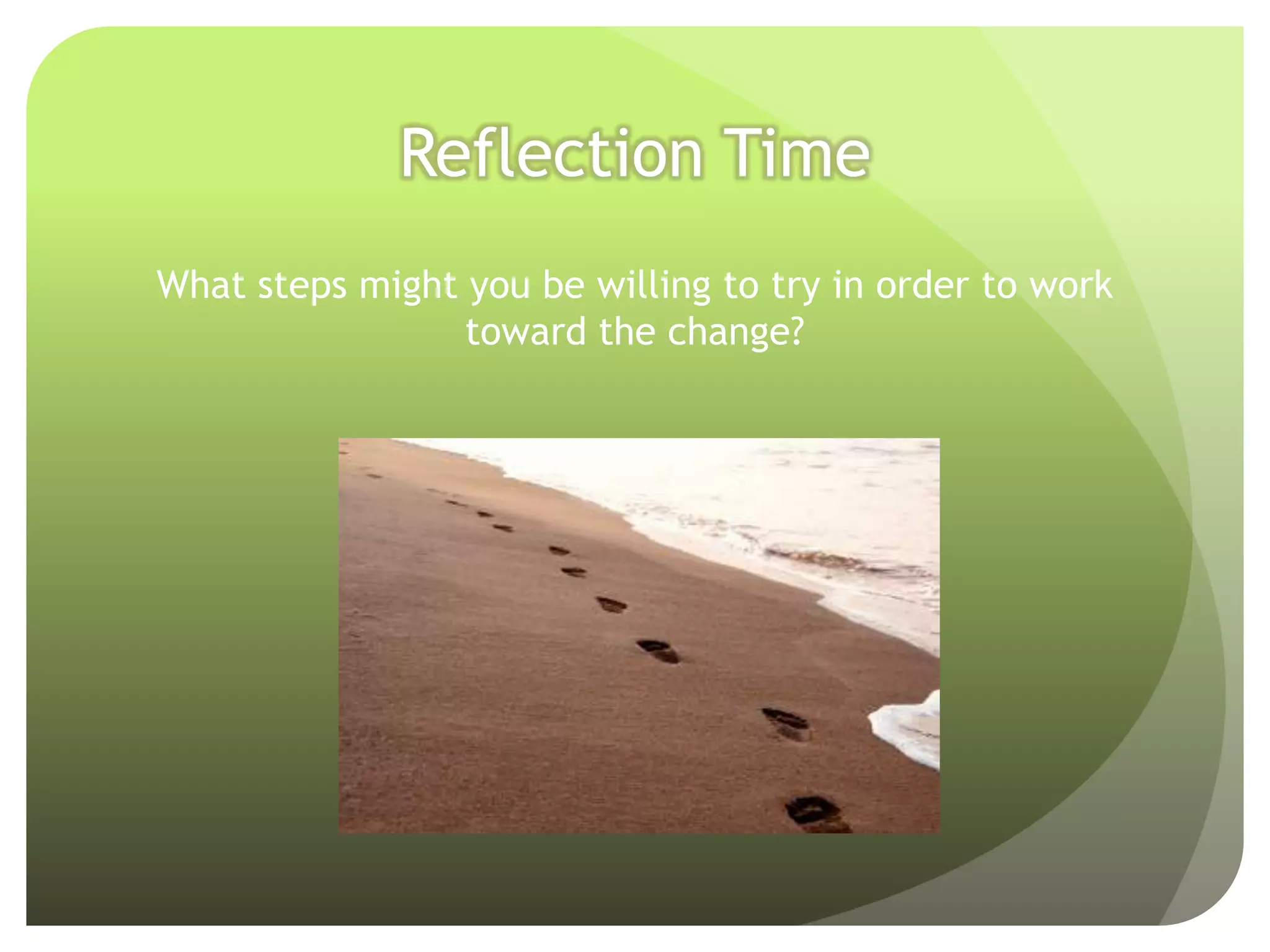
Reflection Time
What steps might you be willing to try in order to work
                 toward the change?
Discussion
 In pairs

 Throw a resistance statement to your partner

 Partner will practice an MI technique (amplified
  reflection, double-sided reflection, reframe, etc)

 Then, discuss potential applications for your program or
  office
References
DiClemente, C.C., & Prochaska, J.O. (1985). Processes and
      stages of change: Coping and competence in
      smoking behavior change. In S.       Shiffman &
      T.A. Wills (Eds.), Coping and Substance Abuse (pp.
      319-343). San Diego, CA: Academic Press.

Miller, W.R. & Rollnick, S. (2002). Motivational interviewing:
        Preparing people for change (2nd ed.). New York:
        Guilford Press.

Pettay, R. & Hughey, J. (2011). A mountain to climb: Strategies
        for working with probationary students. PowerPoint
        lecture presented at NACADA Conference, October 2011.

Motivational Interviewing

  • 1.
    Rolling with Resistance UsingMotivational Interviewing with Probationary Students Sarah McKay, M.Ed; Academic Advisor for UGS
  • 2.
    Discussion Goals  Historyand techniques of Motivational Interviewing (M.I.)  Discuss stages of change for probationary students  Discuss potential application of M.I. style
  • 3.
    Reflection Time Thinkof one situation in your life that you’re considering changing, but haven’t taken action yet (write it down) (Don’t worry, you’re not being asked to share!) What worries you about your current situation?
  • 4.
    Forced Behavior Change Students placed on probation are being told by UT Austin that the need to change in a limited amount of time/credit hours  Factors contributing to academic difficulty:  Adjustment to UT expectations  Home/family issues  Study skills  Lack of effective time mangement  Lacking academic goals or future plans  Physical/mental illness  Inadequate finances  Many more!
  • 5.
    M.I.: What isit? A “directive, client-centered, counseling style for eliciting behavior change by helping clients explore and resolve ambivalence” “Motivational interviewing has one leading in a way that is subtle, gentle, responsive, and imaginative.” (Miller and Rollnick, 1991 & 2002)
  • 6.
    General Principles ofM.I. 1. Express empathy and active listening: use of open- ended questions, assess readiness to change 2. Develop discrepancy: allow students to provide arguments for change, use affirmation, transitional summary, and key questions 3. Roll with resistance: avoid arguing for change; use reflective listening and provide information 4. Support self-efficacy: work on belief for change, use summaries and work on negotiating a change plan
  • 7.
    The Spirit ofM.I.  Collaboration  Partnership, asking permission from student  Evocation  “Intrinsic motivation for change is enhanced by drawing on the [student’s] own perceptions, goals, and values” (Miller and Rollnick, 2002)  Autonomy  Student has the right to make decisions (regardless of the advisor’s opinions)
  • 8.
    M.I. Research andApplication  Historically, M.I. has been researched and used in health behavior change programs:  Smoking cessation  Weight loss  Addiction and substance abuse  Disease management/adherence to treatment
  • 9.
    Stages of Change: Transtheoretical Model  Change is a progression; series of decisions rather than one move Stages:  Precontemplation**  Contemplation**  Preparation  Action  Maintenance (DiClemente & Prochaska, 1985)
  • 10.
    Reflection Time What would be the advantages of making a change? If you could magically fix the problem immediately, how might things be better for you? Dumbledore, preparing to get all magical on your problem
  • 11.
    Ambivalence “I want to change, and I don’t want to change.”  Ambivalence is normal, but it keeps us stuck! Tools: Decisional balance sheet  Weighs the benefits/costs of status quo, costs/benefits of change
  • 12.
    M.I.: Arguing forChange M.I. will:  Increase student change talk  Diminish student resistance talk What makes you feel defensive?  More time student spends defending the status quo = More likely to stay the same  More time student spends arguing for change = More likely to change behavior
  • 13.
    RAW Is now the right Ready: time? Priorities! Can I do this? Able: Confidence! What’s most Willing: important to me? Importance! “Change starts when someone sees the next step.” -William Drayton
  • 14.
    Clarifying Goals andValues  Identifying issues important to the student  Highlighting intrinsic motivation rather than extrinsic  Change more likely to happen if it comes from inside  Tool: Importance Ruler “Change will not come if we wait for some other person, or if we wait for some other time. We are the ones we've been waiting for. We are the change that we seek.” ― Barack Obama
  • 15.
    Reflection Time How important is your issue to you, on a scale from 1 to 10? 1=not important at all 10=the most important *The Importance Ruler*
  • 16.
    Rolling with Resistance Resistance is a sign to respond differently A good general principle is to respond to resistance with nonresistance. (This means avoiding arguing) Simple reflection: acknowledging Double-sided reflection: developing discrepancy Amplification: magnifying resistance statement to the absurd Shifting the focus: detour Reframing: interpreting with new meaning Agreeing with a twist: reflection with reframe Emphasizing personal choice: reinforcing autonomy
  • 17.
    Resistance Talk vs.Change Talk Resistance Talk Change Talk  Advantages of the status  Disadvantages to the quo status quo  Disadvantages of change  Advantages of change  Intention to stay the same  Intention to change  Pessimism about change  Optimism about change (RAW) “Change quote”
  • 18.
    Open Questions toEvoke Change Talk Disadvantages to the Status Quo  Why do you think that you need to do something about your academic performance?  In what ways does this concern you?  How has this stopped you from doing what you want to do in life?  What do you think will happen if nothing changes?
  • 19.
    Open Questions toEvoke Change Talk Advantages of Change  How would you like for things to be different?  What would be the good things about doing better academically?  What would you like your life to be like 5 years from now?  What would be the advantages of making this change?
  • 20.
    Open Questions toEvoke Change Talk Optimism about Change  What encourages you that you can change if you want to?  What do you think would work for you if you decide to change?  Who could offer you helpful support in making this change?
  • 21.
    Open Questions toEvoke Change Talk Intention to Change  What are you think about your academic performance at this point?  What do you think you might do differently?  What are some steps you would be willing to try?  Nevermind the “how” right now – what do you want to have happen?  What do you intend to do in the next (insert time frame)?
  • 22.
    Reflection Time Howconfident are you that you can make a change? What personal strengths do you have that will help you succeed?
  • 23.
    Pettay, R. &Hughey, J. (2011)
  • 24.
    Pettay, R. &Hughey, J. (2011)
  • 25.
    Pettay, R. &Hughey, J. (2011)
  • 26.
    Pettay, R. &Hughey, J. (2011)
  • 27.
    Reflection Time What stepsmight you be willing to try in order to work toward the change?
  • 28.
    Discussion  In pairs Throw a resistance statement to your partner  Partner will practice an MI technique (amplified reflection, double-sided reflection, reframe, etc)  Then, discuss potential applications for your program or office
  • 29.
    References DiClemente, C.C., &Prochaska, J.O. (1985). Processes and stages of change: Coping and competence in smoking behavior change. In S. Shiffman & T.A. Wills (Eds.), Coping and Substance Abuse (pp. 319-343). San Diego, CA: Academic Press. Miller, W.R. & Rollnick, S. (2002). Motivational interviewing: Preparing people for change (2nd ed.). New York: Guilford Press. Pettay, R. & Hughey, J. (2011). A mountain to climb: Strategies for working with probationary students. PowerPoint lecture presented at NACADA Conference, October 2011.

Editor's Notes

  • #2 Welcome!Introduce myself (CSA Advisor) and topicMaster’s in counselingMy background with MI – structured research project
  • #4 My friends joke with me that I need a lot of buffer/quiet time, so it wouldn’t be a presentation of mine if it didn’t include some introspection!We’ll be coming back to this throughout the presentation, and I’ll be asking you some questions that are in line with the MI style to give you a sense of what it’s like to answer those types of questions.
  • #5 The idea is that there are many factors that might impact a student’s academic standing, and so lots of different kinds of changes to be made (flexibility)
  • #6 We get stuck when there are two (or more) options/approaches that we can see working. We lose sight of what’s (really) important to us and become paralyzed. What does ambivalence look like with our students?(Note: ambivalence is normal!MI is used to propel a student out of ambivalence (feeling two ways about something).
  • #8 In line with developmental advising: we’re building a relationship and forming a partnership (rather than prescriptive advising).Shared responsibility; in MI, this manifests in simply asking permission (ex with our scho pro documents).Identifying student’s goals and values – what’s important to YOU, and how does that compare to what people are telling you/what you are doing right now?I might not like the decisions the student makes! And that’s ok!
  • #9 My background with binge drinking college students
  • #10 One issue that impacts the process is where the student is in the change process.Transtheoretical model of intentional behavior changePrecontemplation: behavior is not a problem, not considering change; often labeled “resistant.” Not convinced that the negative aspects of the current or problem behavior outweigh the positive. When faced with forced change: Reluctant, rebellious, resignation, rationalization (4 R’s)Contemplation: acknowledge possibility of need for change; far from making a commitment to action, but is weighing options and gathering information. Hopeful, but the most ambivalence in this stage (paradox)Preparation: making a decision to change; developing action stepsAction: following through. Even the action stage is fragile and tenuous; can “relapse”
  • #12 Decisional balance sheet, aka “Pro/con list” for us n00by types-Example of structuring conversation: when talking about status quo, let’s end on the costs (or negative);
  • #13 Question: what makes you feel defensive?MI is used to help propel a student out of ambivalenceIncreasing change talk: the more I talk about doing something, the more likely I am to do it.The more time I spend defending something, the less likely I am to change.
  • #14 In order for change to occur, a student must be RAW.When listening for change talk, listen for a student referring to these three areas(I’m ready, I’m confident in my ability, I want to change)
  • #17 What are some examples of resistance that you’ve seen? What’s our natural response when that happens?
  • #29 Remember, a resistance statement could be arguing for status quo, resistance to change, intention to stay the same, lack of confidence in ability to change.