Ganesh Naik
Dileep Masanakatti
Bharath.R
The Nature of Motivation
• Motivation
– The set of forces that cause people to behave in certain
ways.
– The goal of managers is to maximize desired behaviors and
minimize undesirable behaviors.

• The Importance of Motivation in the Workplace
– Determinants of Individual Performance
• Motivation—the desire to do the job.
• Ability—the capability to do the job.
• Work environment—the resources to do the job

– P = M + A + E when:
P = performance
A = ability

M= motivation
E = environment
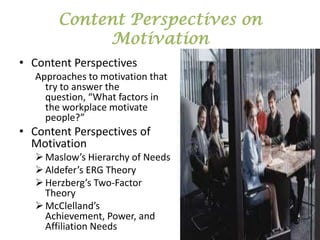
Content Perspectives on
Motivation
• Content Perspectives
Approaches to motivation that
try to answer the
question, “What factors in
the workplace motivate
people?”

• Content Perspectives of
Motivation
 Maslow’s Hierarchy of Needs
 Aldefer’s ERG Theory
 Herzberg’s Two-Factor
Theory
 McClelland’s
Achievement, Power, and
Affiliation Needs
Process Perspectives on Motivation
• Process Perspectives
Approaches to motivation that focus on:
• Why people choose certain behavioral options to satisfy their
needs
• How they evaluate their satisfaction after they have attained their
goals.

• Process Perspectives of Motivation
 Expectancy Theory
 Porter-Lawler Extension of Expectancy
Theory
 Equity Theory
 Goal-Setting Theory
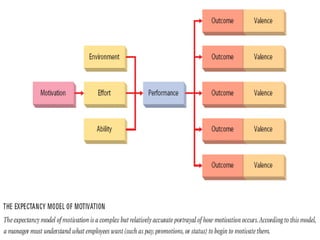
Vroom’s Expectancy Theory
 Motivation depends on how much we want something and
how likely we are to get it.
 Assumes that:
• Behavior is determined by personal and environmental
forces.
• People make decisions about their behavior in
organizations.
• People have different types of needs, desires, and goals.
• People choose among alternatives of behaviors in selecting
one that that leads to a desired outcome.
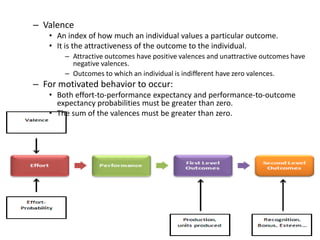
• Motivation leads to effort that, when combined with ability
and environmental factors, results in performance which
leads to various outcomes that have value (valence) to
employees.
Elements of Expectancy Theory
– Effort-to-Performance Expectancy
• The employee’s perception of the probability
that effort will lead to a high level of
performance.

– Performance-to-Outcome Expectancy
• The employee’s perception of the probability
that performance will lead to a specific
outcome—the consequence or reward
for behaviors in an organizational setting.
– Valence
• An index of how much an individual values a particular outcome.
• It is the attractiveness of the outcome to the individual.
– Attractive outcomes have positive valences and unattractive outcomes have
negative valences.
– Outcomes to which an individual is indifferent have zero valences.

– For motivated behavior to occur:
• Both effort-to-performance expectancy and performance-to-outcome
expectancy probabilities must be greater than zero.
• The sum of the valences must be greater than zero.
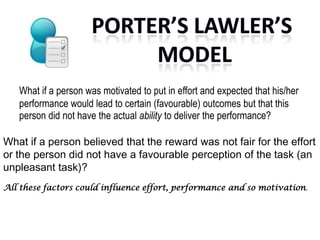
What if a person was motivated to put in effort and expected that his/her
performance would lead to certain (favourable) outcomes but that this
person did not have the actual ability to deliver the performance?
What if a person believed that the reward was not fair for the effort
or the person did not have a favourable perception of the task (an
unpleasant task)?
All these factors could influence effort, performance and so motivation.
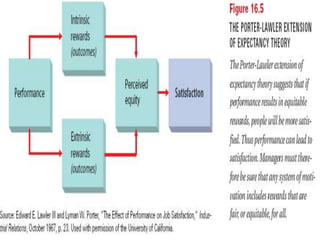
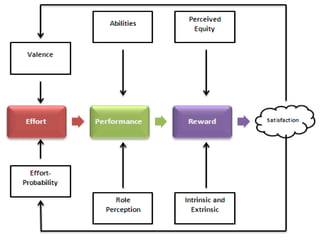
Porter-Lawler Extension of
Expectancy
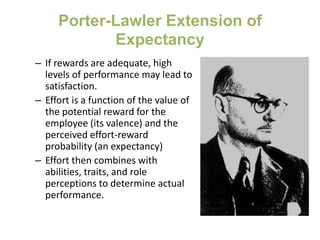
– If rewards are adequate, high
levels of performance may lead to
satisfaction.
– Effort is a function of the value of
the potential reward for the
employee (its valence) and the
perceived effort-reward
probability (an expectancy)
– Effort then combines with
abilities, traits, and role
perceptions to determine actual
performance.
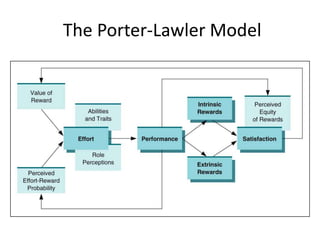
The Porter-Lawler Model
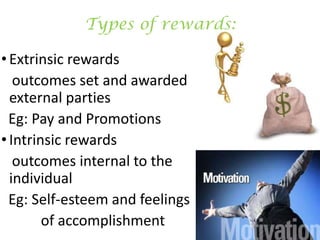
Types of rewards:
• Extrinsic rewards
outcomes set and awarded by
external parties
Eg: Pay and Promotions
• Intrinsic rewards
outcomes internal to the
individual
Eg: Self-esteem and feelings
of accomplishment
motivation model
motivation model
motivation model
motivation model

motivation model

  • 1.
  • 2.
    The Nature ofMotivation • Motivation – The set of forces that cause people to behave in certain ways. – The goal of managers is to maximize desired behaviors and minimize undesirable behaviors. • The Importance of Motivation in the Workplace – Determinants of Individual Performance • Motivation—the desire to do the job. • Ability—the capability to do the job. • Work environment—the resources to do the job – P = M + A + E when: P = performance A = ability M= motivation E = environment
  • 4.
    Content Perspectives on Motivation •Content Perspectives Approaches to motivation that try to answer the question, “What factors in the workplace motivate people?” • Content Perspectives of Motivation  Maslow’s Hierarchy of Needs  Aldefer’s ERG Theory  Herzberg’s Two-Factor Theory  McClelland’s Achievement, Power, and Affiliation Needs
  • 5.
    Process Perspectives onMotivation • Process Perspectives Approaches to motivation that focus on: • Why people choose certain behavioral options to satisfy their needs • How they evaluate their satisfaction after they have attained their goals. • Process Perspectives of Motivation  Expectancy Theory  Porter-Lawler Extension of Expectancy Theory  Equity Theory  Goal-Setting Theory
  • 6.
    Vroom’s Expectancy Theory Motivation depends on how much we want something and how likely we are to get it.  Assumes that: • Behavior is determined by personal and environmental forces. • People make decisions about their behavior in organizations. • People have different types of needs, desires, and goals. • People choose among alternatives of behaviors in selecting one that that leads to a desired outcome. • Motivation leads to effort that, when combined with ability and environmental factors, results in performance which leads to various outcomes that have value (valence) to employees.
  • 7.
    Elements of ExpectancyTheory – Effort-to-Performance Expectancy • The employee’s perception of the probability that effort will lead to a high level of performance. – Performance-to-Outcome Expectancy • The employee’s perception of the probability that performance will lead to a specific outcome—the consequence or reward for behaviors in an organizational setting.
  • 8.
    – Valence • Anindex of how much an individual values a particular outcome. • It is the attractiveness of the outcome to the individual. – Attractive outcomes have positive valences and unattractive outcomes have negative valences. – Outcomes to which an individual is indifferent have zero valences. – For motivated behavior to occur: • Both effort-to-performance expectancy and performance-to-outcome expectancy probabilities must be greater than zero. • The sum of the valences must be greater than zero.
  • 10.
    What if aperson was motivated to put in effort and expected that his/her performance would lead to certain (favourable) outcomes but that this person did not have the actual ability to deliver the performance? What if a person believed that the reward was not fair for the effort or the person did not have a favourable perception of the task (an unpleasant task)? All these factors could influence effort, performance and so motivation.
  • 11.
    Porter-Lawler Extension of Expectancy –If rewards are adequate, high levels of performance may lead to satisfaction. – Effort is a function of the value of the potential reward for the employee (its valence) and the perceived effort-reward probability (an expectancy) – Effort then combines with abilities, traits, and role perceptions to determine actual performance.
  • 12.
  • 13.
    Types of rewards: •Extrinsic rewards outcomes set and awarded by external parties Eg: Pay and Promotions • Intrinsic rewards outcomes internal to the individual Eg: Self-esteem and feelings of accomplishment