Motivation
Motivation
Motivation
Motivation
Motivation
Motivation
Motivation
Motivation
Motivation
Motivation
Motivation
Motivation
Motivation
Motivation
Motivation
Motivation
Motivation
Motivation
Motivation
Motivation
Motivation
Motivation
Motivation
Motivation
Motivation
Motivation

Editor's Notes

  • #2 Some people are content to sit and watch life pass them by, while others seem to need far more out of life. Some people want to do great things, while others are happy with more ordinary lives. What motivates people to do the things they do? DNB residents What exactly is motivation?
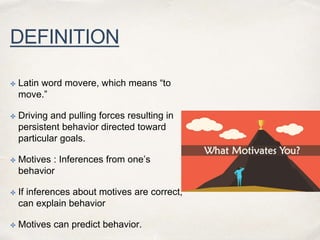
  • #4 Motivation is what “moves” people to do the things they do. For example, when a person is relaxing in front of the television and begins to feel hungry, the physical need for food might cause the person to get up, go into the kitchen, and search for something to eat. The physical need of hunger caused the action (getting up), directed it (going to the kitchen), and sustained the search (finding or preparing something to eat). Hunger is only one example, of course From basic need of hunger to complicated demands of life all is determined by one’s motivation. These examples show us that behavior is driven and pulled toward goals. We need a term to refer to the driving and pulIing forces which result in persistent behavior directed toward particular goals. The term is motivation. An important characteristic 'of motives is that we never observe tht;m directly. We infer their existence from what people say about the way they feel and from observing that people work toward certain goals. In other words, motives are inferences from behavior (the things that are said and done). For example, we might observe that a student works hard at almost every task that comes along; from this, we might infer a motive to achieve-to master challenges, Why are you in college? The answer is usually given in terms of your motivation. You are there because you want to learn,_because you feel that you need a college degree to get a good job, because it is a good place to make friends and "connections" that you desire, or, perhaps, because it's more fun than working for a living. infer motives from a sample of a person's behavior, and if our inferences are correct, we can make predictions aboUt what that person will do in the future. A person who seeks to hurt others will express hostility in many different situations; a person who needs the company of others will seek it in many situations.
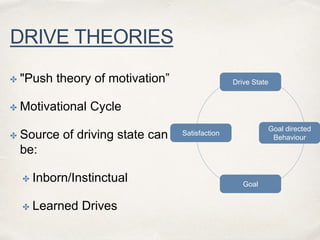
  • #6 "push theories of motivation” behavior is "pushed" toward goals by driving states within the person When an internal driving state is aroused, the individual is pushed to engage in behavior which will lead to a goal that reduces the intensity of the driving state. In human beings, at least, reaching the appropriate goal which reduces the drive state is pleasurable and satisfying. This sequence is also termed as motivational cycle Drive theories differ on the source of the driving state which impels people to action. Some theorists, Freud included, conceived of the driving state as being inborn, or instinctive. Other drive theorists have emphasized the role of learning in the origin of driving states. Such learned drives, as they called them, originate in the person's past experience thus differ from one individual to another a heroin addict, for example, develops a drive to get the substance and'is therefore pushed in that direction. And in the realm of human social motives (), people are said to have learned drives for power, aggression, or achievement, to name just a few of the socialmotives. Such learned driving states become enduring characteristics of the particular person and push that person toward appropriate goals;
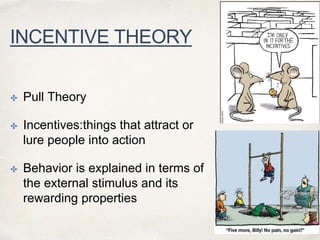
  • #7 In incentive approaches, behavior is explained in terms of the external stimulus and its rewarding properties goal-directed behavior of two groups of rats which have equivalent hunger drives; the rats in both groups have starved for a day. One group is given a very tasty food (chocolate-chip cookies, perhaps), while the other group gets plain old laboratory rat chow. As you might expect, the chocolate-chip group would probably eat far more than would the lab-chow group. There is something about the goal itself that motivates behavior. The goal objects which motivate behavior are known as incentives. An important part of many incentive theories is that individuals expect pleasure from the attainment of what are called positive incentives and from the avoidance of what are known as negative incentives.
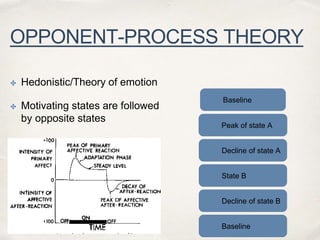
  • #8 say that we are motivated to seek goals which give us good emotional feelings and to avoid those resulting in displeasure So called Theory of emotion emotional-motivating states are followed by opposing, or opposite, states. Thus, as in the following example, feelings-of pleasure and happiness follow feelings of fear and dread. A woman at work discovers a lump in her breast and immediately is terrified. She sits still, intermittently weeping, or she paces the floor. After a few hours, she slowly regains her composure, stops crying, and begins work. At this point, she is still tense and disturbed, but no longer terrified and distracted. She manifests the symptoms usually associated with intense anxiety. While in this state she calls her doctor for an appointment. A few hours later she is at his office, still tense, still frightened: She is obviously a very unhappy woman. The doctor makes his examination. He then informs her that there is no possibiliry of cancer, that there is nothing to worry about, and that her proBlem is just a clogged sebaceous gland requiring no medical attention. A few minutes later, the woman leaves the doctor's office, smiling, greeting strangers, and walking with an unusually buoyant stride. Her euphoric mood permeates all her activities as she resumes her normal duties. She exudes joy, which is not in character for heL A few.hours later, however, she is working in her normal, way. Her emotional expression is back to normal.
  • #9 here is a certain optimal, or best, level of arousal that is pleasurable if arousal is too low, a person will seek situations or. stimuli to increase arousal; if arousal is too high, behavior will be directed toward decreasing it.
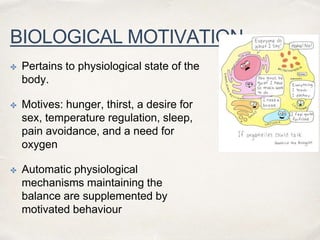
  • #10 rooted in the physiological state of the body. There are many such motives, including hunger, thirst, a desire for sex, tempernure regulation, sleep, pain avoidance, and a need for oxygen There are many such motives, including hunger, thirst, a desire for sex, tempernure regulation, sleep, pain avoidance, and a need for oxygen. For instance, falling temperature leads to motivated behavior-putting on a sweater, turning up the thermostat, closing the window,-'and so on. When the body lacks substances such as food and water, auromatic physiological processes go to work to conserve the substances that are lacking, but sooner or later water and food must be obtained from the outside. Here the departure from homeostasis creates a drive state that pushes (page 269) a person seek food and water.
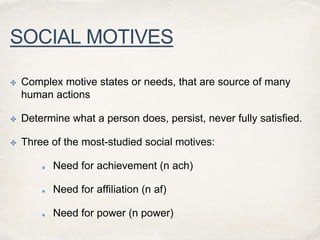
  • #11 complex motive states, or needs, that are the sources of many human actions. They are called social becal\se they are learned in social groups, especially in the family as children grow up, and because they usually involve other people Not only do they help to determine much of what a person does, they persist, never fully satisfied, over the years. No sooner is one goal reached than the motive is directed toward another one Three of the most-studied social motives: Need for achievement (nAch) Need for affiliation Need for power
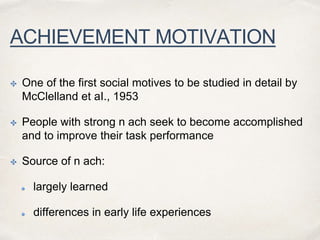
  • #12 one of the first social motives to be studied in detail (McClelland et aI., 1953), and research into this motive continues tod_y People in whom the need for achievement is strong seek to become accomplished and to improve their task performance. They are taskoriented and prefer to work on tasks that are challenging and on which their performance can be evaluated in some way, either by compann& it with other people's performance or in terms of some other standard. The Source of Achievement Motivation: Why are some people high in the need tor achievement? Since the social motives-including the need for achievement-are largely learned, differences in early life experiences lead to variations in the amount of achievement motivation More specifically, children learn by copying the behavior of their parents and other important people who serve as models. Through such observational learning (Bandura & Walters, 1963), children take on, or adopt, many characteristics of the model (Chapter 14, page 596), including the need for achievement if the model possesses this motive to a marked degree The expectations parents have for their children are also said t;; be important in the development of achievement motivation [Eccles (Parsons), 1983]. Parents who expect their children to work hard and to strive for success will encourage them to do so and praise them for achievementdirected behavior.
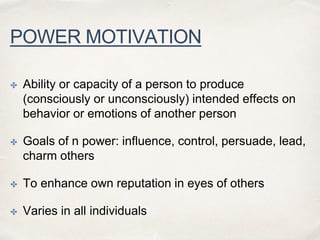
  • #13 Winter (1973, p. 5) has defined social power as "the ability or capacity of a person to produce (consciously or unconsciously) intended effects on the behavior or emotions of another person.” The goals of power motivation are to influence, control,, persuade, lead, charm others, and to enhance one's own reputation in the eyes of other people. People with strong power motivation derive satisfaction from achieving these goals. varies in strength from person to person
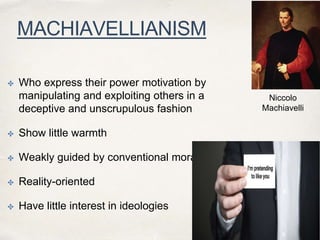
  • #14 Niccolo Machiavelli (1469-1527), in his book The Prince, gave some practical advice to rulers on how to maintain power. In brief, he said, rulers should outWardly follow the rules of conventional 'morality but secretly use craft and deceitful practices to maintain themselves in power describe people who express their power motivation by manipulating and exploiting others in a deceptive and unscrupulous fashion. Machiavellianism is not the same as power motivation; it refers to a particular strategy that some people, dubbed "Machiavels," use to express their power motivation. Machiavels" generally show little warmth in their personal relationships, are only weakly guided by conventional morality in their dealings with others, are reality-oriented (interested in practical results), and have little interest in ideologies
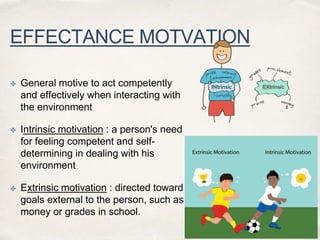
  • #15 The stimulus and exploration needs described in the last section can be considered to be involved in attempts to be competent in dealing with the environment. The motivation behind these competence activities has been called effectance motivation-a general motive to act competently and effectively when interacting with the environment intrinsic motivation : a person's need for feeling competent and self-deter mining in dealing with his environment intrinsic because the goals are internal feelings of effectiveness, competence, and self-determination
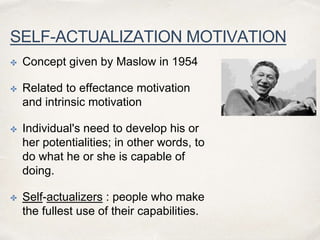
  • #16 Concept given by Maslow in 1954 related to effectance motivation and intrinsic motivation an individual's need to develop his or her potentialities; in other words, to do what he or she is capable of doing. Self-actualizers," then, are people who make the fullest use of their capabilities. For some, it means achievement in the literary or scientific field; for others, it means leadership in politics, the community, or the church; for still others, it merely mear..s living life fully without being unduly restrained by social conventions
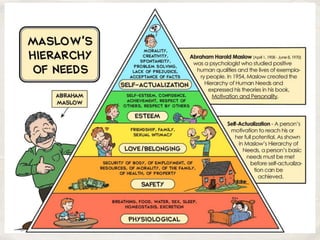
  • #17 Self-actualization is thought to be the top need in a hierarchy of needs, or motives (Maslow, 1954). The needs appear in this order, from lowest to highest (Figure 7.12), with physiological needs first and self-actualization needs last, during a person's normal development. From lowest to highest, this is also the order in which they must be satisfied. In other words, physiological needs must be satisfied before any of the others can be met Physiological needs, such as hunger, thirst, and sex Safety needs, such as needs for security, stability, and order Belongingness and love needs, such as needs for affection, affiliation, and identification Esteem needs, such as needs for prestige, success, and self-respect The need for self-actualization For instance, a starving man is preoccupied with obtaining food. He doesn't even wonder where tomorrow's meal is coming from (safety need); only today's meal counts. But once he is assured of eating today, he can begin to worry about his safety needs and take steps to see that his physiological needs will always be met; thus he moves on to safety needs. If a woman has a steady job, or knows she can get one if she loses the one she has (her safety needs are .met), her belongingness- and esteem needs come to the fore. She is now motivated by her needs to be liked, to be successful, and to feel self-esteem. Finally, if all her other needs are met, her main motive will be to do things which she does well and enjoys; she will thus be satisfying her need to realize her potentialities-she will be selfactualizing.
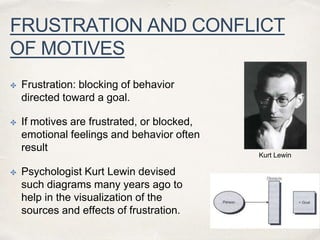
  • #18 The course of motivation does not always run smoothly. Things happen that prevent us from reaching the goals toward which we are driven or pulled. frustration refers to the blocking of behavior directed toward a goal. If motives are frustrated, or blocked, emotional feelings and behavior often result. People who cannot achieve their important goals feel depressed, fearful, anxious, guilty, or angry (page 290). Often they are simply unable to derive ordinary pleasure from living. The box denotes the total environment of a person, and the vertical line represents the thwarting of a goal. In such diagrams, goals arc depicted by either plus (+ ) or minus (- ) signs, called valences. A plus sign indicates a goal to which a person is attracted; a minus sign indicates a goal which repels-punishment, threat, or something an individual fears or has learned to avoid. The arrow is used to indicate the direction of motivating forces atting on the individual. psychologist Kurt Lewin devised such diagrams many years ago to help in the visualization of the sources and effects of frustration.
  • #19 environmental forces that block motive fulfillment, (2) personal inadequacies that make it impossible to reach goals, and (3) conflicts between and among motives. By making it difficult or impossible for a person to attain a goal, environmental obstacles can frustrat.e the satisfaction of motives. An Qostacle may be something physical, such as a locked door or a lack of mon_y. Or it may be people-parents, teachers, or police The barrier may be another person, or object in the environment, or it may be the individual's own lack of ability of skill. Personal Frustration : Unattainable goals can be important sources of frustration. These are largely learned goals that cannot be achieved because they are beyond a person's abilities For instance, a boy may be taught to aspire to high academic achievement but lack the ability to make better than a mediocre record. He may be motivated to join the school band, play on the football team, be admitted to a certain club, or act the lead in a play and be frustrated because he does not have the necessary talent motivational conflict, : A major source of frustration is found in motivational conflict, in which the expression of one motive interferes with the expression of other motives. In expressing aggression, for example, people are often caught in such a conflict. On the one hand, they would like to give vent to their rage; on the other, they fear the social disapproval which will result if they do. Aggression is thus in-eonflict with the need for social approval.
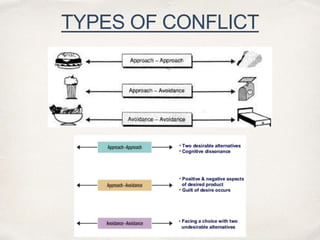
  • #20 Of the three general sources of frustration described above, the one that often causes the most persistent and deep-seated frustration in many individuals is motivational conflict. This kind of frustration can be the most important in determining a person's anxieties, or "hang-ups." On analysis, it seems that this kind of frustration can arise from three major kinds of conflict, which have been called approach-approach, avoidance-avoidance, and approach-avoidance
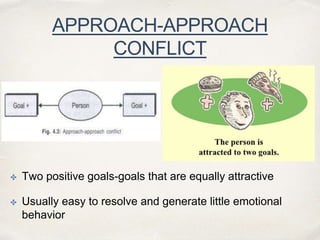
  • #21 an approach-approach is a conflict between two positive goals-goals that are equally attractive at the same time For instance, a physiological conflict arises when a person is hungry and sleepy at the same time. In the social context, a conflict may arise when a person wants to go to both a political rally and a swimming party scheduled for the same night Such conflicts are usually resolvec either by satisfying first one goal and then the other-for example, eating and then going to bed. if a person is both hungry and sleepy-or b) choosing one of the goal and giving up the other. Compared with other conflict situations, approach-approach conflicts are usually easy to resolve and generate little emotional behavior.
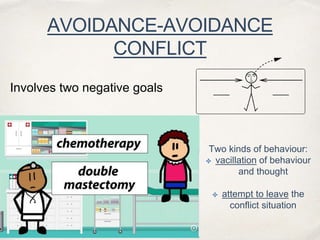
  • #22 involves two negative goals (Figure 7.15) and is a fairly common experience. PG student has to prepare a seminar otherwise one full week he is on call duty. Two kinds of behavior are likely to be conspicuous in .avoidanceavoidance conflicts. One is vacillation of behavior and thought, meaning that people are inconsistent in what they do and think; they do first one thing and then another. Vacillation occurs because the strength of a goal increases as the person nears it. As one of the negative goals is approached, the person finds it increasingly repellent and consequently retreats or withdraws from it. But when this is done, the person comes closer to the other negative goal and finds it, in turn, unbearably obnoxious. A second important behavioral feature of this kind of conflict is an attempt to leave the conflict situation. Theoretic;lIly, a person can escape from an avoidance-avoidance conflict by running away-and people do, indeed, try this. But the consequences of running away are even worse than his other alternatives, and so he does not do it.
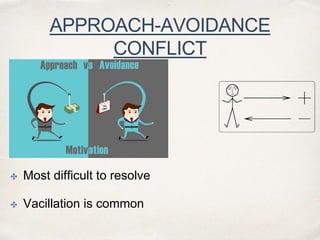
  • #23 thC-most difficult to resolve because, in this type of conflict, a person is both attracted and repelled by the same goal object Because of the positive valence of the goal, the person approaches it; but as it is approached, the negative valence becomes stronger. If, at some point during the approach tv the goal, its repellent,aspects become stronger than its positive aspects, the person will stop before reaching the goal. Because the goal is not reached, the individual is frustrated. The individual is attracted to a positive goal, but this goal also has fear or threat(negative valance) associated with it As with avoidance-avoidance conflicts, vacillation is common in approach-avoidance conflicts; people in these conflicts approach the goal until the negative valence becomes too strong, and then they back away from it. Often, however, the negative valence is not repellent enough to stop the approach behavior. In such cases, people reach the goal, but much more slowly and hesitatingly than they would have without the negative valence; and, until the goal is reached, there is frustration. Even after the goal is reached, an individual may feel uneasy because of the negative valence attached to it. Whether a person is frustrated by reaching a goal slowly or by not reaching it at all, emotional reactions such as fear, anger, and resentment commonly accompany approach-avoidance conflicts.
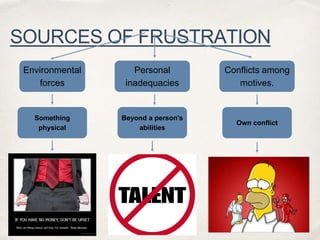
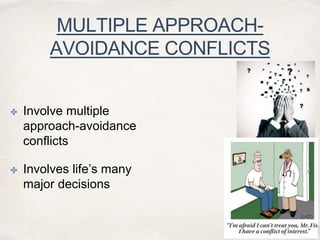
  • #24 Many of life's major decisions involve multiple approach-avoidance conflicts, meaning that several goals with positive and negative valences are involved Suppose a woman is engaged to be married; suppose, further, that the goal of marriage has a positive valence for her because of the stability and security it will provide and because she loves the man she will be marrying. Suppose, on the other hand, that marriage is repellent to her because it will mean giving up an attractive offer of a job in another city. With respect to her career, the woman is attracted to the new job but also repelled by the problems it will create for her marriage. What will she do? In part, the answer depends on the relative strengths of the approach and the avoidance tendencies. After a good deal of vacillation, she might break the engagement if the sum total of the positive career valence minus the negative career valence is greater than that for positive and negative valences associated with marriage. (See Figure 7.17.) Or, if the overall sum of the marriage valences is greater than that of the career ones, she might hesitate for a while, vacillating back and forth, and then get married. Thus, what a person does in a multiple approach-avoidance conflict will depend on the relative strengths of all the positive and negative valences involved.
  • #25 Motivation refers to the driving and pulling forces which result in persistent behavior directed toward particular goals. Theories of motivation include drive theories, incentive theories, the opponent-process theory, and optimal-level theories SELF-ACTUALIZAtiON MOTIVATION : an individual's need to develop his or her potentialities; in other words, to do what he or she is capable of doing. Physiological needs, Safety needs, Belongingness and love needs, Esteem needs, such as needs for prestige, success, and self-respect and The need for self-actualization People in avoidance-avoidance conflicts may try a different means of running away: They may rely on their imaginations to free them from the fear and anxiety generated by the conflict. They may spend much of their time daydreaming-conjuring up an imaginary world where there are no conflicts. If the two negative goals are fear-producing and threatening, a person caught between them will experience fear. Or the individual may be angry and resentful at being trapped in a situation where the goals are negative. The study of motivation helps us understand not only why we do the things we do but also why our behaviors can change when our focus shifts or gets redirected. Emotions are a part of everything we do, affecting our relationships with others and our own health, as well as influencing important decisions.
  • #27 Two kinds of behavior are likely to be conspicuous in .avoidanceavoidance conflicts. One is vacillation of behavior and thought, meaning that people are inconsistent in what they do and think; they do first one thing and then another. Vacillation occurs because the strength of a goal increases as the person nears it. As one of the negative goals is approached, the person finds it increasingly repellent and consequently retreats or withdraws from it. But when this is done, the person comes closer to the other negative goal and finds it, in turn, unbearably obnoxious.