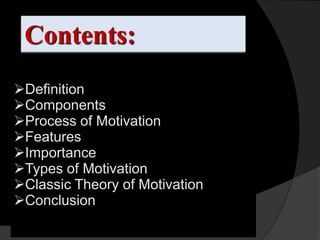
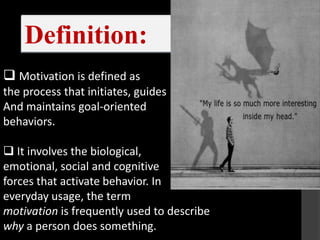
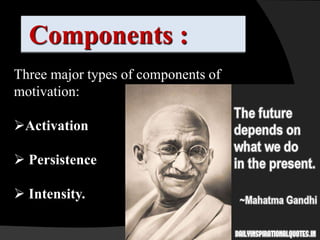
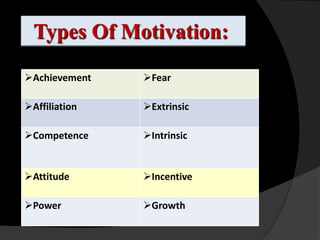
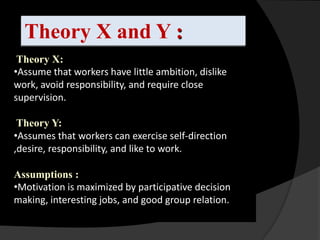
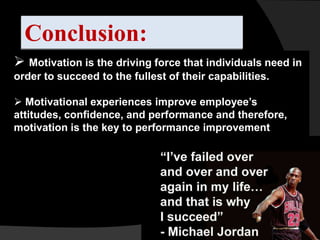
This document defines motivation and its key components, processes, features, importance, and types. It discusses motivation as the process that initiates and guides goal-oriented behaviors, involving biological, emotional, social and cognitive forces. The three major components of motivation are activation, persistence, and intensity. It also outlines several classic theories of motivation, including Maslow's hierarchy of needs, Herzberg's two-factor theory, and McGregor's Theory X and Theory Y. Motivation is important for productive use of resources, increased efficiency and output, achievement of goals, and development of relationships.