By,
Fardeen Faisal
OBJECTIVESOBJECTIVES
Motion involves a change in the position of
an object over time.
Motion can be described using
mathematical relationships.
Many technologies that apply concepts
related to kinematics have societal and
environmental implications
MotionsMotions
 When an object changes its position with
elapse of time in respect to a stationary
object, such as a building, electric pole, etc.,
the object is said to be in motion.
MotionMotion
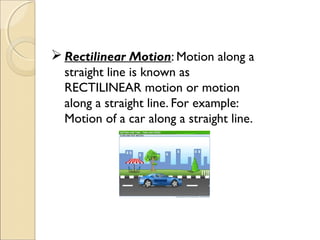
 Rectilinear Motion: Motion along a
straight line is known as
RECTILINEAR motion or motion
along a straight line. For example:
Motion of a car along a straight line.
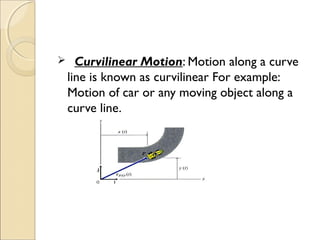
 Curvilinear Motion: Motion along a curve
line is known as curvilinear For example:
Motion of car or any moving object along a
curve line.
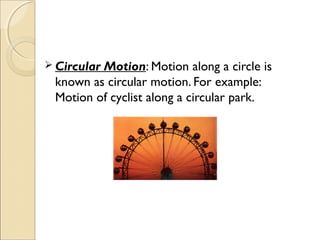
 Circular Motion: Motion along a circle is
known as circular motion. For example:
Motion of cyclist along a circular park.
Slow and Fast Motion: If an object ‘A’
covers a distance in less time and
another object covers the same distance
in more time, the object A is called a
faster moving object and object B is
called a slower moving object. In
other words, object A has faster
motion and object B has slower motion.
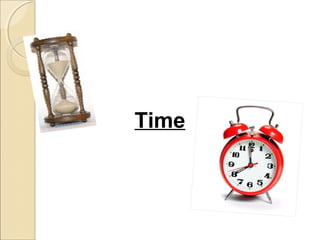
Time
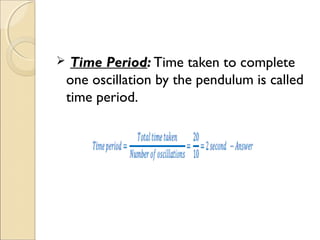
 Time Period: Time taken to complete
one oscillation by the pendulum is called
time period.
Unit of Time: Time is measured in
second. Unit of time is second. Second is
denoted by ‘s’.
60 second = 1 minute
60 minute = 1 hour
24 hour = 1 day
7 day = 1 week
365 days = 1 year
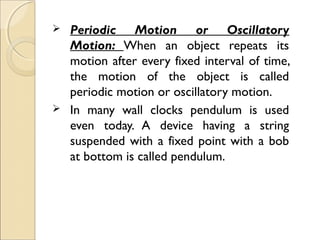
 Periodic Motion or Oscillatory
Motion: When an object repeats its
motion after every fixed interval of time,
the motion of the object is called
periodic motion or oscillatory motion.
 In many wall clocks pendulum is used
even today. A device having a string
suspended with a fixed point with a bob
at bottom is called pendulum.
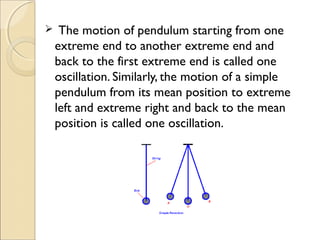
 The motion of pendulum starting from one
extreme end to another extreme end and
back to the first extreme end is called one
oscillation. Similarly, the motion of a simple
pendulum from its mean position to extreme
left and extreme right and back to the mean
position is called one oscillation.
Review Question:
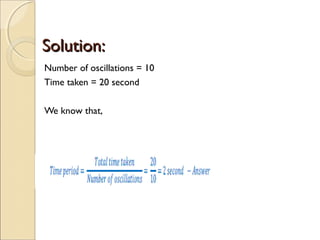
A pendulum takes 20 second
to complete 10 oscillations,
calculate its time period.
Solution:Solution:
Number of oscillations = 10
Time taken = 20 second
We know that,
SpeedSpeed
Speed: Distance covered by an object in
unit time is called speed.
Uniform Speed: If an object covers a
fixed distance in each unit of time the motion
is known as uniform motion or uniform
speed.
Non-uniform Speed: If an object does not
cover a fixed distance in each unit of time
the
motion is known as non-uniform motion or
non-uniform speed.
 Unit of speed: Units of speed are
• Meter / second
• Meter / minute
• Kilometer / hour
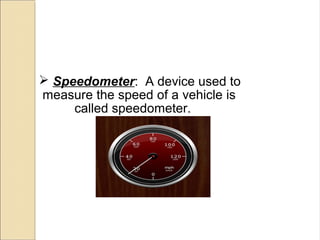
 Speedometer: A device used to
measure the speed of a vehicle is
called speedometer.
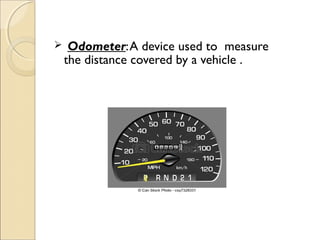
 Odometer:A device used to measure
the distance covered by a vehicle .
THANK YOU !!!!

Motion,time and speed

  • 1.
  • 2.
    OBJECTIVESOBJECTIVES Motion involves achange in the position of an object over time. Motion can be described using mathematical relationships. Many technologies that apply concepts related to kinematics have societal and environmental implications
  • 3.
    MotionsMotions  When anobject changes its position with elapse of time in respect to a stationary object, such as a building, electric pole, etc., the object is said to be in motion.
  • 4.
  • 5.
     Rectilinear Motion:Motion along a straight line is known as RECTILINEAR motion or motion along a straight line. For example: Motion of a car along a straight line.
  • 6.
     Curvilinear Motion:Motion along a curve line is known as curvilinear For example: Motion of car or any moving object along a curve line.
  • 7.
     Circular Motion:Motion along a circle is known as circular motion. For example: Motion of cyclist along a circular park.
  • 8.
    Slow and FastMotion: If an object ‘A’ covers a distance in less time and another object covers the same distance in more time, the object A is called a faster moving object and object B is called a slower moving object. In other words, object A has faster motion and object B has slower motion.
  • 9.
  • 10.
     Time Period:Time taken to complete one oscillation by the pendulum is called time period.
  • 11.
    Unit of Time:Time is measured in second. Unit of time is second. Second is denoted by ‘s’. 60 second = 1 minute 60 minute = 1 hour 24 hour = 1 day 7 day = 1 week 365 days = 1 year
  • 12.
     Periodic Motionor Oscillatory Motion: When an object repeats its motion after every fixed interval of time, the motion of the object is called periodic motion or oscillatory motion.  In many wall clocks pendulum is used even today. A device having a string suspended with a fixed point with a bob at bottom is called pendulum.
  • 13.
     The motionof pendulum starting from one extreme end to another extreme end and back to the first extreme end is called one oscillation. Similarly, the motion of a simple pendulum from its mean position to extreme left and extreme right and back to the mean position is called one oscillation.
  • 14.
    Review Question: A pendulumtakes 20 second to complete 10 oscillations, calculate its time period.
  • 15.
    Solution:Solution: Number of oscillations= 10 Time taken = 20 second We know that,
  • 16.
  • 17.
    Speed: Distance coveredby an object in unit time is called speed. Uniform Speed: If an object covers a fixed distance in each unit of time the motion is known as uniform motion or uniform speed. Non-uniform Speed: If an object does not cover a fixed distance in each unit of time the motion is known as non-uniform motion or non-uniform speed.
  • 18.
     Unit ofspeed: Units of speed are • Meter / second • Meter / minute • Kilometer / hour
  • 19.
     Speedometer: Adevice used to measure the speed of a vehicle is called speedometer.
  • 20.
     Odometer:A deviceused to measure the distance covered by a vehicle .
  • 21.