TIME AND MOTION
CHAPTER: 9
CLASS: 7
SUBJECT: SCIENCE
GRETA GUPTA
Learning Objectives
1.Knowledge of Time
2.Understanding of the Simple Pendulum and time period
3.Knowledge of units of time and speed
4.Knowledge of common modern and ancient time-measuring devices
5. Skills of measurement of Speed
MEASUREMENT OF TIME IN ANCIENT TIMES
1. The time between one sunrise to the next snrise was called a ‘day’ or ‘solar day’.
2. The time between one new moon to the new moon was called a ‘month’.
3. The time taken by earth to complete one revoluion of the sn was called a ‘year’.
Ancient clocks
Do You Know?
• The Jantar Mantar is a collection of 19 astronomical instruments built by the Rajput king Sawai Jai
Singh II, the founder of Jaipur, Rajasthan. The monument was completed in 1734. It features
the world's largest stone sundial, and is a UNESCO World Heritage site. It is located near City
Palace and Hawa Mahal.
Measurement of time
• All the clocks & watches use the principle of periodic motion for
measuring time.
• Periodic motion: A motion that repeat itself at regular intervals of
time.
• One of the most common devices to show periodic motion is Simple
Pendulum.
Simple Pendulum
• It consists of a small metal ball(called bob) suspended by a long
thread from a rigid support, such that the bob is free to swing back &
forth.
• The pendulum motion was first studied by Galileo.
SOME TERMS RELATED TO SIMPLE PENDULUM
1. Length of the pendulum: The length of the string (thread) from the point of
suspension to the center of the bob.
2. Mean position of the bob: The position of the bob when it is at rest.
3. Extreme positions of bob: The positions where the bob is at the maximum
distance from the mean position,
4. Oscillation of the pendulum: One complete to & fro motion of the bob about
its mean position.
5. Amplitude of the pendulum: The maximum displacement of the bob from its
mean position on either side.
6. Time period of the pendulum: The time taken by the bob to complete one
oscillation.
7. Frequency of the pendulum: The number of oscillations made by a pendulum
in 1 second.
Equation triangle
Check point
• Label the following diagram:
Clue box:
1. Extreme position
2. Mean position
3. Long thread
4. Point of suspension
5. Amplitude
CHECK POINT
1. A simple pendulum takes 32 seconds to complete 20
oscillations. What is the time period of the pendulum?
2. A simple pendulum completes 40 oscillation in a minute
.Find its (a) frequency (b) time period.
3. Calculate Time-period of a simple pendulum if it takes 72
seconds to complete 24 oscillations.
4. A simple pendulum takes 15 seconds to complete 5
oscillations. What is the time period of pendulum?
Do you know?
• Galileo's escapement is a design for a clock escapement, invented around 1637
by Italian scientist Galileo Galilei (1564 - 1642). It was the earliest design of
a pendulum clock. Since he was by then blind, Galileo described the device to
his son, who drew a sketch of it. The son began construction of a prototype, but
both he and Galileo died before it was completed.
LATEST TREND IN MEASUREMENT OF TIME
• The principle of simple pendulum is used in pendulum clock.
• A mechanical wrist watch has a balance wheel which controls the movement of hands.
• Quartz clocks & watches measure time accurately.
• Quartz has a unique property of oscillating when subjected to a small amount of electric
current..
• For measuring short intervals of time, a stop watch is used.
• For the most accurate meausrement, atomic clocks are being used.
Stopwatch in
sports can
measure one-
tenth of a
second
Atomic watch
A timer is used to
record the
sequence of an
event
UNIT OF TIME
• The standard unit of measuring time is second(s).
• Larger units are minutes(min), & hours(h).
UNIT CONVESION
60 seconds 1 minute
60 minutes 1 hour
24 hours 1 day
30 days 1 month
12 months 1 year
10 years 1 decade
100 years (10
decades)
1 century
1000 years (10
centuries)
1 millenium
OPTICAL LATTICE CLOCK
• DESIGNED BY Jerome
Lodewyck & his team at the
Paris Observatory
• Most accurate clock, ‘ redefine
the second’.
• Uses laser beams, more than
twice as accurate as an atomic
clock.
• It can be used in
telecomunications & satellite
navigation clocks
MOTION
• In Science, an object is said to be at rest when it does not change its position with time or with
respect to its surroundings.
• An object is said to be in motion when its position changes with time or with respect to its
surroundings.
TYPES OF MOTION
SLOW & FAST MOTION
• An object which takes a longer time to cover a certain distance is said to be slow, whereas an
object which takes a shorter time to cover the same distance is said to be fast.
SPEED
• Speed of a moving object is the distance travelled by it in a unit time.
CHECK POINT
1. The distance between two stations is 300 km. A train takes 6 hours
to cover this distance. Calculate the speed of the train.
2. Sumit covers a distance of 2.4 Km from his house to reach her college
on a scooter. If the scooter has a speed of 6m/sec, calculate the time
taken by her to reach the college.
3. If a car is moving with a speed of 5Km/h on highway then find the
distance travelled by the car in 4 hours?
UNITS OF SPEED
• The standard unit of distance is meter (m) and of the time is second (s)
• So the standard unit of speed is meter per second (m/s)
SPEEDOMETER & ODOMETER
• Speedometer: An instrument on a vehicle’s dashboard which indicates the speed of the vehicle at
that instant of time in kilometer per hur (km/h).
• Odometer: An instrument which shows the distance travelled by the vehicle in kilometers.
NUMERICAL PROBLEMS BASED ON SPEED
1. Find speed when, distance is 142 km and time is 2 hours.
2. Find out the distance covered when, speed is 960 km/hour and time is 1 hour 50
minutes.
3. Determine the time taken when, distance is 7150 km and speed is 780 km/hr.
4. If distance travelled by a train is 495 km in 4 hours 30 minutes, what is its
speed?
5. A cyclist covers 950 m in 5 minutes. Find his speed in km/ hour.
UNIFORM & NON UNIFORM MOTION
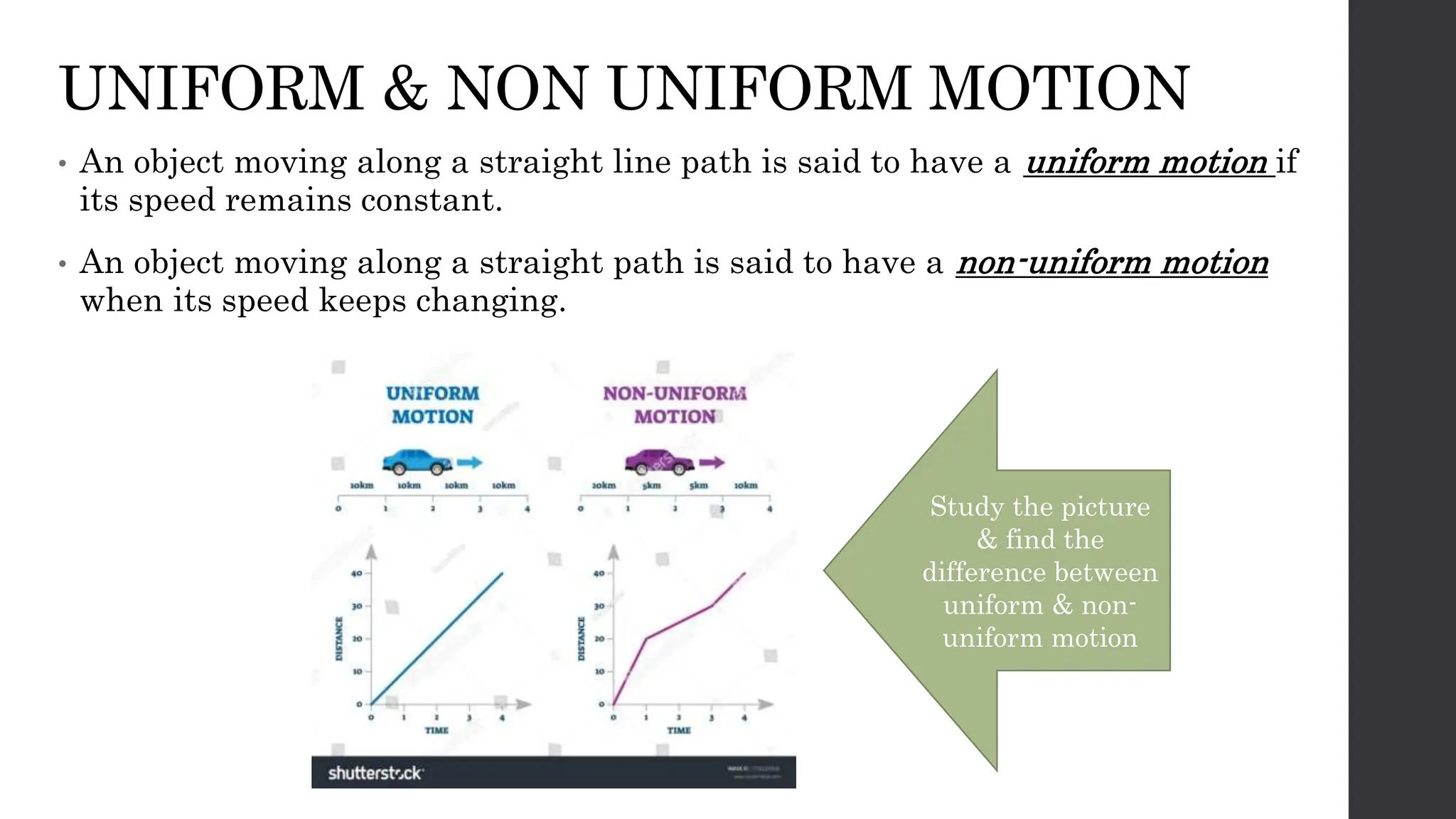
• An object moving along a straight line path is said to have a uniform motion if
its speed remains constant.
• An object moving along a straight path is said to have a non-uniform motion
when its speed keeps changing.
Study the picture
& find the
difference between
uniform & non-
uniform motion
DISTANCE-TIME GRAPH FOR VARIOUS FORMS OF MOTION
DISTANCE TIME GRAPH
• It shows how the distance travelled by a moving object changes with time.
DISTANCE TIME GRAPH
• The motion of objects showing relationship between distance travelled & time taken to cover that
distance can be represented by a graph – Distance time graph.
• It shows how the distance travelled by a moving object changes with time.

class7 time motion chapter 8 science ppt.pptx

  • 1.
    TIME AND MOTION CHAPTER:9 CLASS: 7 SUBJECT: SCIENCE GRETA GUPTA
  • 2.
    Learning Objectives 1.Knowledge ofTime 2.Understanding of the Simple Pendulum and time period 3.Knowledge of units of time and speed 4.Knowledge of common modern and ancient time-measuring devices 5. Skills of measurement of Speed
  • 3.
    MEASUREMENT OF TIMEIN ANCIENT TIMES 1. The time between one sunrise to the next snrise was called a ‘day’ or ‘solar day’. 2. The time between one new moon to the new moon was called a ‘month’. 3. The time taken by earth to complete one revoluion of the sn was called a ‘year’.
  • 4.
  • 5.
    Do You Know? •The Jantar Mantar is a collection of 19 astronomical instruments built by the Rajput king Sawai Jai Singh II, the founder of Jaipur, Rajasthan. The monument was completed in 1734. It features the world's largest stone sundial, and is a UNESCO World Heritage site. It is located near City Palace and Hawa Mahal.
  • 6.
    Measurement of time •All the clocks & watches use the principle of periodic motion for measuring time. • Periodic motion: A motion that repeat itself at regular intervals of time. • One of the most common devices to show periodic motion is Simple Pendulum.
  • 7.
    Simple Pendulum • Itconsists of a small metal ball(called bob) suspended by a long thread from a rigid support, such that the bob is free to swing back & forth. • The pendulum motion was first studied by Galileo.
  • 8.
    SOME TERMS RELATEDTO SIMPLE PENDULUM 1. Length of the pendulum: The length of the string (thread) from the point of suspension to the center of the bob. 2. Mean position of the bob: The position of the bob when it is at rest. 3. Extreme positions of bob: The positions where the bob is at the maximum distance from the mean position, 4. Oscillation of the pendulum: One complete to & fro motion of the bob about its mean position. 5. Amplitude of the pendulum: The maximum displacement of the bob from its mean position on either side. 6. Time period of the pendulum: The time taken by the bob to complete one oscillation. 7. Frequency of the pendulum: The number of oscillations made by a pendulum in 1 second.
  • 9.
  • 10.
    Check point • Labelthe following diagram: Clue box: 1. Extreme position 2. Mean position 3. Long thread 4. Point of suspension 5. Amplitude
  • 11.
    CHECK POINT 1. Asimple pendulum takes 32 seconds to complete 20 oscillations. What is the time period of the pendulum? 2. A simple pendulum completes 40 oscillation in a minute .Find its (a) frequency (b) time period. 3. Calculate Time-period of a simple pendulum if it takes 72 seconds to complete 24 oscillations. 4. A simple pendulum takes 15 seconds to complete 5 oscillations. What is the time period of pendulum?
  • 12.
    Do you know? •Galileo's escapement is a design for a clock escapement, invented around 1637 by Italian scientist Galileo Galilei (1564 - 1642). It was the earliest design of a pendulum clock. Since he was by then blind, Galileo described the device to his son, who drew a sketch of it. The son began construction of a prototype, but both he and Galileo died before it was completed.
  • 13.
    LATEST TREND INMEASUREMENT OF TIME • The principle of simple pendulum is used in pendulum clock. • A mechanical wrist watch has a balance wheel which controls the movement of hands. • Quartz clocks & watches measure time accurately. • Quartz has a unique property of oscillating when subjected to a small amount of electric current..
  • 14.
    • For measuringshort intervals of time, a stop watch is used. • For the most accurate meausrement, atomic clocks are being used. Stopwatch in sports can measure one- tenth of a second Atomic watch A timer is used to record the sequence of an event
  • 15.
    UNIT OF TIME •The standard unit of measuring time is second(s). • Larger units are minutes(min), & hours(h). UNIT CONVESION 60 seconds 1 minute 60 minutes 1 hour 24 hours 1 day 30 days 1 month 12 months 1 year 10 years 1 decade 100 years (10 decades) 1 century 1000 years (10 centuries) 1 millenium
  • 16.
    OPTICAL LATTICE CLOCK •DESIGNED BY Jerome Lodewyck & his team at the Paris Observatory • Most accurate clock, ‘ redefine the second’. • Uses laser beams, more than twice as accurate as an atomic clock. • It can be used in telecomunications & satellite navigation clocks
  • 17.
    MOTION • In Science,an object is said to be at rest when it does not change its position with time or with respect to its surroundings. • An object is said to be in motion when its position changes with time or with respect to its surroundings.
  • 18.
  • 19.
    SLOW & FASTMOTION • An object which takes a longer time to cover a certain distance is said to be slow, whereas an object which takes a shorter time to cover the same distance is said to be fast.
  • 20.
    SPEED • Speed ofa moving object is the distance travelled by it in a unit time.
  • 21.
    CHECK POINT 1. Thedistance between two stations is 300 km. A train takes 6 hours to cover this distance. Calculate the speed of the train. 2. Sumit covers a distance of 2.4 Km from his house to reach her college on a scooter. If the scooter has a speed of 6m/sec, calculate the time taken by her to reach the college. 3. If a car is moving with a speed of 5Km/h on highway then find the distance travelled by the car in 4 hours?
  • 22.
    UNITS OF SPEED •The standard unit of distance is meter (m) and of the time is second (s) • So the standard unit of speed is meter per second (m/s)
  • 23.
    SPEEDOMETER & ODOMETER •Speedometer: An instrument on a vehicle’s dashboard which indicates the speed of the vehicle at that instant of time in kilometer per hur (km/h). • Odometer: An instrument which shows the distance travelled by the vehicle in kilometers.
  • 24.
    NUMERICAL PROBLEMS BASEDON SPEED 1. Find speed when, distance is 142 km and time is 2 hours. 2. Find out the distance covered when, speed is 960 km/hour and time is 1 hour 50 minutes. 3. Determine the time taken when, distance is 7150 km and speed is 780 km/hr. 4. If distance travelled by a train is 495 km in 4 hours 30 minutes, what is its speed? 5. A cyclist covers 950 m in 5 minutes. Find his speed in km/ hour.
  • 25.
    UNIFORM & NONUNIFORM MOTION • An object moving along a straight line path is said to have a uniform motion if its speed remains constant. • An object moving along a straight path is said to have a non-uniform motion when its speed keeps changing. Study the picture & find the difference between uniform & non- uniform motion
  • 26.
    DISTANCE-TIME GRAPH FORVARIOUS FORMS OF MOTION
  • 27.
    DISTANCE TIME GRAPH •It shows how the distance travelled by a moving object changes with time.
  • 28.
    DISTANCE TIME GRAPH •The motion of objects showing relationship between distance travelled & time taken to cover that distance can be represented by a graph – Distance time graph. • It shows how the distance travelled by a moving object changes with time.