






Morris Mosseri, MD Director of Interventional Cardiology Hadassah-Hebrew University Medical Center The Israeli Working Group of Interventional Cardiology The Titan Stent in Real Life Results from a Multi-Center Registry
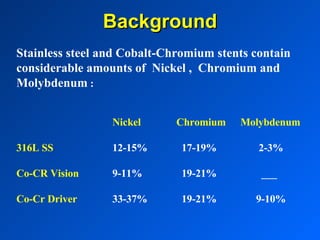
Stainless steel and Cobalt-Chromium stents contain considerable amounts of  Nickel ,  Chromium and  Molybdenum  : Nickel Chromium Molybdenum 316L SS 12-15%   17-19%   2-3% Co-CR Vision 9-11%   19-21%   ___ Co-Cr Driver 33-37%   19-21%   9-10% Background
Allergy  5-15 % of  the population are allergic to Nickel. Nickel allergy Background
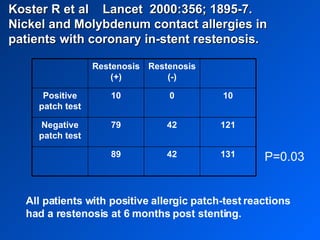
All patients with positive allergic patch-test reactions had a restenosis at 6 months post stenting. Koster R et al  Lancet  2000:356; 1895-7.  Nickel and Molybdenum contact allergies in patients with coronary in-stent restenosis. P=0.03 131 42 89 121 42 79 Negative patch test 10 0 10 Positive patch test Restenosis (-) Restenosis (+)
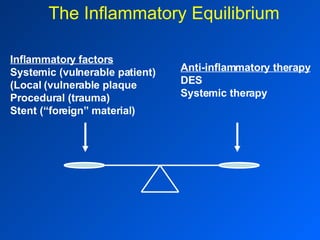
The Inflammatory Equilibrium Inflammatory factors Systemic (vulnerable patient) Local (vulnerable plaque) Procedural (trauma) Stent (“foreign” material) Anti-inflammatory therapy DES Systemic therapy
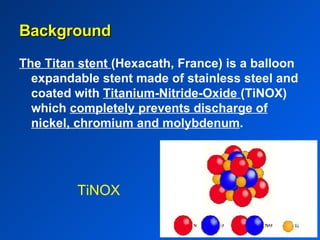
TiNOX The Titan stent  (Hexacath, France) is a balloon expandable stent made of stainless steel and coated with  Titanium-Nitride-Oxide  (TiNOX) which  completely prevents discharge of nickel, chromium and molybdenum . Background
Purpose To assess the short and long term characteristics of the Titan stent in a multi-center registry.
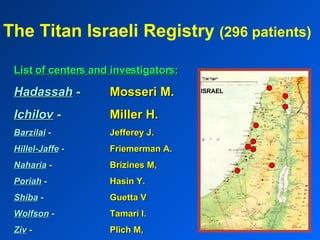
The Titan Israeli Registry  (296 patients) List of centers and investigators: Hadassah   - Mosseri M. Ichilov   - Miller H. Barzilai   - Jefferey J. Hillel-Jaffe  - Friemerman A. Naharia  - Brizines M, Poriah   - Hasin Y. Shiba   -  Guetta V Wolfson  -  Tamari I. Ziv   - Plich M, ISRAEL
Methods Inclusion criteria This real life registry included all patients candidate for stent implantation. Choosing of Titan stent was at the operator discretion. Exclusion criterion Cardiogenic shock
Methods Lesions :  De novo  and  restenotic  lesions of native coronary arteries and SVG’s.
30 day and 6 months follow-up was performed by an independent research nurse. Methods
Outcome data  included immediate technical and clinical success and complications, and MACE (sub-acute thrombosis, MI, TLR and death) at 30 days and 6 months. Methods
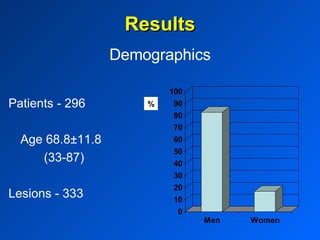
Demographics Patients - 296  Age 68.8±11.8    (33-87) Lesions - 333 Results %
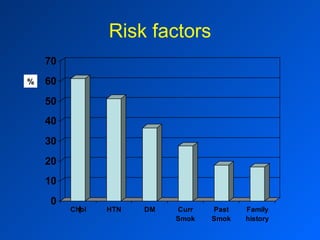
Risk factors %
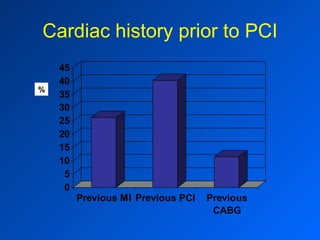
Cardiac history prior to PCI %
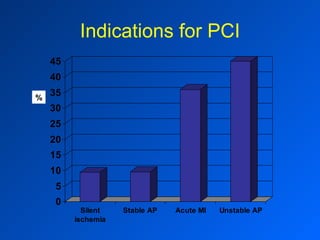
Indications for PCI %
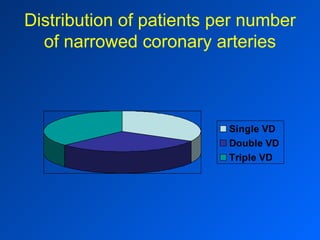
Distribution of patients per number of narrowed coronary arteries
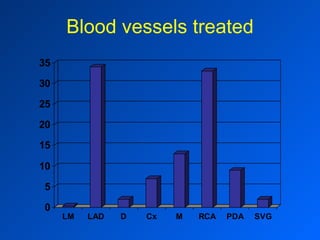
Blood vessels treated
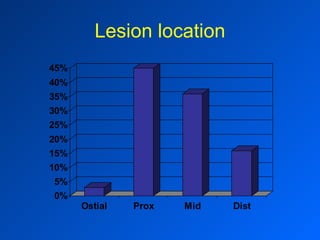
Lesion location
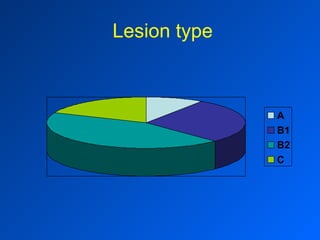
Lesion type
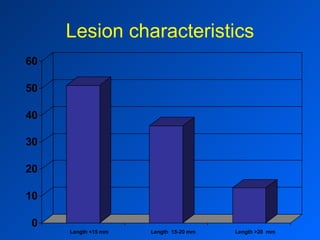
Lesion characteristics Length <15 mm Length  15-20 mm Length >20  mm
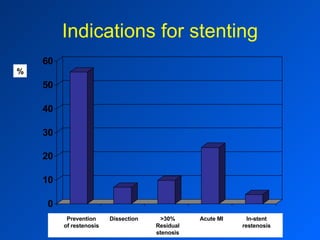
Indications for stenting % Acute MI Prevention of restenosis >30% Residual stenosis In-stent restenosis Dissection
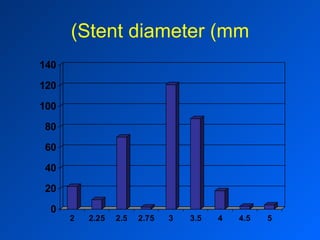
Stent diameter (mm)
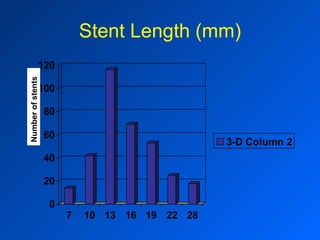
Stent Length (mm) Number of stents
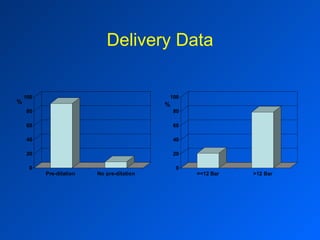
Delivery Data % %
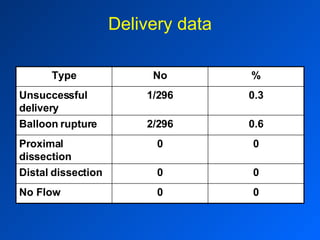
Delivery data 0 0 No Flow 0 0 Distal dissection 0 0 Proximal dissection 0.6 2/296 Balloon rupture 0.3 1/296 Unsuccessful delivery % No Type
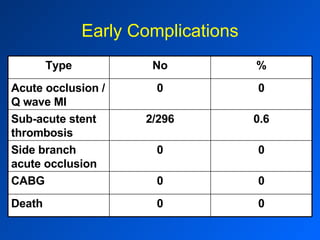
Early Complications 0 0 Death 0 0 CABG 0 0 Side branch acute occlusion 0.6 2/296 Sub-acute stent thrombosis 0 0 Acute occlusion / Q wave MI % No Type
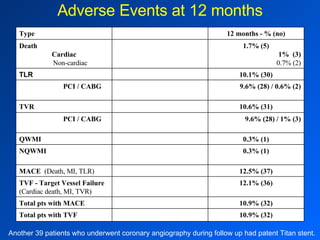
Adverse Events at 12 months Another 39 patients who underwent coronary angiography during follow up had patent Titan stent. 10.9% (32)   Total pts with TVF 10.9% (32)   Total pts with MACE  12.1% (36)   TVF - Target Vessel Failure  (Cardiac death, MI, TVR) 12.5% (37)   MACE  (Death, MI, TLR) 0.3% (1)   NQWMI 0.3% (1)   QWMI 9.6% (28) / 1% (3)   PCI / CABG 10.6% (31)   TVR 9.6% (28) / 0.6% (2)   PCI / CABG 10.1% (30)   TLR 1.7% (5) 1%  (3) 0.7% (2)   Death Cardiac Non-cardiac 12 months - % (no)   Type
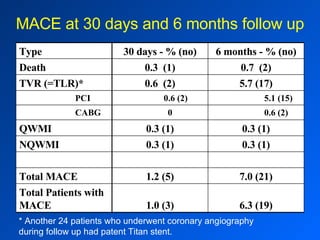
MACE at 30 days and 6 months follow up * Another 24 patients who underwent coronary angiography  during follow up had patent Titan stent.  6.3 (19) 1.0 (3) Total Patients with MACE 7.0 (21) 1.2 (5) Total MACE       0.3 (1) 0.3 (1) NQWMI 0.3 (1) 0.3 (1) QWMI 0.6 (2) 0 CABG 5.1 (15) 0.6 (2) PCI 5.7 (17) 0.6  (2) TVR (=TLR)* 0.7  (2) 0.3  (1) Death 6 months - % (no) 30 days - % (no) Type
MACE at 30 days and 6 months follow up See notes page for report on the 2 patients who died
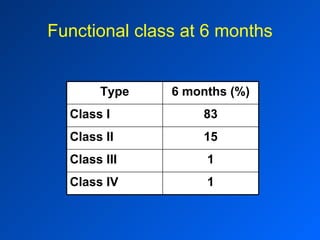
Functional class at 6 months 1 Class IV 1 Class III 15 Class II 83 Class I 6 months (%) Type
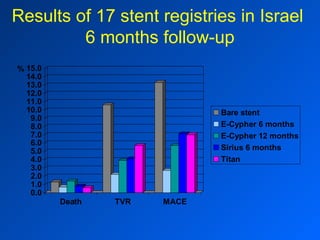
Results of 17 stent registries in Israel  6 months follow-up %
Discussion TLR rate in randomized trials tends to be higher than registries because patients may undergo follow-up angiographic driven revascularization.  Therefore, comparison of studies of the same kind (registries, randomized studies) is preferable.
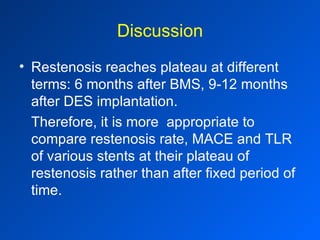
Discussion Restenosis reaches plateau at different terms: 6 months after BMS, 9-12 months after DES implantation.  Therefore, it is more  appropriate to compare restenosis rate, MACE and TLR of various stents at their plateau of restenosis rather than after fixed period of time.
Discussion Since death is an ultimate and irreversible complication, its clinical importance exceeds that of other MACE such as TLR and hospital admissions.
Discussion In the Israeli registries Cypher’s MACE and TLR rates were slightly lower than Titan’s whereas death rate was somewhat higher, possibly due to sub-acute and late thrombosis
The Titan stent has  a remarkable safety profile  and can be used in complex coronary lesions  Conclusions
After adjusting for the significance of different MACE, current studies suggest that Titan is clinically comparable to DES Conclusions
Thank you !

Mosseri Titan Presentation For Tct 2005

  • 1.
    Morris Mosseri, MDDirector of Interventional Cardiology Hadassah-Hebrew University Medical Center The Israeli Working Group of Interventional Cardiology The Titan Stent in Real Life Results from a Multi-Center Registry
  • 2.
    Stainless steel andCobalt-Chromium stents contain considerable amounts of Nickel , Chromium and Molybdenum : Nickel Chromium Molybdenum 316L SS 12-15% 17-19% 2-3% Co-CR Vision 9-11% 19-21% ___ Co-Cr Driver 33-37% 19-21% 9-10% Background
  • 3.
    Allergy 5-15% of the population are allergic to Nickel. Nickel allergy Background
  • 4.
    All patients withpositive allergic patch-test reactions had a restenosis at 6 months post stenting. Koster R et al Lancet 2000:356; 1895-7. Nickel and Molybdenum contact allergies in patients with coronary in-stent restenosis. P=0.03 131 42 89 121 42 79 Negative patch test 10 0 10 Positive patch test Restenosis (-) Restenosis (+)
  • 5.
    The Inflammatory EquilibriumInflammatory factors Systemic (vulnerable patient) Local (vulnerable plaque) Procedural (trauma) Stent (“foreign” material) Anti-inflammatory therapy DES Systemic therapy
  • 6.
    TiNOX The Titanstent (Hexacath, France) is a balloon expandable stent made of stainless steel and coated with Titanium-Nitride-Oxide (TiNOX) which completely prevents discharge of nickel, chromium and molybdenum . Background
  • 7.
    Purpose To assessthe short and long term characteristics of the Titan stent in a multi-center registry.
  • 8.
    The Titan IsraeliRegistry (296 patients) List of centers and investigators: Hadassah - Mosseri M. Ichilov - Miller H. Barzilai - Jefferey J. Hillel-Jaffe - Friemerman A. Naharia - Brizines M, Poriah - Hasin Y. Shiba - Guetta V Wolfson - Tamari I. Ziv - Plich M, ISRAEL
  • 9.
    Methods Inclusion criteriaThis real life registry included all patients candidate for stent implantation. Choosing of Titan stent was at the operator discretion. Exclusion criterion Cardiogenic shock
  • 10.
    Methods Lesions : De novo and restenotic lesions of native coronary arteries and SVG’s.
  • 11.
    30 day and6 months follow-up was performed by an independent research nurse. Methods
  • 12.
    Outcome data included immediate technical and clinical success and complications, and MACE (sub-acute thrombosis, MI, TLR and death) at 30 days and 6 months. Methods
  • 13.
    Demographics Patients -296 Age 68.8±11.8 (33-87) Lesions - 333 Results %
  • 14.
  • 15.
  • 16.
  • 17.
    Distribution of patientsper number of narrowed coronary arteries
  • 18.
  • 19.
  • 20.
  • 21.
    Lesion characteristics Length<15 mm Length 15-20 mm Length >20 mm
  • 22.
    Indications for stenting% Acute MI Prevention of restenosis >30% Residual stenosis In-stent restenosis Dissection
  • 23.
  • 24.
    Stent Length (mm)Number of stents
  • 25.
  • 26.
    Delivery data 00 No Flow 0 0 Distal dissection 0 0 Proximal dissection 0.6 2/296 Balloon rupture 0.3 1/296 Unsuccessful delivery % No Type
  • 27.
    Early Complications 00 Death 0 0 CABG 0 0 Side branch acute occlusion 0.6 2/296 Sub-acute stent thrombosis 0 0 Acute occlusion / Q wave MI % No Type
  • 28.
    Adverse Events at12 months Another 39 patients who underwent coronary angiography during follow up had patent Titan stent. 10.9% (32)   Total pts with TVF 10.9% (32)   Total pts with MACE 12.1% (36)   TVF - Target Vessel Failure (Cardiac death, MI, TVR) 12.5% (37)   MACE (Death, MI, TLR) 0.3% (1)   NQWMI 0.3% (1)   QWMI 9.6% (28) / 1% (3)   PCI / CABG 10.6% (31)   TVR 9.6% (28) / 0.6% (2)   PCI / CABG 10.1% (30)   TLR 1.7% (5) 1% (3) 0.7% (2)   Death Cardiac Non-cardiac 12 months - % (no)   Type
  • 29.
    MACE at 30days and 6 months follow up * Another 24 patients who underwent coronary angiography during follow up had patent Titan stent. 6.3 (19) 1.0 (3) Total Patients with MACE 7.0 (21) 1.2 (5) Total MACE       0.3 (1) 0.3 (1) NQWMI 0.3 (1) 0.3 (1) QWMI 0.6 (2) 0 CABG 5.1 (15) 0.6 (2) PCI 5.7 (17) 0.6 (2) TVR (=TLR)* 0.7 (2) 0.3 (1) Death 6 months - % (no) 30 days - % (no) Type
  • 30.
    MACE at 30days and 6 months follow up See notes page for report on the 2 patients who died
  • 31.
    Functional class at6 months 1 Class IV 1 Class III 15 Class II 83 Class I 6 months (%) Type
  • 32.
    Results of 17stent registries in Israel 6 months follow-up %
  • 33.
    Discussion TLR ratein randomized trials tends to be higher than registries because patients may undergo follow-up angiographic driven revascularization. Therefore, comparison of studies of the same kind (registries, randomized studies) is preferable.
  • 34.
    Discussion Restenosis reachesplateau at different terms: 6 months after BMS, 9-12 months after DES implantation. Therefore, it is more appropriate to compare restenosis rate, MACE and TLR of various stents at their plateau of restenosis rather than after fixed period of time.
  • 35.
    Discussion Since deathis an ultimate and irreversible complication, its clinical importance exceeds that of other MACE such as TLR and hospital admissions.
  • 36.
    Discussion In theIsraeli registries Cypher’s MACE and TLR rates were slightly lower than Titan’s whereas death rate was somewhat higher, possibly due to sub-acute and late thrombosis
  • 37.
    The Titan stenthas a remarkable safety profile and can be used in complex coronary lesions Conclusions
  • 38.
    After adjusting forthe significance of different MACE, current studies suggest that Titan is clinically comparable to DES Conclusions
  • 39.