Results of the Expert Group on e-InvoicingBo HaraldChairEC Expert Group on e-Invoicing
Expert Group on e-Invoicing - MissionDefined in Commission Decision of 31 October 2007:Identify shortcomings in current regulatory frameworkDefine e-Invoicing business requirementsAddress relevant e-invoicing data elements (and linkages)Propose responsibilities for standardisation bodies and time schedulePropose a European e-Invoicing Framework - a common conceptual structure
ResultsAwareness of fundamentalimportance of e-invoicing for:Competitiveness of EU enterprises
Cost savings in public sectors
Service innovations
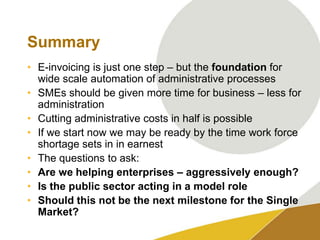
Learning 2. Recommendations3. Next layer visibility e-Invoicing is not dematerialization only – but an enabling platform for automating administrative processes atlarge – a new paradigm
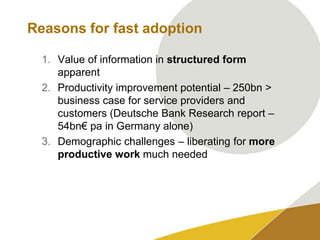
Reasons for fast adoptionValue of information in structured form apparentProductivity improvement potential – 250bn > business case for service providers and customers (Deutsche Bank Research report – 54bn€ pa in Germany alone)Demographic challenges – liberating for more productive work much needed
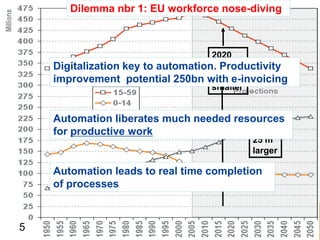
Dilemma nbr 1: EU workforce nose-diving2020   35millionsmaller25 m largerDigitalization key to automation. Productivity improvement  potential 250bn with e-invoicingAutomation liberates much needed resources for productive workAutomation leads to real time completion of processes5
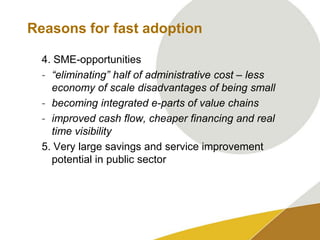
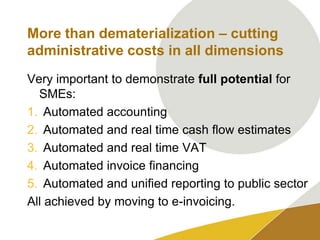
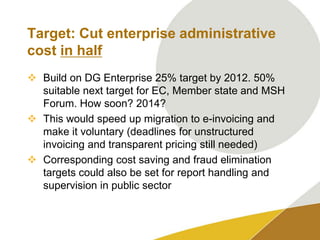
Reasons for fast adoption4. SME-opportunities “eliminating” half of administrative cost – less economy of scale disadvantages of being small
becoming integrated e-parts of value chains
improved cash flow, cheaper financing and real time visibility5. Very large savings and service improvement potential in public sector
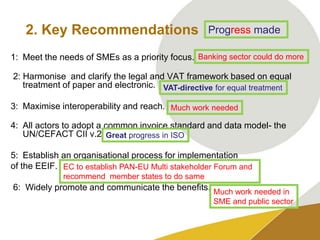
2. Key Recommendations Progress madeBanking sector could do more1: 	Meet the needs of SMEs as a priority focus. 2: Harmonise  and clarify the legal and VAT framework based on equal treatment of paper and electronic.3: 	Maximise interoperability and reach. 4: 	All actors to adopt a common invoice standard and data model- the UN/CEFACT CII v.2.    5: 	Establish an organisational process for implementation of the EEIF.  6:  Widely promote and communicate the benefits.VAT-directive for equal treatmentMuch work neededGreat progress in ISOEC to establish PAN-EU Multi stakeholder Forum and recommend  member states to do sameMuch work needed inSME and public sector
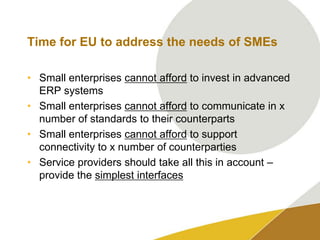
Time for EU to address the needs of SMEs Small enterprises cannot afford to invest in advanced ERP systemsSmall enterprises cannot afford to communicate in x number of standards to their counterpartsSmall enterprises cannot afford to support connectivity to x number of counterpartiesService providers should take all this in account – provide the simplest interfaces

Moscow 3.6.2010

  • 1.
    Results of theExpert Group on e-InvoicingBo HaraldChairEC Expert Group on e-Invoicing
  • 2.
    Expert Group one-Invoicing - MissionDefined in Commission Decision of 31 October 2007:Identify shortcomings in current regulatory frameworkDefine e-Invoicing business requirementsAddress relevant e-invoicing data elements (and linkages)Propose responsibilities for standardisation bodies and time schedulePropose a European e-Invoicing Framework - a common conceptual structure
  • 3.
    ResultsAwareness of fundamentalimportanceof e-invoicing for:Competitiveness of EU enterprises
  • 4.
    Cost savings inpublic sectors
  • 5.
  • 6.
    Learning 2. Recommendations3.Next layer visibility e-Invoicing is not dematerialization only – but an enabling platform for automating administrative processes atlarge – a new paradigm
  • 7.
    Reasons for fastadoptionValue of information in structured form apparentProductivity improvement potential – 250bn > business case for service providers and customers (Deutsche Bank Research report – 54bn€ pa in Germany alone)Demographic challenges – liberating for more productive work much needed
  • 8.
    Dilemma nbr 1:EU workforce nose-diving2020 35millionsmaller25 m largerDigitalization key to automation. Productivity improvement potential 250bn with e-invoicingAutomation liberates much needed resources for productive workAutomation leads to real time completion of processes5
  • 9.
    Reasons for fastadoption4. SME-opportunities “eliminating” half of administrative cost – less economy of scale disadvantages of being small
  • 10.
  • 11.
    improved cash flow,cheaper financing and real time visibility5. Very large savings and service improvement potential in public sector
  • 12.
    2. Key RecommendationsProgress madeBanking sector could do more1: Meet the needs of SMEs as a priority focus. 2: Harmonise and clarify the legal and VAT framework based on equal treatment of paper and electronic.3: Maximise interoperability and reach. 4: All actors to adopt a common invoice standard and data model- the UN/CEFACT CII v.2. 5: Establish an organisational process for implementation of the EEIF. 6: Widely promote and communicate the benefits.VAT-directive for equal treatmentMuch work neededGreat progress in ISOEC to establish PAN-EU Multi stakeholder Forum and recommend member states to do sameMuch work needed inSME and public sector
  • 13.
    Time for EUto address the needs of SMEs Small enterprises cannot afford to invest in advanced ERP systemsSmall enterprises cannot afford to communicate in x number of standards to their counterpartsSmall enterprises cannot afford to support connectivity to x number of counterpartiesService providers should take all this in account – provide the simplest interfaces