ADDITIONAL SOUNDS (EPENTHESIS)
Fadliah (2223150057)
Nugraha S.L.H. (2223150055)
Puspa V. (2223150047)
Rahmi Aulia (2223150040)
Tety Fajriati (222315
ADDITIONAL SOUNDS (EPENTHESIS)
In phonology, epenthesis is the insertion of an extra
sound into a word. Adjective: epenthetic. Verb:
epenthesize. The word epenthesis comes from epi "in
addition to" and en "in" and thesis "putting".
As a historical sound change
Latin tremulare > French trembler ("to tremble")
Old English thunor > English thunder
(Reconstructed) Proto-Greek *anrotos > Ancient
Greek ambrotos ("immortal")
As a synchronic rule
In French, /t/ is inserted in inverted interrogative phrases
between a verb ending in a vowel and a pronoun beginning with a
vowel, such as il a ('he has') > a-t-il ('has he?'). Here there is no
epenthesis from a historical perspective, since the a-t is derived from
Latin habet (he has), and the t is therefore the original third person
verb inflection. However it is correct to call this epenthesis when
viewed synchronically, since the modern basic form of the verb is a,
and the psycholinguistic process is therefore the addition of t to the
base form.
A similar example is the English indefinite article a, which
becomes an before a vowel. In Old English, this was ane
in all positions, so a diachronic analysis would see the
original n disappearing except where a following vowel
required its retention: an > a. However a synchronic
analysis, in keeping with the perception of most native
speakers, would (equally correctly) see it as epenthesis: a
> an.
As a poetic device
Latin reliquias > poetic relliquias
In informal speech
 English "hamster" often pronounced with an
added "p" sound as [hæmpstəɹ]
 English "warmth" often pronounced with an
added "p" sound as [wɔɹrmpθ]
 English "fence" often pronounced [fɛnts]
 English fam(i)ly> dialectal fambly
Uses
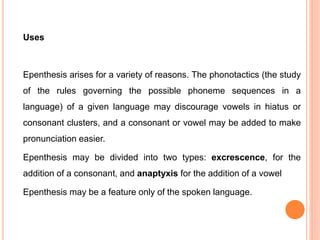
Epenthesis arises for a variety of reasons. The phonotactics (the study
of the rules governing the possible phoneme sequences in a
language) of a given language may discourage vowels in hiatus or
consonant clusters, and a consonant or vowel may be added to make
pronunciation easier.
Epenthesis may be divided into two types: excrescence, for the
addition of a consonant, and anaptyxis for the addition of a vowel
Epenthesis may be a feature only of the spoken language.
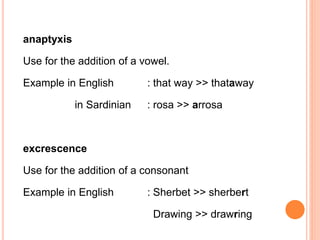
anaptyxis
Use for the addition of a vowel.
Example in English : that way >> thataway
in Sardinian : rosa >> arrosa
excrescence
Use for the addition of a consonant
Example in English : Sherbet >> sherbert
Drawing >> drawring
Anaptyxis devided into 2 kinds based on the place of adding the
vowel :
prothesis
added to beginning
example in Sardinian: rosa >> arrosa
paragoge
added to end
example in English : generic >> generical
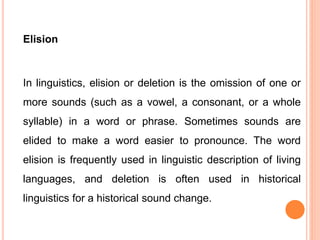
Elision
In linguistics, elision or deletion is the omission of one or
more sounds (such as a vowel, a consonant, or a whole
syllable) in a word or phrase. Sometimes sounds are
elided to make a word easier to pronounce. The word
elision is frequently used in linguistic description of living
languages, and deletion is often used in historical
linguistics for a historical sound change.
Additional sounds (epenthesis)

Additional sounds (epenthesis)

  • 1.
    ADDITIONAL SOUNDS (EPENTHESIS) Fadliah(2223150057) Nugraha S.L.H. (2223150055) Puspa V. (2223150047) Rahmi Aulia (2223150040) Tety Fajriati (222315
  • 2.
    ADDITIONAL SOUNDS (EPENTHESIS) Inphonology, epenthesis is the insertion of an extra sound into a word. Adjective: epenthetic. Verb: epenthesize. The word epenthesis comes from epi "in addition to" and en "in" and thesis "putting". As a historical sound change Latin tremulare > French trembler ("to tremble") Old English thunor > English thunder (Reconstructed) Proto-Greek *anrotos > Ancient Greek ambrotos ("immortal")
  • 3.
    As a synchronicrule In French, /t/ is inserted in inverted interrogative phrases between a verb ending in a vowel and a pronoun beginning with a vowel, such as il a ('he has') > a-t-il ('has he?'). Here there is no epenthesis from a historical perspective, since the a-t is derived from Latin habet (he has), and the t is therefore the original third person verb inflection. However it is correct to call this epenthesis when viewed synchronically, since the modern basic form of the verb is a, and the psycholinguistic process is therefore the addition of t to the base form.
  • 4.
    A similar exampleis the English indefinite article a, which becomes an before a vowel. In Old English, this was ane in all positions, so a diachronic analysis would see the original n disappearing except where a following vowel required its retention: an > a. However a synchronic analysis, in keeping with the perception of most native speakers, would (equally correctly) see it as epenthesis: a > an.
  • 5.
    As a poeticdevice Latin reliquias > poetic relliquias In informal speech  English "hamster" often pronounced with an added "p" sound as [hæmpstəɹ]  English "warmth" often pronounced with an added "p" sound as [wɔɹrmpθ]  English "fence" often pronounced [fɛnts]  English fam(i)ly> dialectal fambly
  • 6.
    Uses Epenthesis arises fora variety of reasons. The phonotactics (the study of the rules governing the possible phoneme sequences in a language) of a given language may discourage vowels in hiatus or consonant clusters, and a consonant or vowel may be added to make pronunciation easier. Epenthesis may be divided into two types: excrescence, for the addition of a consonant, and anaptyxis for the addition of a vowel Epenthesis may be a feature only of the spoken language.
  • 7.
    anaptyxis Use for theaddition of a vowel. Example in English : that way >> thataway in Sardinian : rosa >> arrosa excrescence Use for the addition of a consonant Example in English : Sherbet >> sherbert Drawing >> drawring
  • 8.
    Anaptyxis devided into2 kinds based on the place of adding the vowel : prothesis added to beginning example in Sardinian: rosa >> arrosa paragoge added to end example in English : generic >> generical
  • 9.
    Elision In linguistics, elisionor deletion is the omission of one or more sounds (such as a vowel, a consonant, or a whole syllable) in a word or phrase. Sometimes sounds are elided to make a word easier to pronounce. The word elision is frequently used in linguistic description of living languages, and deletion is often used in historical linguistics for a historical sound change.