Types of morphemes: Roots,
   Affixes, Stems, Bases
           Done by:
      Kumargalieva Aidana
       Makanbayeva Alma
WHAT IS MORPHEME?
• The basic unit of
  morphology is the
  morpheme. A morpheme
  can be described as a set
  of equivalent morphs, ie.
  linguistic signs that can
  not be dissected into
  smaller signs and can
  thus be glossed 'smallest
  meaningful units'.
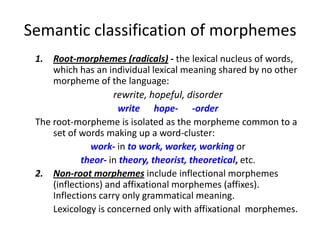
Semantic classification of morphemes
 1. Root-morphemes (radicals) - the lexical nucleus of words,
     which has an individual lexical meaning shared by no other
     morpheme of the language:
                     rewrite, hopeful, disorder
                      write hope- -order
 The root-morpheme is isolated as the morpheme common to a
     set of words making up a word-cluster:
               work- in to work, worker, working or
            theor- in theory, theorist, theoretical, etc.
 2. Non-root morphemes include inflectional morphemes
     (inflections) and affixational morphemes (affixes).
     Inflections carry only grammatical meaning.
     Lexicology is concerned only with affixational morphemes.
Root
A root is the base form
of a word which cannot
be further analysed
without left without
total loss of identity. It is
that part of the word left
when all the affixes are
removed.
Stem
• A stem is that part of a word to which grammatical affixes
  are added. It may consist -amongst others
• a) solely of a single root morpheme (i.e. a simple stem as in
  dog)
• b) two root morphemes (i.e. a compound stem, as in
  blackbird)
• c) root morpheme plus a derivational affix (i.e. a complex
  stem, as in unscrew)
• a):cats: single root morpheme: cat+ inflectional suffix –s
• b):crowbars: two root morphemes (crow + bar) +
  inflectional suffix –s
• c):inventions : root morpheme invent+ lexical suffix -ion +
  inflectional suffix -s
Affixes
• The term 'affix' is a collective term for the types of morphemes that
  can only be used in combination with other morphemes -ie for
  bound morphemes. Depending on the position where the affix is
  attached we can differentiate between
• Prefix. A prefix is an affix preceedes a base: un-tidy, dis-honest, ir—
  regular
• Suffix. A suffix is an affix which follows a base: dog-s, kick-ed,
  national—ise
• Infix. An infix is an affix which is added within a base. Infixation is
  not a morphological process in English. Compare German stand -
  stehen.
• Circumfix. A circumfix is an affix which spans a base. Circumfixation
  is not a morphological process in English. Compare Berber amdakul:
  tamdakul: "friend" / t-amdakul -t "friend (Fem)"
BASE
• Every form to which an affix can be added is a
  base. Every root and every stem is a thus a base.
  The set of bases, however, is larger than the
  union of all roots and stems, because the process
  of affixation applies recursively.
• EXAMPLE: untouchable Lexical prefix un- +
  touchable. touchable is not a root (it is complex,
  consisting of the root touch + lexical suffix -
  able).touchable is not a stem, either -it is not an
  inflectional form.
Just for fun =)
Morpheme
Morpheme

Morpheme

  • 1.
    Types of morphemes:Roots, Affixes, Stems, Bases Done by: Kumargalieva Aidana Makanbayeva Alma
  • 2.
    WHAT IS MORPHEME? •The basic unit of morphology is the morpheme. A morpheme can be described as a set of equivalent morphs, ie. linguistic signs that can not be dissected into smaller signs and can thus be glossed 'smallest meaningful units'.
  • 3.
    Semantic classification ofmorphemes 1. Root-morphemes (radicals) - the lexical nucleus of words, which has an individual lexical meaning shared by no other morpheme of the language: rewrite, hopeful, disorder write hope- -order The root-morpheme is isolated as the morpheme common to a set of words making up a word-cluster: work- in to work, worker, working or theor- in theory, theorist, theoretical, etc. 2. Non-root morphemes include inflectional morphemes (inflections) and affixational morphemes (affixes). Inflections carry only grammatical meaning. Lexicology is concerned only with affixational morphemes.
  • 4.
    Root A root isthe base form of a word which cannot be further analysed without left without total loss of identity. It is that part of the word left when all the affixes are removed.
  • 5.
    Stem • A stemis that part of a word to which grammatical affixes are added. It may consist -amongst others • a) solely of a single root morpheme (i.e. a simple stem as in dog) • b) two root morphemes (i.e. a compound stem, as in blackbird) • c) root morpheme plus a derivational affix (i.e. a complex stem, as in unscrew) • a):cats: single root morpheme: cat+ inflectional suffix –s • b):crowbars: two root morphemes (crow + bar) + inflectional suffix –s • c):inventions : root morpheme invent+ lexical suffix -ion + inflectional suffix -s
  • 6.
    Affixes • The term'affix' is a collective term for the types of morphemes that can only be used in combination with other morphemes -ie for bound morphemes. Depending on the position where the affix is attached we can differentiate between • Prefix. A prefix is an affix preceedes a base: un-tidy, dis-honest, ir— regular • Suffix. A suffix is an affix which follows a base: dog-s, kick-ed, national—ise • Infix. An infix is an affix which is added within a base. Infixation is not a morphological process in English. Compare German stand - stehen. • Circumfix. A circumfix is an affix which spans a base. Circumfixation is not a morphological process in English. Compare Berber amdakul: tamdakul: "friend" / t-amdakul -t "friend (Fem)"
  • 7.
    BASE • Every formto which an affix can be added is a base. Every root and every stem is a thus a base. The set of bases, however, is larger than the union of all roots and stems, because the process of affixation applies recursively. • EXAMPLE: untouchable Lexical prefix un- + touchable. touchable is not a root (it is complex, consisting of the root touch + lexical suffix - able).touchable is not a stem, either -it is not an inflectional form.
  • 9.