Catholic Social Teaching
A Key to Catholic Identity


Office for Social Justice
Archdiocese of Saint Paul and Minneapolis
328 West Kellogg Blvd., St. Paul, MN 55102
651-291-4477 http://www.osjspm.org
The Problem
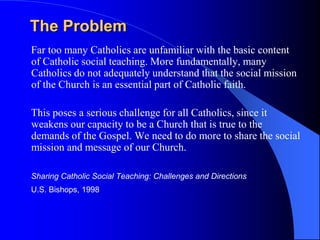
Far too many Catholics are unfamiliar with the basic content
of Catholic social teaching. More fundamentally, many
Catholics do not adequately understand that the social mission
of the Church is an essential part of Catholic faith.

This poses a serious challenge for all Catholics, since it
weakens our capacity to be a Church that is true to the
demands of the Gospel. We need to do more to share the social
mission and message of our Church.

Sharing Catholic Social Teaching: Challenges and Directions
U.S. Bishops, 1998
A Key to Catholic Identity
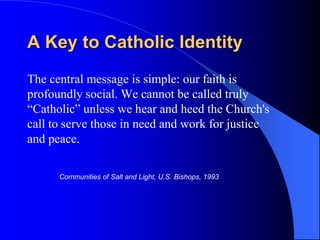
The central message is simple: our faith is
profoundly social. We cannot be called truly
“Catholic” unless we hear and heed the Church's
call to serve those in need and work for justice
and peace.

      Communities of Salt and Light, U.S. Bishops, 1993
Vatican II’s Ecclesiology

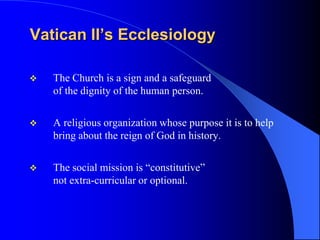
   The Church is a sign and a safeguard
    of the dignity of the human person.


   A religious organization whose purpose it is to help
    bring about the reign of God in history.

   The social mission is “constitutive”
    not extra-curricular or optional.
Justice in the World, 1971 Synod


Action on behalf of justice and participation
in the transformation of the world fully
appear to us as a constitutive dimension of
the preaching of the Gospel, or, in other
words, of the Church's mission for the
redemption of the human race and its
liberation from every oppressive situation.
Constitutive Elements of Church


   Scripture        -- hearing the Good News

   Sacraments       -- worship, prayer life, etc.

   Social Mission   -- action for social justice
Catholic Social Teaching
   Rooted in the Bible

   Continually developed in Catholic Social Teaching

         -- Observe, judge, act
Biblical themes of justice
   God is active in human history
   Creation
   Covenant relationship
   Community
   Anawim -- "the widows, orphans and aliens”
   The example of Jesus – reign of God, healing


          In biblical faith, the doing of justice
         is the primary expectation of Yahweh.
                                    Walter Brueggeman
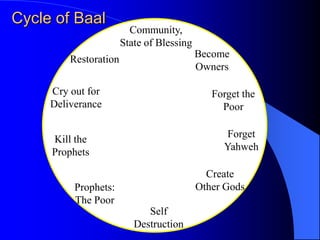
Cycle of Baal
                         Community,
                       State of Blessing
                                           Become
         Restoration
                                           Owners

     Cry out for                              Forget the
     Deliverance                                Poor


     Kill the                                    Forget
                                                Yahweh
     Prophets

                                             Create
          Prophets:                        Other Gods
          The Poor
                             Self
                          Destruction
Vatican II
This split between the faith which many profess and
their daily lives deserves to be counted among the
more serious errors of our age.

Long since, the Prophets of the Old Testament fought
vehemently against this scandal and even more so did
Jesus Christ Himself in the New Testament threaten it
with grave punishments.
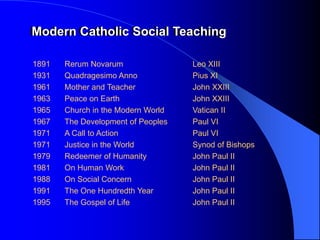
Modern Catholic Social Teaching

1891   Rerum Novarum                Leo XIII
1931   Quadragesimo Anno            Pius XI
1961   Mother and Teacher           John XXIII
1963   Peace on Earth               John XXIII
1965   Church in the Modern World   Vatican II
1967   The Development of Peoples   Paul VI
1971   A Call to Action             Paul VI
1971   Justice in the World         Synod of Bishops
1979   Redeemer of Humanity         John Paul II
1981   On Human Work                John Paul II
1988   On Social Concern            John Paul II
1991   The One Hundredth Year       John Paul II
1995   The Gospel of Life           John Paul II
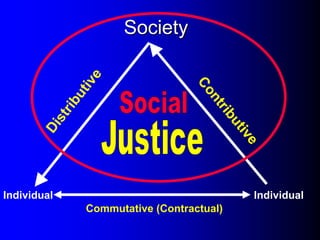
Society


Individual                               Individual
             Commutative (Contractual)
Major Themes from Catholic Social Teaching
1.    Human dignity
2.    Community
3.    Rights and duties
4.    Option for the poor
5.    Participation
6.    Economic Justice
7.    Stewardship of Creation
8.    Solidarity
9.    Role of Government
10.   Promotion of Peace
1. Human dignity

The person is sacred, made in the image of God.
2. Community / Common Good
   The social nature of the human person

  The fact that human beings are social by nature
  indicates that the betterment of the person and
  the improvement of society depend on each
  other.…humanity by its very nature stands
  completely in need of life in society.
                    Vatican II, The Church in the Modern World


  “Every man for himself,” said the elephant
  as he danced among the chickens.
                                  Charles Dickens
3. Rights and duties

      Civil/political

      Economic/social

       Every person has a right to the basic material
       necessities that are required to live a decent life.
4. Option for the Poor

 Remember the   “widows, orphans, and aliens.”

A   necessary element of the common good
5. Participation

  All people have a right to
  a minimum level of participation
  in the economic, political, and
  cultural life of society.
6. Economic Justice
    The economy must serve people, not the other way around.
     People are more important than things; labor is more
     important than capital.

    All workers have a right to productive work, to decent
     wages, to safe working conditions; and they have a right to
     organize and join unions.

    People have a right to economic initiative and private
     property, but these rights have limits. No one is allowed
     to amass excessive wealth when others lack the
     basic necessities of life.
7. Stewardship of Creation
  The goods of the earth are gifts.
  We hold them in trust, as stewards.

  “God destined the earth and all it contains for all people
  and nations so that all created things would be shared
  fairly by all humankind under the guidance of justice
  tempered by charity.”
                              On the Development of Peoples
8. The Virtue of Solidarity


  “It is a firm and persevering determination
  to commit oneself to the common good; that
  is to say, to the good of all ...because we are
  all really responsible for all.”

               Pope John Paul II, On Social Concern, 1987
9. Role of Government

 The state has a positive moral function.
  It is an instrument to promote human dignity,
  protect human rights, and build
  the common good

 Subsidiarity
      As small as possible
      As big as necessary
10. Promotion of Peace

    Peace is not just the absence of war

    “If you want peace, work for justice.”
            Pope Paul VI, 1972, World Day of Peace Message
Major Themes from Catholic Social Teaching

1.    Human dignity
2.    Community
3.    Rights and duties
4.    Option for the poor
5.    Participation
6.    Economic Justice
7.    Stewardship of Creation
8.    Solidarity
9.    Role of Government
10.   Promotion of Peace
Implications for Catholic Educators
Catholic schools, religious education and faith
formation programs are vitally important for sharing
the substance and values of the Catholic social
justice heritage.

Just as the social teaching of the Church is integral to
Catholic faith, the social justice dimensions of
teaching are integral to Catholic education and
catechesis. They are an essential part of Catholic
identity and formation.
      Sharing Catholic Social Teaching: Challenges and Directions
      U.S. Bishops, 1998
“Seven Commandments” for Integrating
Catholic Social Teaching into Our Faith

1.   Rooted in prayer and worship.
2.   Integrate, don’t isolate.
3.   Content counts – study the documents.
4.   Competency really counts.
5.   Charity (social service) is not enough.
6.   Thou shalt observe, judge, act.
7.   Thou shalt have fun!
Make sure the teaching
is rooted in prayer and worship.
Cultivate a spirituality that is not just private,
but also public and social.


    Catholicism does not call us to abandon
    the world, but to help shape it.
    This does not mean leaving worldly tasks and
    responsibilities, but transforming them.

    Everyday Christianity: To Hunger and Thirst for Justice
    U.S. Bishops, November, 1998
Integrate, don’t isolate
The commitment to human life and dignity, to
human rights and solidarity is a calling every
Catholic must share. It is not a vocation for a few,
but a challenge for every Catholic educator.

The values of the Church's social teaching must not
be treated as tangential or optional. They must be a
core part of teaching and formation.
Sharing Catholic Social Teaching: Challenges and Directions, U.S. Bishops, 1998
Content counts
Study the documents.

There is a universal need to be more explicit
in teaching the principles of Catholic social
thought and helping people apply and act on
those principles.

Sharing Catholic Social Teaching: Challenges and Directions
U.S. Bishops, 1998
Competency really counts

We strongly urge Catholic to create additional
resources and programs that will address the lack
of familiarity with Catholic social teaching among
many….
Sharing Catholic Social Teaching: Challenges and Directions
U.S. Bishops, 1998
Charity (social service)
is not enough.

There is a need for Catholic educational and
catechetical programs not only to continue
offering direct service experiences, but also to
offer opportunities to work for change in the
policies and structures that cause injustice.
       Sharing Catholic Social Teaching: Challenges and Directions
       U.S. Bishops, 1998
Thou shalt observe, judge, act

     Observe the facts; know the reality

     Use social analysis and moral values to make
      judgments about the facts

     Plan a realistic and effective strategy
      for action
Thou shalt have fun

No one likes a grim do-gooder!
Conclusion

Salt and Light for the World


“You’re supposed to be the leaven in the
loaf, not part of the lump.”
Internet Resources on
Catholic Social Teaching
 http://www.osjspm.org/cst
 http://www.osjspm.org/justed.htm
 http://www.mcgill.pvt.k12.al.us/jerryd/cm/cst.htm


    This PowerPoint presentation can be
       downloaded at the following web address:

        http://www.osjspm.org/cst.htm
Catholic Social Teaching

A Key to Catholic Identity
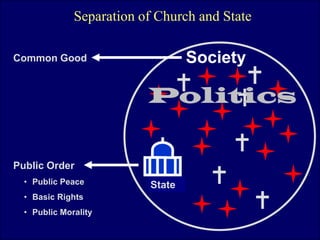
Separation of Church and State

Common Good                       Society

                          Politics

Public Order
  • Public Peace          State
  • Basic Rights
  • Public Morality

Catholic social teaching

  • 1.
    Catholic Social Teaching AKey to Catholic Identity Office for Social Justice Archdiocese of Saint Paul and Minneapolis 328 West Kellogg Blvd., St. Paul, MN 55102 651-291-4477 http://www.osjspm.org
  • 2.
    The Problem Far toomany Catholics are unfamiliar with the basic content of Catholic social teaching. More fundamentally, many Catholics do not adequately understand that the social mission of the Church is an essential part of Catholic faith. This poses a serious challenge for all Catholics, since it weakens our capacity to be a Church that is true to the demands of the Gospel. We need to do more to share the social mission and message of our Church. Sharing Catholic Social Teaching: Challenges and Directions U.S. Bishops, 1998
  • 3.
    A Key toCatholic Identity The central message is simple: our faith is profoundly social. We cannot be called truly “Catholic” unless we hear and heed the Church's call to serve those in need and work for justice and peace. Communities of Salt and Light, U.S. Bishops, 1993
  • 4.
    Vatican II’s Ecclesiology  The Church is a sign and a safeguard of the dignity of the human person.  A religious organization whose purpose it is to help bring about the reign of God in history.  The social mission is “constitutive” not extra-curricular or optional.
  • 5.
    Justice in theWorld, 1971 Synod Action on behalf of justice and participation in the transformation of the world fully appear to us as a constitutive dimension of the preaching of the Gospel, or, in other words, of the Church's mission for the redemption of the human race and its liberation from every oppressive situation.
  • 6.
    Constitutive Elements ofChurch  Scripture -- hearing the Good News  Sacraments -- worship, prayer life, etc.  Social Mission -- action for social justice
  • 7.
    Catholic Social Teaching  Rooted in the Bible  Continually developed in Catholic Social Teaching -- Observe, judge, act
  • 8.
    Biblical themes ofjustice  God is active in human history  Creation  Covenant relationship  Community  Anawim -- "the widows, orphans and aliens”  The example of Jesus – reign of God, healing In biblical faith, the doing of justice is the primary expectation of Yahweh. Walter Brueggeman
  • 9.
    Cycle of Baal Community, State of Blessing Become Restoration Owners Cry out for Forget the Deliverance Poor Kill the Forget Yahweh Prophets Create Prophets: Other Gods The Poor Self Destruction
  • 10.
    Vatican II This splitbetween the faith which many profess and their daily lives deserves to be counted among the more serious errors of our age. Long since, the Prophets of the Old Testament fought vehemently against this scandal and even more so did Jesus Christ Himself in the New Testament threaten it with grave punishments.
  • 11.
    Modern Catholic SocialTeaching Modern Catholic Social Teaching 1891 Rerum Novarum Leo XIII 1931 Quadragesimo Anno Pius XI 1961 Mother and Teacher John XXIII 1963 Peace on Earth John XXIII 1965 Church in the Modern World Vatican II 1967 The Development of Peoples Paul VI 1971 A Call to Action Paul VI 1971 Justice in the World Synod of Bishops 1979 Redeemer of Humanity John Paul II 1981 On Human Work John Paul II 1988 On Social Concern John Paul II 1991 The One Hundredth Year John Paul II 1995 The Gospel of Life John Paul II
  • 12.
    Society Individual Individual Commutative (Contractual)
  • 13.
    Major Themes fromCatholic Social Teaching 1. Human dignity 2. Community 3. Rights and duties 4. Option for the poor 5. Participation 6. Economic Justice 7. Stewardship of Creation 8. Solidarity 9. Role of Government 10. Promotion of Peace
  • 14.
    1. Human dignity Theperson is sacred, made in the image of God.
  • 15.
    2. Community /Common Good The social nature of the human person The fact that human beings are social by nature indicates that the betterment of the person and the improvement of society depend on each other.…humanity by its very nature stands completely in need of life in society. Vatican II, The Church in the Modern World “Every man for himself,” said the elephant as he danced among the chickens. Charles Dickens
  • 16.
    3. Rights andduties  Civil/political  Economic/social Every person has a right to the basic material necessities that are required to live a decent life.
  • 17.
    4. Option forthe Poor  Remember the “widows, orphans, and aliens.” A necessary element of the common good
  • 18.
    5. Participation All people have a right to a minimum level of participation in the economic, political, and cultural life of society.
  • 19.
    6. Economic Justice  The economy must serve people, not the other way around. People are more important than things; labor is more important than capital.  All workers have a right to productive work, to decent wages, to safe working conditions; and they have a right to organize and join unions.  People have a right to economic initiative and private property, but these rights have limits. No one is allowed to amass excessive wealth when others lack the basic necessities of life.
  • 20.
    7. Stewardship ofCreation The goods of the earth are gifts. We hold them in trust, as stewards. “God destined the earth and all it contains for all people and nations so that all created things would be shared fairly by all humankind under the guidance of justice tempered by charity.” On the Development of Peoples
  • 21.
    8. The Virtueof Solidarity “It is a firm and persevering determination to commit oneself to the common good; that is to say, to the good of all ...because we are all really responsible for all.” Pope John Paul II, On Social Concern, 1987
  • 22.
    9. Role ofGovernment  The state has a positive moral function. It is an instrument to promote human dignity, protect human rights, and build the common good  Subsidiarity As small as possible As big as necessary
  • 23.
    10. Promotion ofPeace  Peace is not just the absence of war  “If you want peace, work for justice.” Pope Paul VI, 1972, World Day of Peace Message
  • 24.
    Major Themes fromCatholic Social Teaching 1. Human dignity 2. Community 3. Rights and duties 4. Option for the poor 5. Participation 6. Economic Justice 7. Stewardship of Creation 8. Solidarity 9. Role of Government 10. Promotion of Peace
  • 25.
    Implications for CatholicEducators Catholic schools, religious education and faith formation programs are vitally important for sharing the substance and values of the Catholic social justice heritage. Just as the social teaching of the Church is integral to Catholic faith, the social justice dimensions of teaching are integral to Catholic education and catechesis. They are an essential part of Catholic identity and formation. Sharing Catholic Social Teaching: Challenges and Directions U.S. Bishops, 1998
  • 26.
    “Seven Commandments” forIntegrating Catholic Social Teaching into Our Faith 1. Rooted in prayer and worship. 2. Integrate, don’t isolate. 3. Content counts – study the documents. 4. Competency really counts. 5. Charity (social service) is not enough. 6. Thou shalt observe, judge, act. 7. Thou shalt have fun!
  • 27.
    Make sure theteaching is rooted in prayer and worship. Cultivate a spirituality that is not just private, but also public and social. Catholicism does not call us to abandon the world, but to help shape it. This does not mean leaving worldly tasks and responsibilities, but transforming them. Everyday Christianity: To Hunger and Thirst for Justice U.S. Bishops, November, 1998
  • 28.
    Integrate, don’t isolate Thecommitment to human life and dignity, to human rights and solidarity is a calling every Catholic must share. It is not a vocation for a few, but a challenge for every Catholic educator. The values of the Church's social teaching must not be treated as tangential or optional. They must be a core part of teaching and formation. Sharing Catholic Social Teaching: Challenges and Directions, U.S. Bishops, 1998
  • 29.
    Content counts Study thedocuments. There is a universal need to be more explicit in teaching the principles of Catholic social thought and helping people apply and act on those principles. Sharing Catholic Social Teaching: Challenges and Directions U.S. Bishops, 1998
  • 30.
    Competency really counts Westrongly urge Catholic to create additional resources and programs that will address the lack of familiarity with Catholic social teaching among many…. Sharing Catholic Social Teaching: Challenges and Directions U.S. Bishops, 1998
  • 31.
    Charity (social service) isnot enough. There is a need for Catholic educational and catechetical programs not only to continue offering direct service experiences, but also to offer opportunities to work for change in the policies and structures that cause injustice. Sharing Catholic Social Teaching: Challenges and Directions U.S. Bishops, 1998
  • 32.
    Thou shalt observe,judge, act  Observe the facts; know the reality  Use social analysis and moral values to make judgments about the facts  Plan a realistic and effective strategy for action
  • 33.
    Thou shalt havefun No one likes a grim do-gooder!
  • 34.
    Conclusion Salt and Lightfor the World “You’re supposed to be the leaven in the loaf, not part of the lump.”
  • 35.
    Internet Resources on CatholicSocial Teaching  http://www.osjspm.org/cst  http://www.osjspm.org/justed.htm  http://www.mcgill.pvt.k12.al.us/jerryd/cm/cst.htm This PowerPoint presentation can be downloaded at the following web address: http://www.osjspm.org/cst.htm
  • 36.
    Catholic Social Teaching AKey to Catholic Identity
  • 37.
    Separation of Churchand State Common Good Society Politics Public Order • Public Peace State • Basic Rights • Public Morality