Theology

   Theology is “faith seeking
    understanding.” - St. Anselm

   Theology is “the science which
    interprets, explains, defends and unfolds
    divine revelation” - (F. Muñiz, O.P.).
Two things are required to be a responsible
Christian
according to Protestant theologian Karl Barth.

 To read the newspapers and to read the
  Sacred Scriptures daily
 One has to read the newspapers to
  know the situation of the world and of
  the country.
 One has to read the Bible to interpret
  that situation – the signs of the times –
  according to faith.
Theology is specifically one science: God is
One.
 it deals with God and the things that
  have relationship with God, either as
  principle or as end
 It has no subjective or specific parts
 It has, however, different integral parts -
  different treatises
 It is mainly divided, according to content,
  into dogmatic and moral theology.
Dogmatic Theology and Moral Theology

 Dogmatic Theology guides us in the
  contemplation of the truth about God
  One and Triune and his Creation: it is
  orthodoxy.
 Moral Theology points to us how to do
  the truth in love: it is orthopraxis.
 There is, indeed, one theology:
  dogmatic theology has moral
  consequences, and moral theology
  possesses dogmatic premises.
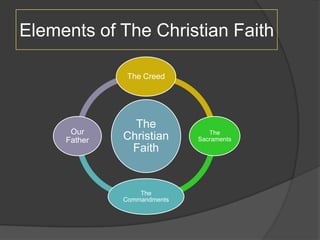
Elements of The Christian Faith

               The Creed


                The
      Our                       The
     Father   Christian      Sacraments
               Faith


                  The
              Commandments
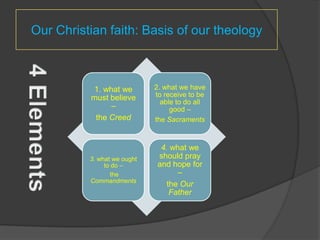
Our Christian faith: Basis of our theology


           1. what we        2. what we have
          must believe       to receive to be
                               able to do all
                –                 good –
           the Creed         the Sacraments


                               4. what we
          3. what we ought    should pray
               to do –        and hope for
                 the                –
          Commandments
                                 the Our
                                  Father
Christian Morality
 Christianity is not a morality, but
  radically an experience of the paschal
  mystery.
 Christianity, however, implies
  necessarily a morality, a way of being
  and acting.
 A Christian has to face this moral
  question: “What must I do?” (Act. 2:37)
MORAL
    THEOLOGY
 The human person is fundamentally a moral or ethical
  being, that is, she or he is fundamentally free – and
  responsible.
 People talk of moral (good) and immoral (bad) things; and
  of moral, immoral or amoral people.
 Immoral, when a person who knowing what he should do
  does not do it, or does the opposite: he possesses moral
  sense but has no moral strength
 Amoral, when a person does not have a moral sense,
  that is, he is blind to some moral values
 Moral, when he or she knows what is good and usually
  does it, and what is evil and ordinarily does not do it
 The radical question of ethics and
  Christian ethics is not really what must I
  do?
 But rather, what –or who- must I be?
            - (Cornelius van der Poel, C.S.Sp.).
 A morally good person has good
  (loving), options, attitudes and actions.
“What  counts is
   not to do,
  but to love.”
  - St. Francis of Assisi
Moral
    Theology
According to St. Thomas Aquinas,
“Moral Theology studies the human person
             as the image of God.”
 Moral theology points out to man the
  way to be a good image of God, that
  is, a good creature and child of God.
 Moral Theology points out to us the way
  to follow Jesus Christ, the way to be his
  disciples.
Moral
    Theology
 St. Thomas gives a second definition of
  Moral Theology: “Moral Theology
  studies the movement of the rational
  creature towards God.”
 life is a movement towards personal and
  communitarian realization;
 it is becoming more what one is, a
  journey to God - to happiness, to
  perfection, to love.
Task of Moral Theology

   The task of Moral Theology is to guide
    Christians – and men and women of
    good will – to become more and more
    good human beings, that is, free and
    responsible, and good Christians, that is
    real followers of Christ.
PARTS OF MORAL THEOLOGY

 General Theology considers the
  fundamental moral principles, values
  and categories
 Special Moral Theology discusses the
  ethics of the person (including bioethics)
  and social ethics; it takes up, above
  all, the human and Christian virtues - the
  moral virtues, the theological virtue and
  the Gifts of the Holy Spirit.
SOURCES OF MORAL THEOLOGY

 The   two main sources Moral Theology :
        Sacred Scriptures and Tradition

 Ethics studies human conduct in the light
  of reason
 Moral Theology considers human
  conduct from the light of reason
  enlightened by faith.
Sacred Scriptures and Tradition:
Sources of Moral Theology
 Moral Theology argues mainly from
  divine authority, that is, from the
  revelation of faith.
 As a true science, Moral Theology also
  uses reason to argue its propositions
  and premises.
 Moral Theology builds on human ethics;
  it connects with revelation (faith) and
  culture (natural theology); it is a bridge
  that links both.
Sacred Scriptures and Tradition:
Sources of Moral Theology

    “The Church is, by the will of God, the
    teacher of the truth. It is her duty to give
       utterance to and authoritatively to
        teach, that Truth which is Christ
  himself, and also to declare and confirm by
   her authority those principles of the moral
     order which have their origin in nature
                      itself”
        (Vatican II, Dignitatis Humanae, DH, 14; see Id., Dei
                                           Verbum, DV, 10).
Goal of Moral Theology

   Ethics is the science of correct doing.

   Christian ethics is the science of correct
    Christian “doing” – doing the truth of faith
    in love. Christian ethics or Moral Theology
    is the science of Christian praxis.
Goal of Moral Theology

   The goal of ethics is human happiness
    through right living.

   The goal of Christian ethics or Moral
    Theology is eternal salvation through a
    life in Christ, who is the perfect model of
    humanity.
Moral Theology tries to help us do the
   right thing in our lives. It can give
 direction and meaning to our lives. It
 teaches us the art of living: “How all
     and each one can be happy”.
                              - (R. Larrañeta).
Ultimate Goal
 The ultimate goal of Christian
 ethics is the beatific vision of
 God in heaven in the
 company of Our Lady and the
 saints and our relatives and
 friends - and of all God‟s
 friends.
Proximate Goal
 The proximate goal of Moral
 Theology is to develop “moral
 adulthood,” that is, the ability
   to make decisions and to
     assume responsibility.
                    - (L. Monden, S.J.).
Immediate Goal

The  immediate goal of
 Moral Theology is
 continuing conversion,
 integral liberation, or
 holiness.
“The fundamental principle of
   moral theology is: Love
  God and your neighbor as
          yourself.”
                   - Benedict Ashley
“To know and not to do
     is not to know”
             - (A Buddhist saying)
 The  end of Moral Theology is to help us
  walk by the way of God.
 In a real sense, Christian morality is the
  morality of the Way. And the Way for us is
  Christ (Jn 14:6).
 In truth, “the following of Christ is the
  essential and primordial dimension of
  Christian morality” (John Paul II, Veritatis Splendor, VS, no. 19).
 When   all is said and done, what
  matters in ethics and in Christian
  ethics is love – God’s love and our
  loving response to it.

 “Inthe evening of life, we will be
  examined on love. Only on love!”
                    - St. John of the Cross
Acknowledgement:
 Fr. Fausto Gomez, OP
 Life Today Magazine, August 2002
 A Pilgrim’s Notes

Introduction to moral theology

  • 1.
    Theology  Theology is “faith seeking understanding.” - St. Anselm  Theology is “the science which interprets, explains, defends and unfolds divine revelation” - (F. Muñiz, O.P.).
  • 2.
    Two things arerequired to be a responsible Christian according to Protestant theologian Karl Barth.  To read the newspapers and to read the Sacred Scriptures daily  One has to read the newspapers to know the situation of the world and of the country.  One has to read the Bible to interpret that situation – the signs of the times – according to faith.
  • 3.
    Theology is specificallyone science: God is One.  it deals with God and the things that have relationship with God, either as principle or as end  It has no subjective or specific parts  It has, however, different integral parts - different treatises  It is mainly divided, according to content, into dogmatic and moral theology.
  • 4.
    Dogmatic Theology andMoral Theology  Dogmatic Theology guides us in the contemplation of the truth about God One and Triune and his Creation: it is orthodoxy.  Moral Theology points to us how to do the truth in love: it is orthopraxis.  There is, indeed, one theology: dogmatic theology has moral consequences, and moral theology possesses dogmatic premises.
  • 5.
    Elements of TheChristian Faith The Creed The Our The Father Christian Sacraments Faith The Commandments
  • 6.
    Our Christian faith:Basis of our theology 1. what we 2. what we have must believe to receive to be able to do all – good – the Creed the Sacraments 4. what we 3. what we ought should pray to do – and hope for the – Commandments the Our Father
  • 7.
    Christian Morality  Christianityis not a morality, but radically an experience of the paschal mystery.  Christianity, however, implies necessarily a morality, a way of being and acting.  A Christian has to face this moral question: “What must I do?” (Act. 2:37)
  • 8.
    MORAL THEOLOGY  The human person is fundamentally a moral or ethical being, that is, she or he is fundamentally free – and responsible.  People talk of moral (good) and immoral (bad) things; and of moral, immoral or amoral people.  Immoral, when a person who knowing what he should do does not do it, or does the opposite: he possesses moral sense but has no moral strength  Amoral, when a person does not have a moral sense, that is, he is blind to some moral values  Moral, when he or she knows what is good and usually does it, and what is evil and ordinarily does not do it
  • 9.
     The radicalquestion of ethics and Christian ethics is not really what must I do?  But rather, what –or who- must I be? - (Cornelius van der Poel, C.S.Sp.).  A morally good person has good (loving), options, attitudes and actions.
  • 10.
    “What countsis not to do, but to love.” - St. Francis of Assisi
  • 11.
    Moral Theology According to St. Thomas Aquinas, “Moral Theology studies the human person as the image of God.”  Moral theology points out to man the way to be a good image of God, that is, a good creature and child of God.  Moral Theology points out to us the way to follow Jesus Christ, the way to be his disciples.
  • 12.
    Moral Theology  St. Thomas gives a second definition of Moral Theology: “Moral Theology studies the movement of the rational creature towards God.”  life is a movement towards personal and communitarian realization;  it is becoming more what one is, a journey to God - to happiness, to perfection, to love.
  • 13.
    Task of MoralTheology  The task of Moral Theology is to guide Christians – and men and women of good will – to become more and more good human beings, that is, free and responsible, and good Christians, that is real followers of Christ.
  • 14.
    PARTS OF MORALTHEOLOGY  General Theology considers the fundamental moral principles, values and categories  Special Moral Theology discusses the ethics of the person (including bioethics) and social ethics; it takes up, above all, the human and Christian virtues - the moral virtues, the theological virtue and the Gifts of the Holy Spirit.
  • 15.
    SOURCES OF MORALTHEOLOGY  The two main sources Moral Theology : Sacred Scriptures and Tradition  Ethics studies human conduct in the light of reason  Moral Theology considers human conduct from the light of reason enlightened by faith.
  • 16.
    Sacred Scriptures andTradition: Sources of Moral Theology  Moral Theology argues mainly from divine authority, that is, from the revelation of faith.  As a true science, Moral Theology also uses reason to argue its propositions and premises.  Moral Theology builds on human ethics; it connects with revelation (faith) and culture (natural theology); it is a bridge that links both.
  • 17.
    Sacred Scriptures andTradition: Sources of Moral Theology  “The Church is, by the will of God, the teacher of the truth. It is her duty to give utterance to and authoritatively to teach, that Truth which is Christ himself, and also to declare and confirm by her authority those principles of the moral order which have their origin in nature itself” (Vatican II, Dignitatis Humanae, DH, 14; see Id., Dei Verbum, DV, 10).
  • 18.
    Goal of MoralTheology  Ethics is the science of correct doing.  Christian ethics is the science of correct Christian “doing” – doing the truth of faith in love. Christian ethics or Moral Theology is the science of Christian praxis.
  • 19.
    Goal of MoralTheology  The goal of ethics is human happiness through right living.  The goal of Christian ethics or Moral Theology is eternal salvation through a life in Christ, who is the perfect model of humanity.
  • 20.
    Moral Theology triesto help us do the right thing in our lives. It can give direction and meaning to our lives. It teaches us the art of living: “How all and each one can be happy”. - (R. Larrañeta).
  • 21.
    Ultimate Goal  Theultimate goal of Christian ethics is the beatific vision of God in heaven in the company of Our Lady and the saints and our relatives and friends - and of all God‟s friends.
  • 22.
    Proximate Goal  Theproximate goal of Moral Theology is to develop “moral adulthood,” that is, the ability to make decisions and to assume responsibility. - (L. Monden, S.J.).
  • 23.
    Immediate Goal The immediate goal of Moral Theology is continuing conversion, integral liberation, or holiness.
  • 24.
    “The fundamental principleof moral theology is: Love God and your neighbor as yourself.” - Benedict Ashley
  • 25.
    “To know andnot to do is not to know” - (A Buddhist saying)
  • 26.
     The end of Moral Theology is to help us walk by the way of God.  In a real sense, Christian morality is the morality of the Way. And the Way for us is Christ (Jn 14:6).  In truth, “the following of Christ is the essential and primordial dimension of Christian morality” (John Paul II, Veritatis Splendor, VS, no. 19).
  • 27.
     When all is said and done, what matters in ethics and in Christian ethics is love – God’s love and our loving response to it.  “Inthe evening of life, we will be examined on love. Only on love!” - St. John of the Cross
  • 28.
    Acknowledgement:  Fr. FaustoGomez, OP  Life Today Magazine, August 2002  A Pilgrim’s Notes