CHAPTER 7:          Struggling with
                     Moral Evil: SIN
Everyday we are challenged by occasions
of sin;
 Sin is the greatest obstacle to authentic
freedom; it rejects the good to which we
are directed by our conscience;
It is a refusal of God’s love in the moral
law.
Sin is breaking our fundamental loving
relationship with God, others and even
ourselves.
Awareness of our sinfulness can also
be a moment of grace, for we have
realized our failure to act in love.

But the most important thing to
remember is not suffering brought
about by sin and sin itself:

It is God’s love, mercy, healing and
forgiveness.
But what is really the reality of sin all about?


When do we commit sin?

At its core is human selfishness or
self-centeredness; this is an event
or moment in our life when we fail
to love and hurt others.
But what is really the reality of sin all about?

At the middle of sin is letter “I”

We can say that it is also basically PRIDE.

As followers of Christ we have to be aware of our
sinfulness in order to be able to sense our need for
God’s love and forgiveness, our need for Christ.

In sin we forget that we are persons-in-a-community,
especially when we hurt or offend them. .

The irony of it is this: “by being selfish we deceive
and destroy our very selves.”
Sometimes we downgrade the reality of sin in our life
and mistook them as petty mistakes. What are the
effects of this notion regarding sin?

•it is merely a stage in our personal growth, a part of
self-becoming. It is the loss the sense of sin. (ex.
Freedom to do what they want to do . . . anyway
everybody is doing it . . . )

•We tend to rationalize our sinful acts.

•It is simply a state of the mind or acts of the thoughts
that create feelings of sin or guilt.

•Some people over stress the power of sin to the point
of that they lose God’s power to save them. Evil will
triumph. Tao lang tayo, mahina, walang magagawa.
Jesus and Sin
To understand the extent and depth of human
sinfulness, we need to experience and behold the
depth and greatness of God’s love to humanity – in
particular at the crucified Savior.
The cross is a symbol of shame – of the power and
ugliness of sin, its power that created so much
human suffering.

But the crucified Savior transformed the cross into a
symbol of God’s great love, of forgiveness of
redemption. Through he cross Christ destroys sin
and death! Through the cross, Jesus restores our
friendship with God - a relationship broken by sin.
Jesus and Sin
Jesus shows us that sin hinders us from truly
loving God and others.
The Parable of the Prodigal Son describes
clearly God’s love for humanity. But
forgiveness comes about after repentance
and conversion -       it is a process of
transformation.

Jesus is giving us a new chance!
Sin Stories
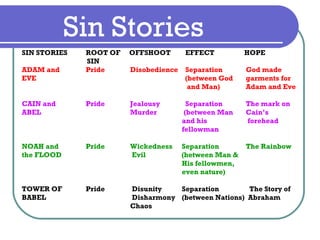
SIN STORIES   ROOT OF   OFFSHOOT       EFFECT           HOPE
              SIN
ADAM and      Pride     Disobedience   Separation       God made
EVE                                    (between God     garments for
                                        and Man)        Adam and Eve

CAIN and      Pride     Jealousy         Separation     The mark on
ABEL                    Murder          (between Man    Cain’s
                                       and his          forehead
                                       fellowman

NOAH and      Pride     Wickedness     Separation       The Rainbow
the FLOOD               Evil           (between Man &
                                       His fellowmen,
                                       even nature)

TOWER OF      Pride     Disunity   Separation        The Story of
BABEL                   Disharmony (between Nations) Abraham
                        Chaos
What is Original Sin?
In the story of Adam and Eve, we learned that
because of pride and disobedience, sin started to
enter into the world, with its consequences.

In baptism, we learned that through the symbol of
water and through the power of the Holy Spirit, we
are cleansed from all sins, given a new life and
incorporated into the Church

Through these two notions or concepts, we will try
to understand what original is all about.
What is Original Sin?
ORIGINAL SIN – can refer to two concepts
• The sinful act committed by our first parents

When Adam and Eve abused their freedom and
 disobeyed God and did evil before Him, they
 REJECTED God (th4e Cause of their existence).

By sinning, they lost the true meaning of their
  TRUE selves as the image and likeness of God.
  By sinning they acted against their own very
  nature as human beings.

By sinning they lost original holiness and justice.
What is Original Sin?
2. The sinful state or condition resulting
  from their sinful act.

Original sin as “kasalanang mana” (that we
 already have a sin when we were born),
 does not mean that we carry within
 ourselves that sinful act of our first
 parents.

Instead what we inherited the sinful
  condition which was the consequence of
  the first sinful act, which we experience
What is Original Sin?

Sin is not biological that can be
inherited.

The water used in baptism does
not physically wash away original
sin. Rather it symbolizes a new
life, through the Holy Spirit. It
empowers us to reject sin.
What is Original Sin?
Baptism incorporates us into the
Church, into the family of God. It
cleanses us. It reconciles us with
God.

However, we remain in this sinful
world and continue to experience the
lure of sin and its effects. We need to
continue to resist and fight sin.
Therefore, our experience of original sin
            includes two points:
1. Our Concupiscence - it refers to the disorder of
      our natural desires that attracts us to sin; it is
      our weakened state within; though our
conscience obliges us to do good,        nonetheless
deep inside us there is an        inclination to sin.
This is the tension within         us: the effects of
grace and effects of sin.

            It creates an obstacle to the authentic
      exercise of our freedom. Thus we have to be
      strong and never forget to pray for God’s
assistance, especially when deciding or    making
decisions.
What is Original Sin?
2. The sin of the world –   this is what we
experience        in this     sinful world,
temptations, sufferings,    pains, death –
all because of sin.

It refers to the effects of the first sinful
act; it does not only disturb our inner
disposition, it equally affected also all
levels of human relationships (refer to
the sin stories)
Kinds of Sin
3.Mortal Sin –   destroys our relationship with God
                 and with one another; needs to be
                 confessed

5.Venial Sin –   weakens our relationship with God
                 and with one another; sincere act
                 of contrition is enough to obtain
                 forgiveness

Note: though believed to be relatively small, venial
      sins are very dangerous; repeatedly
committed, it can also LEAD us to commit mortal
sin.
Classification of Sin

3.Sin of Commission:

     - performance of a forbidden act.
     - doing what we are not supposed to do

2. Sin of Omission:

     - failure to perform an obligatory act
     - not doing what we are supposed to do
Other forms of sins

Personal Sin and Social Sin:

Personal sins results when we freely choose to
give in to our self centered tendencies; however
since we are all persons-in-community, all
personal sins (no matter how secret or private they
seem to be) have social effects;

All our evil inclinations can be summed up into
seven. We call them seven capital sins, not
because they are sins per se but because they are
the easiest sources of our sins.
Other forms of sins

  2. Social Sins:

  These sins refer to negative
moral attitudes and acts or failure
to act which run counter to the
common good.

  Ex.      discrimination,      or
prejudices
The Seven “Capital” (deadly) Sins
1. Pride:           an inordinate love of one’s own excellence; an excessive love
                    of self or self esteem

           The virtue of humility (which disposes us to acknowledge
           our limitations) is opposed to pride

2. Covetousness:              the excessive love for, and seeking after, wealth
   and other                  worldly possessions

           Liberality (disposes us to rightly use worldly goods) is
           opposed to covetousness.

3. Lust:            the inordinate seeking of the pleasures of the flesh
           Chastity is the virtue opposed to lust.

4. Anger:           a strong feeling of displeasure, combined with a desire to
                    inflict punishment on the offender

           The virtues of meekness and patience are opposed to anger.
The Seven “Capital” (deadly) Sins
    5. Gluttony: an excessive desire for or indulgence in food and
                         drink

                        The virtue of temperance is opposed to
gluttony.

    6. Envy:    a bitter feeling at the excellence or good fortune of
                          those who are better or happier, with a
desire to rob             them of what they have.

                        The virtue opposed to envy is charity.

    7. Sloth:   the neglect of one’s duties, spiritual or temporal,
                        through laziness. (also called tepidity –
spiritual
                        sloth)

                        The virtues of diligence and zeal (fervor for
                        salvation) are opposed to sloth.
The Sacrament of Reconciliation
       Important points to remember:
1. We are all sinners and we need God’s mercy and
   forgiveness.
2. We need to confess at least once a year; it is
   recommended to go to confession once we have
   committed sins.
3. In confession, there is a need for sincerity and
   humility.
4. In confession, the most important thing is not
   our sins; it the experience of God’s loving
   mercy and forgiveness – which in return we
   must do to others
5. Inasmuch as we have been forgiven, we too must
   also forgive others.

Sin

  • 1.
    CHAPTER 7: Struggling with Moral Evil: SIN Everyday we are challenged by occasions of sin; Sin is the greatest obstacle to authentic freedom; it rejects the good to which we are directed by our conscience; It is a refusal of God’s love in the moral law. Sin is breaking our fundamental loving relationship with God, others and even ourselves.
  • 2.
    Awareness of oursinfulness can also be a moment of grace, for we have realized our failure to act in love. But the most important thing to remember is not suffering brought about by sin and sin itself: It is God’s love, mercy, healing and forgiveness.
  • 3.
    But what isreally the reality of sin all about? When do we commit sin? At its core is human selfishness or self-centeredness; this is an event or moment in our life when we fail to love and hurt others.
  • 4.
    But what isreally the reality of sin all about? At the middle of sin is letter “I” We can say that it is also basically PRIDE. As followers of Christ we have to be aware of our sinfulness in order to be able to sense our need for God’s love and forgiveness, our need for Christ. In sin we forget that we are persons-in-a-community, especially when we hurt or offend them. . The irony of it is this: “by being selfish we deceive and destroy our very selves.”
  • 5.
    Sometimes we downgradethe reality of sin in our life and mistook them as petty mistakes. What are the effects of this notion regarding sin? •it is merely a stage in our personal growth, a part of self-becoming. It is the loss the sense of sin. (ex. Freedom to do what they want to do . . . anyway everybody is doing it . . . ) •We tend to rationalize our sinful acts. •It is simply a state of the mind or acts of the thoughts that create feelings of sin or guilt. •Some people over stress the power of sin to the point of that they lose God’s power to save them. Evil will triumph. Tao lang tayo, mahina, walang magagawa.
  • 6.
    Jesus and Sin Tounderstand the extent and depth of human sinfulness, we need to experience and behold the depth and greatness of God’s love to humanity – in particular at the crucified Savior. The cross is a symbol of shame – of the power and ugliness of sin, its power that created so much human suffering. But the crucified Savior transformed the cross into a symbol of God’s great love, of forgiveness of redemption. Through he cross Christ destroys sin and death! Through the cross, Jesus restores our friendship with God - a relationship broken by sin.
  • 7.
    Jesus and Sin Jesusshows us that sin hinders us from truly loving God and others. The Parable of the Prodigal Son describes clearly God’s love for humanity. But forgiveness comes about after repentance and conversion - it is a process of transformation. Jesus is giving us a new chance!
  • 8.
    Sin Stories SIN STORIES ROOT OF OFFSHOOT EFFECT HOPE SIN ADAM and Pride Disobedience Separation God made EVE (between God garments for and Man) Adam and Eve CAIN and Pride Jealousy Separation The mark on ABEL Murder (between Man Cain’s and his forehead fellowman NOAH and Pride Wickedness Separation The Rainbow the FLOOD Evil (between Man & His fellowmen, even nature) TOWER OF Pride Disunity Separation The Story of BABEL Disharmony (between Nations) Abraham Chaos
  • 9.
    What is OriginalSin? In the story of Adam and Eve, we learned that because of pride and disobedience, sin started to enter into the world, with its consequences. In baptism, we learned that through the symbol of water and through the power of the Holy Spirit, we are cleansed from all sins, given a new life and incorporated into the Church Through these two notions or concepts, we will try to understand what original is all about.
  • 10.
    What is OriginalSin? ORIGINAL SIN – can refer to two concepts • The sinful act committed by our first parents When Adam and Eve abused their freedom and disobeyed God and did evil before Him, they REJECTED God (th4e Cause of their existence). By sinning, they lost the true meaning of their TRUE selves as the image and likeness of God. By sinning they acted against their own very nature as human beings. By sinning they lost original holiness and justice.
  • 11.
    What is OriginalSin? 2. The sinful state or condition resulting from their sinful act. Original sin as “kasalanang mana” (that we already have a sin when we were born), does not mean that we carry within ourselves that sinful act of our first parents. Instead what we inherited the sinful condition which was the consequence of the first sinful act, which we experience
  • 12.
    What is OriginalSin? Sin is not biological that can be inherited. The water used in baptism does not physically wash away original sin. Rather it symbolizes a new life, through the Holy Spirit. It empowers us to reject sin.
  • 13.
    What is OriginalSin? Baptism incorporates us into the Church, into the family of God. It cleanses us. It reconciles us with God. However, we remain in this sinful world and continue to experience the lure of sin and its effects. We need to continue to resist and fight sin.
  • 14.
    Therefore, our experienceof original sin includes two points: 1. Our Concupiscence - it refers to the disorder of our natural desires that attracts us to sin; it is our weakened state within; though our conscience obliges us to do good, nonetheless deep inside us there is an inclination to sin. This is the tension within us: the effects of grace and effects of sin. It creates an obstacle to the authentic exercise of our freedom. Thus we have to be strong and never forget to pray for God’s assistance, especially when deciding or making decisions.
  • 15.
    What is OriginalSin? 2. The sin of the world – this is what we experience in this sinful world, temptations, sufferings, pains, death – all because of sin. It refers to the effects of the first sinful act; it does not only disturb our inner disposition, it equally affected also all levels of human relationships (refer to the sin stories)
  • 16.
    Kinds of Sin 3.MortalSin – destroys our relationship with God and with one another; needs to be confessed 5.Venial Sin – weakens our relationship with God and with one another; sincere act of contrition is enough to obtain forgiveness Note: though believed to be relatively small, venial sins are very dangerous; repeatedly committed, it can also LEAD us to commit mortal sin.
  • 17.
    Classification of Sin 3.Sinof Commission: - performance of a forbidden act. - doing what we are not supposed to do 2. Sin of Omission: - failure to perform an obligatory act - not doing what we are supposed to do
  • 18.
    Other forms ofsins Personal Sin and Social Sin: Personal sins results when we freely choose to give in to our self centered tendencies; however since we are all persons-in-community, all personal sins (no matter how secret or private they seem to be) have social effects; All our evil inclinations can be summed up into seven. We call them seven capital sins, not because they are sins per se but because they are the easiest sources of our sins.
  • 19.
    Other forms ofsins 2. Social Sins: These sins refer to negative moral attitudes and acts or failure to act which run counter to the common good. Ex. discrimination, or prejudices
  • 20.
    The Seven “Capital”(deadly) Sins 1. Pride: an inordinate love of one’s own excellence; an excessive love of self or self esteem The virtue of humility (which disposes us to acknowledge our limitations) is opposed to pride 2. Covetousness: the excessive love for, and seeking after, wealth and other worldly possessions Liberality (disposes us to rightly use worldly goods) is opposed to covetousness. 3. Lust: the inordinate seeking of the pleasures of the flesh Chastity is the virtue opposed to lust. 4. Anger: a strong feeling of displeasure, combined with a desire to inflict punishment on the offender The virtues of meekness and patience are opposed to anger.
  • 21.
    The Seven “Capital”(deadly) Sins 5. Gluttony: an excessive desire for or indulgence in food and drink The virtue of temperance is opposed to gluttony. 6. Envy: a bitter feeling at the excellence or good fortune of those who are better or happier, with a desire to rob them of what they have. The virtue opposed to envy is charity. 7. Sloth: the neglect of one’s duties, spiritual or temporal, through laziness. (also called tepidity – spiritual sloth) The virtues of diligence and zeal (fervor for salvation) are opposed to sloth.
  • 22.
    The Sacrament ofReconciliation Important points to remember: 1. We are all sinners and we need God’s mercy and forgiveness. 2. We need to confess at least once a year; it is recommended to go to confession once we have committed sins. 3. In confession, there is a need for sincerity and humility. 4. In confession, the most important thing is not our sins; it the experience of God’s loving mercy and forgiveness – which in return we must do to others 5. Inasmuch as we have been forgiven, we too must also forgive others.