Flexible short learning programs and MOOCs for the
European Labour Market
Expert workshop “Towards an efficient learning ecosystem for European
SMEs: Fully exploiting the potential of online training”
Brussels, 20 March 2018,
EASME/DG GROW of the European Commission
Brussels, 12 February 2019
Piet Henderikx
EADTU
12-02-19 EASME, Piet Henderikx 1
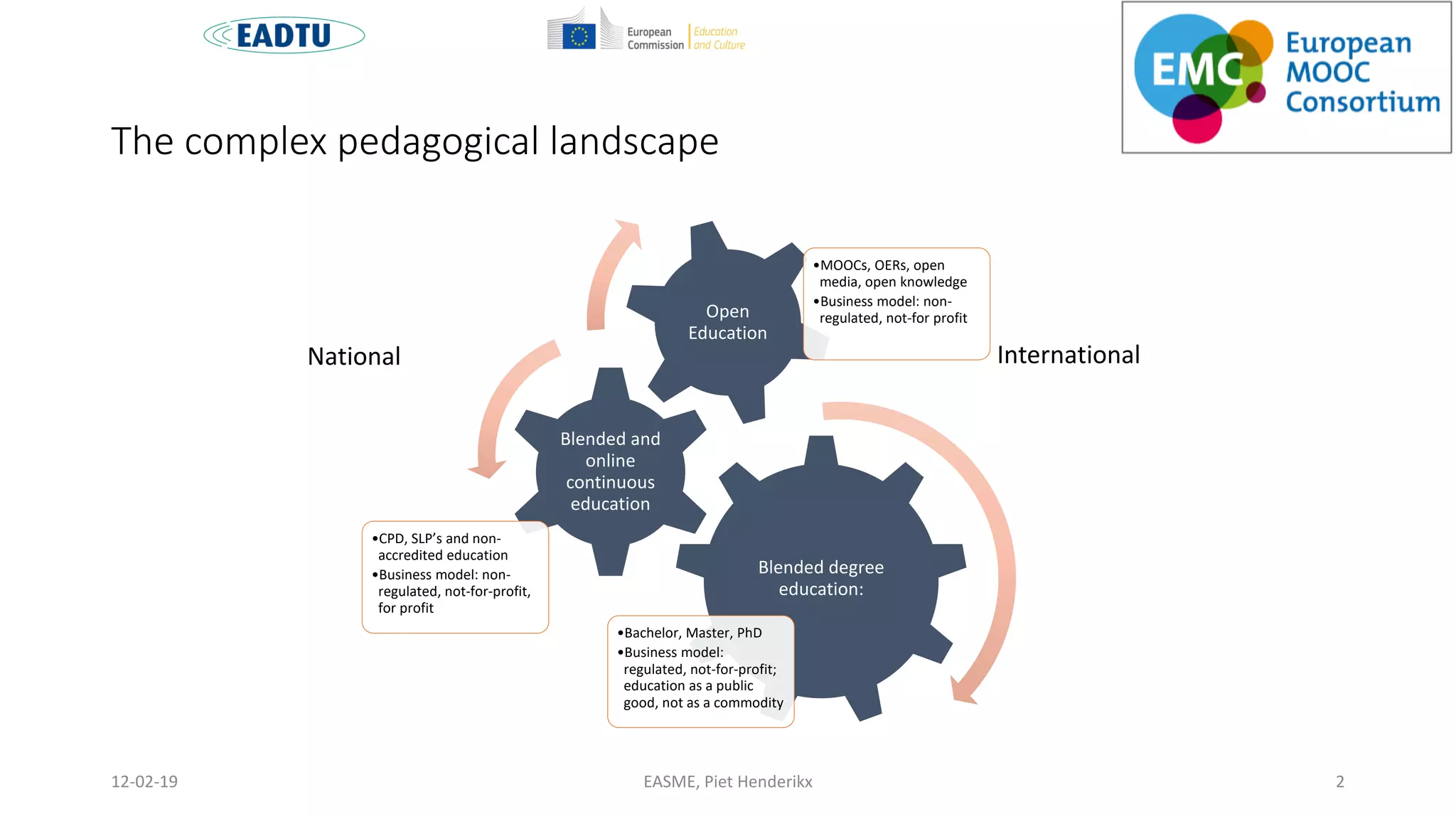
The complex pedagogical landscape
Blended degree
education:
•Bachelor, Master, PhD
•Business model:
regulated, not-for-profit;
education as a public
good, not as a commodity
Blended and
online
continuous
education
•CPD, SLP’s and non-
accredited education
•Business model: non-
regulated, not-for-profit,
for profit
Open
Education
•MOOCs, OERs, open
media, open knowledge
•Business model: non-
regulated, not-for profit
InternationalNational
EASME, Piet Henderikx 212-02-19
EASME, Piet Henderikx 312-02-19
E-SLP project
• Developing a concept for short learning programs for continuous
education and CPD in the EHEA
• Developing recognition frameworks
• Preparing and implementing pilots for collaborative SLP’s
• Building a policy framework at the national and EU level (EHEA)
12-02-19 EASME, Piet Henderikx 4
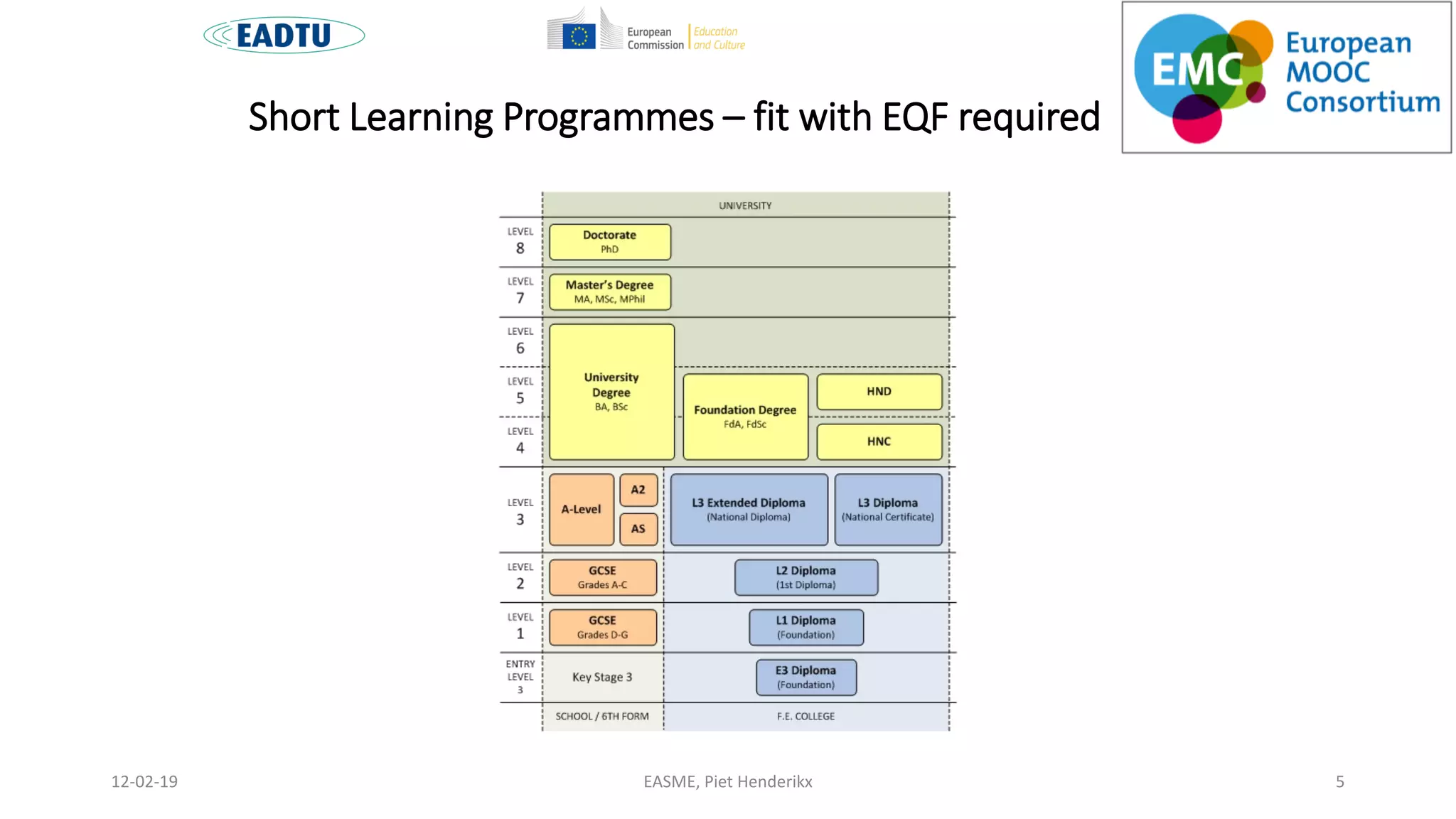
Short Learning Programmes – fit with EQF required
EASME, Piet Henderikx 512-02-19
MOOCs
MOOCs are an educational spin-off product of research, innovation and education
in universities, from which they are derived.
They contribute to the core mission of universities, sharing education with all
citizens by
open accessibility (open education),
transferring and valorising innovative knowledge to enterprises (continuing
education, CPD),
and formally or informally integrating MOOCs as an enriching learning experience
in blended degree education (bachelor, master, doctorate).
EASME, Piet Henderikx 612-02-19
12-02-19 EASME, Piet Henderikx 7
Micro-Credentials
Microcredential
Type Average Price
Average # Months
to Complete
(Minimum)[2]
Average Minimum
Effort Per Week
Number Included in
the Analysis[3]
Coursera
Specialization $245.51 5 3 hours 243
edX XSeries $267.62 5 5 hours 30
FutureLearn
Program $540.33 4 4 hours 28
edX Professional
Certificate $542.51 5 3 hours 56
Kadenze Program $700.00 3 9 hours 17
Udacity Nanodegree$887.03 4 10 hours 27
edX MicroMasters $962.98 9 6 hours 46
Coursera
MasterTrack $2,596.67 5 6 hours 3
Coursera
Professional
Certificate $3,121.99 6 9 hours 3
FutureLearn
Graduate Certificate$8,626.98 7 Not given 7
FutureLearn
Graduate Diploma $17,504.40 12
12-02-19 EASME, Piet Henderikx 8
Analysis of 450 MOOC-Based Microcredentials Reveals Many Options But Little Consistency
Written by Laurie Pickard , July 2018, Class Central
https://www.class-central.com/report/moocs-microcredentials-analysis-2018
Training the EU labour market
12-02-19 EASME, Piet Henderikx 9
Recruitment
For meeting the needs of the labour market efficiently and at scale, it is
a mistake keep recruiting CE/CPD and MOOC learners in the same way
as regular students. To deploy and upscale these sectors, different or at
least complementary market mechanisms play.
EASME, Piet Henderikx 1012-02-19
Structural approach of the world of work
The focus should shift more to clusters/groups of learners, served by
other stakeholders than universities (e.g. alumni and professional
organizations, public employment services, in-company training).
Therefore, a structural collaboration with these other stakeholders
should be sought.
EASME, Piet Henderikx 1112-02-19
European MOOC
Consortium – Labour
Market
Erasmus+ Programme, Key Action 2:
Knowledge Alliances
601213-EPP-1-2018-1-NL-EPPKA2-KA (EMC-
LM)
“EMC-LM”
• EADTU
• Futurelearn
• FUN
• MiriadaX (TED)
• UniFg
• OUUK
• VDAB
• ANPAL
• Opcalim
12-02-19 EASME, Piet Henderikx 12
European MOOC Consortium
EMC partners represent most of the MOOC
development work in Europe in terms of learners and
number of MOOCs, by offering together almost a
1.000 MOOCs. Together, they represent a large
network of 250 higher education institutions (HEIs)
working in a variety of European languages, including
English, France, Spanish and Italian. The Consortium
is open to new platforms, that might be established
in European countries.
EASME, Piet Henderikx 12-02-19 13
Employment services and SME training centres
• All EU countries have public employment services and SME training
centres, agencies of ministries
• They screen continuously the needs for employment and support
companies
• Regional job centres and training institutes
• They are familair with online learning
They become agencies for work and lifelong learning, organizing continuous
education and training at all stages of life, related to employability,
innovation, career development, and entrepreneurship.
EASME, Piet Henderikx 12-02-19 14
Knowledge alliance: objectives
• Strengthen the partners by sharing experience and
expertise on digital CE and CT and MOOCs
• Create a framework for structural collaboration on
the joint development, delivery and use of CE/CT
and MOOCs for the EU labour market
• Empower all partners on digital CE/CT and MOOCs
for the labour market
• Implement a responsive and large-scale outreach to
the EU labour market.
EASME, Piet Henderikx 12-02-19 15
5. EMC-LM approach
• WP1 – Building a knowledge alliance responding to the needs of the EU labour
market
• WP2 - Strengthening the EMC MOOC platforms for the EU labour market
• WP3 - Empowering universities, employment services and companies in
developing, delivering and using MOOCs for the EU labour market
• WP4- Assessment and recognition of MOOCs for the EU labour market
• WP5 - Creating increased visibility and accessibility for European MOOCs
• WP6 - Contributing to regional, national and EU policies and strategies to
support the organisation of MOOCs for the EU labour market
• WP7-10 QA-Evaluation-dissemination and exploitation -management
EASME, Piet Henderikx 12-02-19 16
Long term impact of EMC-LM
on MOOC platforms
• MOOC platforms form a knowledge alliance with
employment services, universities and companies to
realize a structural approach to the EU labour market.
• A European MOOCs knowledge alliance, continuously
developing synergies between the platforms, innovating
MOOCs, upscaling the reach-out of European MOOCs in
their market segments of innovation and business
(language-bound, national, international).
• Emerging platforms can benefit from services and
support and can become a member
12-02-19 EASME, Piet Henderikx 17
Long term impact of EMC-LM
on universities
• Three complementary areas of higher education provision are emerging at
scale in European universities: degree education, continuous
education/CPD, open education/MOOCs
• Universities develop institutional policies and strategies on continuous
education/CPD and MOOCs to serve better their alumni and learners who
update knowledge for their careers or switch careers.
• Universities create divisions for large-scale continuous education/CPD and
MOOCs to develop and deliver online education and training
• Universities develop MOOCs and online CE/CPD in collaboration with
employment services, companies and regions/cities, social partners to
develop, deliver and use MOOCs
• Universities are involved in the exchange and re-use of MOOCs in distinct
markets served by the platforms and in new markets in Europe (eg in
Central and Eastern Europe)
12-02-19 EASME, Piet Henderikx 18
Long term impact on
employment services
• Employment services integrate MOOCs and online
CE/CPD in training offerings for learners in order to
enhance their employability or career development in
collaboration with MOOC platforms, universities and
companies.
• Gradually, employment services become agencies for work
and lifelong learning, organizing continuous education and
training for employability, innovation, career guidance and
development, and entrepreneurship
• The knowledge alliance with regard to MOOCs and online
CE/CPD is growing by involving more public employment
services EU-wide
12-02-19 EASME, Piet Henderikx 19
Long term impact of EMC-LM
on companies
• Companies engage in continuous education and MOOCs in
collaboration with platforms, employment services and
universities. Education and training within HRD policies are a
constituent part of a company and resources are foreseen.
• Enterprises create a training environment connected to HEI’s and
public employment services, involving MOOCs and online
education and training.
• Companies are involved in the social dialogue for policies at the
level of the enterprise, the sector and the region/country. The
project will contribute to the discourse on MOOCs and continuous
education by social partners and regional/national authorities
12-02-19 EASME, Piet Henderikx 20
Long term impact of EMS-LM
on learners
• The knowledge alliance will reach-out to learners in a more
structured approach through MOOC platforms, PES and
companies EU-wide. Potential learners get aware of training
opportunities and online training
• Learners will have ubiquitous access to MOOCs and to flexible
continuous education and CPD/CVT at the time they need
learning for their career or for switching careers. They are
supported by employment services and HRD departments of their
companies or directly by the MOOC platforms and universities.
Their learning efforts are recognized and part of their portfolio.
• Learners register whenever they need flexible training and add
achievements in their portfolio (credits, awards, certificates,
diplomas, degrees). Learners engage in a personal LLL plan.
12-02-19 EASME, Piet Henderikx 21
Long term impact on
governmental policies
• Governments engage in continuous education/CPD and open
education in the framework of their educational and
employment policies and enable universities to develop fully
these areas of provision.
• This can include that they take initiatives to make
national/regional/language-bound MOOC platforms available,
eventually within a broader framework of provisions for
continuous and open education.
• Governments engage in integrating continuous education and
open education as part of higher education systems and in
providing funding schemes. They stimulate the public demand.
They take complementary measures in their employment policies.
12-02-19 EASME, Piet Henderikx 22
Policy aspects
12-02-19 EASME, Piet Henderikx 23
The European Agenda
• Launching the New Skills agenda, the EU Ministers showed concerns about “the level of
knowledge, competences and skills in a competitive, complex and multicultural world.
• The Ministers agreed that it is “important to go beyond the immediate needs of the
labour market and focus also on those aspects of education and training that are able to
drive innovation, entrepreneurship and creativity, shape sectors, create jobs and new
markets, empower people (including the most vulnerable), ..”.
• EU2020 fact sheets of the EUC Education and Training Monitor (2017) reveal indeed that
neither the EU attainment objectives for higher education nor for lifelong learning are
achieved and that there are dramatic differences between member states, although
progress is made. In 12 EU countries, the employment rate of recent graduates is below
75%. 40% of the employers face problems with recruiting workforce with the right
qualifications. Education and training become more important to fulfil the requirements
of the open vacancies.
• Also, knowledge from school or university becomes rapidly obsolete, even more as
careers become longer.
• Challenge: MOOCs and digital continuous education/training as a scalable and flexible
response in educational provisions of universities and other providers
EASME, Piet Henderikx 12-02-19 24
Knowledge alliances
EU and national government should promote the organic growth of
knowledge alliances/networks between the universities and other
stakeholders, anchored in both the world of education and work
EAC – Employment –Growth
Education and Training – Social Afiars – Economic Affairs
12-02-19 EASME, Piet Henderikx 25
Continuous education, CPD, career
development
New education and training eco-systems have to be built by
universities, networking between players of different sectors
At the national level (employment services, SME training centres,
training and HR depts of companies, R&D institutes) – language issues
At the EU level (professional networks, sectoral organisations,
multinationals)
12-02-19 EASME, Piet Henderikx 26
Thank You!
Piet.Henderikx@eadtu.eu
Piet.Henderikx@kuleuven.be
12-02-19 EASME, Piet Henderikx 27

Flexible short learning programs and MOOCs for the European Labour Market

  • 1.
    Flexible short learningprograms and MOOCs for the European Labour Market Expert workshop “Towards an efficient learning ecosystem for European SMEs: Fully exploiting the potential of online training” Brussels, 20 March 2018, EASME/DG GROW of the European Commission Brussels, 12 February 2019 Piet Henderikx EADTU 12-02-19 EASME, Piet Henderikx 1
  • 2.
    The complex pedagogicallandscape Blended degree education: •Bachelor, Master, PhD •Business model: regulated, not-for-profit; education as a public good, not as a commodity Blended and online continuous education •CPD, SLP’s and non- accredited education •Business model: non- regulated, not-for-profit, for profit Open Education •MOOCs, OERs, open media, open knowledge •Business model: non- regulated, not-for profit InternationalNational EASME, Piet Henderikx 212-02-19
  • 3.
  • 4.
    E-SLP project • Developinga concept for short learning programs for continuous education and CPD in the EHEA • Developing recognition frameworks • Preparing and implementing pilots for collaborative SLP’s • Building a policy framework at the national and EU level (EHEA) 12-02-19 EASME, Piet Henderikx 4
  • 5.
    Short Learning Programmes– fit with EQF required EASME, Piet Henderikx 512-02-19
  • 6.
    MOOCs MOOCs are aneducational spin-off product of research, innovation and education in universities, from which they are derived. They contribute to the core mission of universities, sharing education with all citizens by open accessibility (open education), transferring and valorising innovative knowledge to enterprises (continuing education, CPD), and formally or informally integrating MOOCs as an enriching learning experience in blended degree education (bachelor, master, doctorate). EASME, Piet Henderikx 612-02-19
  • 7.
  • 8.
    Micro-Credentials Microcredential Type Average Price Average# Months to Complete (Minimum)[2] Average Minimum Effort Per Week Number Included in the Analysis[3] Coursera Specialization $245.51 5 3 hours 243 edX XSeries $267.62 5 5 hours 30 FutureLearn Program $540.33 4 4 hours 28 edX Professional Certificate $542.51 5 3 hours 56 Kadenze Program $700.00 3 9 hours 17 Udacity Nanodegree$887.03 4 10 hours 27 edX MicroMasters $962.98 9 6 hours 46 Coursera MasterTrack $2,596.67 5 6 hours 3 Coursera Professional Certificate $3,121.99 6 9 hours 3 FutureLearn Graduate Certificate$8,626.98 7 Not given 7 FutureLearn Graduate Diploma $17,504.40 12 12-02-19 EASME, Piet Henderikx 8 Analysis of 450 MOOC-Based Microcredentials Reveals Many Options But Little Consistency Written by Laurie Pickard , July 2018, Class Central https://www.class-central.com/report/moocs-microcredentials-analysis-2018
  • 9.
    Training the EUlabour market 12-02-19 EASME, Piet Henderikx 9
  • 10.
    Recruitment For meeting theneeds of the labour market efficiently and at scale, it is a mistake keep recruiting CE/CPD and MOOC learners in the same way as regular students. To deploy and upscale these sectors, different or at least complementary market mechanisms play. EASME, Piet Henderikx 1012-02-19
  • 11.
    Structural approach ofthe world of work The focus should shift more to clusters/groups of learners, served by other stakeholders than universities (e.g. alumni and professional organizations, public employment services, in-company training). Therefore, a structural collaboration with these other stakeholders should be sought. EASME, Piet Henderikx 1112-02-19
  • 12.
    European MOOC Consortium –Labour Market Erasmus+ Programme, Key Action 2: Knowledge Alliances 601213-EPP-1-2018-1-NL-EPPKA2-KA (EMC- LM) “EMC-LM” • EADTU • Futurelearn • FUN • MiriadaX (TED) • UniFg • OUUK • VDAB • ANPAL • Opcalim 12-02-19 EASME, Piet Henderikx 12
  • 13.
    European MOOC Consortium EMCpartners represent most of the MOOC development work in Europe in terms of learners and number of MOOCs, by offering together almost a 1.000 MOOCs. Together, they represent a large network of 250 higher education institutions (HEIs) working in a variety of European languages, including English, France, Spanish and Italian. The Consortium is open to new platforms, that might be established in European countries. EASME, Piet Henderikx 12-02-19 13
  • 14.
    Employment services andSME training centres • All EU countries have public employment services and SME training centres, agencies of ministries • They screen continuously the needs for employment and support companies • Regional job centres and training institutes • They are familair with online learning They become agencies for work and lifelong learning, organizing continuous education and training at all stages of life, related to employability, innovation, career development, and entrepreneurship. EASME, Piet Henderikx 12-02-19 14
  • 15.
    Knowledge alliance: objectives •Strengthen the partners by sharing experience and expertise on digital CE and CT and MOOCs • Create a framework for structural collaboration on the joint development, delivery and use of CE/CT and MOOCs for the EU labour market • Empower all partners on digital CE/CT and MOOCs for the labour market • Implement a responsive and large-scale outreach to the EU labour market. EASME, Piet Henderikx 12-02-19 15
  • 16.
    5. EMC-LM approach •WP1 – Building a knowledge alliance responding to the needs of the EU labour market • WP2 - Strengthening the EMC MOOC platforms for the EU labour market • WP3 - Empowering universities, employment services and companies in developing, delivering and using MOOCs for the EU labour market • WP4- Assessment and recognition of MOOCs for the EU labour market • WP5 - Creating increased visibility and accessibility for European MOOCs • WP6 - Contributing to regional, national and EU policies and strategies to support the organisation of MOOCs for the EU labour market • WP7-10 QA-Evaluation-dissemination and exploitation -management EASME, Piet Henderikx 12-02-19 16
  • 17.
    Long term impactof EMC-LM on MOOC platforms • MOOC platforms form a knowledge alliance with employment services, universities and companies to realize a structural approach to the EU labour market. • A European MOOCs knowledge alliance, continuously developing synergies between the platforms, innovating MOOCs, upscaling the reach-out of European MOOCs in their market segments of innovation and business (language-bound, national, international). • Emerging platforms can benefit from services and support and can become a member 12-02-19 EASME, Piet Henderikx 17
  • 18.
    Long term impactof EMC-LM on universities • Three complementary areas of higher education provision are emerging at scale in European universities: degree education, continuous education/CPD, open education/MOOCs • Universities develop institutional policies and strategies on continuous education/CPD and MOOCs to serve better their alumni and learners who update knowledge for their careers or switch careers. • Universities create divisions for large-scale continuous education/CPD and MOOCs to develop and deliver online education and training • Universities develop MOOCs and online CE/CPD in collaboration with employment services, companies and regions/cities, social partners to develop, deliver and use MOOCs • Universities are involved in the exchange and re-use of MOOCs in distinct markets served by the platforms and in new markets in Europe (eg in Central and Eastern Europe) 12-02-19 EASME, Piet Henderikx 18
  • 19.
    Long term impacton employment services • Employment services integrate MOOCs and online CE/CPD in training offerings for learners in order to enhance their employability or career development in collaboration with MOOC platforms, universities and companies. • Gradually, employment services become agencies for work and lifelong learning, organizing continuous education and training for employability, innovation, career guidance and development, and entrepreneurship • The knowledge alliance with regard to MOOCs and online CE/CPD is growing by involving more public employment services EU-wide 12-02-19 EASME, Piet Henderikx 19
  • 20.
    Long term impactof EMC-LM on companies • Companies engage in continuous education and MOOCs in collaboration with platforms, employment services and universities. Education and training within HRD policies are a constituent part of a company and resources are foreseen. • Enterprises create a training environment connected to HEI’s and public employment services, involving MOOCs and online education and training. • Companies are involved in the social dialogue for policies at the level of the enterprise, the sector and the region/country. The project will contribute to the discourse on MOOCs and continuous education by social partners and regional/national authorities 12-02-19 EASME, Piet Henderikx 20
  • 21.
    Long term impactof EMS-LM on learners • The knowledge alliance will reach-out to learners in a more structured approach through MOOC platforms, PES and companies EU-wide. Potential learners get aware of training opportunities and online training • Learners will have ubiquitous access to MOOCs and to flexible continuous education and CPD/CVT at the time they need learning for their career or for switching careers. They are supported by employment services and HRD departments of their companies or directly by the MOOC platforms and universities. Their learning efforts are recognized and part of their portfolio. • Learners register whenever they need flexible training and add achievements in their portfolio (credits, awards, certificates, diplomas, degrees). Learners engage in a personal LLL plan. 12-02-19 EASME, Piet Henderikx 21
  • 22.
    Long term impacton governmental policies • Governments engage in continuous education/CPD and open education in the framework of their educational and employment policies and enable universities to develop fully these areas of provision. • This can include that they take initiatives to make national/regional/language-bound MOOC platforms available, eventually within a broader framework of provisions for continuous and open education. • Governments engage in integrating continuous education and open education as part of higher education systems and in providing funding schemes. They stimulate the public demand. They take complementary measures in their employment policies. 12-02-19 EASME, Piet Henderikx 22
  • 23.
  • 24.
    The European Agenda •Launching the New Skills agenda, the EU Ministers showed concerns about “the level of knowledge, competences and skills in a competitive, complex and multicultural world. • The Ministers agreed that it is “important to go beyond the immediate needs of the labour market and focus also on those aspects of education and training that are able to drive innovation, entrepreneurship and creativity, shape sectors, create jobs and new markets, empower people (including the most vulnerable), ..”. • EU2020 fact sheets of the EUC Education and Training Monitor (2017) reveal indeed that neither the EU attainment objectives for higher education nor for lifelong learning are achieved and that there are dramatic differences between member states, although progress is made. In 12 EU countries, the employment rate of recent graduates is below 75%. 40% of the employers face problems with recruiting workforce with the right qualifications. Education and training become more important to fulfil the requirements of the open vacancies. • Also, knowledge from school or university becomes rapidly obsolete, even more as careers become longer. • Challenge: MOOCs and digital continuous education/training as a scalable and flexible response in educational provisions of universities and other providers EASME, Piet Henderikx 12-02-19 24
  • 25.
    Knowledge alliances EU andnational government should promote the organic growth of knowledge alliances/networks between the universities and other stakeholders, anchored in both the world of education and work EAC – Employment –Growth Education and Training – Social Afiars – Economic Affairs 12-02-19 EASME, Piet Henderikx 25
  • 26.
    Continuous education, CPD,career development New education and training eco-systems have to be built by universities, networking between players of different sectors At the national level (employment services, SME training centres, training and HR depts of companies, R&D institutes) – language issues At the EU level (professional networks, sectoral organisations, multinationals) 12-02-19 EASME, Piet Henderikx 26
  • 27.