MOOCs Platforms Panoramic
By Jingjing Lin
USI Università della Svizzera italiana 25/03/2015
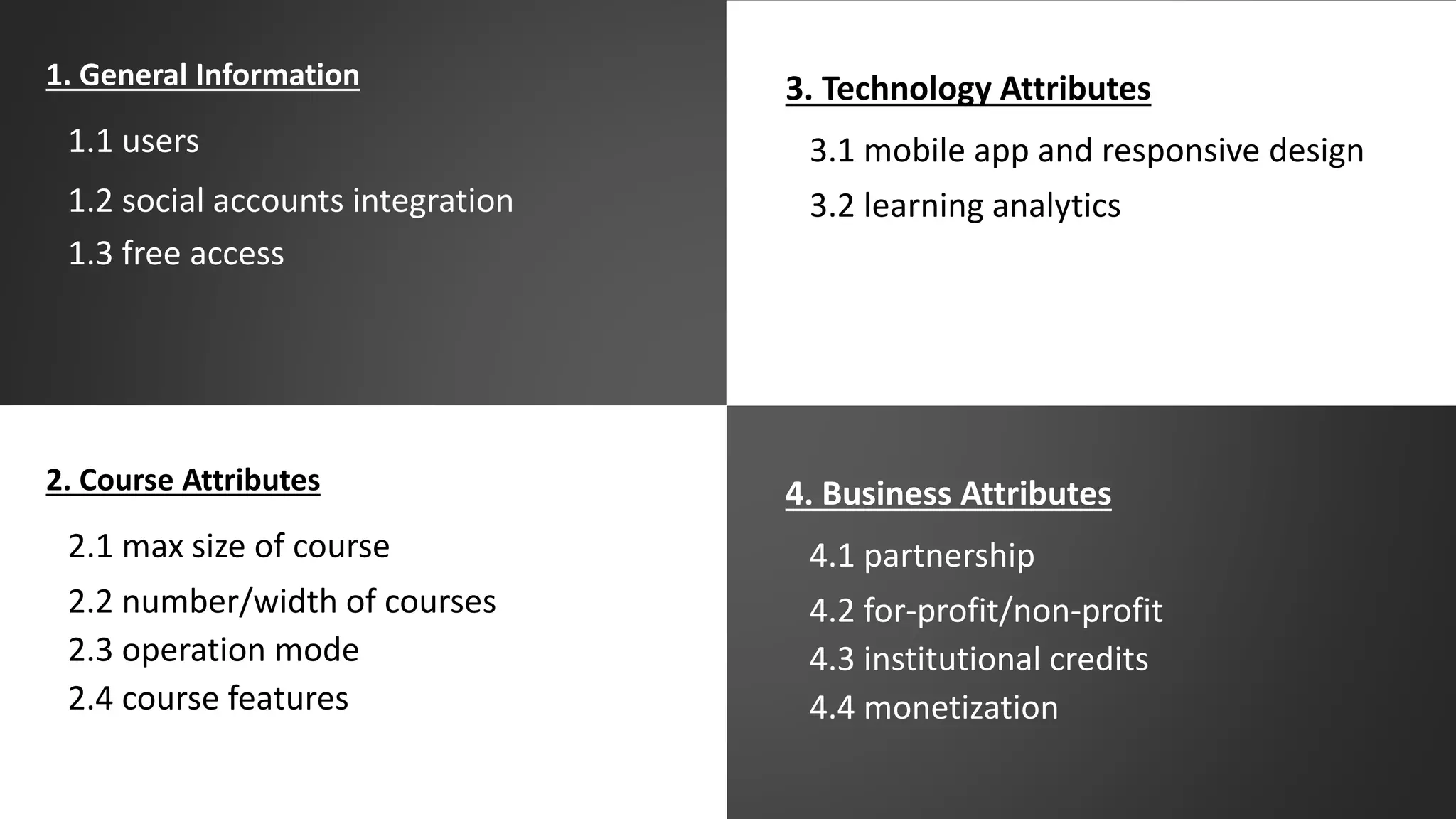
3. Technology Attributes
3.1 mobile app and responsive design
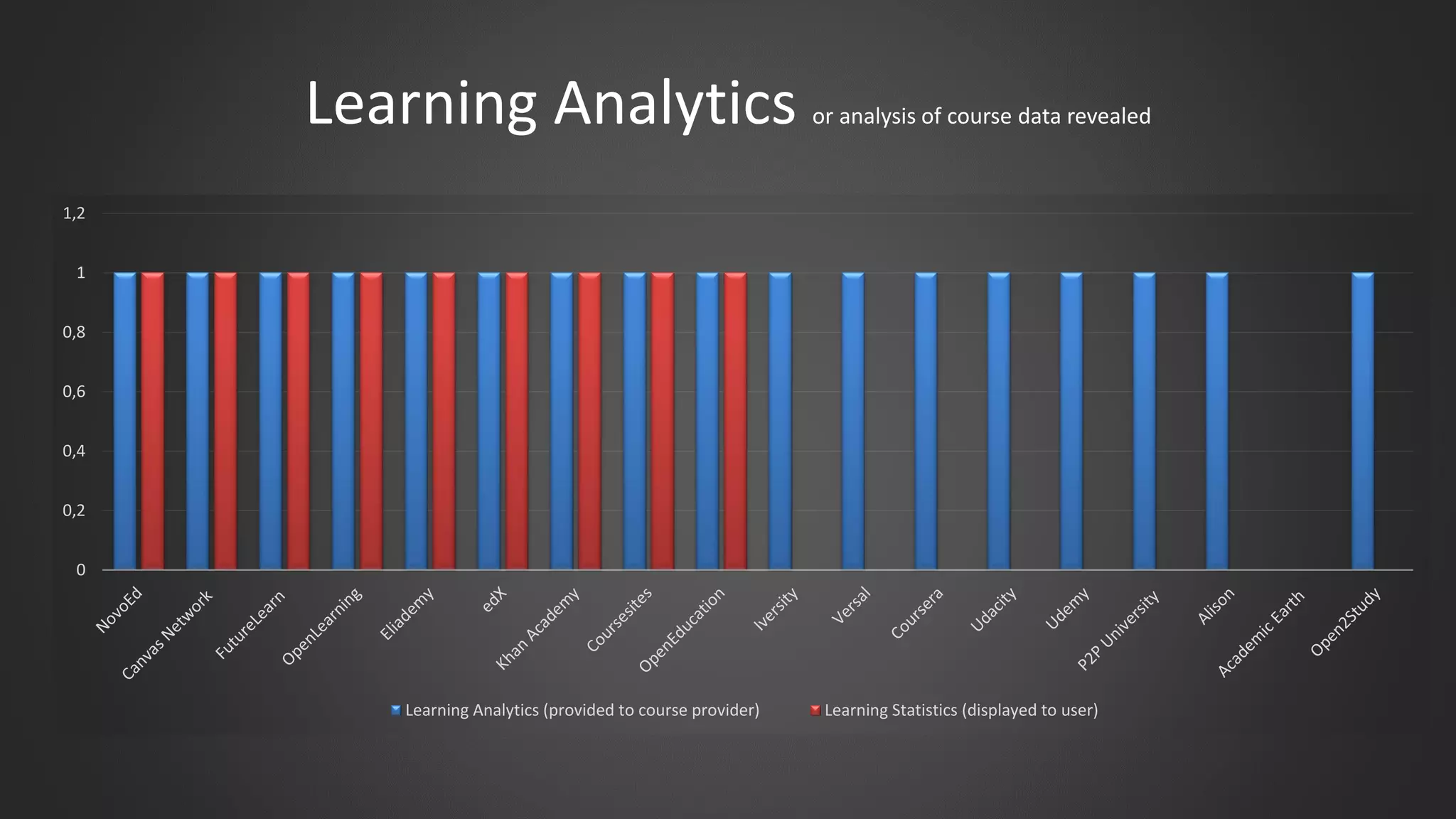
3.2 learning analytics
1. General Information
1.1 users
1.2 social accounts integration
1.3 free access
2. Course Attributes
2.1 max size of course
2.2 number/width of courses
2.3 operation mode
2.4 course features
4. Business Attributes
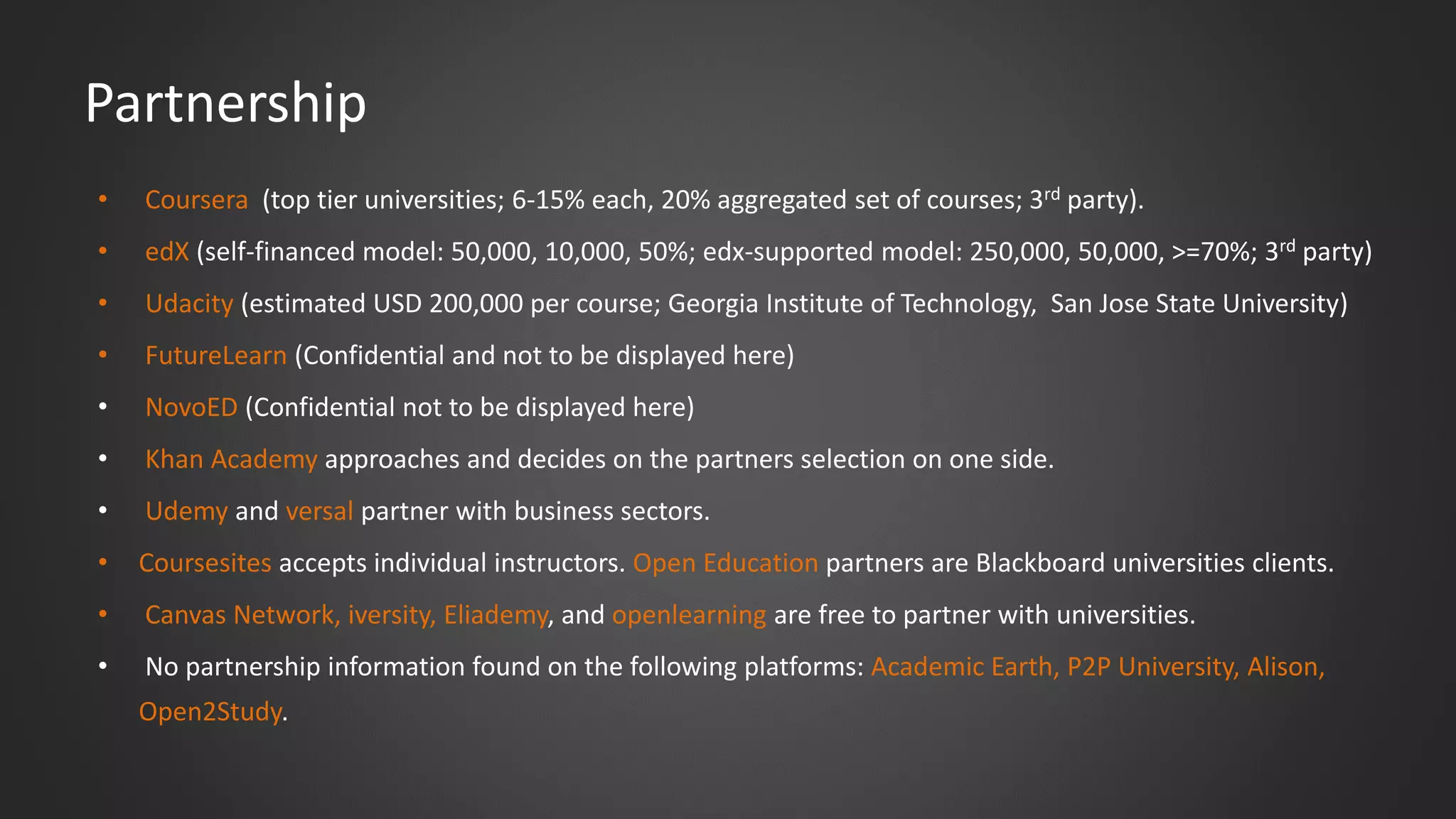
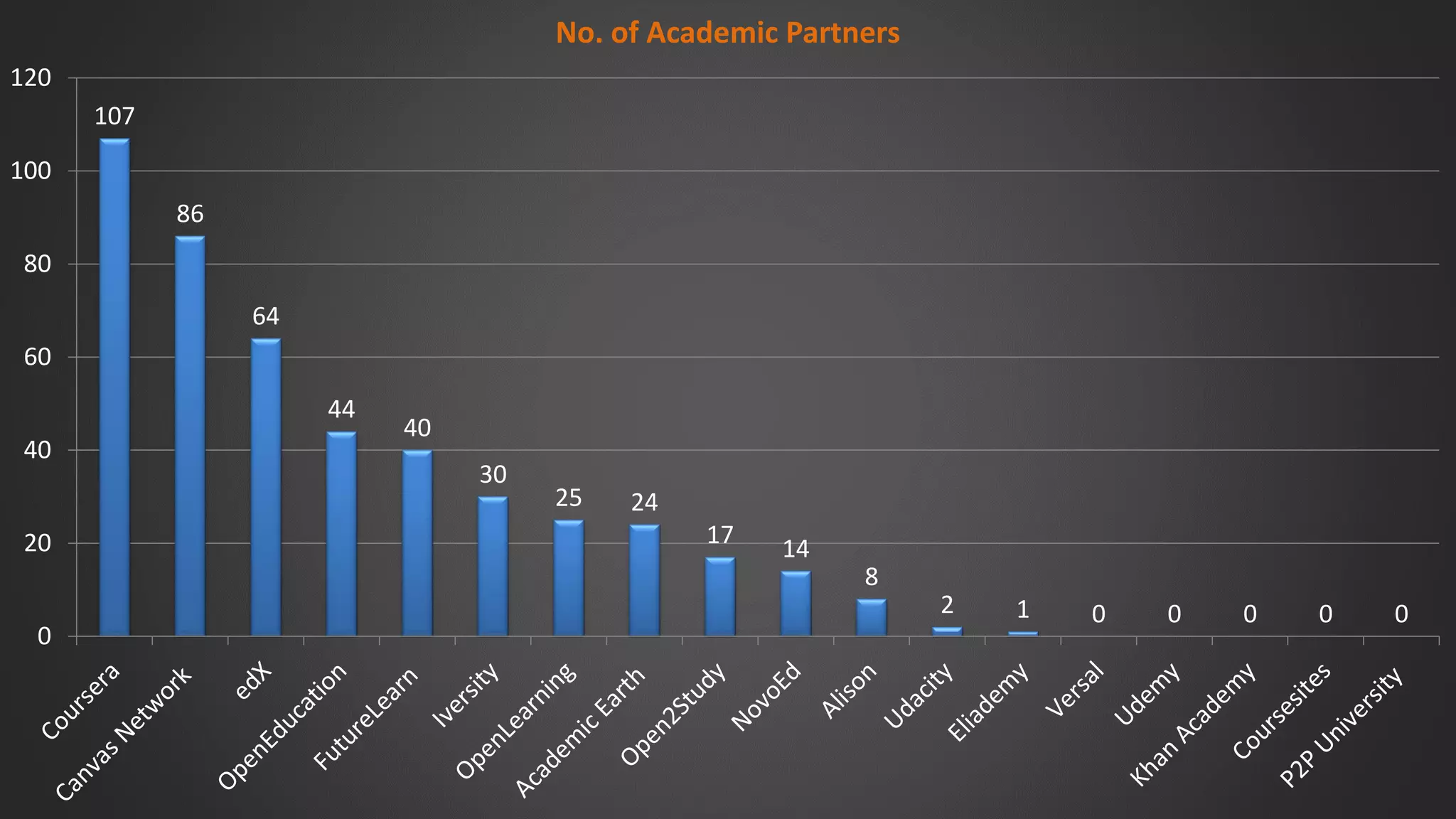
4.1 partnership
4.2 for-profit/non-profit
4.3 institutional credits
4.4 monetization
GENERAL INFORMATION
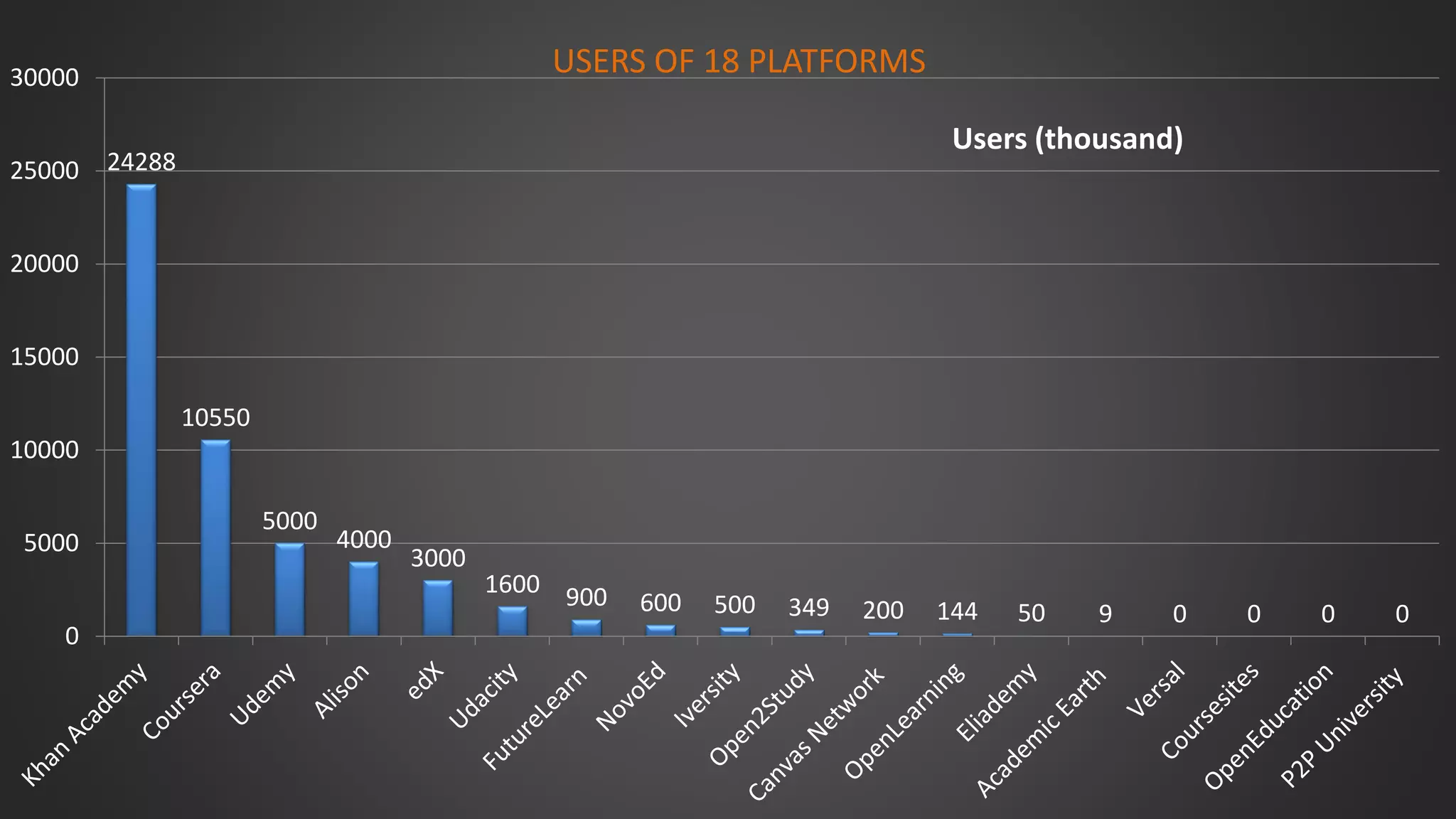
USERS OF 18 PLATFORMS
24288
10550
5000
4000
3000
1600 900 600 500 349 200 144 50 9 0 0 0 0
0
5000
10000
15000
20000
25000
30000
Users (thousand)
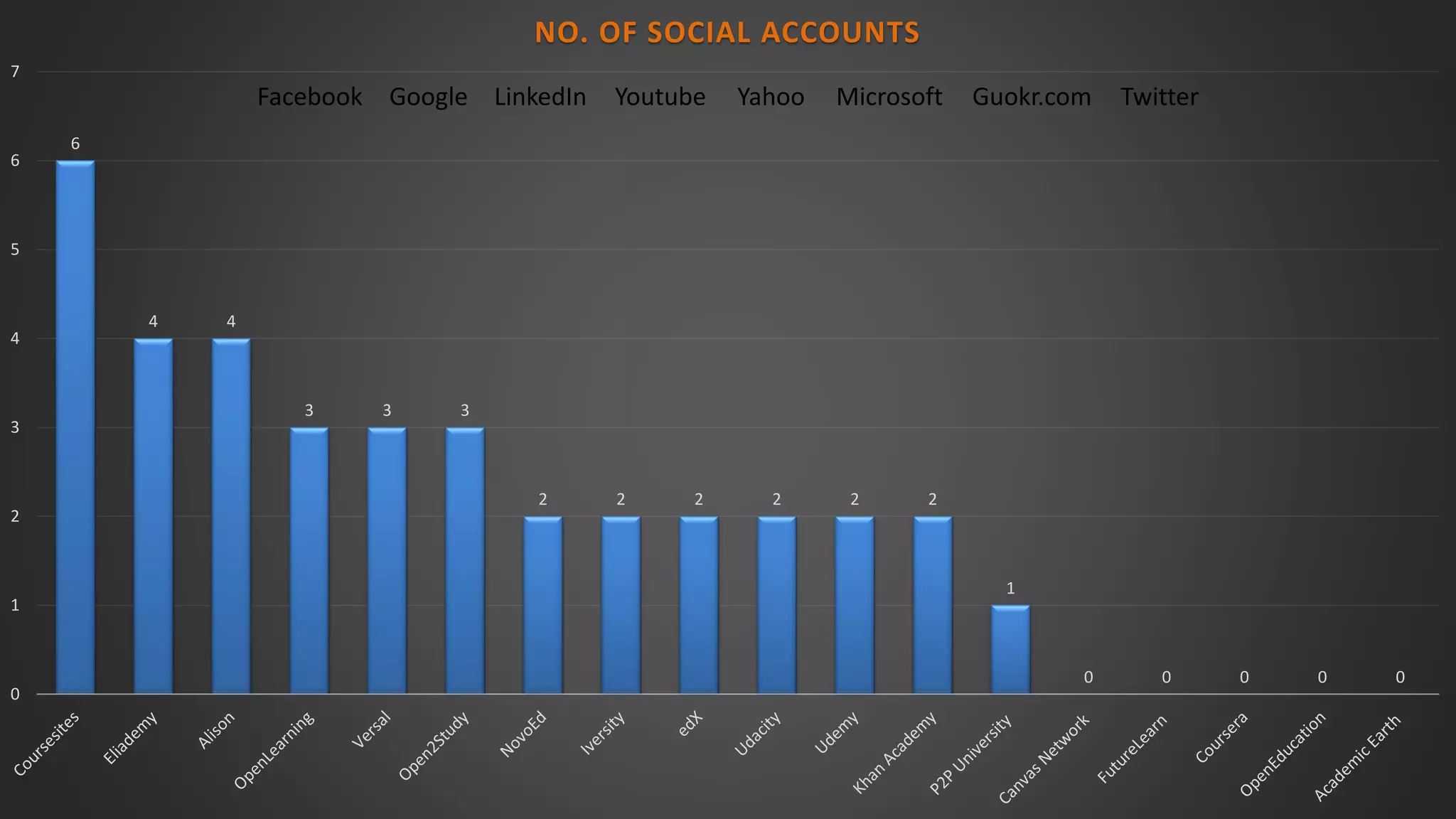
6
4 4
3 3 3
2 2 2 2 2 2
1
0 0 0 0 0
0
1
2
3
4
5
6
7
NO. OF SOCIAL ACCOUNTS
Facebook Google LinkedIn Youtube Yahoo Microsoft Guokr.com Twitter
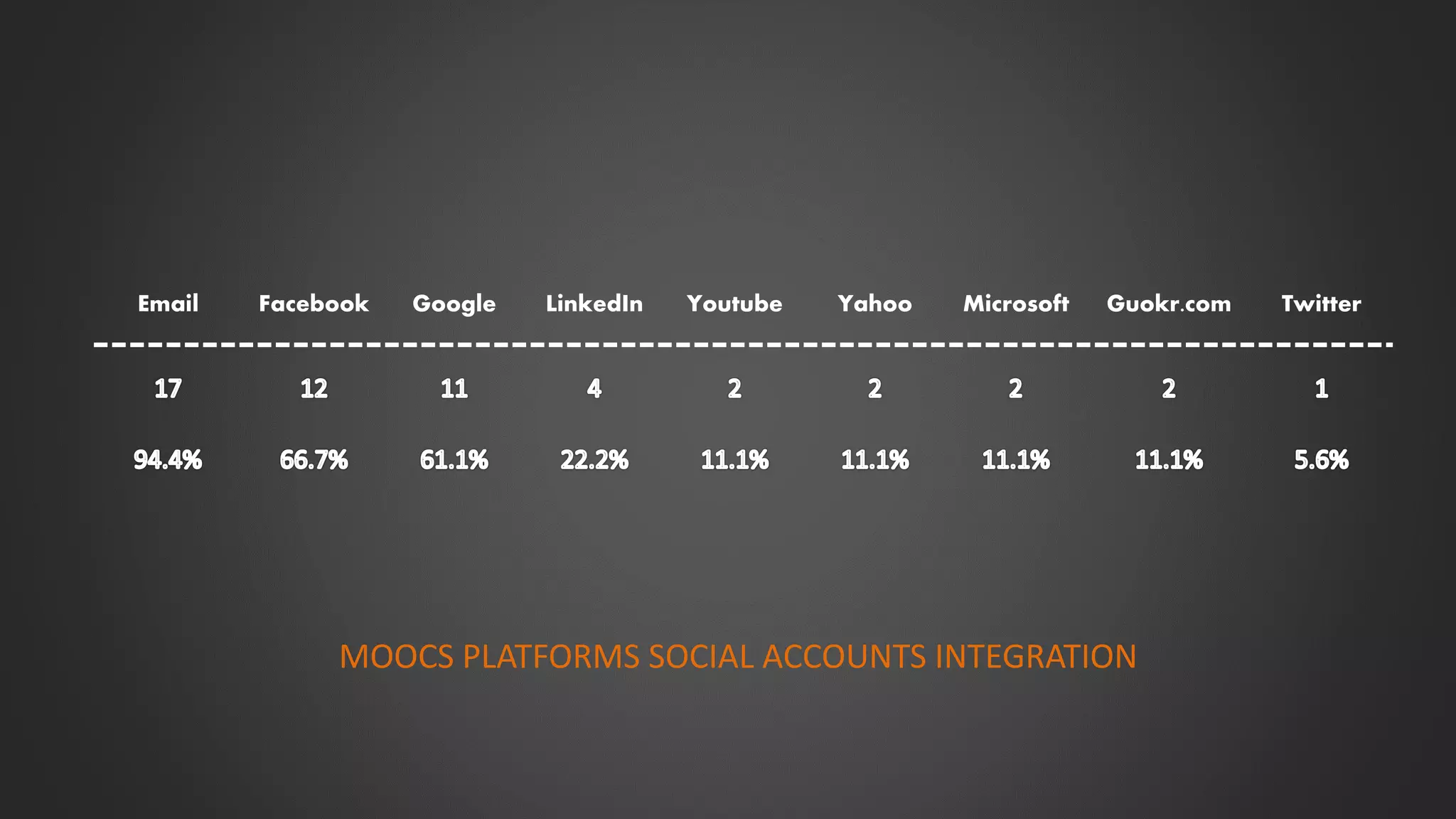
Email Facebook Google LinkedIn Youtube Yahoo Microsoft Guokr.com Twitter
MOOCS PLATFORMS SOCIAL ACCOUNTS INTEGRATION
FreeAccess
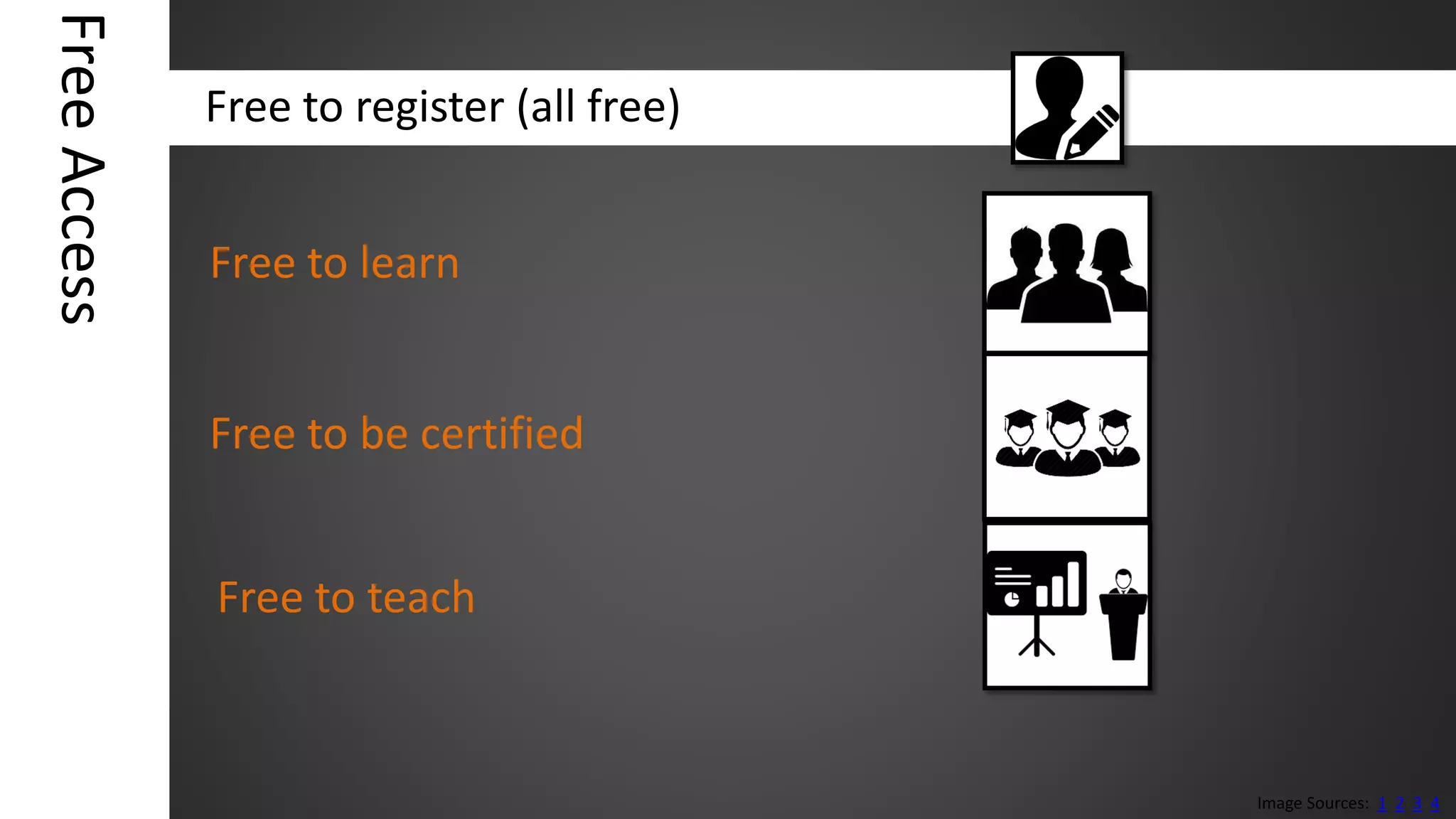
Free to register (all free)
Image Sources: 1 2 3 4
Free to learn
Free to be certified
Free to teach
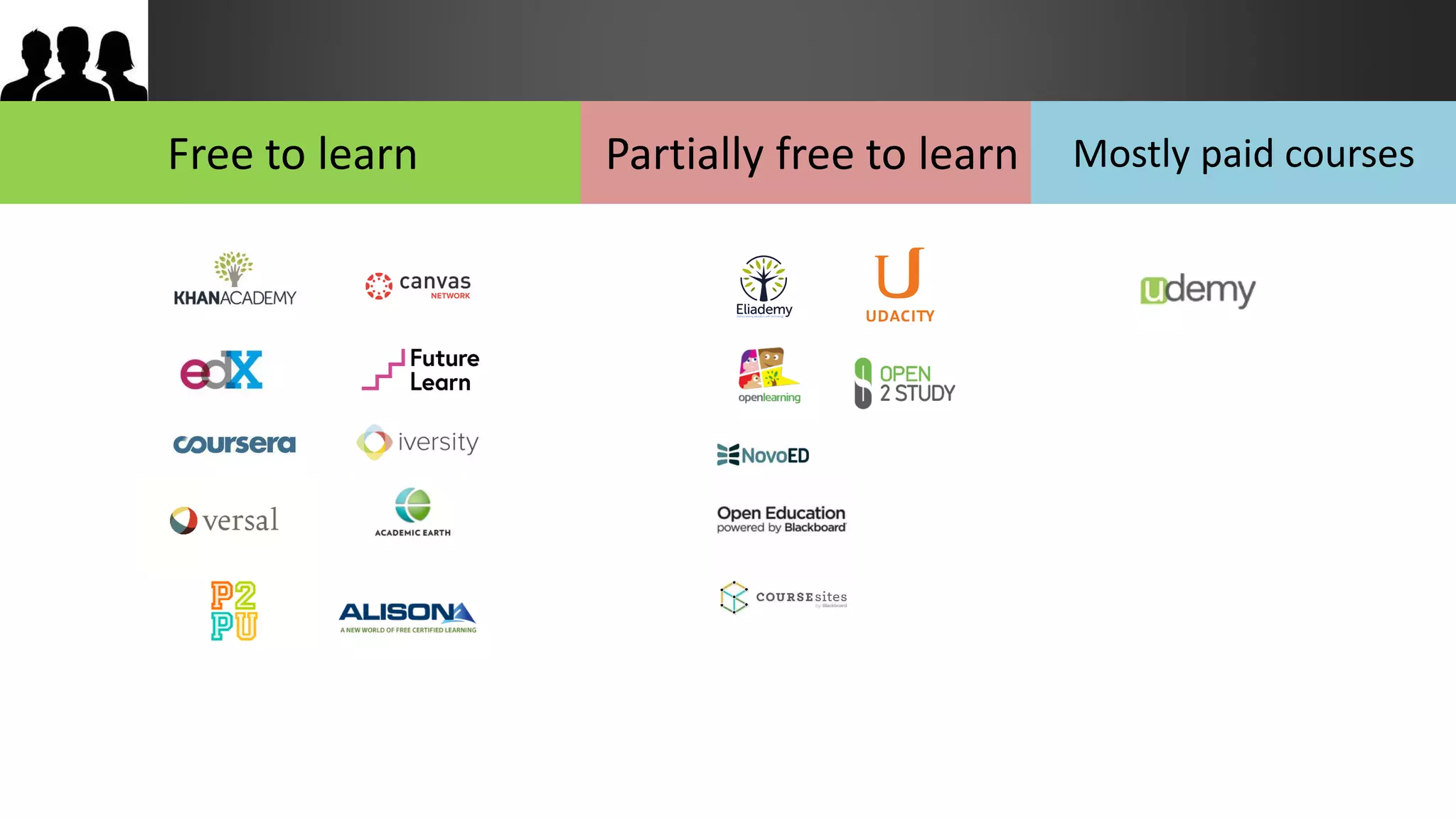
Free to learn Partially free to learn Mostly paid courses
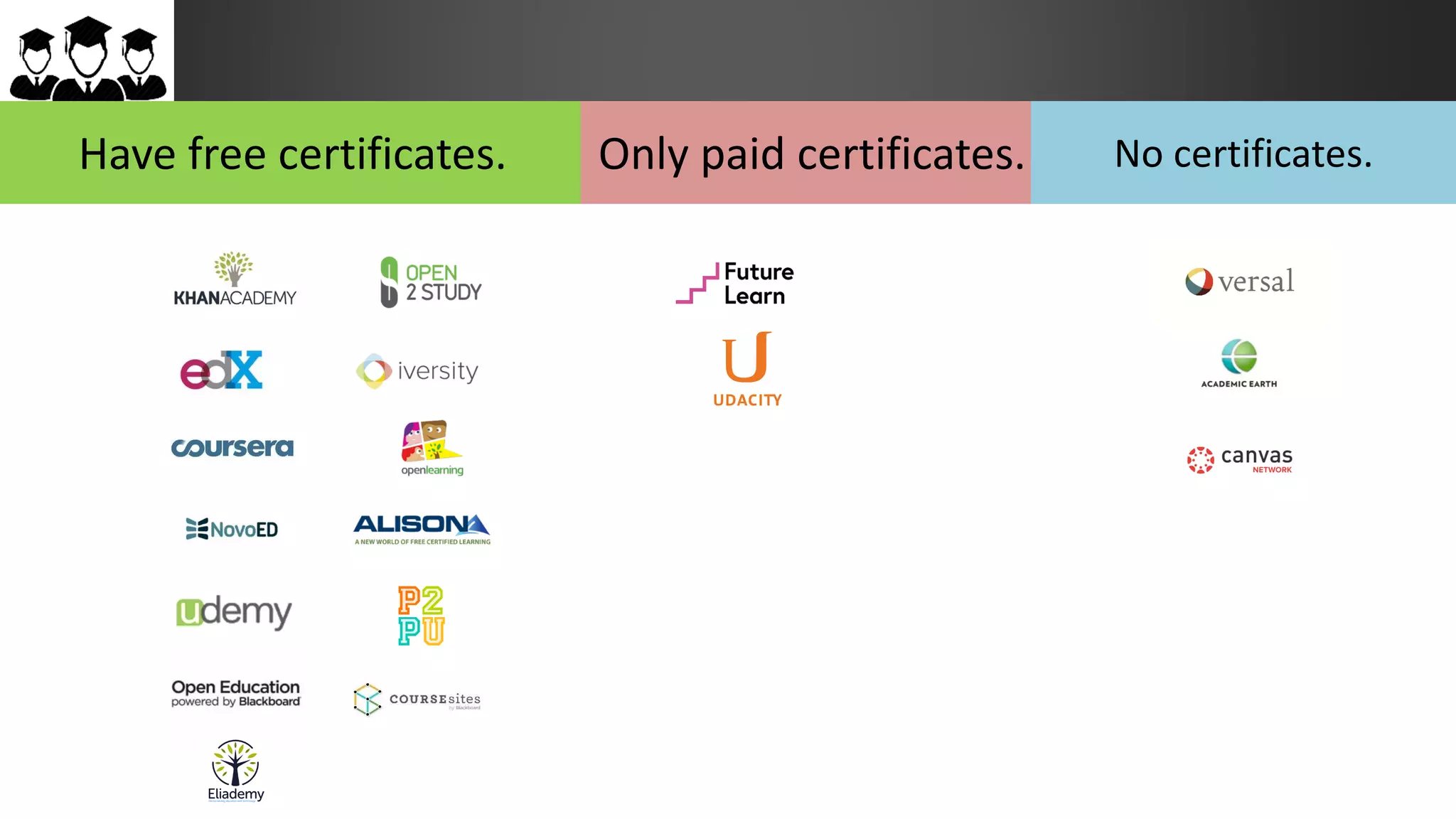
Have free certificates. Only paid certificates. No certificates.
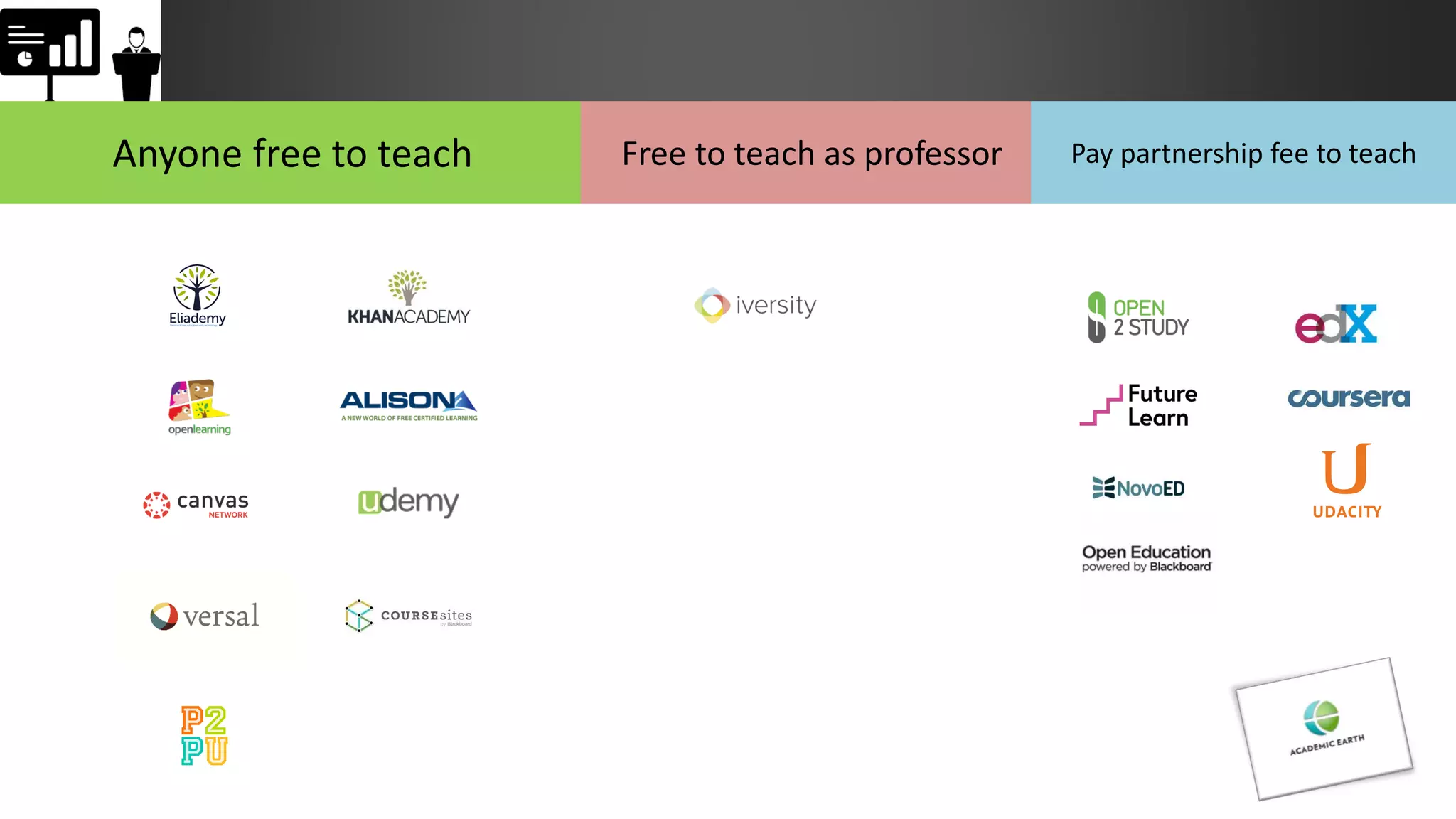
Anyone free to teach Free to teach as professor Pay partnership fee to teach
COURSE ATTRIBUTES
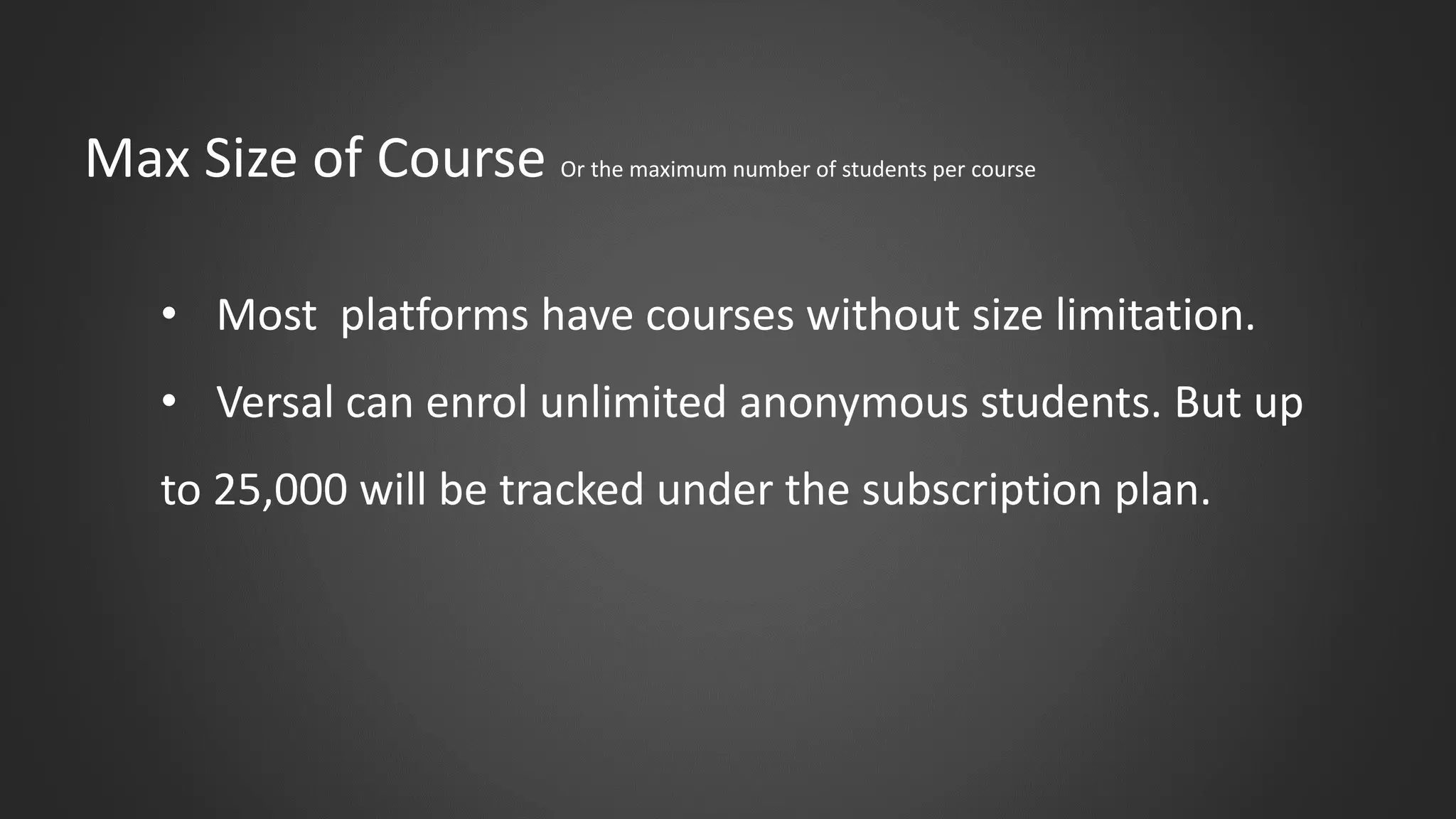
Max Size of Course Or the maximum number of students per course
• Most platforms have courses without size limitation.
• Versal can enrol unlimited anonymous students. But up
to 25,000 will be tracked under the subscription plan.
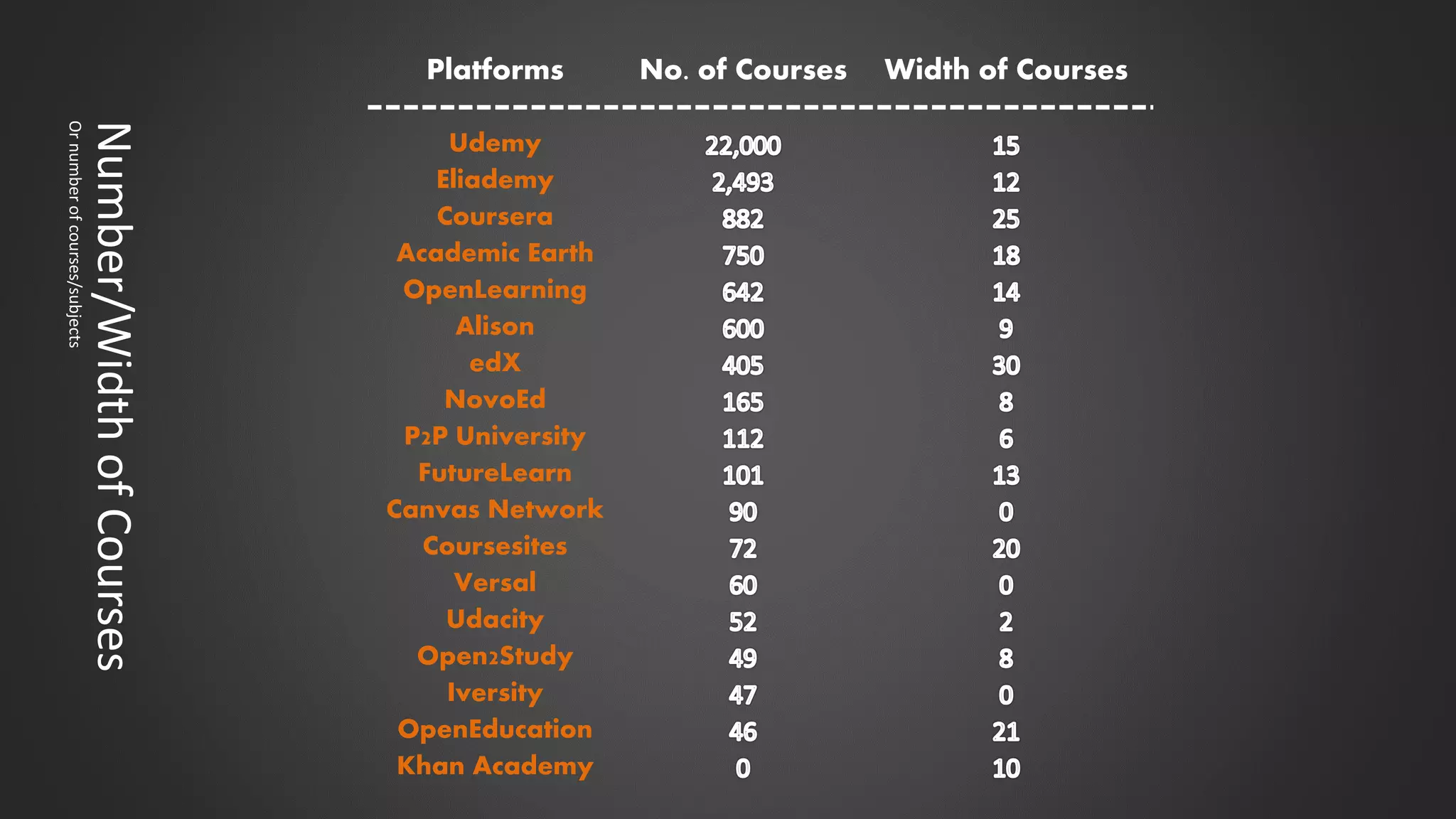
Platforms No. of Courses Width of Courses
Udemy
Eliademy
Coursera
Academic Earth
OpenLearning
Alison
edX
NovoEd
P2P University
FutureLearn
Canvas Network
Coursesites
Versal
Udacity
Open2Study
Iversity
OpenEducation
Khan Academy
Number/WidthofCourses
Ornumberofcourses/subjects
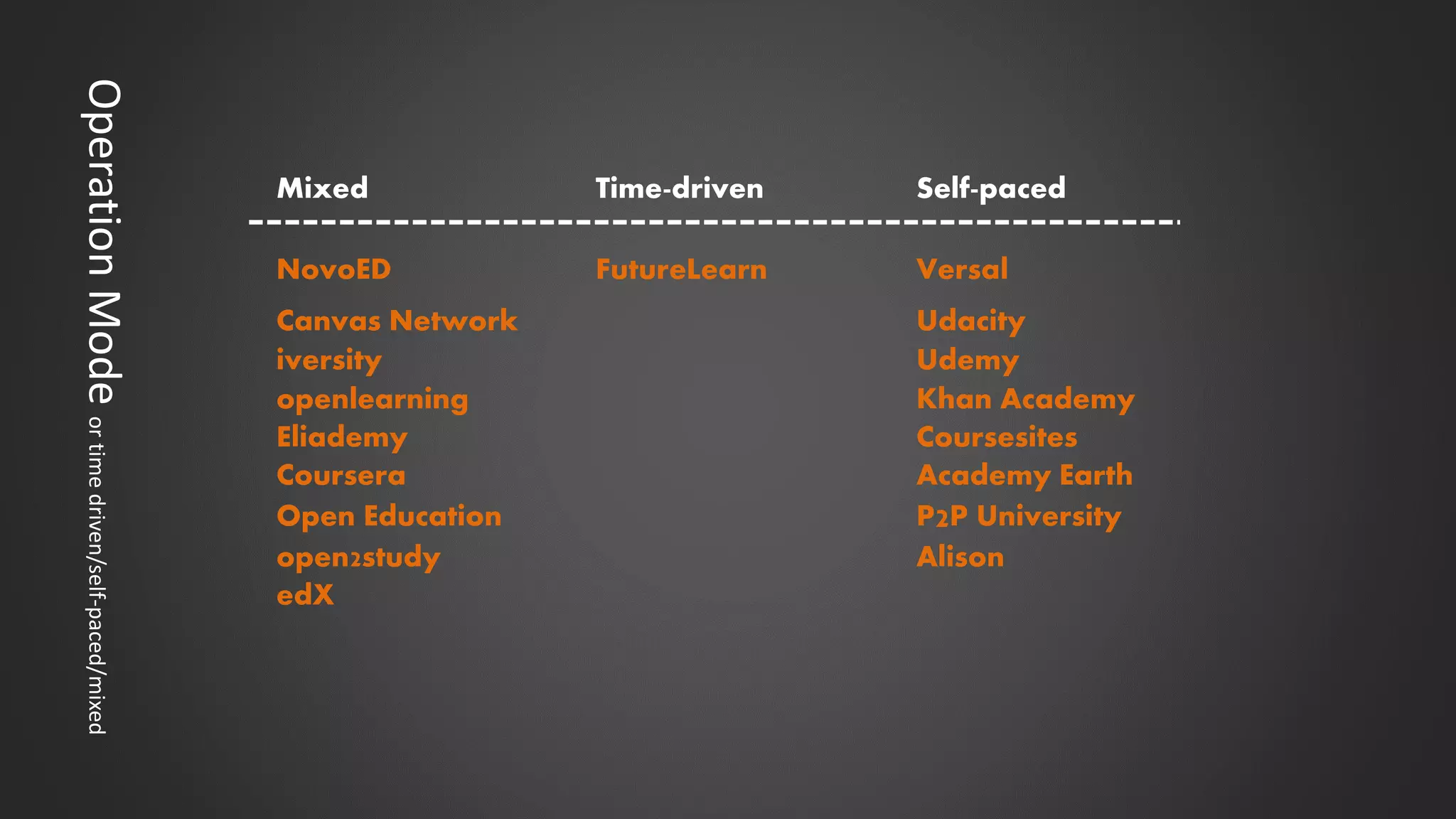
Mixed Time-driven Self-paced
NovoED FutureLearn Versal
Canvas Network Udacity
iversity Udemy
openlearning Khan Academy
Eliademy Coursesites
Coursera Academy Earth
Open Education P2P University
open2study Alison
edX
OperationModeortimedriven/self-paced/mixed
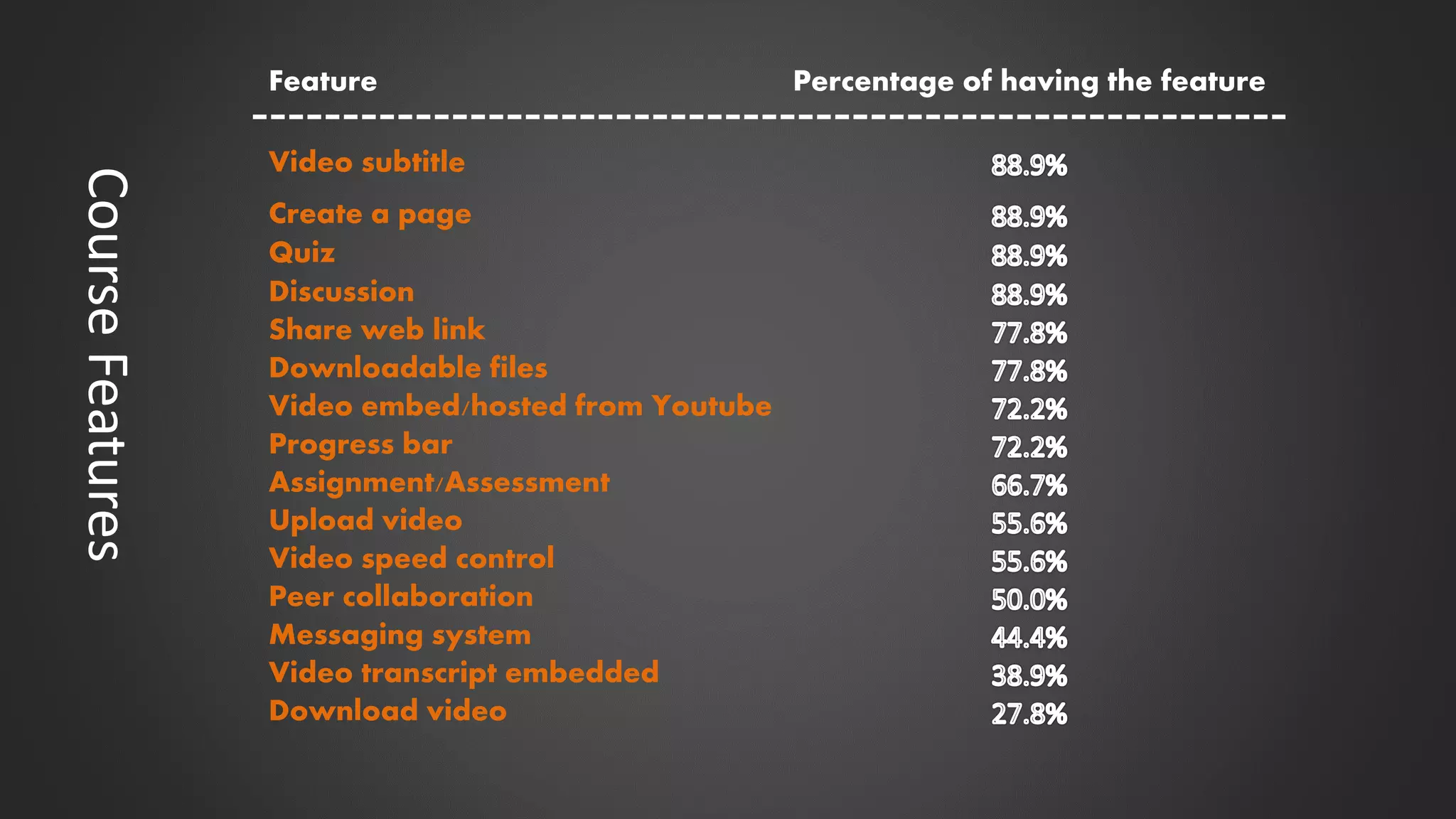
Feature Percentage of having the feature
Video subtitle
Create a page
Quiz
Discussion
Share web link
Downloadable files
Video embed/hosted from Youtube
Progress bar
Assignment/Assessment
Upload video
Video speed control
Peer collaboration
Messaging system
Video transcript embedded
Download video
CourseFeatures
TECHNOLOGY ATTRIBUTES
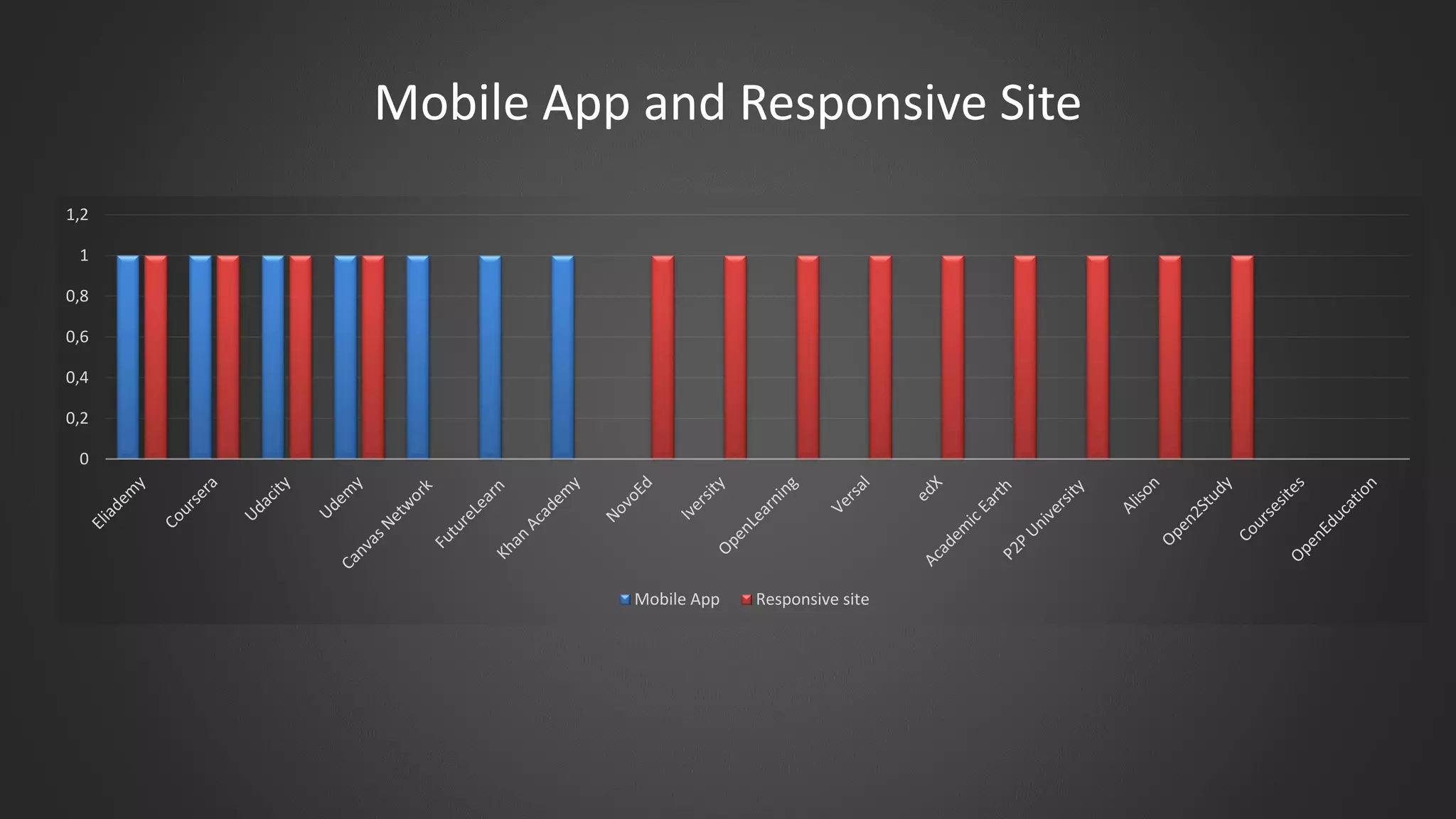
Mobile App and Responsive Site
0
0,2
0,4
0,6
0,8
1
1,2
Mobile App Responsive site
Learning Analytics or analysis of course data revealed
0
0,2
0,4
0,6
0,8
1
1,2
Learning Analytics (provided to course provider) Learning Statistics (displayed to user)
BUSINESS ATTRIBUTES
Partnership
• Coursera (top tier universities; 6-15% each, 20% aggregated set of courses; 3rd party).
• edX (self-financed model: 50,000, 10,000, 50%; edx-supported model: 250,000, 50,000, >=70%; 3rd party)
• Udacity (estimated USD 200,000 per course; Georgia Institute of Technology, San Jose State University)
• FutureLearn (Confidential and not to be displayed here)
• NovoED (Confidential not to be displayed here)
• Khan Academy approaches and decides on the partners selection on one side.
• Udemy and versal partner with business sectors.
• Coursesites accepts individual instructors. Open Education partners are Blackboard universities clients.
• Canvas Network, iversity, Eliademy, and openlearning are free to partner with universities.
• No partnership information found on the following platforms: Academic Earth, P2P University, Alison,
Open2Study.
107
86
64
44
40
30
25 24
17
14
8
2 1 0 0 0 0 0
0
20
40
60
80
100
120
No. of Academic Partners
Institutional credits
• Some courses on Coursera, Udacity and iversity bear institutional credits that can be recognized by
partner institutions.
• For example, Udacity partners with Georgia Tech on a course.
For-profit/Non-profit
Non-profit platforms:
• FutureLearn
• edX
• Khan Academy
• P2P University
• Open2Study
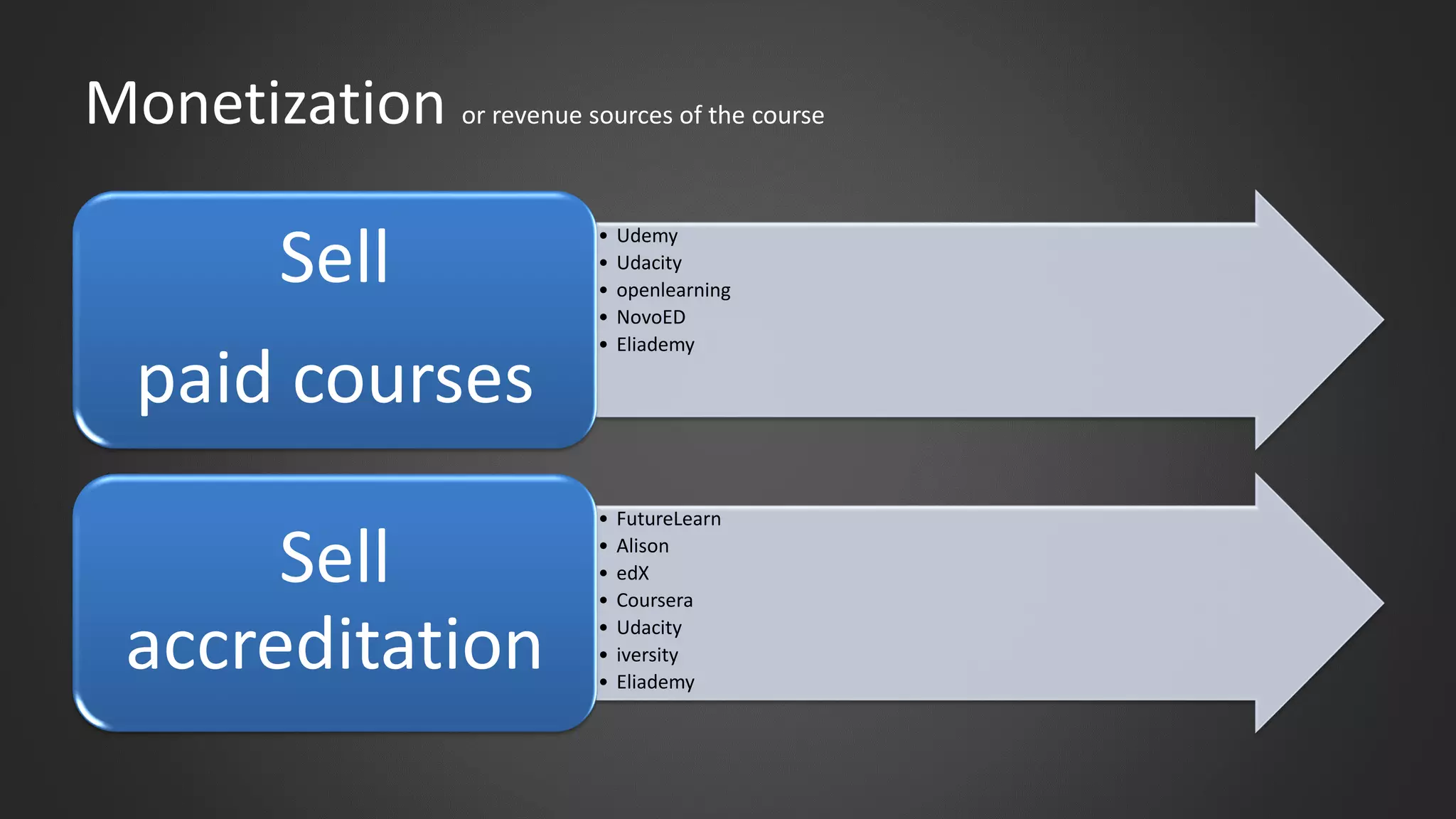
Monetization or revenue sources of the course
• Udemy
• Udacity
• openlearning
• NovoED
• Eliademy
Sell
paid courses
• FutureLearn
• Alison
• edX
• Coursera
• Udacity
• iversity
• Eliademy
Sell
accreditation
edX
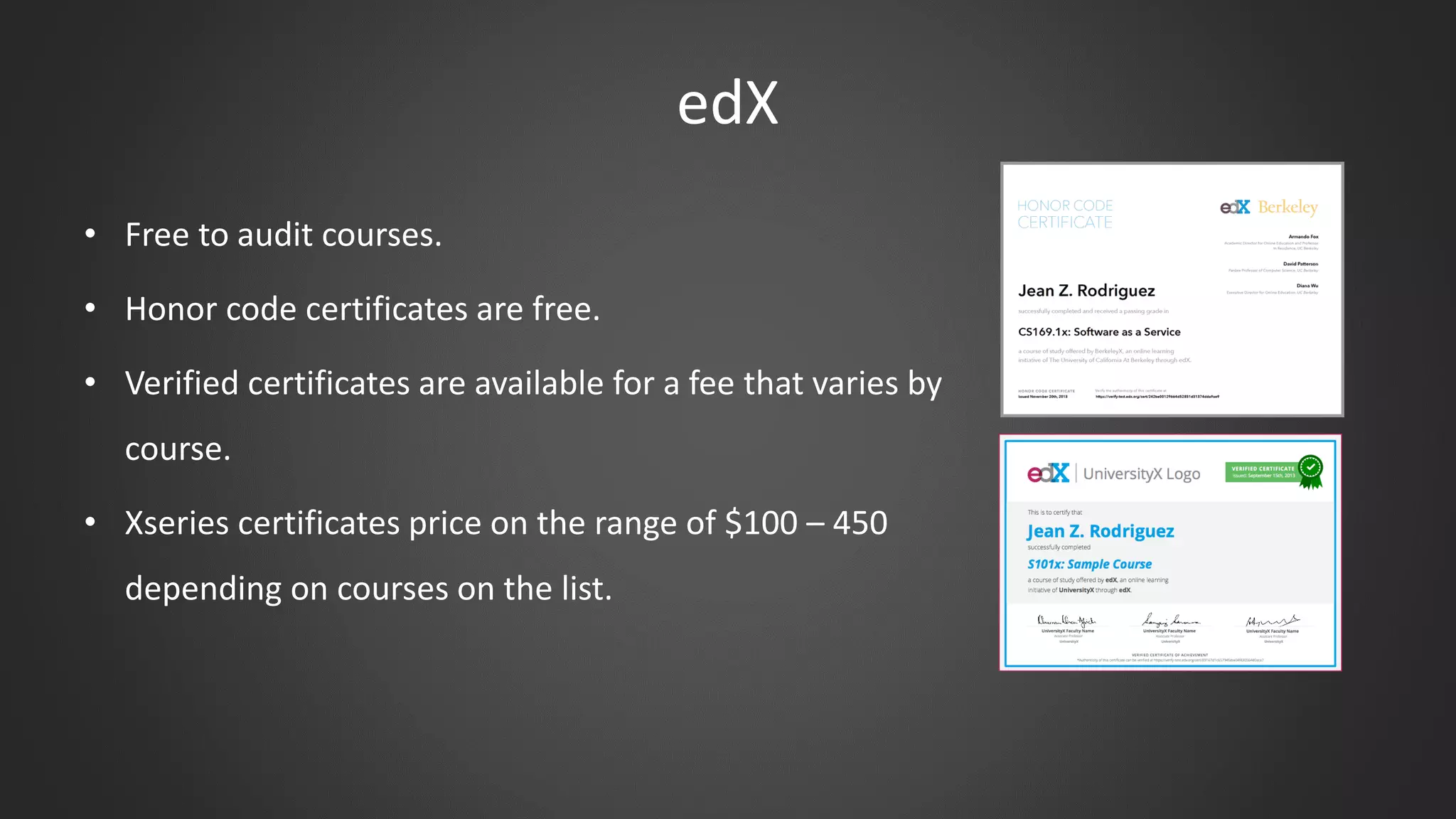
• Free to audit courses.
• Honor code certificates are free.
• Verified certificates are available for a fee that varies by
course.
• Xseries certificates price on the range of $100 – 450
depending on courses on the list.
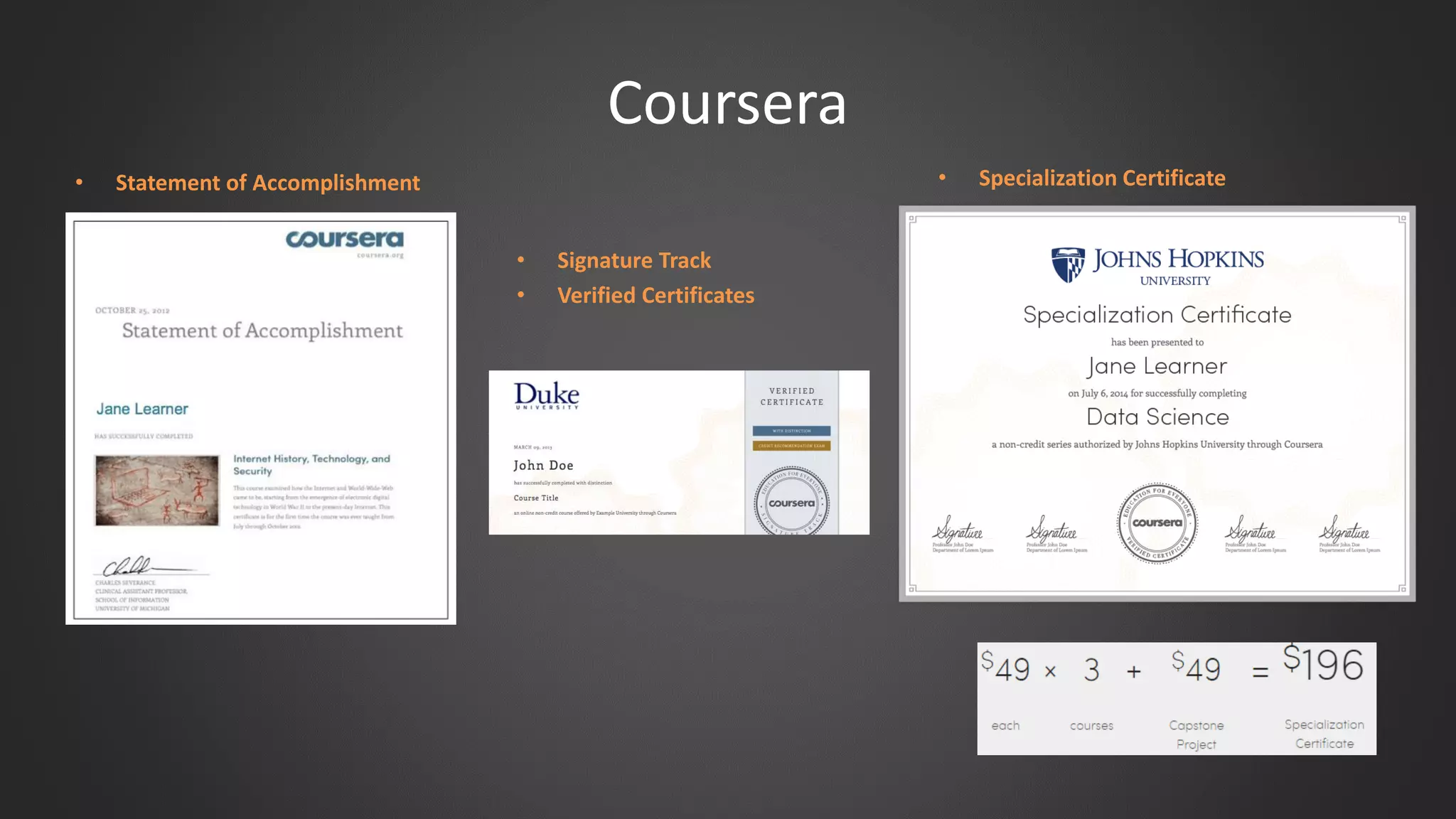
Coursera
• Statement of Accomplishment • Specialization Certificate
• Signature Track
• Verified Certificates
Udacity
• Free access to course materials.
• Class Enrollment
Need to pay for enrollment for full experiences in a selection of classes. This gives you access to projects,
code-review and feedback, a personal Coach, and verified certificates. The price varies depending on the
course. All prices are given per month.
• Verified Certificates
Awarded based on successful completion of course projects. After successfully completing your final project,
your identity will be verified through a live exit interview during which you will need to show government-
issued identification and chat with one of our project evaluators to verify your independent work on your final
project. Upon successful completion of this process, you will receive an official Udacity verified certificate.
• Nanodegree Credentials
You can take a Nanodegree program for $200/month. Most programs are expected to take between 6-12
months to complete, depending on your study schedule and prior background.
References
• Kolowich, S. (2013). How EdX plans to earn, and share, revenue from its free online
courses. The Chronicle of Higher Education, 21.
• What do MOOCS cost? (2013) Retrieved on March 23, 2015 from:
http://www.mindingthecampus.com/2013/09/what_do_moocs_cost/
THE RISE OF USI MOOCS
GET TUNED
For any question, please contact me via jingjing.lin@usi.ch

MOOCs platforms panoramic

  • 1.
    MOOCs Platforms Panoramic ByJingjing Lin USI Università della Svizzera italiana 25/03/2015
  • 4.
    3. Technology Attributes 3.1mobile app and responsive design 3.2 learning analytics 1. General Information 1.1 users 1.2 social accounts integration 1.3 free access 2. Course Attributes 2.1 max size of course 2.2 number/width of courses 2.3 operation mode 2.4 course features 4. Business Attributes 4.1 partnership 4.2 for-profit/non-profit 4.3 institutional credits 4.4 monetization
  • 5.
  • 6.
    USERS OF 18PLATFORMS 24288 10550 5000 4000 3000 1600 900 600 500 349 200 144 50 9 0 0 0 0 0 5000 10000 15000 20000 25000 30000 Users (thousand)
  • 7.
    6 4 4 3 33 2 2 2 2 2 2 1 0 0 0 0 0 0 1 2 3 4 5 6 7 NO. OF SOCIAL ACCOUNTS Facebook Google LinkedIn Youtube Yahoo Microsoft Guokr.com Twitter
  • 8.
    Email Facebook GoogleLinkedIn Youtube Yahoo Microsoft Guokr.com Twitter MOOCS PLATFORMS SOCIAL ACCOUNTS INTEGRATION
  • 9.
    FreeAccess Free to register(all free) Image Sources: 1 2 3 4 Free to learn Free to be certified Free to teach
  • 10.
    Free to learnPartially free to learn Mostly paid courses
  • 11.
    Have free certificates.Only paid certificates. No certificates.
  • 12.
    Anyone free toteach Free to teach as professor Pay partnership fee to teach
  • 13.
  • 14.
    Max Size ofCourse Or the maximum number of students per course • Most platforms have courses without size limitation. • Versal can enrol unlimited anonymous students. But up to 25,000 will be tracked under the subscription plan.
  • 15.
    Platforms No. ofCourses Width of Courses Udemy Eliademy Coursera Academic Earth OpenLearning Alison edX NovoEd P2P University FutureLearn Canvas Network Coursesites Versal Udacity Open2Study Iversity OpenEducation Khan Academy Number/WidthofCourses Ornumberofcourses/subjects
  • 16.
    Mixed Time-driven Self-paced NovoEDFutureLearn Versal Canvas Network Udacity iversity Udemy openlearning Khan Academy Eliademy Coursesites Coursera Academy Earth Open Education P2P University open2study Alison edX OperationModeortimedriven/self-paced/mixed
  • 17.
    Feature Percentage ofhaving the feature Video subtitle Create a page Quiz Discussion Share web link Downloadable files Video embed/hosted from Youtube Progress bar Assignment/Assessment Upload video Video speed control Peer collaboration Messaging system Video transcript embedded Download video CourseFeatures
  • 18.
  • 19.
    Mobile App andResponsive Site 0 0,2 0,4 0,6 0,8 1 1,2 Mobile App Responsive site
  • 20.
    Learning Analytics oranalysis of course data revealed 0 0,2 0,4 0,6 0,8 1 1,2 Learning Analytics (provided to course provider) Learning Statistics (displayed to user)
  • 21.
  • 22.
    Partnership • Coursera (toptier universities; 6-15% each, 20% aggregated set of courses; 3rd party). • edX (self-financed model: 50,000, 10,000, 50%; edx-supported model: 250,000, 50,000, >=70%; 3rd party) • Udacity (estimated USD 200,000 per course; Georgia Institute of Technology, San Jose State University) • FutureLearn (Confidential and not to be displayed here) • NovoED (Confidential not to be displayed here) • Khan Academy approaches and decides on the partners selection on one side. • Udemy and versal partner with business sectors. • Coursesites accepts individual instructors. Open Education partners are Blackboard universities clients. • Canvas Network, iversity, Eliademy, and openlearning are free to partner with universities. • No partnership information found on the following platforms: Academic Earth, P2P University, Alison, Open2Study.
  • 23.
    107 86 64 44 40 30 25 24 17 14 8 2 10 0 0 0 0 0 20 40 60 80 100 120 No. of Academic Partners
  • 24.
    Institutional credits • Somecourses on Coursera, Udacity and iversity bear institutional credits that can be recognized by partner institutions. • For example, Udacity partners with Georgia Tech on a course.
  • 25.
    For-profit/Non-profit Non-profit platforms: • FutureLearn •edX • Khan Academy • P2P University • Open2Study
  • 26.
    Monetization or revenuesources of the course • Udemy • Udacity • openlearning • NovoED • Eliademy Sell paid courses • FutureLearn • Alison • edX • Coursera • Udacity • iversity • Eliademy Sell accreditation
  • 27.
    edX • Free toaudit courses. • Honor code certificates are free. • Verified certificates are available for a fee that varies by course. • Xseries certificates price on the range of $100 – 450 depending on courses on the list.
  • 28.
    Coursera • Statement ofAccomplishment • Specialization Certificate • Signature Track • Verified Certificates
  • 29.
    Udacity • Free accessto course materials. • Class Enrollment Need to pay for enrollment for full experiences in a selection of classes. This gives you access to projects, code-review and feedback, a personal Coach, and verified certificates. The price varies depending on the course. All prices are given per month. • Verified Certificates Awarded based on successful completion of course projects. After successfully completing your final project, your identity will be verified through a live exit interview during which you will need to show government- issued identification and chat with one of our project evaluators to verify your independent work on your final project. Upon successful completion of this process, you will receive an official Udacity verified certificate. • Nanodegree Credentials You can take a Nanodegree program for $200/month. Most programs are expected to take between 6-12 months to complete, depending on your study schedule and prior background.
  • 30.
    References • Kolowich, S.(2013). How EdX plans to earn, and share, revenue from its free online courses. The Chronicle of Higher Education, 21. • What do MOOCS cost? (2013) Retrieved on March 23, 2015 from: http://www.mindingthecampus.com/2013/09/what_do_moocs_cost/
  • 31.
    THE RISE OFUSI MOOCS GET TUNED For any question, please contact me via jingjing.lin@usi.ch