EDUCATION IN THE CONCURRENT LIST AND ITS IMPLICATIONS
Dr. ROMA SMARTJOSEPH
Teacher Educator
LUCKNOW, UP, India
WHAT IS CONCURRENT LIST-
The Concurrent List or List-III(Seventh Schedule) is a list of 52 items
(though the last item is numbered 47) given in the Seventh Schedule to
the Constitution of India. It includes the power to be considered by both
the central and state government. The legislative section is divided into
three lists: Union List, State List and Concurrent List. Unlike the federal
governments of the United States, Switzerland or Australia, residual
powers remain with the Union Government, as with the Canadian federal
government.
There are 52 items currently on the Concurrent list. Few are listed
below:
1. Criminal law, including all matters included in the Indian Penal Code
at the commencement of this Constitution but excluding offences
against laws with respect to any of the matters specified in List I or List
II and excluding the use of naval, military or air forces or any other
armed forces of the Union in aid of the civil power.
2. Criminal procedure, including all matters included in the Code of
Criminal Procedure at the commencement of this Constitution.
3. Preventive detention for reasons connected with the security of a
State, the maintenance of public order, or the maintenance of
supplies and services essential to the community; persons subjected
to such detention.
4. Removal from one State to another State of prisoners, accused
persons and persons subjected to preventive detention for
reasons specified in Entry 3 of this list.
5. Marriage and divorce; infants and minors; adoption; wills,
intestacy and succession; joint family and partition; all matters in
respect of which parties in judicial proceedings were immediately
before the commencement of this Constitution subject to their
personal law.
6. Education, including technical education, medical education
and universities, subject to the provisions of Entries 63, 64, 65
and 66 of List I; vocational and technical training of labour.
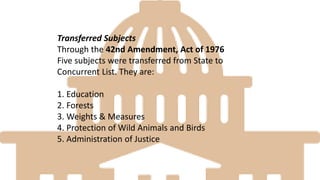
Transferred Subjects
Through the 42nd Amendment, Act of 1976
Five subjects were transferred from State to
Concurrent List. They are:
1. Education
2. Forests
3. Weights & Measures
4. Protection of Wild Animals and Birds
5. Administration of Justice
REFERENCES
http://www.yourarticlelibrary.com/constitution/12-major-constitutional-provisions-on-
education-in-india/45230
https://en.wikipedia.org/wiki/Concurrent_List
https://www.india.gov.in/sites/upload_files/npi/files/coi_part_full.pdf
http://www.yourarticlelibrary.com/education/the-history-of-womens-education-in-
india/9982
Education in the concurrent list

Education in the concurrent list

  • 1.
    EDUCATION IN THECONCURRENT LIST AND ITS IMPLICATIONS Dr. ROMA SMARTJOSEPH Teacher Educator LUCKNOW, UP, India
  • 3.
    WHAT IS CONCURRENTLIST- The Concurrent List or List-III(Seventh Schedule) is a list of 52 items (though the last item is numbered 47) given in the Seventh Schedule to the Constitution of India. It includes the power to be considered by both the central and state government. The legislative section is divided into three lists: Union List, State List and Concurrent List. Unlike the federal governments of the United States, Switzerland or Australia, residual powers remain with the Union Government, as with the Canadian federal government.
  • 4.
    There are 52items currently on the Concurrent list. Few are listed below: 1. Criminal law, including all matters included in the Indian Penal Code at the commencement of this Constitution but excluding offences against laws with respect to any of the matters specified in List I or List II and excluding the use of naval, military or air forces or any other armed forces of the Union in aid of the civil power. 2. Criminal procedure, including all matters included in the Code of Criminal Procedure at the commencement of this Constitution. 3. Preventive detention for reasons connected with the security of a State, the maintenance of public order, or the maintenance of supplies and services essential to the community; persons subjected to such detention.
  • 5.
    4. Removal fromone State to another State of prisoners, accused persons and persons subjected to preventive detention for reasons specified in Entry 3 of this list. 5. Marriage and divorce; infants and minors; adoption; wills, intestacy and succession; joint family and partition; all matters in respect of which parties in judicial proceedings were immediately before the commencement of this Constitution subject to their personal law. 6. Education, including technical education, medical education and universities, subject to the provisions of Entries 63, 64, 65 and 66 of List I; vocational and technical training of labour.
  • 6.
    Transferred Subjects Through the42nd Amendment, Act of 1976 Five subjects were transferred from State to Concurrent List. They are: 1. Education 2. Forests 3. Weights & Measures 4. Protection of Wild Animals and Birds 5. Administration of Justice
  • 24.