Faculty  attitudes  towards  OER  
and  open  textbooks  in  British  
Columbia  and  beyond
Rajiv  Jhangiani BCcampus  Open  Textbook  Fellow  
Beck  Pitt  OER  Research  Hub
Christina  Hendricks  BCcampus  Open  Textbook  Fellow
Clint  Lalonde  BCcampus
Open  Education  Conference
Vancouver  BC
Nov  19,  2015
#opened15
In  the  beginning
open.bccampus.ca
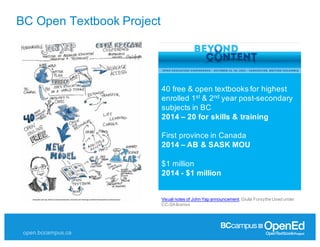
BC  Open  Textbook  Project
40  free  &  open  textbooks  for  highest  
enrolled  1st &  2nd year  post-­secondary  
subjects  in  BC
2014  – 20  for  skills  &  training
First  province  in  Canada
2014  – AB  &  SASK  MOU
$1  million
2014  -­ $1  million
Visual  notes  of  John  Yap  announcement,  Giulia  Forsythe  Used  under  
CC-­SA  license
open.bccampus.ca
open.bccampus.ca
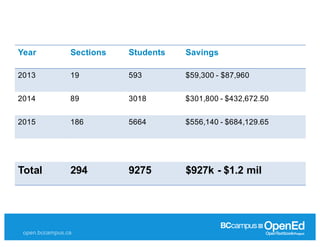
Year Sections Students Savings
2013 19 593 $59,300  -­ $87,960
2014 89 3018 $301,800  -­ $432,672.50
2015   186 5664 $556,140  -­ $684,129.65
Total 294 9275 $927k  -­ $1.2  mil
Faculty  are  key
Why  do  they  adopt?
What  challenges  do  they  face?
How  can  we  overcome  those  challenges?
The  Study
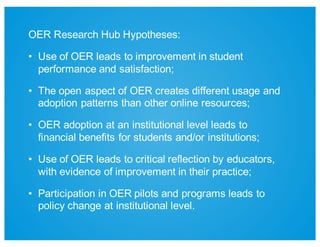
OER  Research  Hub  Hypotheses:  
• Use  of  OER  leads  to  improvement  in  student  
performance  and  satisfaction;;
• The  open  aspect  of  OER  creates  different  usage  and  
adoption  patterns  than  other  online  resources;;
• OER  adoption  at  an  institutional  level  leads  to  
financial  benefits  for  students  and/or  institutions;;
• Use  of  OER  leads  to  critical  reflection  by  educators,  
with  evidence  of  improvement  in  their  practice;;
• Participation  in  OER  pilots  and  programs  leads  to  
policy  change  at  institutional  level.
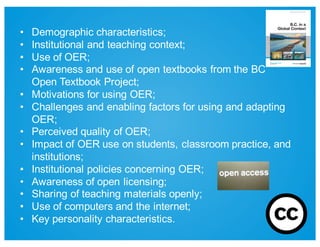
• Demographic  characteristics;;  
• Institutional  and  teaching  context;;
• Use  of  OER;;  
• Awareness  and  use  of  open  textbooks  from  the  BC  
Open  Textbook  Project;;  
• Motivations  for  using  OER;;  
• Challenges  and  enabling  factors  for  using  and  adapting  
OER;;  
• Perceived  quality  of  OER;;  
• Impact  of  OER  use  on  students,  classroom  practice,  and  
institutions;;  
• Institutional  policies  concerning  OER;;  
• Awareness  of  open  licensing;;  
• Sharing  of  teaching  materials  openly;;  
• Use  of  computers  and  the  internet;;  
• Key  personality  characteristics.  
What  do  we  know  so  far?
Usage  Patterns
Quality
Barriers/Enabling  Factors
Policy
open.bccampus.ca
Perceived  quality  of  OER
0%
5%
10%
15%
20%
25%
30%
35%
Compared	
  to	
  traditional,	
  
proprietary	
  materials
open.bccampus.ca
Adoption,  adaptation,  creation  correlations
0.39
Adopted	
  
OER
Created
OER
Adapted
OER
0.45
0.43
All	
  correlations	
  
significant	
  at	
  p<.001
open.bccampus.ca
Use,  adaptation,  creation,  by  type  of  institution
0%
10%
20%
30%
40%
50%
60%
70%
Research	
  University Teaching	
  University College/Institute
Adopted
Adapted
Created
open.bccampus.ca
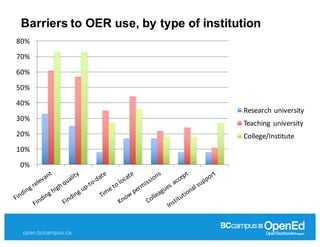
Barriers  to  OER  use,  by  type  of  institution
0%
10%
20%
30%
40%
50%
60%
70%
80%
Research	
  university
Teaching	
  university
College/Institute
open.bccampus.ca
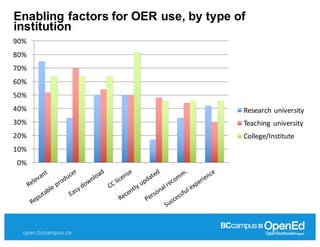
Enabling  factors  for  OER  use,  by  type  of  
institution
0%
10%
20%
30%
40%
50%
60%
70%
80%
90%
Research	
  university
Teaching	
  university
College/Institute
So  what  have  
we  learned?
open.bccampus.ca
The	
  Question	
  of	
  OER	
  Quality
open.bccampus.ca
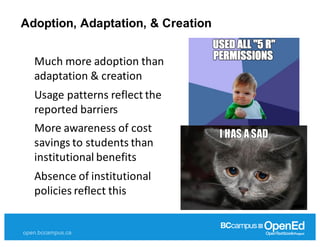
Adoption,  Adaptation,  &  Creation
Much	
  more	
  adoption	
  than	
  
adaptation	
  &	
  creation
Usage	
  patterns	
  reflect	
  the	
  
reported	
  barriers
More	
  awareness	
  of	
  cost	
  
savings	
  to	
  students	
  than	
  
institutional	
  benefits
Absence	
  of	
  institutional	
  
policies	
  reflect	
  this
open.bccampus.ca
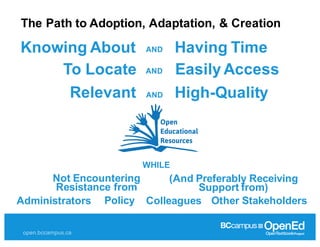
The  Path  to  Adoption,  Adaptation,  &  Creation
Knowing  About   AND Having  Time
To  Locate AND Easily  Access
Relevant High-­Quality
WHILE
Not  Encountering  
Resistance  from
(And  Preferably  Receiving  
Support  from)
ColleaguesAdministrators
AND
Policy Other  Stakeholders
open.bccampus.ca Source:	
  "Pencil" by sylviaduckworth.	
  Reproduced	
  with	
  permission.
Thank  You
Questions?

Faculty Attitudes Towards OER

  • 1.
    Faculty  attitudes  towards OER   and  open  textbooks  in  British   Columbia  and  beyond Rajiv  Jhangiani BCcampus  Open  Textbook  Fellow   Beck  Pitt  OER  Research  Hub Christina  Hendricks  BCcampus  Open  Textbook  Fellow Clint  Lalonde  BCcampus Open  Education  Conference Vancouver  BC Nov  19,  2015 #opened15
  • 2.
  • 3.
    open.bccampus.ca BC  Open  Textbook Project 40  free  &  open  textbooks  for  highest   enrolled  1st &  2nd year  post-­secondary   subjects  in  BC 2014  – 20  for  skills  &  training First  province  in  Canada 2014  – AB  &  SASK  MOU $1  million 2014  -­ $1  million Visual  notes  of  John  Yap  announcement,  Giulia  Forsythe  Used  under   CC-­SA  license
  • 4.
  • 5.
    open.bccampus.ca Year Sections StudentsSavings 2013 19 593 $59,300  -­ $87,960 2014 89 3018 $301,800  -­ $432,672.50 2015   186 5664 $556,140  -­ $684,129.65 Total 294 9275 $927k  -­ $1.2  mil
  • 6.
  • 7.
    Why  do  they adopt? What  challenges  do  they  face? How  can  we  overcome  those  challenges?
  • 8.
  • 9.
    OER  Research  Hub Hypotheses:   • Use  of  OER  leads  to  improvement  in  student   performance  and  satisfaction;; • The  open  aspect  of  OER  creates  different  usage  and   adoption  patterns  than  other  online  resources;; • OER  adoption  at  an  institutional  level  leads  to   financial  benefits  for  students  and/or  institutions;; • Use  of  OER  leads  to  critical  reflection  by  educators,   with  evidence  of  improvement  in  their  practice;; • Participation  in  OER  pilots  and  programs  leads  to   policy  change  at  institutional  level.
  • 10.
    • Demographic  characteristics;;  • Institutional  and  teaching  context;; • Use  of  OER;;   • Awareness  and  use  of  open  textbooks  from  the  BC   Open  Textbook  Project;;   • Motivations  for  using  OER;;   • Challenges  and  enabling  factors  for  using  and  adapting   OER;;   • Perceived  quality  of  OER;;   • Impact  of  OER  use  on  students,  classroom  practice,  and   institutions;;   • Institutional  policies  concerning  OER;;   • Awareness  of  open  licensing;;   • Sharing  of  teaching  materials  openly;;   • Use  of  computers  and  the  internet;;   • Key  personality  characteristics.  
  • 11.
    What  do  we know  so  far? Usage  Patterns Quality Barriers/Enabling  Factors Policy
  • 12.
    open.bccampus.ca Perceived  quality  of OER 0% 5% 10% 15% 20% 25% 30% 35% Compared  to  traditional,   proprietary  materials
  • 13.
    open.bccampus.ca Adoption,  adaptation,  creation correlations 0.39 Adopted   OER Created OER Adapted OER 0.45 0.43 All  correlations   significant  at  p<.001
  • 14.
    open.bccampus.ca Use,  adaptation,  creation, by  type  of  institution 0% 10% 20% 30% 40% 50% 60% 70% Research  University Teaching  University College/Institute Adopted Adapted Created
  • 15.
    open.bccampus.ca Barriers  to  OER use,  by  type  of  institution 0% 10% 20% 30% 40% 50% 60% 70% 80% Research  university Teaching  university College/Institute
  • 16.
    open.bccampus.ca Enabling  factors  for OER  use,  by  type  of   institution 0% 10% 20% 30% 40% 50% 60% 70% 80% 90% Research  university Teaching  university College/Institute
  • 17.
    So  what  have  we  learned?
  • 18.
  • 19.
    open.bccampus.ca Adoption,  Adaptation,  & Creation Much  more  adoption  than   adaptation  &  creation Usage  patterns  reflect  the   reported  barriers More  awareness  of  cost   savings  to  students  than   institutional  benefits Absence  of  institutional   policies  reflect  this
  • 20.
    open.bccampus.ca The  Path  to Adoption,  Adaptation,  &  Creation Knowing  About   AND Having  Time To  Locate AND Easily  Access Relevant High-­Quality WHILE Not  Encountering   Resistance  from (And  Preferably  Receiving   Support  from) ColleaguesAdministrators AND Policy Other  Stakeholders
  • 21.
    open.bccampus.ca Source:  "Pencil"by sylviaduckworth.  Reproduced  with  permission.
  • 22.