Quality Frameworks
for Online Education
EMOOCs2017
23 May 2017
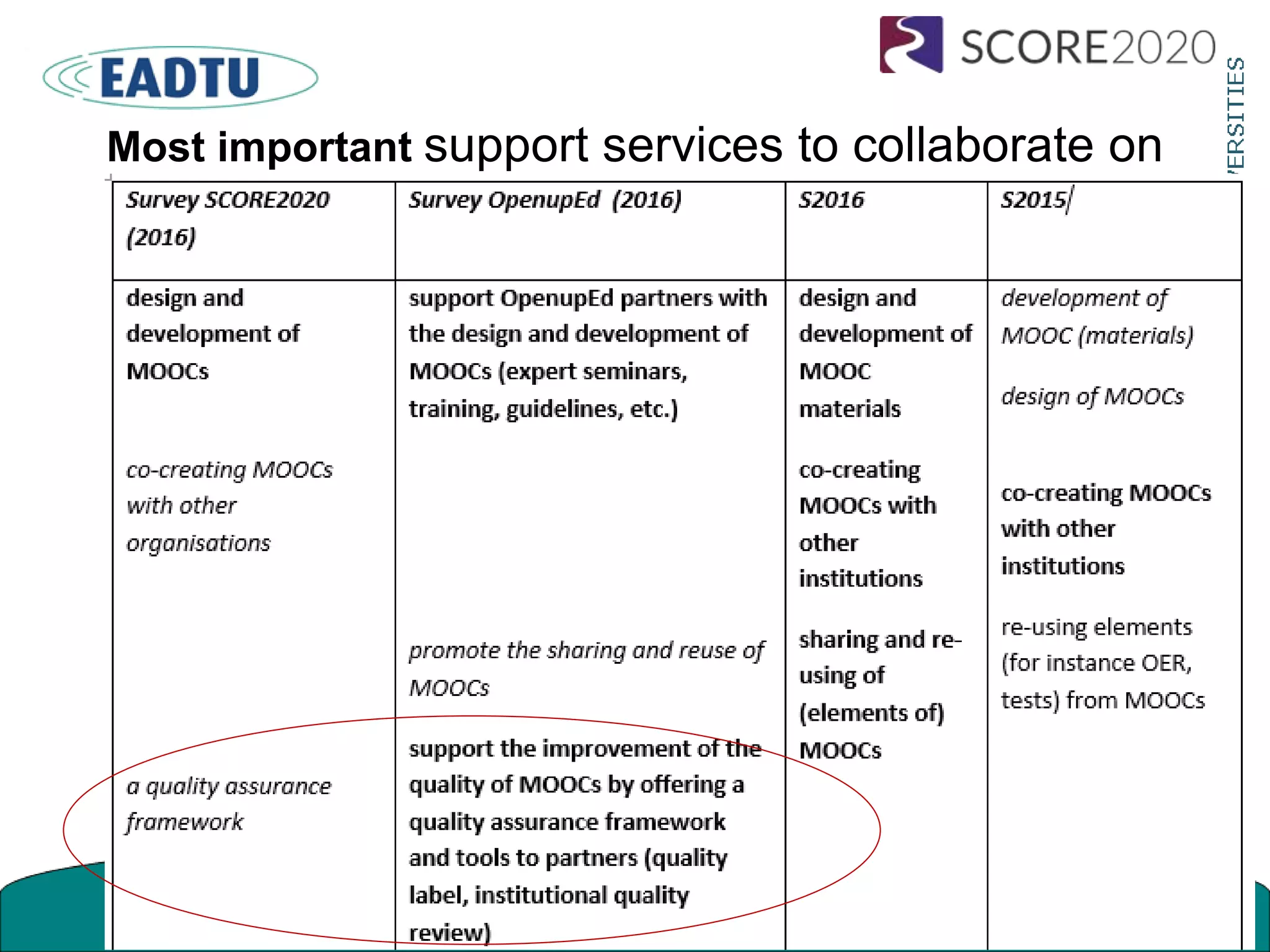
Most important support services to collaborate on
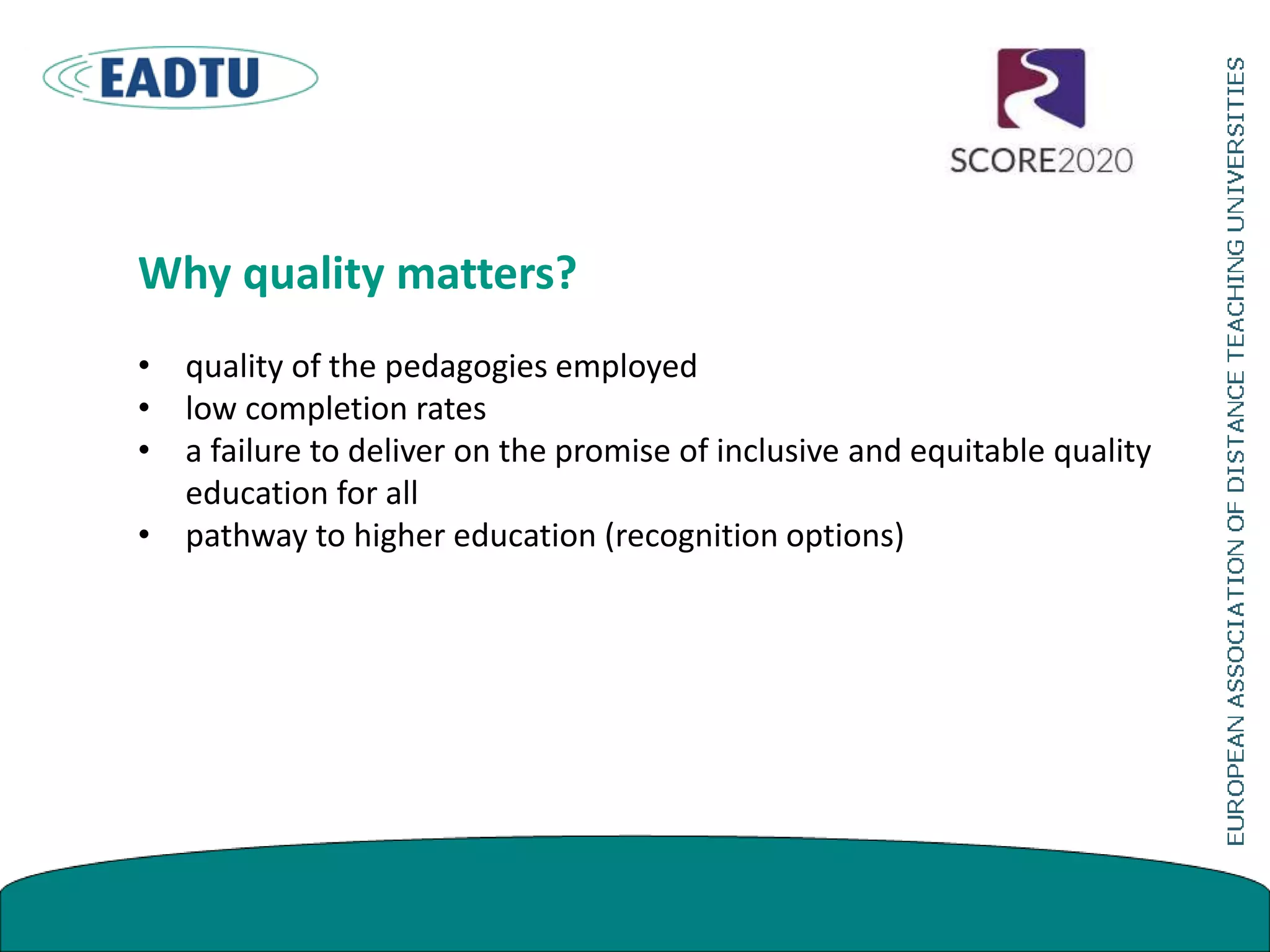
Why quality matters?
• quality of the pedagogies employed
• low completion rates
• a failure to deliver on the promise of inclusive and equitable quality
education for all
• pathway to higher education (recognition options)
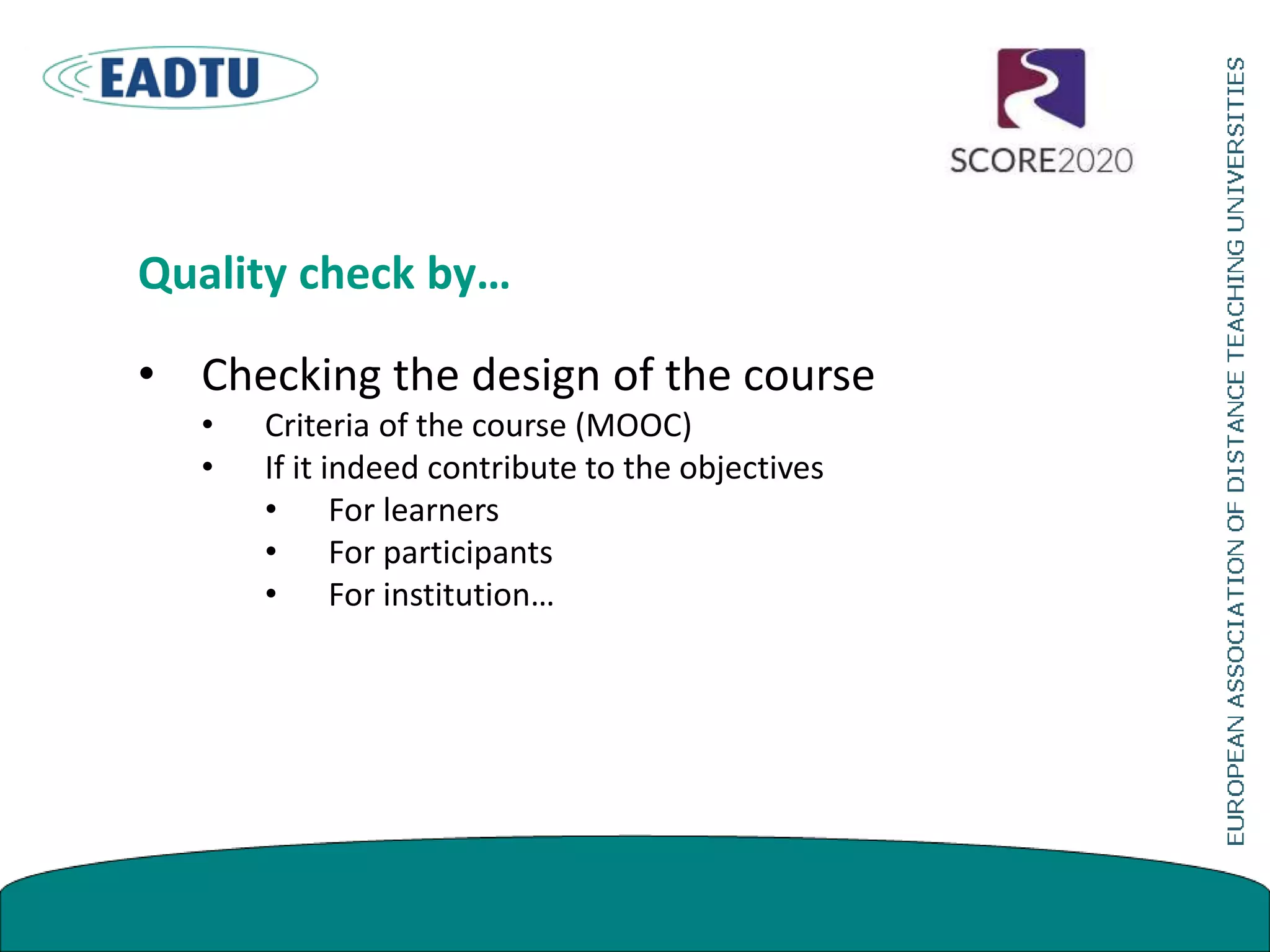
Quality check by…
• Checking the design of the course
• Criteria of the course (MOOC)
• If it indeed contribute to the objectives
• For learners
• For participants
• For institution…
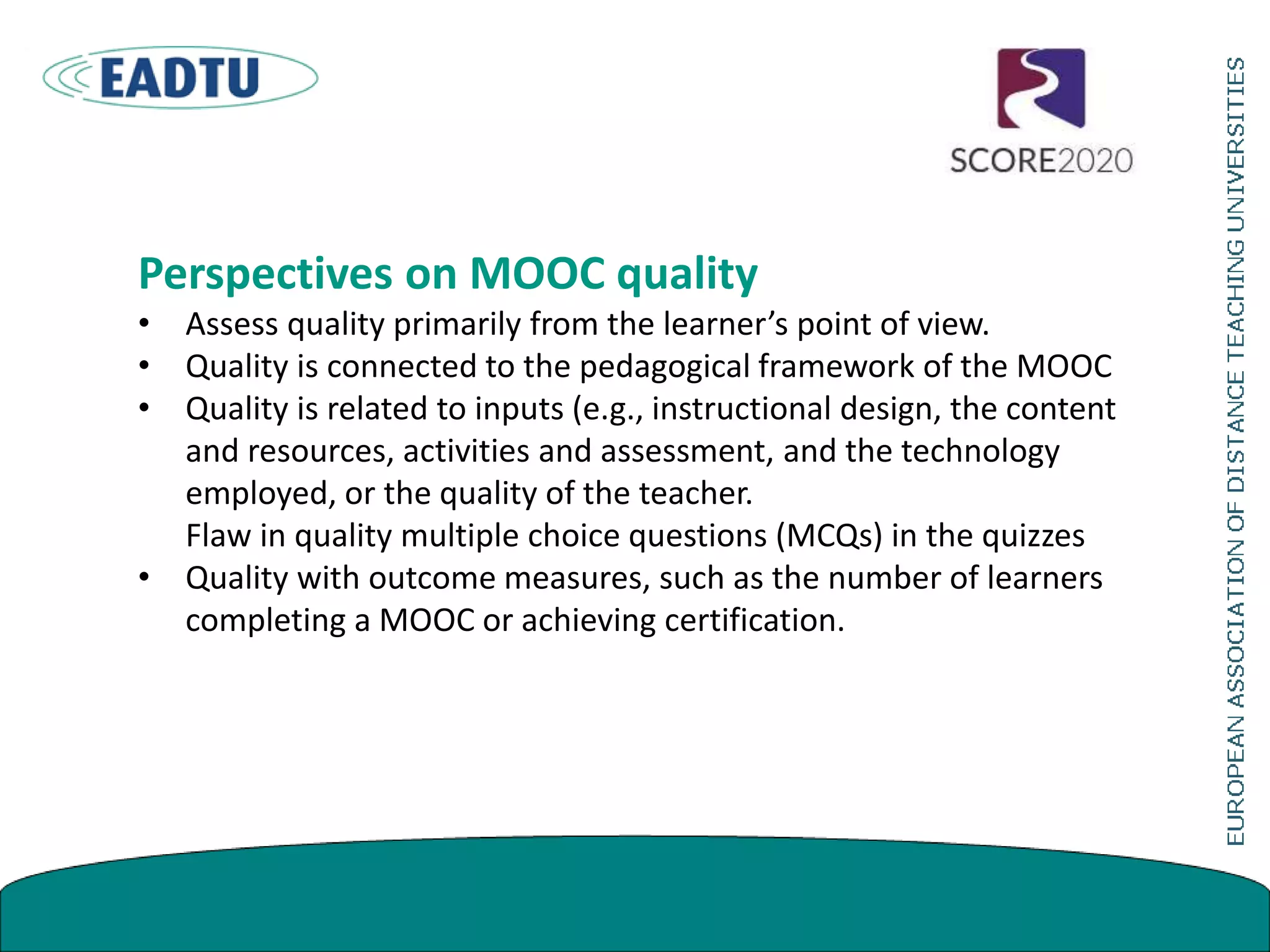
Perspectives on MOOC quality
• Assess quality primarily from the learner’s point of view.
• Quality is connected to the pedagogical framework of the MOOC
• Quality is related to inputs (e.g., instructional design, the content
and resources, activities and assessment, and the technology
employed, or the quality of the teacher.
Flaw in quality multiple choice questions (MCQs) in the quizzes
• Quality with outcome measures, such as the number of learners
completing a MOOC or achieving certification.
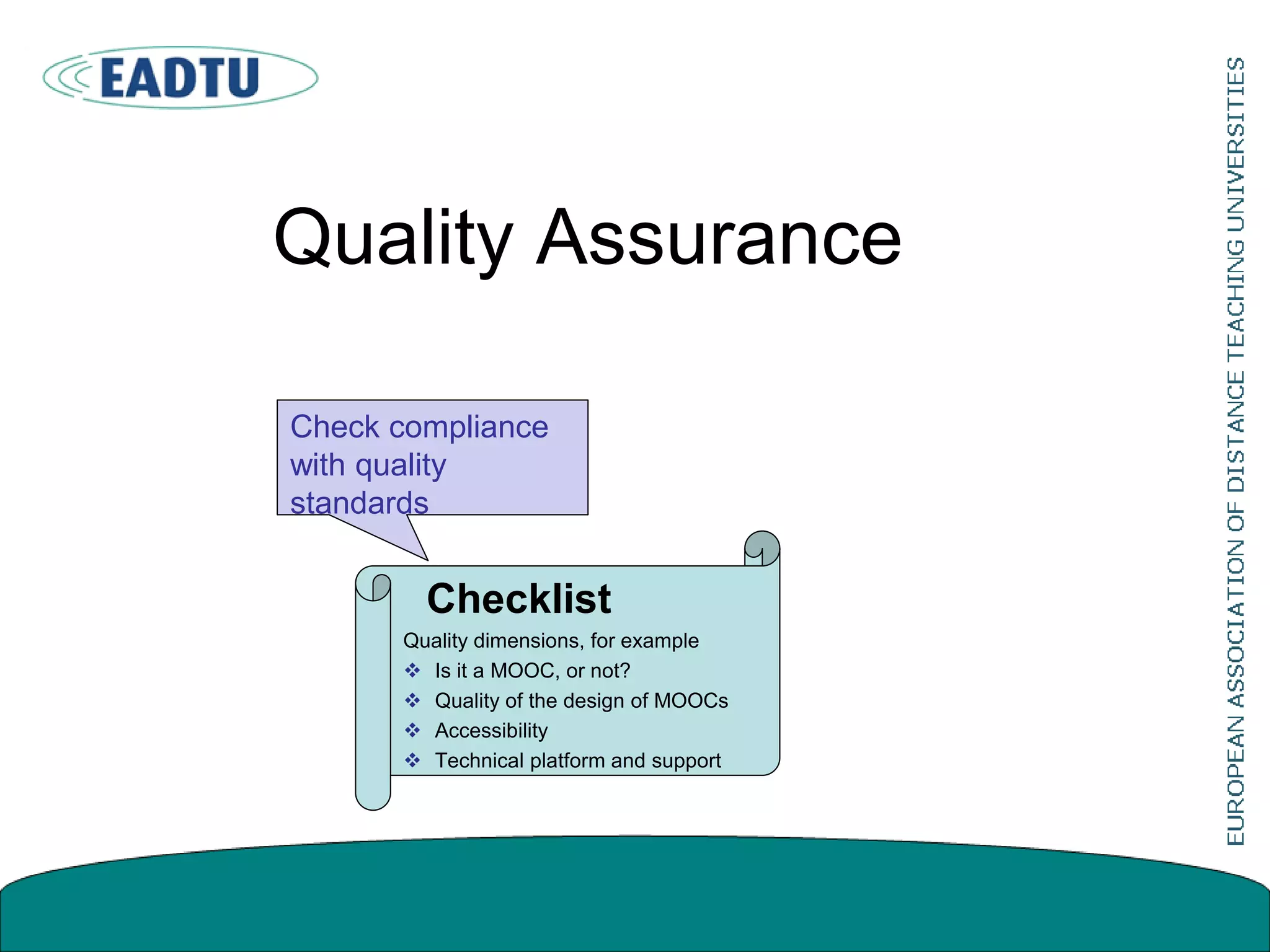
Quality Assurance
Check compliance
with quality
standards
Checklist
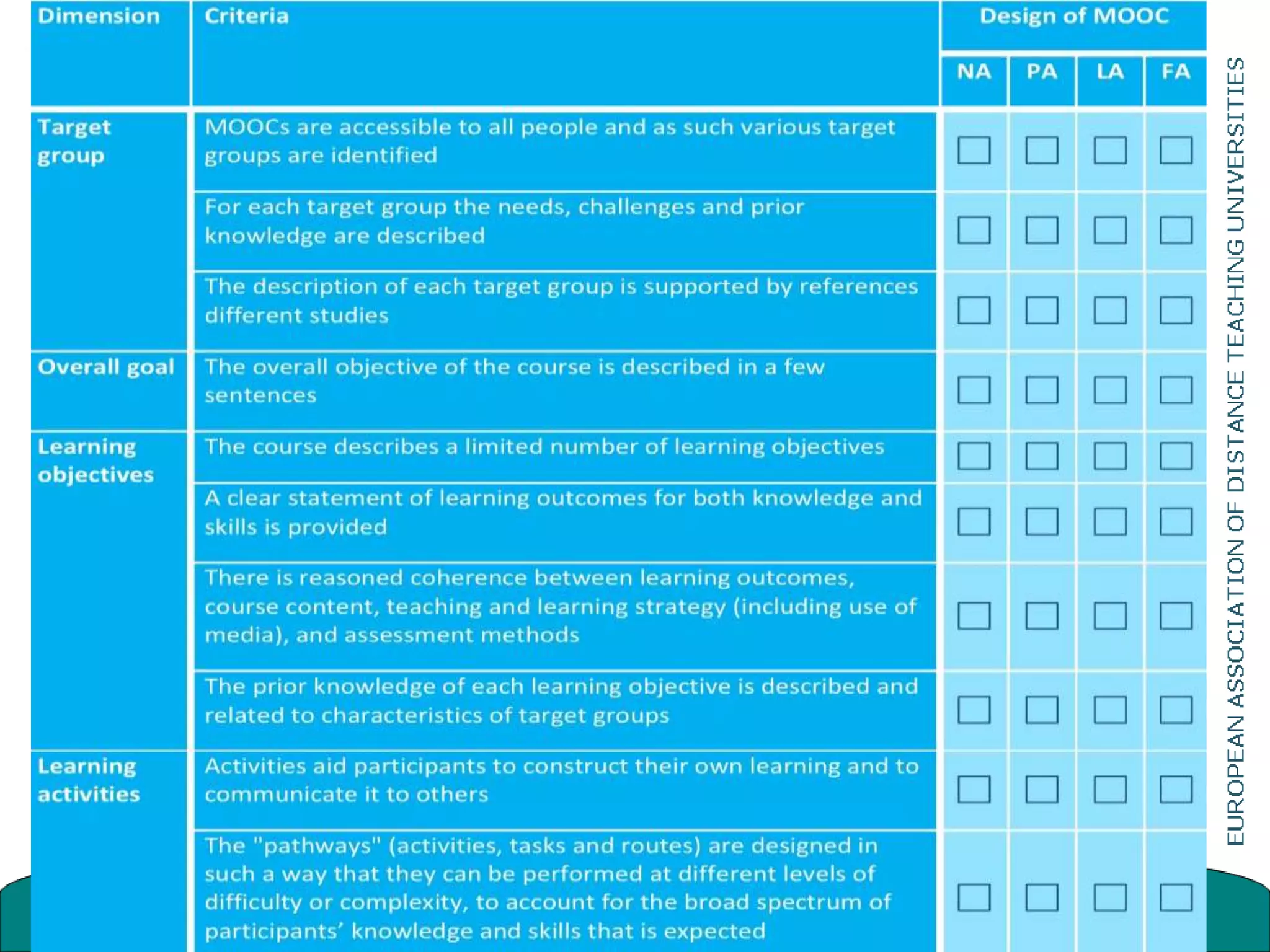
Quality dimensions, for example
 Is it a MOOC, or not?
 Quality of the design of MOOCs
 Accessibility
 Technical platform and support
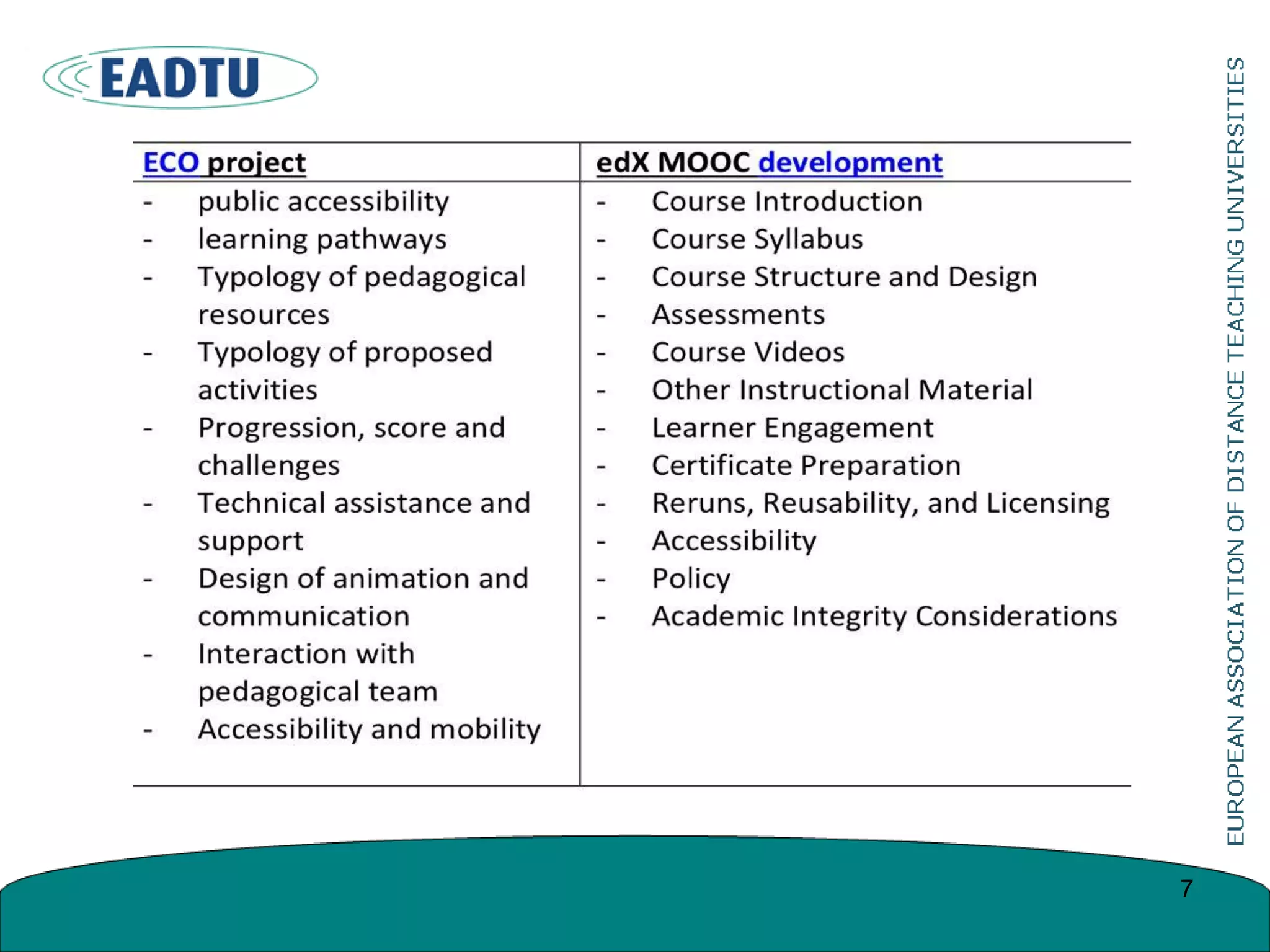
7
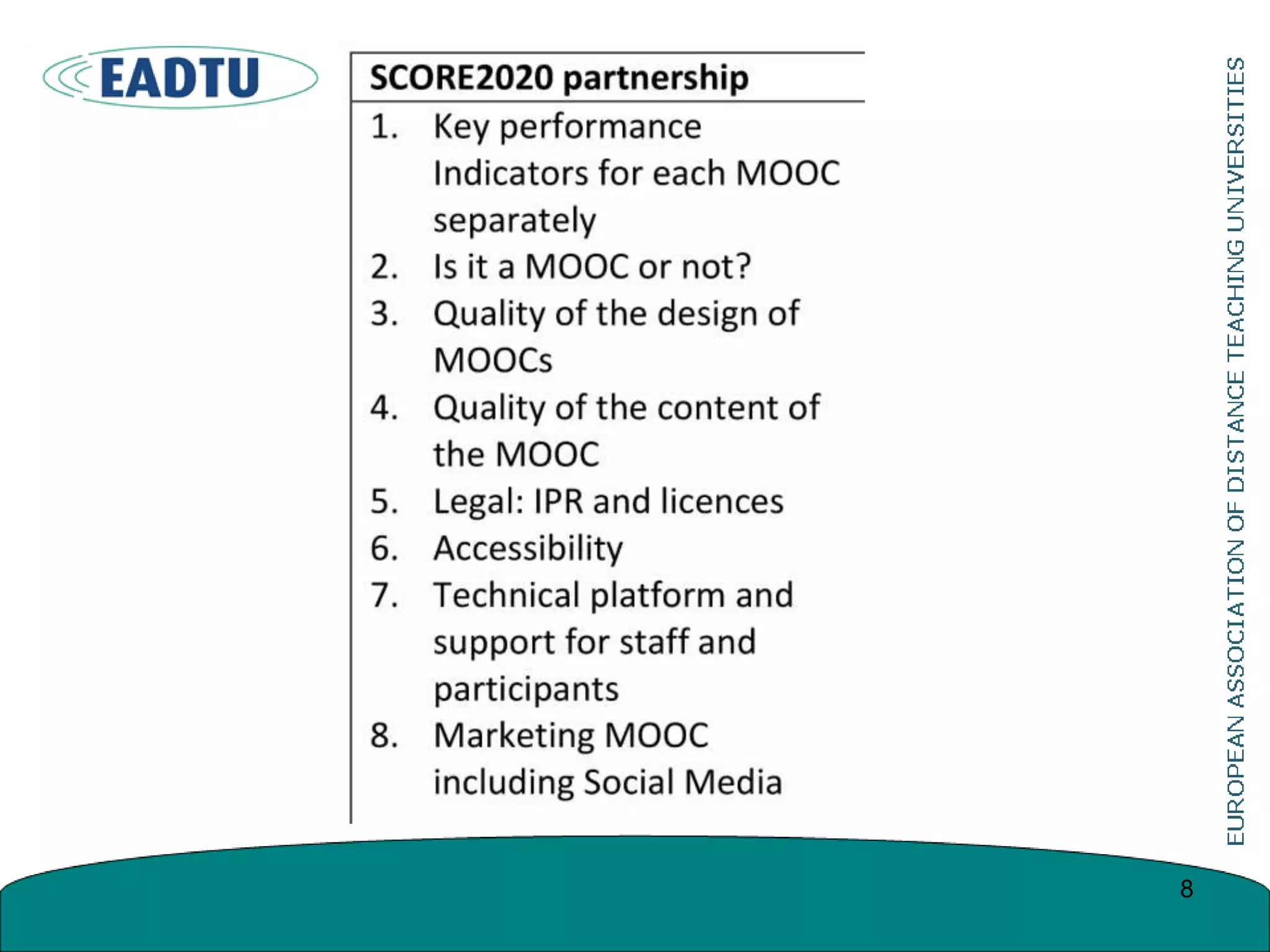
8
9
Complexity with MOOC quality
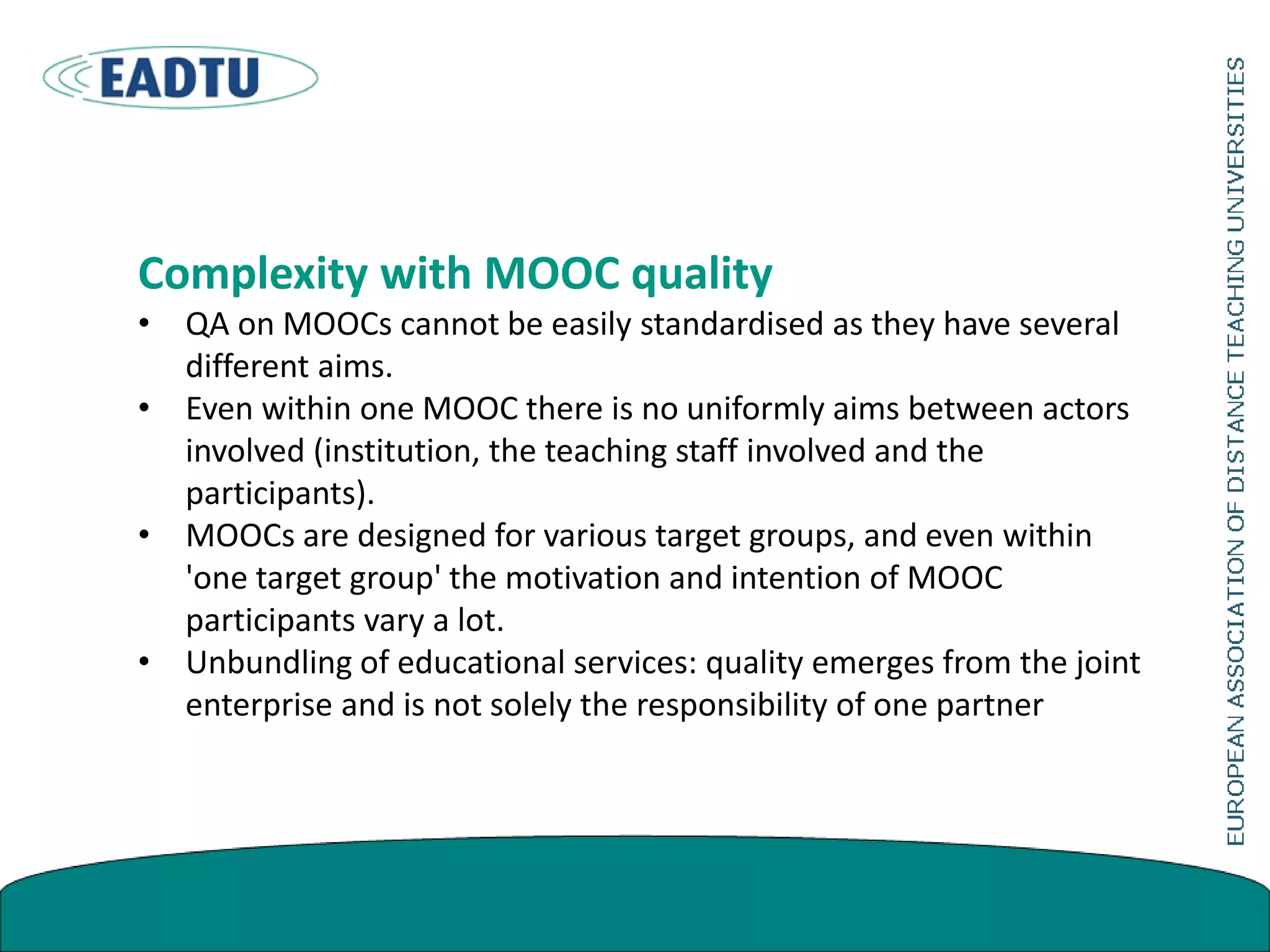
• QA on MOOCs cannot be easily standardised as they have several
different aims.
• Even within one MOOC there is no uniformly aims between actors
involved (institution, the teaching staff involved and the
participants).
• MOOCs are designed for various target groups, and even within
'one target group' the motivation and intention of MOOC
participants vary a lot.
• Unbundling of educational services: quality emerges from the joint
enterprise and is not solely the responsibility of one partner
MOOC quality models
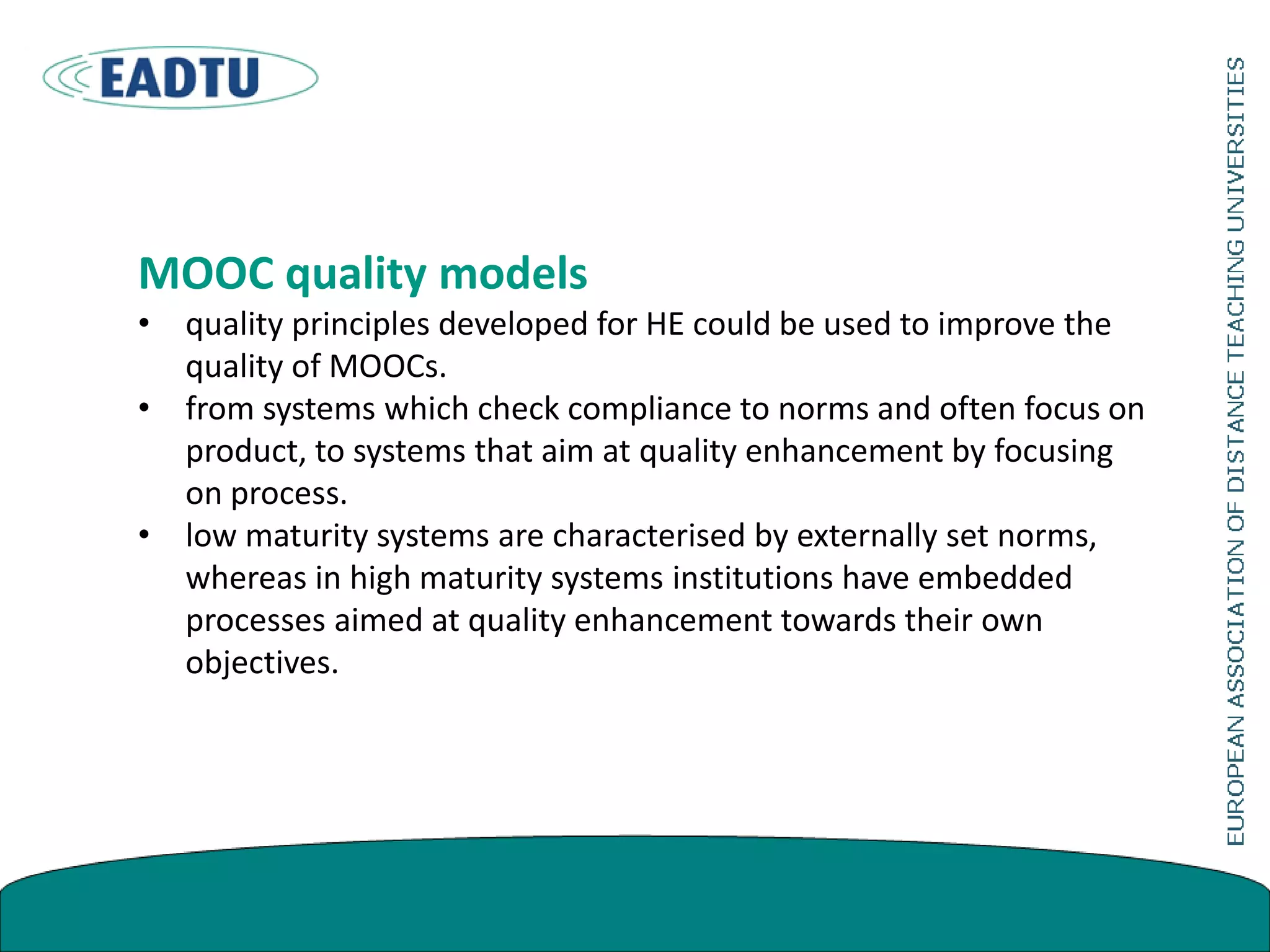
• quality principles developed for HE could be used to improve the
quality of MOOCs.
• from systems which check compliance to norms and often focus on
product, to systems that aim at quality enhancement by focusing
on process.
• low maturity systems are characterised by externally set norms,
whereas in high maturity systems institutions have embedded
processes aimed at quality enhancement towards their own
objectives.
More holistic MOOC quality models
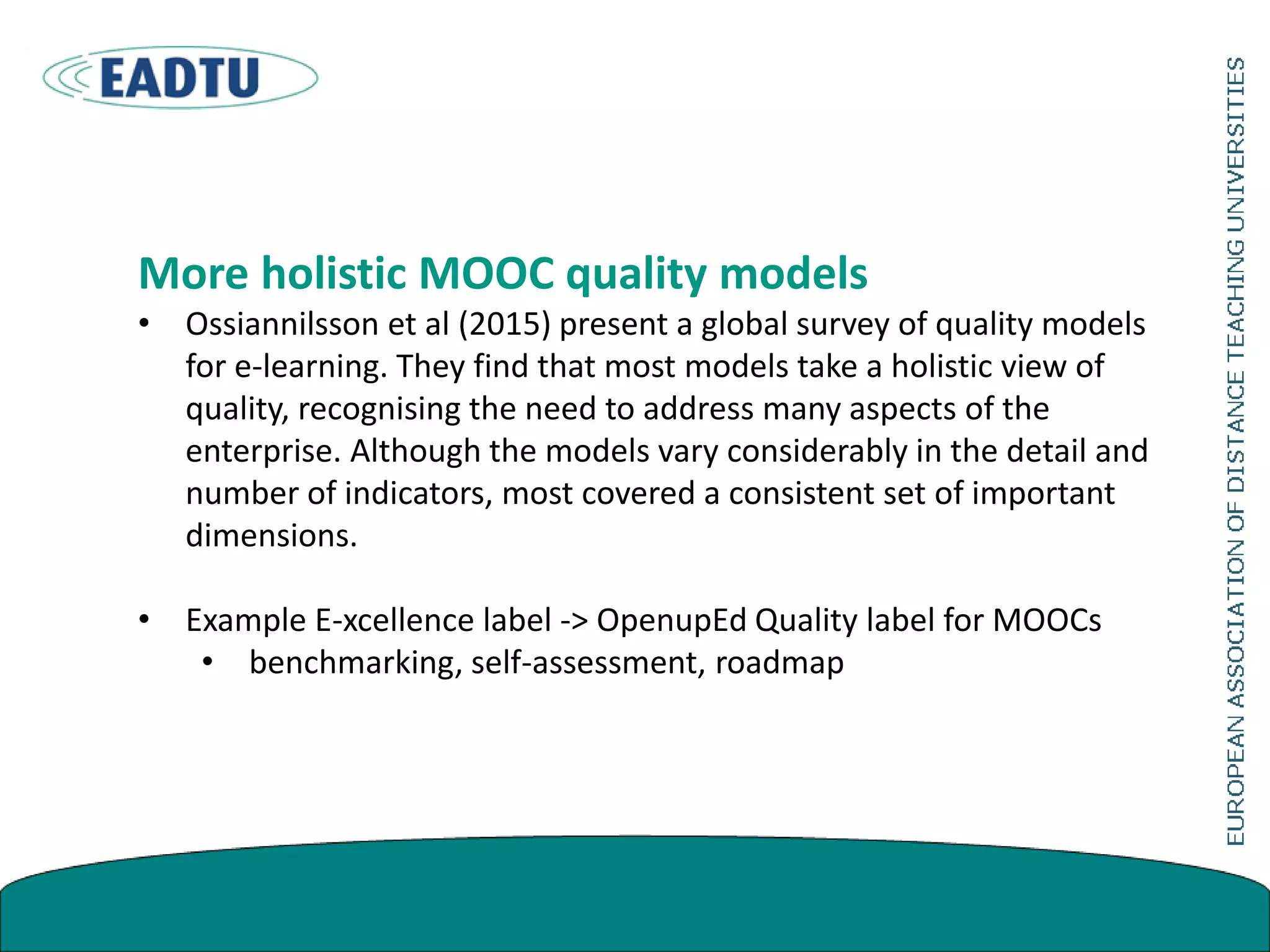
• Ossiannilsson et al (2015) present a global survey of quality models
for e-learning. They find that most models take a holistic view of
quality, recognising the need to address many aspects of the
enterprise. Although the models vary considerably in the detail and
number of indicators, most covered a consistent set of important
dimensions.
• Example E-xcellence label -> OpenupEd Quality label for MOOCs
• benchmarking, self-assessment, roadmap
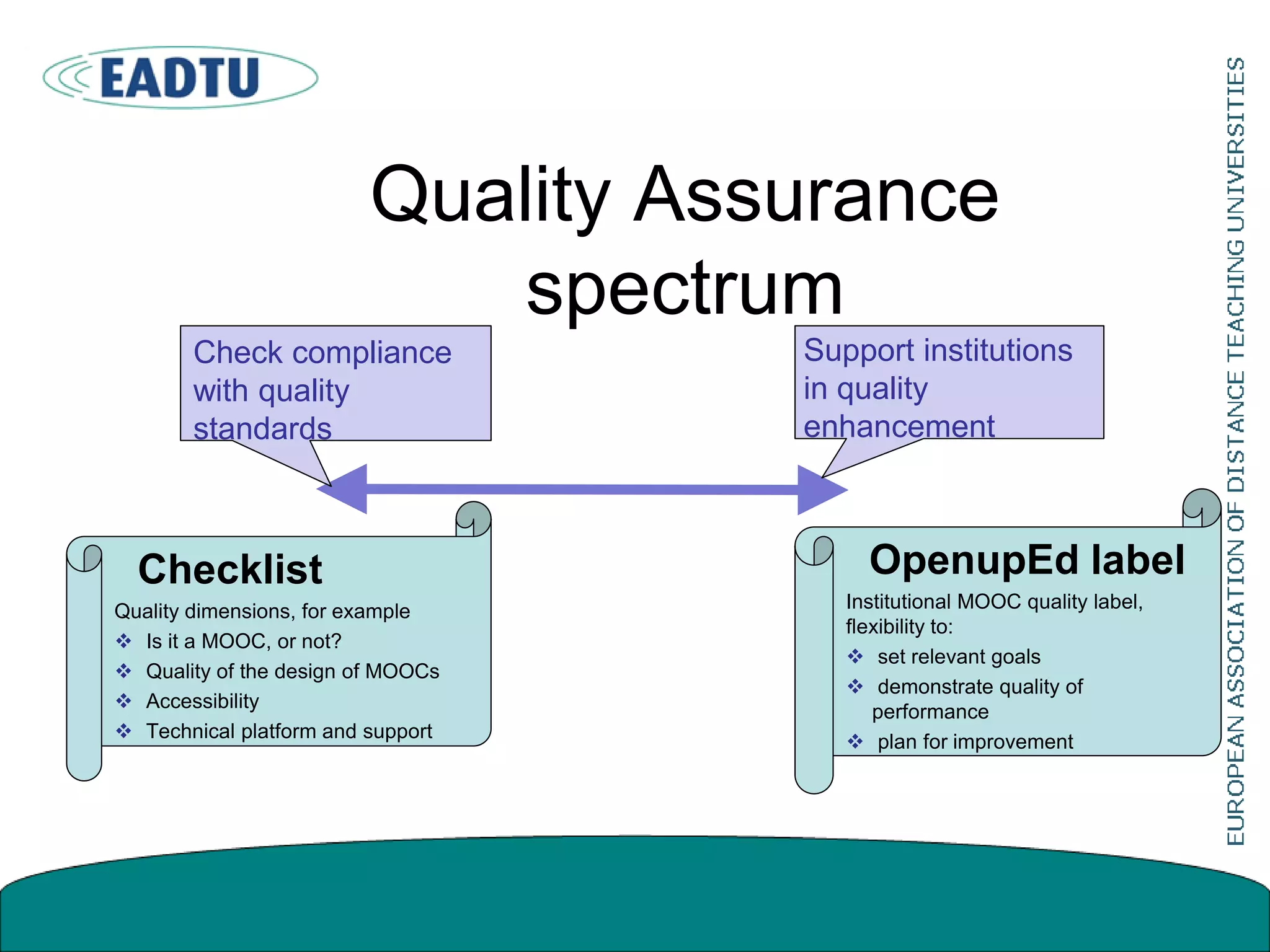
Quality Assurance
spectrum
Check compliance
with quality
standards
Support institutions
in quality
enhancement
OpenupEd label
Institutional MOOC quality label,
flexibility to:
 set relevant goals
 demonstrate quality of
performance
 plan for improvement
Checklist
Quality dimensions, for example
 Is it a MOOC, or not?
 Quality of the design of MOOCs
 Accessibility
 Technical platform and support
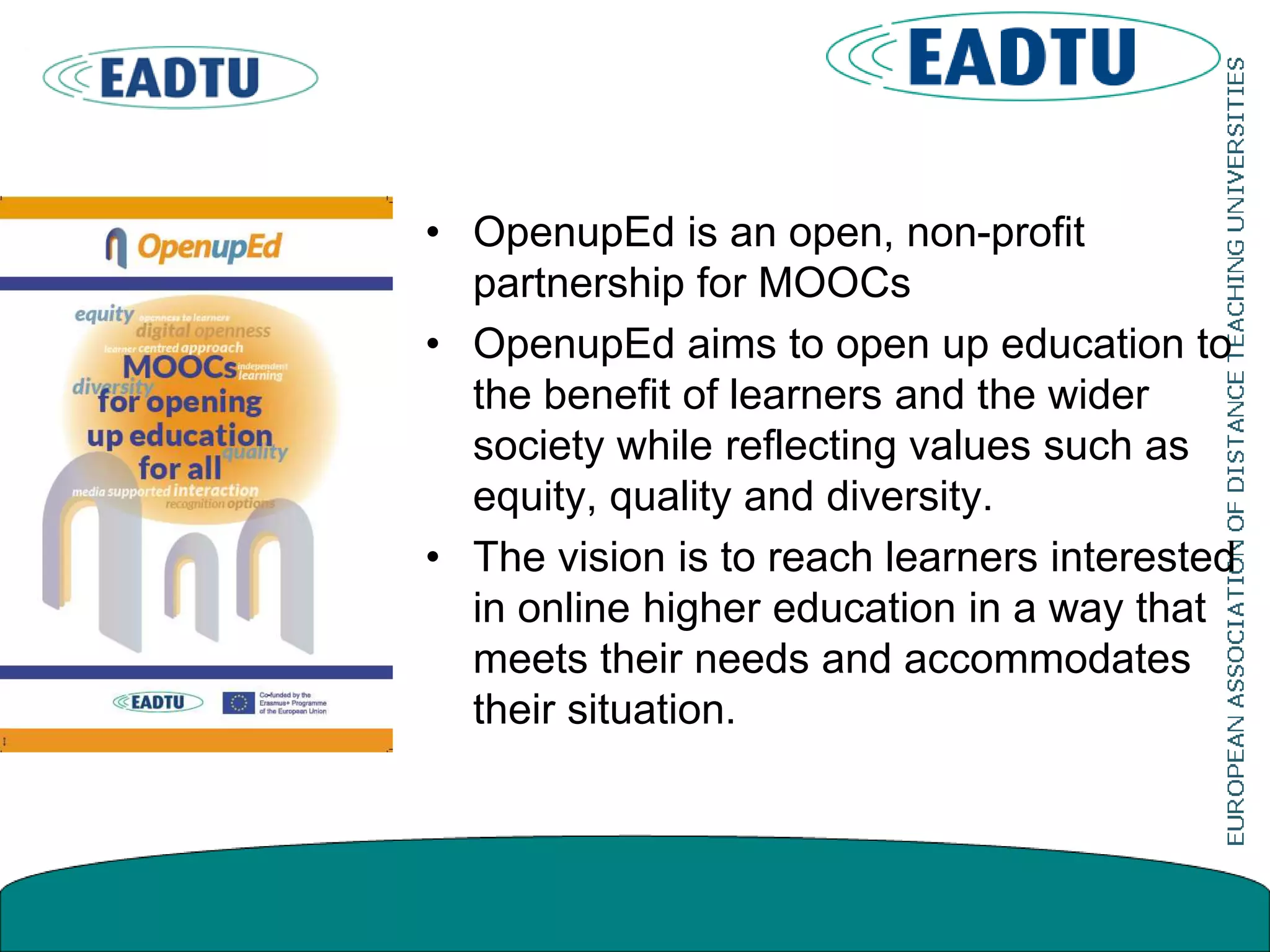
• OpenupEd is an open, non-profit
partnership for MOOCs
• OpenupEd aims to open up education to
the benefit of learners and the wider
society while reflecting values such as
equity, quality and diversity.
• The vision is to reach learners interested
in online higher education in a way that
meets their needs and accommodates
their situation.
Quality models for MOOCs
http://eadtu.eu/documents/Publications/Quality_Frameworks_for_MOOCs_Springer.pdf
Thank you!!!
Darco.Jansen@eadtu.eu
Coordinator
Partner
4.31
It is clear that higher education institutions, their staff and
students, and the quality assurance agencies all have
concerns about relevant and effective quality assurance
for online and blended education.
They are still in the beginning of a transition period, which
has to be accelerated to fully exploit the opportunities of
new modes of teaching and learning and to keep track
with the international developments in higher education.
• National governments must review their legislative and regulatory frameworks
and practices for quality assurance and accreditation in higher education
(including recognition of prior learning) to ensure that they encourage, and do
not impede, the provision of more flexible educational formats, including degrees
and other ECTS-bearing courses that are fully online.
• National QA agencies should develop their own in-house expertise and
establish processes that are sufficiently flexible to include recognising and
supporting modes of teaching and learning. They should evaluate institutions
on their active support of innovation (or importantly, the lack of it), and its
impact on the quality of teaching and learning.
• ENQA and other relevant European networks should support the sharing of
good practice by national QA agencies in the development of criteria on the
recognition of new modes of teaching and learning.
CPL-Recommendations related to QA
Review format
• Preparation
– Decide programme(s) to be reviewed
– Form interdisciplinary team of the HE institution’s managers, course
designers, educators, students, technical staff
– Team meets to complete QuickScan self-evaluation
• Visit or online meetings
– HE team meets with E-xcellence reviewers (2 - 4 e-learning experts)
– Discuss institution’s e-learning offerings and the QuickScan self-
evaluation
– Reviewers give initial feedback and suggestions
• Reports
– Summary report from E-xcellence reviewers
– Reviewers consider and agree Roadmap for improvement from the
institution
E-xcellent manual
update
• Reflects recent trends in e-learning
– rapid rise of MOOCs
– surge of interest in learning analytics
– increasing use of learning design in course development
• Includes new topics
– increased focus on personalization
– flipped approaches to teaching
– virtual and remote laboratories
– digital badges and e-portfolios.
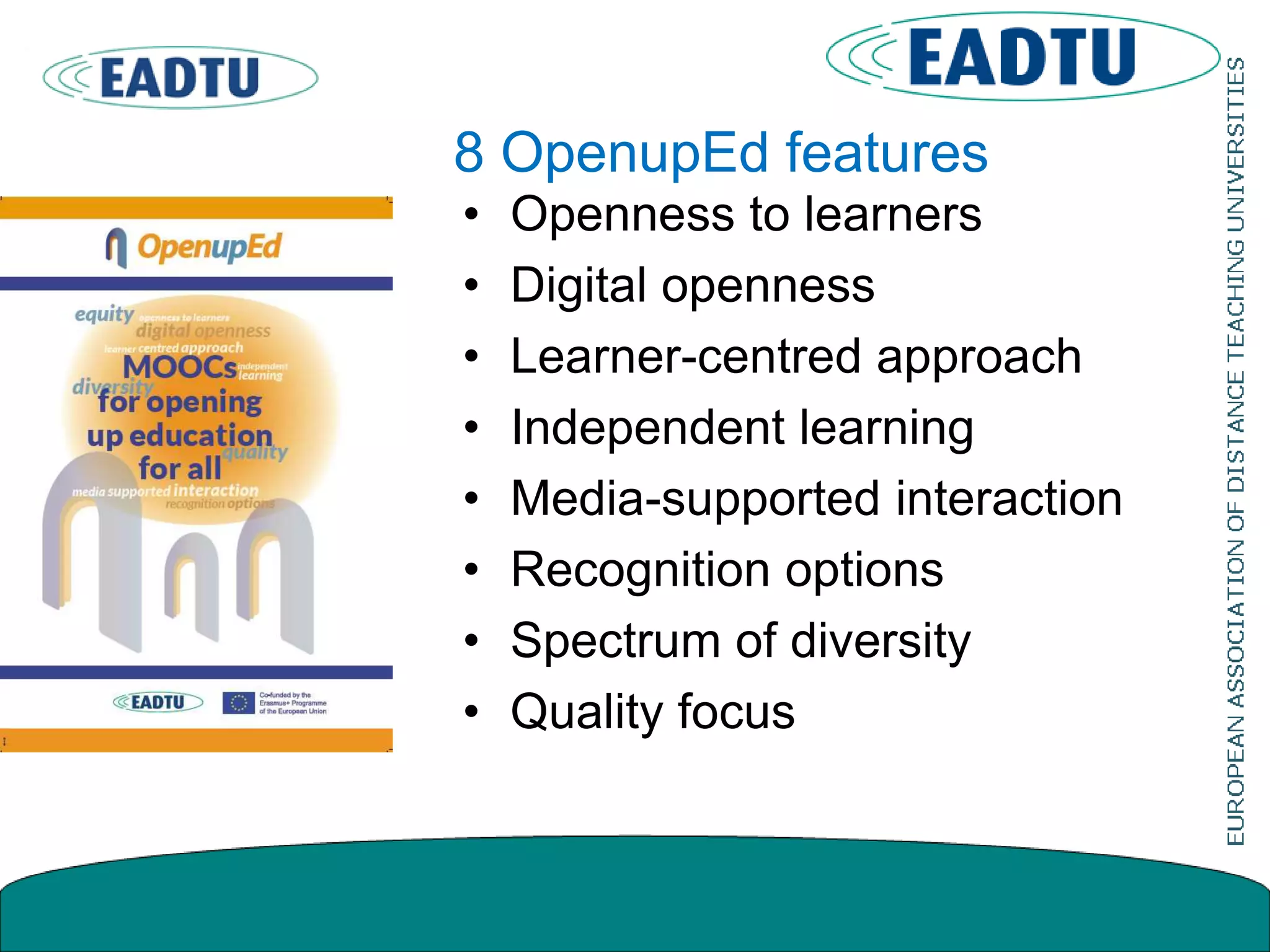
8 OpenupEd features
• Openness to learners
• Digital openness
• Learner-centred approach
• Independent learning
• Media-supported interaction
• Recognition options
• Spectrum of diversity
• Quality focus

Quality Frameworks for Online Education EMOOCs2017

  • 1.
    Quality Frameworks for OnlineEducation EMOOCs2017 23 May 2017
  • 2.
    Most important supportservices to collaborate on
  • 3.
    Why quality matters? •quality of the pedagogies employed • low completion rates • a failure to deliver on the promise of inclusive and equitable quality education for all • pathway to higher education (recognition options)
  • 4.
    Quality check by… •Checking the design of the course • Criteria of the course (MOOC) • If it indeed contribute to the objectives • For learners • For participants • For institution…
  • 5.
    Perspectives on MOOCquality • Assess quality primarily from the learner’s point of view. • Quality is connected to the pedagogical framework of the MOOC • Quality is related to inputs (e.g., instructional design, the content and resources, activities and assessment, and the technology employed, or the quality of the teacher. Flaw in quality multiple choice questions (MCQs) in the quizzes • Quality with outcome measures, such as the number of learners completing a MOOC or achieving certification.
  • 6.
    Quality Assurance Check compliance withquality standards Checklist Quality dimensions, for example  Is it a MOOC, or not?  Quality of the design of MOOCs  Accessibility  Technical platform and support
  • 7.
  • 8.
  • 9.
  • 10.
    Complexity with MOOCquality • QA on MOOCs cannot be easily standardised as they have several different aims. • Even within one MOOC there is no uniformly aims between actors involved (institution, the teaching staff involved and the participants). • MOOCs are designed for various target groups, and even within 'one target group' the motivation and intention of MOOC participants vary a lot. • Unbundling of educational services: quality emerges from the joint enterprise and is not solely the responsibility of one partner
  • 11.
    MOOC quality models •quality principles developed for HE could be used to improve the quality of MOOCs. • from systems which check compliance to norms and often focus on product, to systems that aim at quality enhancement by focusing on process. • low maturity systems are characterised by externally set norms, whereas in high maturity systems institutions have embedded processes aimed at quality enhancement towards their own objectives.
  • 12.
    More holistic MOOCquality models • Ossiannilsson et al (2015) present a global survey of quality models for e-learning. They find that most models take a holistic view of quality, recognising the need to address many aspects of the enterprise. Although the models vary considerably in the detail and number of indicators, most covered a consistent set of important dimensions. • Example E-xcellence label -> OpenupEd Quality label for MOOCs • benchmarking, self-assessment, roadmap
  • 13.
    Quality Assurance spectrum Check compliance withquality standards Support institutions in quality enhancement OpenupEd label Institutional MOOC quality label, flexibility to:  set relevant goals  demonstrate quality of performance  plan for improvement Checklist Quality dimensions, for example  Is it a MOOC, or not?  Quality of the design of MOOCs  Accessibility  Technical platform and support
  • 14.
    • OpenupEd isan open, non-profit partnership for MOOCs • OpenupEd aims to open up education to the benefit of learners and the wider society while reflecting values such as equity, quality and diversity. • The vision is to reach learners interested in online higher education in a way that meets their needs and accommodates their situation.
  • 15.
    Quality models forMOOCs http://eadtu.eu/documents/Publications/Quality_Frameworks_for_MOOCs_Springer.pdf
  • 16.
  • 18.
    4.31 It is clearthat higher education institutions, their staff and students, and the quality assurance agencies all have concerns about relevant and effective quality assurance for online and blended education. They are still in the beginning of a transition period, which has to be accelerated to fully exploit the opportunities of new modes of teaching and learning and to keep track with the international developments in higher education.
  • 19.
    • National governmentsmust review their legislative and regulatory frameworks and practices for quality assurance and accreditation in higher education (including recognition of prior learning) to ensure that they encourage, and do not impede, the provision of more flexible educational formats, including degrees and other ECTS-bearing courses that are fully online. • National QA agencies should develop their own in-house expertise and establish processes that are sufficiently flexible to include recognising and supporting modes of teaching and learning. They should evaluate institutions on their active support of innovation (or importantly, the lack of it), and its impact on the quality of teaching and learning. • ENQA and other relevant European networks should support the sharing of good practice by national QA agencies in the development of criteria on the recognition of new modes of teaching and learning. CPL-Recommendations related to QA
  • 20.
    Review format • Preparation –Decide programme(s) to be reviewed – Form interdisciplinary team of the HE institution’s managers, course designers, educators, students, technical staff – Team meets to complete QuickScan self-evaluation • Visit or online meetings – HE team meets with E-xcellence reviewers (2 - 4 e-learning experts) – Discuss institution’s e-learning offerings and the QuickScan self- evaluation – Reviewers give initial feedback and suggestions • Reports – Summary report from E-xcellence reviewers – Reviewers consider and agree Roadmap for improvement from the institution
  • 21.
    E-xcellent manual update • Reflectsrecent trends in e-learning – rapid rise of MOOCs – surge of interest in learning analytics – increasing use of learning design in course development • Includes new topics – increased focus on personalization – flipped approaches to teaching – virtual and remote laboratories – digital badges and e-portfolios.
  • 22.
    8 OpenupEd features •Openness to learners • Digital openness • Learner-centred approach • Independent learning • Media-supported interaction • Recognition options • Spectrum of diversity • Quality focus