
Monopolistic
Competition
A2 Microeonomics
Assumptions: Monopolistic Competition
1. There are many producers and many consumers - the
industry concentration ratio is low
2. Consumers are aware that there are non-price
differences among products i.e. there is slight product
differentiation – competition is strong and plenty of
consumer switching takes place
3. Producers have some control over price - they are
“price makers” not “price takers” but the price
elasticity of demand is higher than it would be under
monopoly (the cross-price elasticity is high)
4. Barriers to entry and exit are low – this allows
producers respond to changing profit signals
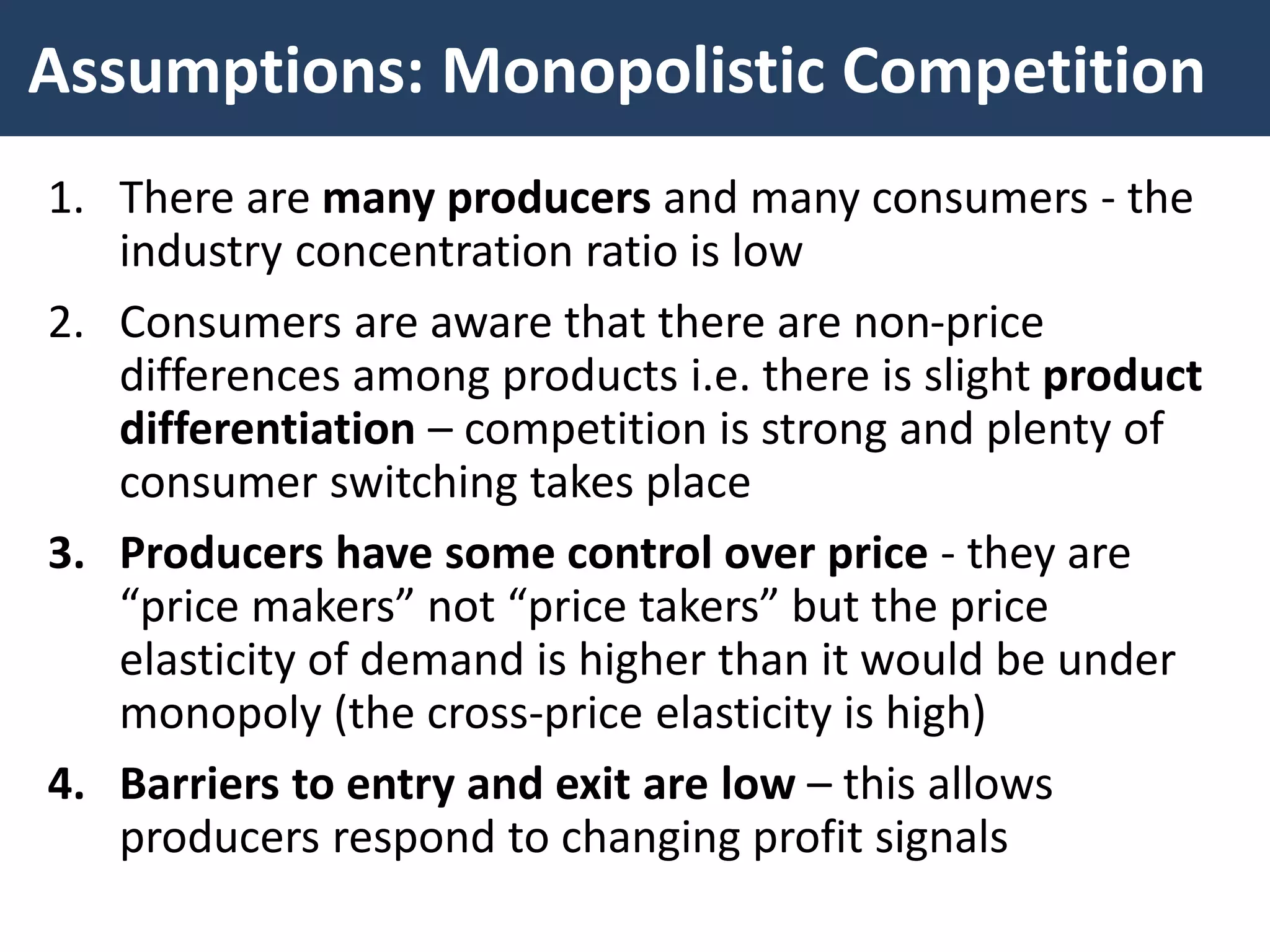
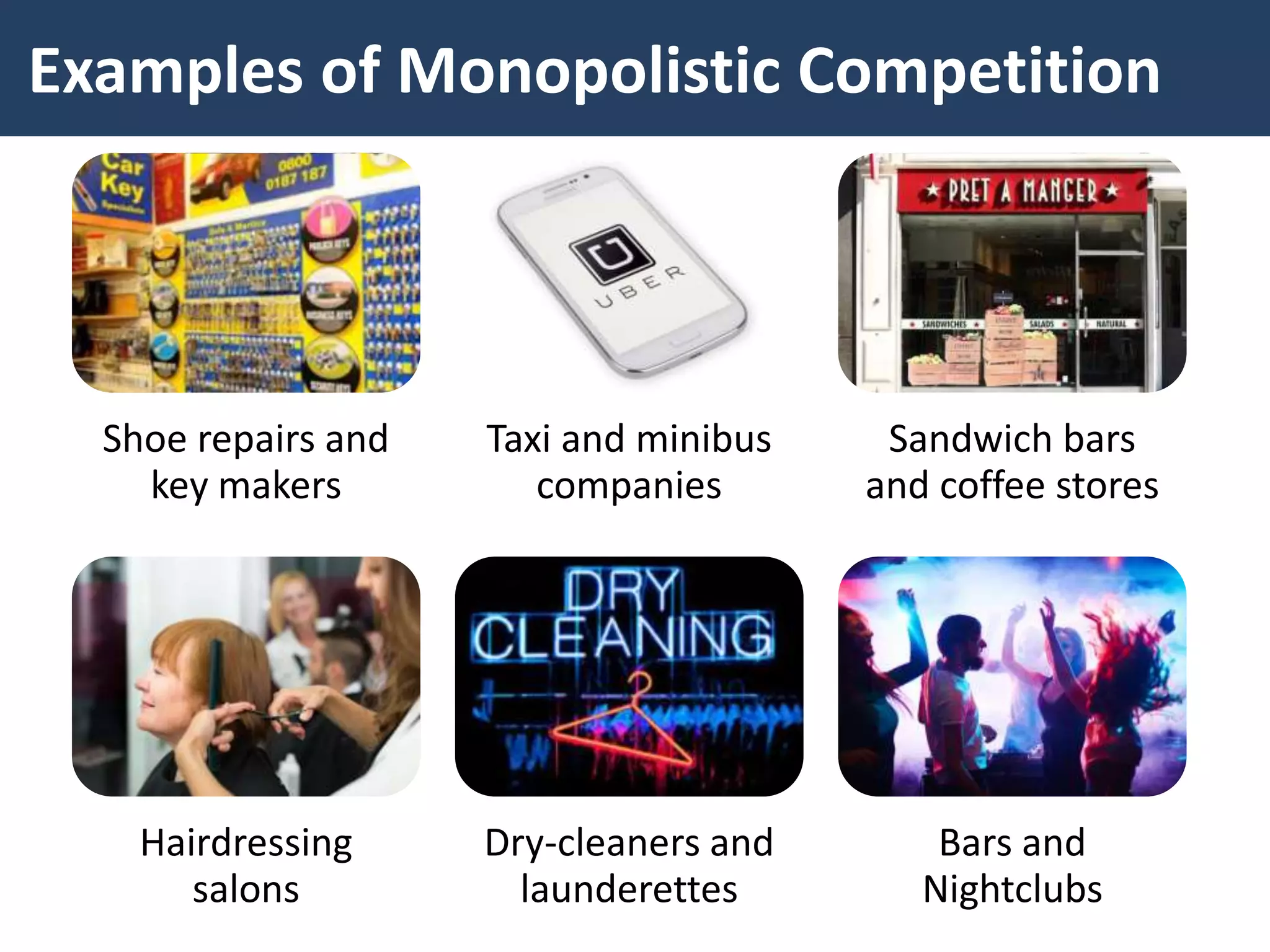
Examples of Monopolistic Competition
Shoe repairs and
key makers
Taxi and minibus
companies
Sandwich bars
and coffee stores
Hairdressing
salons
Dry-cleaners and
launderettes
Bars and
Nightclubs
Short Run Price, Output and Profit
MC
Price
and
Cost
Output
AC
MR
AR
Firms have downward-sloping demand
curves because they have some degree
of price-setting power
Short Run Price, Output and Profit
MC
Price
and
Cost
Output
AC
MR
AR
P1
Q1We assume that firms are
profit maximisers where
MC=MR
Short Run Price, Output and Profit
MC
Price
and
Cost
Output
AC
MR
AR
P1
Q1
C1
At price P1 and Q1,
supernormal profits are being
made because Price > AC
Short Run Price, Output and Profit
MC
Price
and
Cost
Output
AC
MR
AR
P1
Q1
C1
Supernormal
Profit
At price P1 and Q1,
supernormal profits are being
made because Price > AC
Monopolistic
Competition
A2 Microeonomics
Monopolistic Competition

Monopolistic Competition

  • 1.
  • 2.
    Assumptions: Monopolistic Competition 1.There are many producers and many consumers - the industry concentration ratio is low 2. Consumers are aware that there are non-price differences among products i.e. there is slight product differentiation – competition is strong and plenty of consumer switching takes place 3. Producers have some control over price - they are “price makers” not “price takers” but the price elasticity of demand is higher than it would be under monopoly (the cross-price elasticity is high) 4. Barriers to entry and exit are low – this allows producers respond to changing profit signals
  • 3.
    Examples of MonopolisticCompetition Shoe repairs and key makers Taxi and minibus companies Sandwich bars and coffee stores Hairdressing salons Dry-cleaners and launderettes Bars and Nightclubs
  • 4.
    Short Run Price,Output and Profit MC Price and Cost Output AC MR AR Firms have downward-sloping demand curves because they have some degree of price-setting power
  • 5.
    Short Run Price,Output and Profit MC Price and Cost Output AC MR AR P1 Q1We assume that firms are profit maximisers where MC=MR
  • 6.
    Short Run Price,Output and Profit MC Price and Cost Output AC MR AR P1 Q1 C1 At price P1 and Q1, supernormal profits are being made because Price > AC
  • 7.
    Short Run Price,Output and Profit MC Price and Cost Output AC MR AR P1 Q1 C1 Supernormal Profit At price P1 and Q1, supernormal profits are being made because Price > AC
  • 8.