A2 Micro
Oligopoly (Essentials)
Tutor2u, Summer 2013
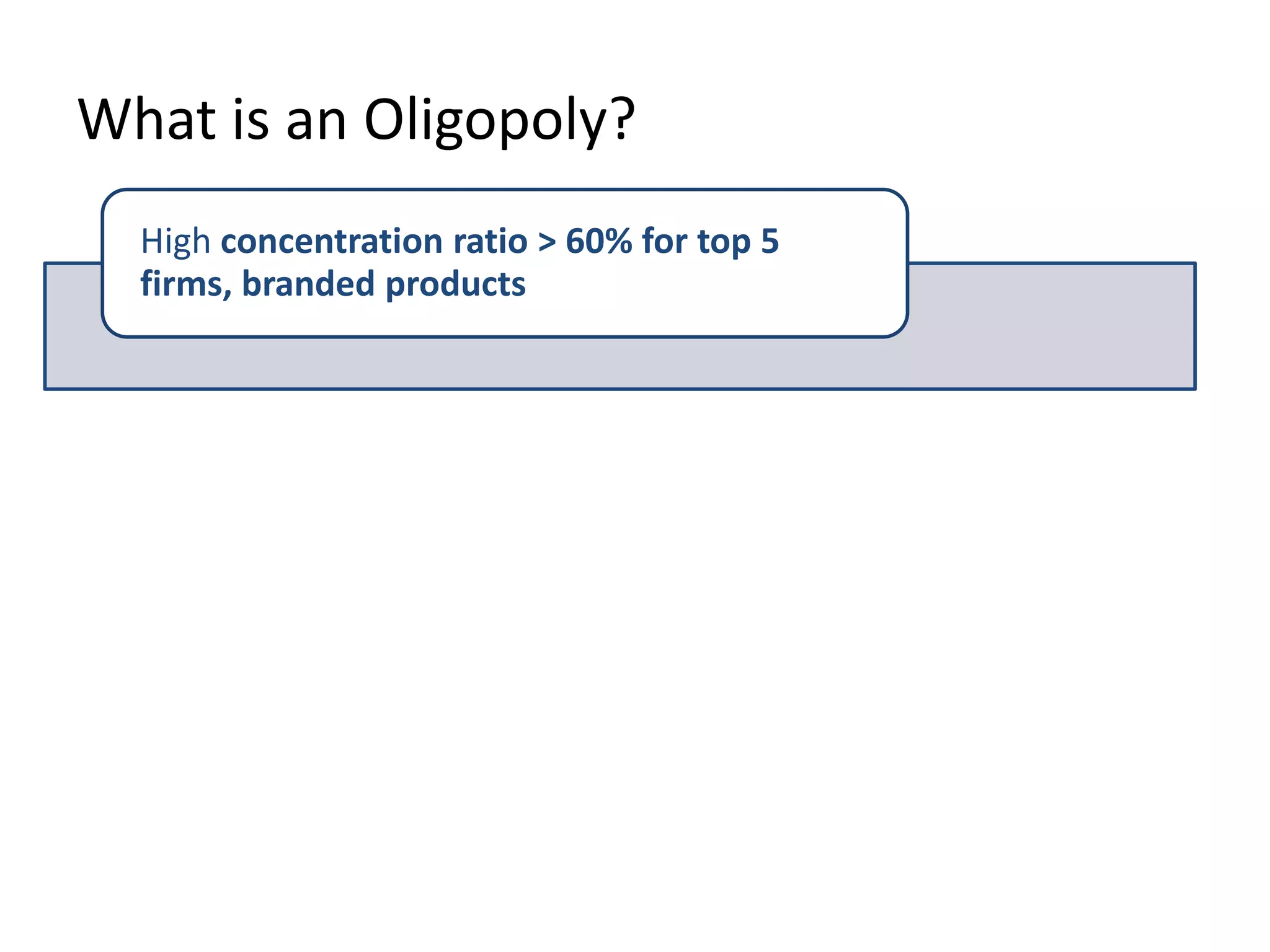
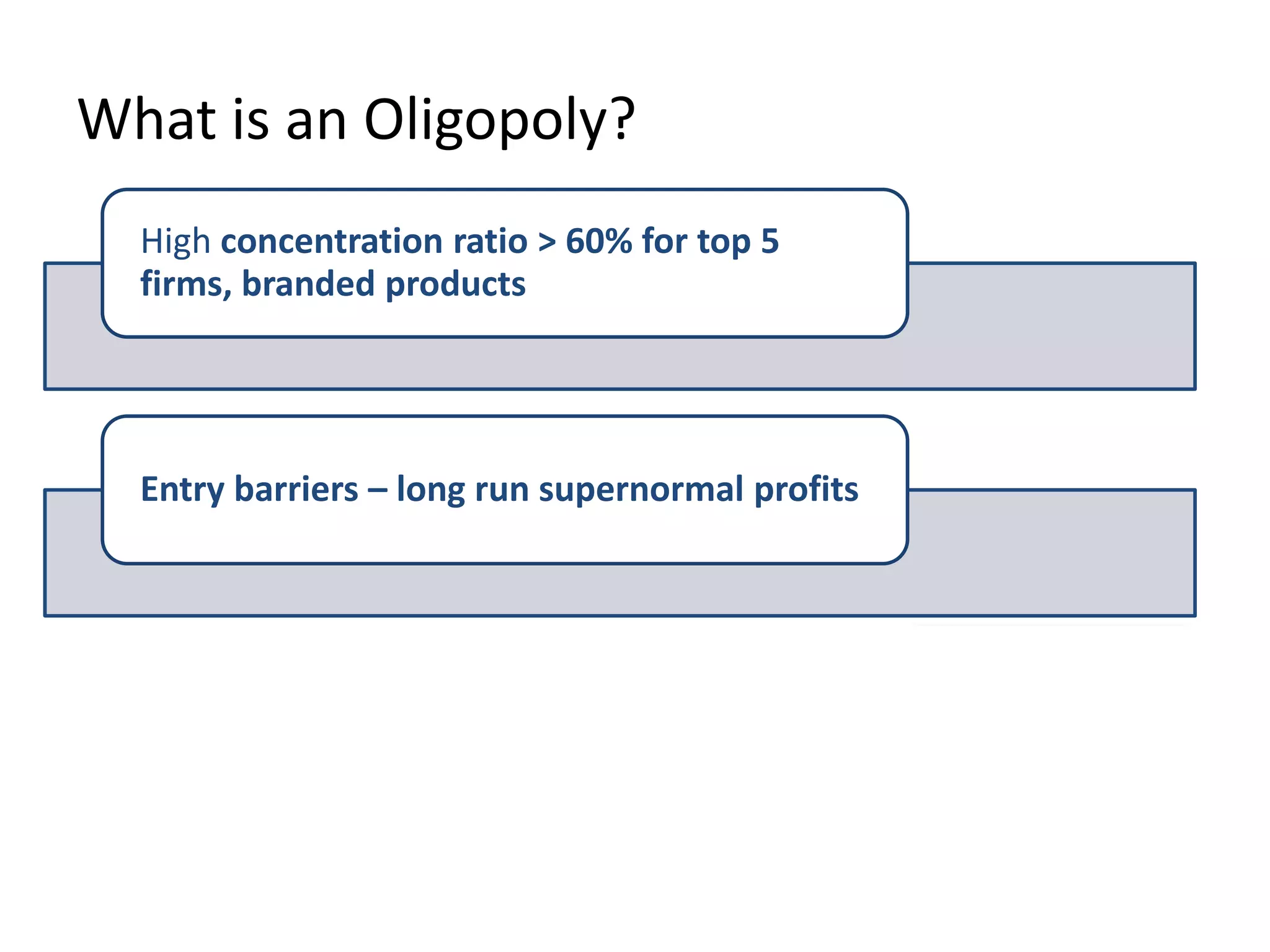
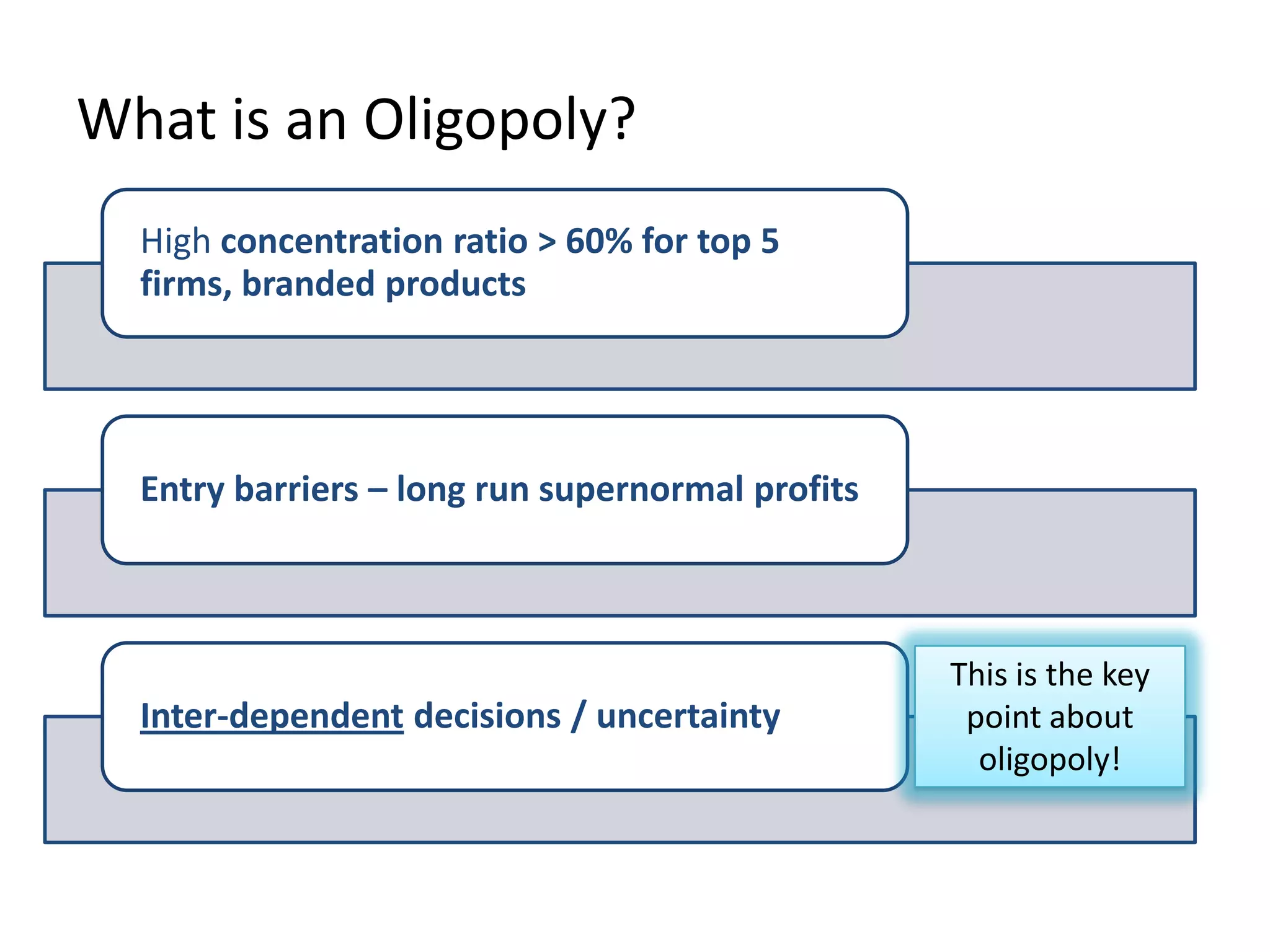
What is an Oligopoly?
High concentration ratio > 60% for top 5
firms, branded products
Entry barriers – long run supernormal profits
Inter-dependent decisions / uncertainty
This is the key
point about
oligopoly!
What is an Oligopoly?
High concentration ratio > 60% for top 5
firms, branded products
Entry barriers – long run supernormal profits
Inter-dependent decisions / uncertainty
This is the key
point about
oligopoly!
What is an Oligopoly?
High concentration ratio > 60% for top 5
firms, branded products
Entry barriers – long run supernormal profits
Inter-dependent decisions / uncertainty
This is the key
point about
oligopoly!
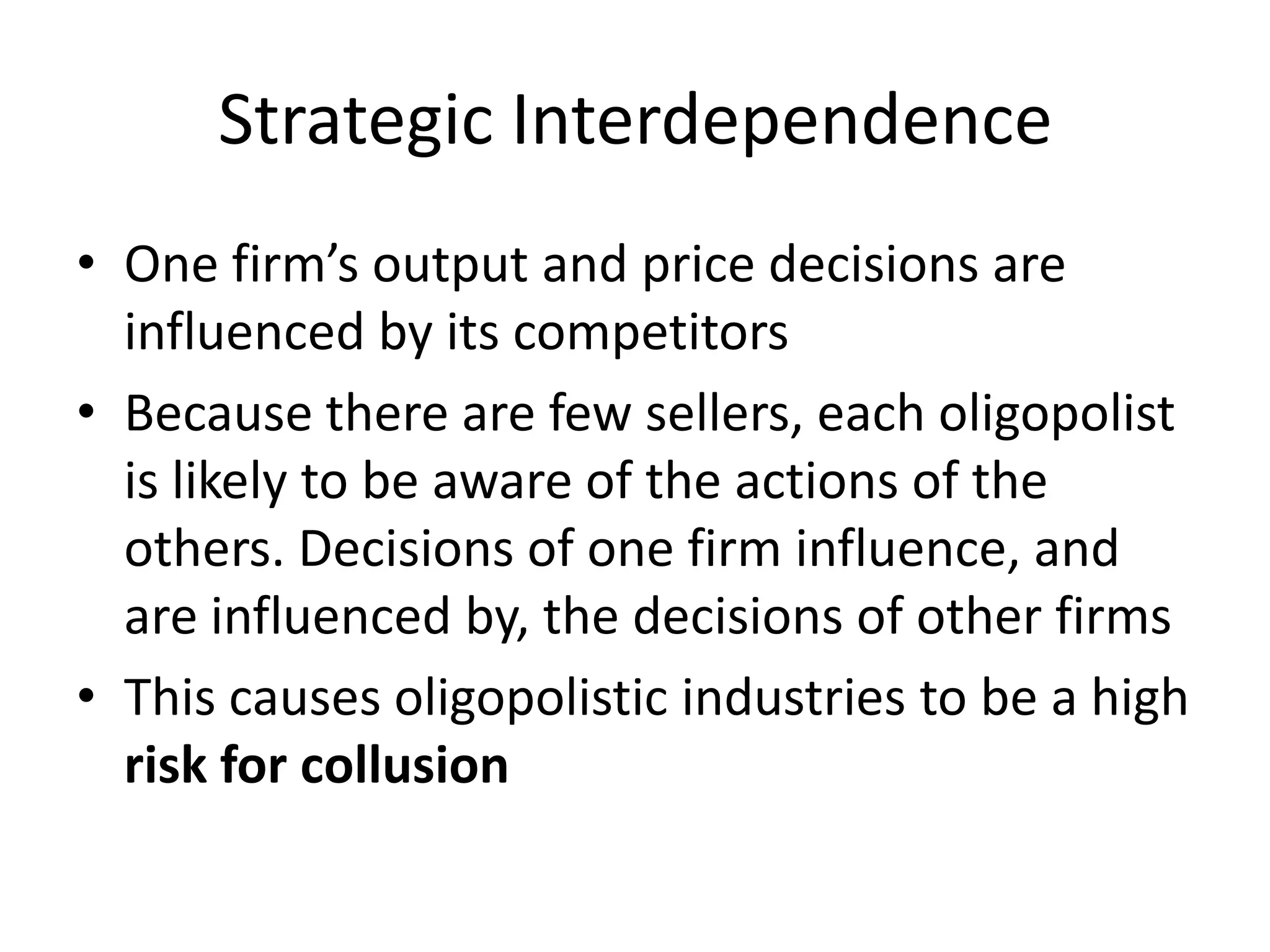
Strategic Interdependence
• One firm’s output and price decisions are
influenced by its competitors
• Because there are few sellers, each oligopolist
is likely to be aware of the actions of the
others. Decisions of one firm influence, and
are influenced by, the decisions of other firms
• This causes oligopolistic industries to be a high
risk for collusion
Business Behaviour
Price
Wars
Price
Matching
Non-Price
Competition
Cartels
Co-
operation
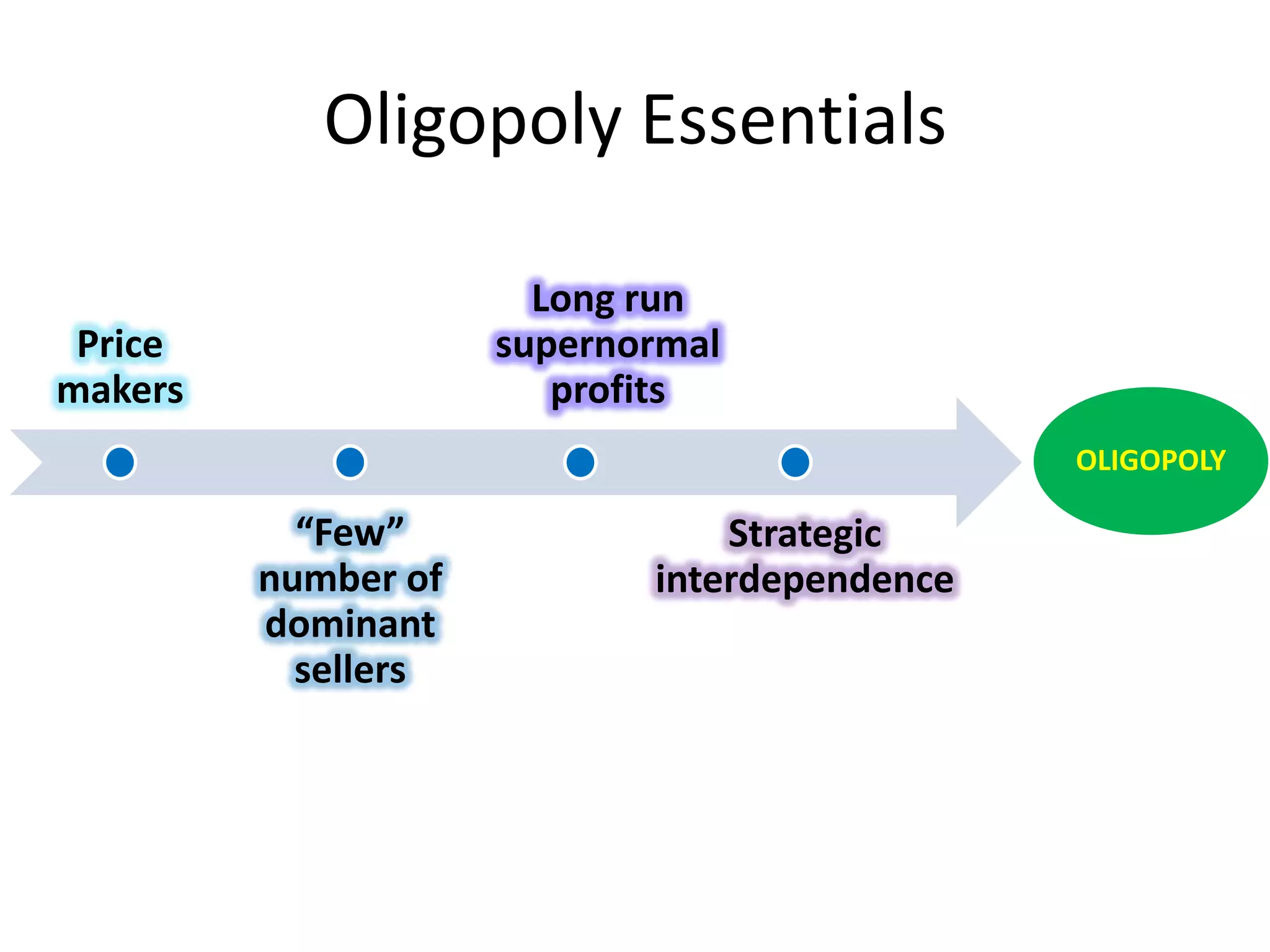
Oligopoly Essentials
OLIGOPOLY
Price
makers
“Few”
number of
dominant
sellers
Long run
supernormal
profits
Strategic
interdependence
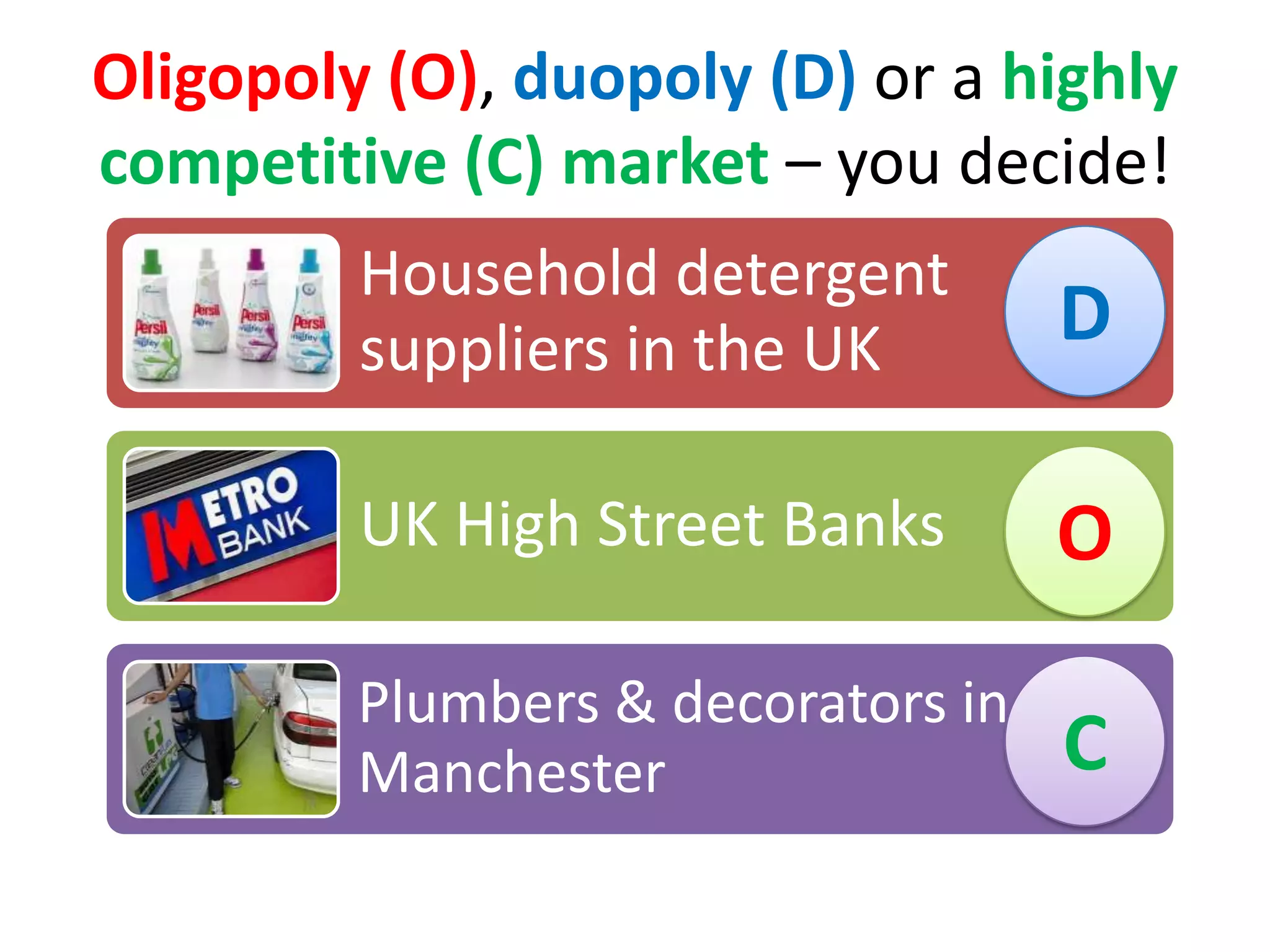
Oligopoly (O), duopoly (D) or a highly
competitive (C) market – you decide!
Household detergent
suppliers in the UK
UK High Street Banks
Plumbers & decorators in
Manchester
D
O
C
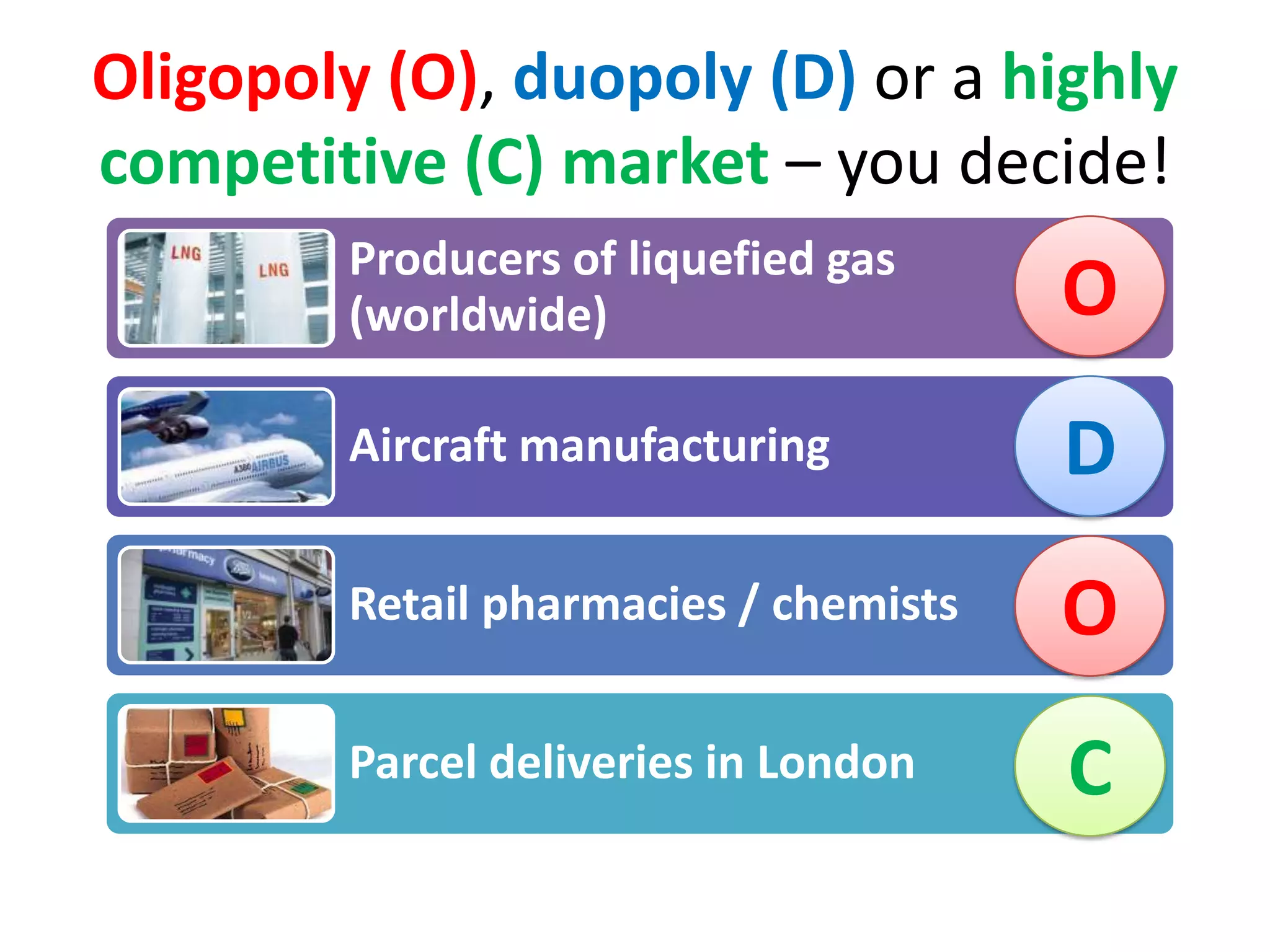
Oligopoly (O), duopoly (D) or a highly
competitive (C) market – you decide!
Producers of liquefied gas
(worldwide)
Aircraft manufacturing
Retail pharmacies / chemists
Parcel deliveries in London
O
D
O
C
Pharmacies in Bristol
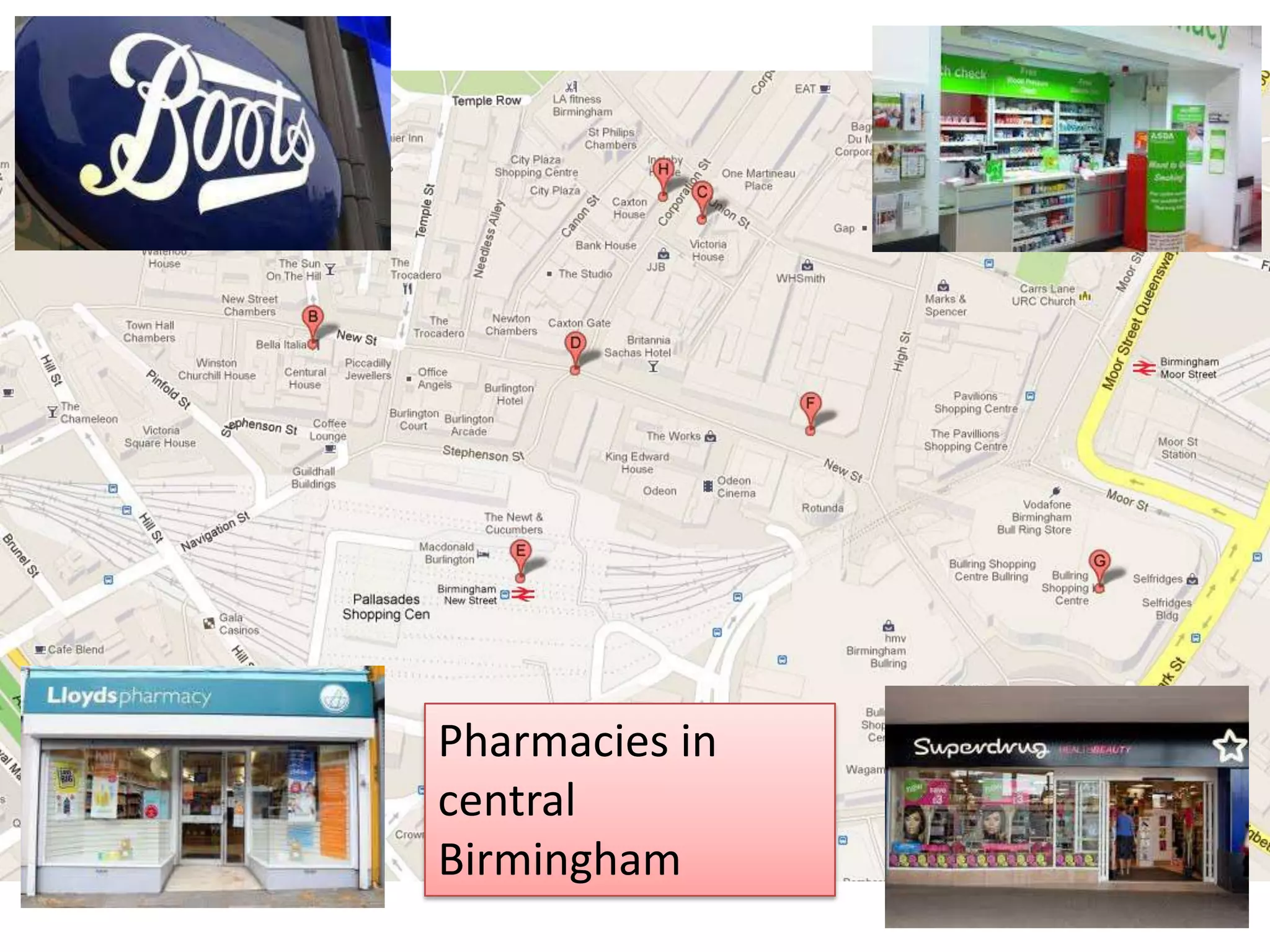
Pharmacies in
central
Birmingham
Crucial aspects of oligopolyKey
Evaluation
1. Oligopoly is best defined by
the actual behaviour of
businesses
2. High market concentration
does not necessarily mean
an absence of competition
3. Non-price competition is
given strong emphasis
There are several
oligopoly models at
A2 – a highly
common area for
examiners to test!
Cost & Price
Output (Q)
The Kinked Demand Curve Model
MR AR
MC
P1
Q1
Importance of Non-Price
Competition in Oligopoly
1. Price stickiness
observed in oligopoly
2. Price may remain close
to P1
Cost & Price
Output (Q)
The Kinked Demand Curve Model
MR AR
MC
P1
Q1
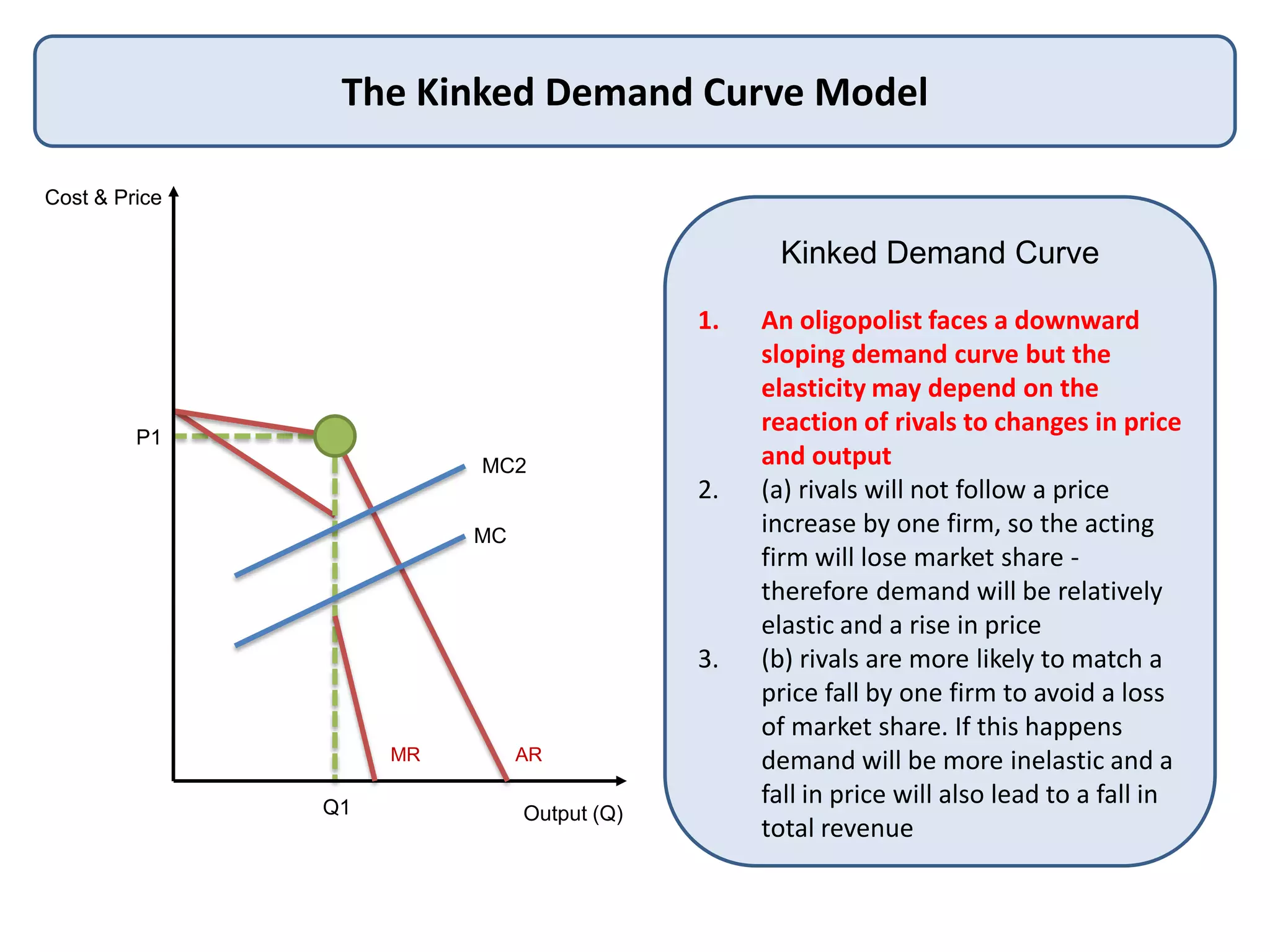
Kinked Demand Curve
1. An oligopolist faces a downward
sloping demand curve but the
elasticity may depend on the
reaction of rivals to changes in price
and output
2. (a) rivals will not follow a price
increase by one firm, so the acting
firm will lose market share -
therefore demand will be relatively
elastic and a rise in price
3. (b) rivals are more likely to match a
price fall by one firm to avoid a loss
of market share. If this happens
demand will be more inelastic and a
fall in price will also lead to a fall in
total revenue
MC2
Cost & Price
Output (Q)
The Kinked Demand Curve Model
MR AR
MC
P1
Q1
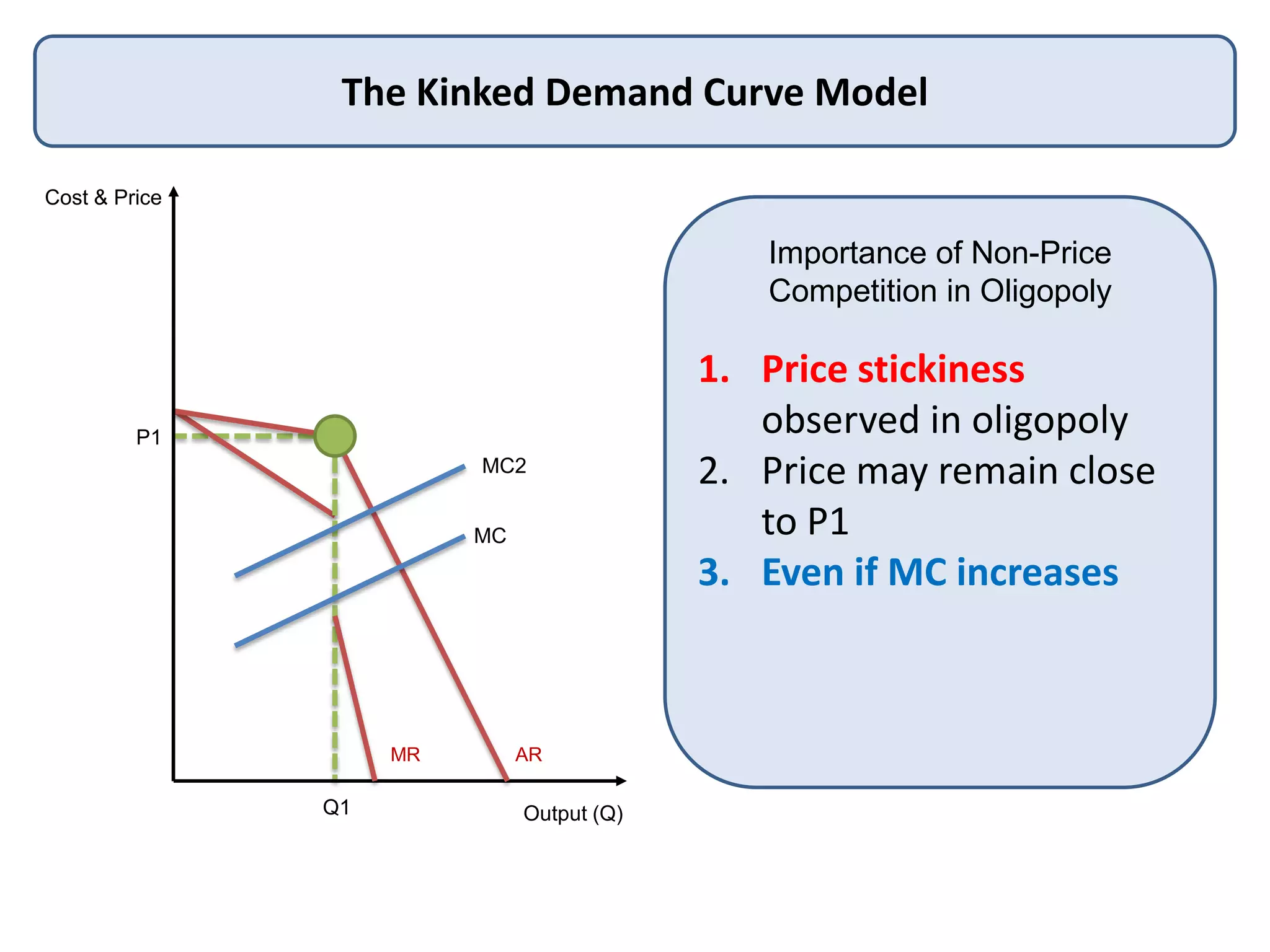
Importance of Non-Price
Competition in Oligopoly
1. Price stickiness
observed in oligopoly
2. Price may remain close
to P1
3. Even if MC increases
MC2
Non-Price Competition is key to market share and profitability
Innovation Quality of service Free Upgrades
Exclusivity
Non-Price Competition is key to market share and profitability
Innovation Quality of service Free Upgrades
Exclusivity
Non-Price Competition is key to market share and profitability
Innovation Quality of service Free Upgrades
Exclusivity
Non-Price Competition is key to market share and profitability
Innovation Quality of service Free Upgrades
Exclusivity
Get help from fellow
students, teachers and
tutor2u on Twitter:
@tutor2u_econ

Oligopoly Essentials

  • 1.
  • 2.
    What is anOligopoly? High concentration ratio > 60% for top 5 firms, branded products Entry barriers – long run supernormal profits Inter-dependent decisions / uncertainty This is the key point about oligopoly!
  • 3.
    What is anOligopoly? High concentration ratio > 60% for top 5 firms, branded products Entry barriers – long run supernormal profits Inter-dependent decisions / uncertainty This is the key point about oligopoly!
  • 4.
    What is anOligopoly? High concentration ratio > 60% for top 5 firms, branded products Entry barriers – long run supernormal profits Inter-dependent decisions / uncertainty This is the key point about oligopoly!
  • 5.
    Strategic Interdependence • Onefirm’s output and price decisions are influenced by its competitors • Because there are few sellers, each oligopolist is likely to be aware of the actions of the others. Decisions of one firm influence, and are influenced by, the decisions of other firms • This causes oligopolistic industries to be a high risk for collusion
  • 6.
  • 7.
  • 8.
    Oligopoly (O), duopoly(D) or a highly competitive (C) market – you decide! Household detergent suppliers in the UK UK High Street Banks Plumbers & decorators in Manchester D O C
  • 9.
    Oligopoly (O), duopoly(D) or a highly competitive (C) market – you decide! Producers of liquefied gas (worldwide) Aircraft manufacturing Retail pharmacies / chemists Parcel deliveries in London O D O C
  • 10.
    Pharmacies in Bristol Pharmaciesin central Birmingham
  • 11.
    Crucial aspects ofoligopolyKey Evaluation 1. Oligopoly is best defined by the actual behaviour of businesses 2. High market concentration does not necessarily mean an absence of competition 3. Non-price competition is given strong emphasis There are several oligopoly models at A2 – a highly common area for examiners to test!
  • 12.
    Cost & Price Output(Q) The Kinked Demand Curve Model MR AR MC P1 Q1 Importance of Non-Price Competition in Oligopoly 1. Price stickiness observed in oligopoly 2. Price may remain close to P1
  • 13.
    Cost & Price Output(Q) The Kinked Demand Curve Model MR AR MC P1 Q1 Kinked Demand Curve 1. An oligopolist faces a downward sloping demand curve but the elasticity may depend on the reaction of rivals to changes in price and output 2. (a) rivals will not follow a price increase by one firm, so the acting firm will lose market share - therefore demand will be relatively elastic and a rise in price 3. (b) rivals are more likely to match a price fall by one firm to avoid a loss of market share. If this happens demand will be more inelastic and a fall in price will also lead to a fall in total revenue MC2
  • 14.
    Cost & Price Output(Q) The Kinked Demand Curve Model MR AR MC P1 Q1 Importance of Non-Price Competition in Oligopoly 1. Price stickiness observed in oligopoly 2. Price may remain close to P1 3. Even if MC increases MC2
  • 15.
    Non-Price Competition iskey to market share and profitability Innovation Quality of service Free Upgrades Exclusivity
  • 16.
    Non-Price Competition iskey to market share and profitability Innovation Quality of service Free Upgrades Exclusivity
  • 17.
    Non-Price Competition iskey to market share and profitability Innovation Quality of service Free Upgrades Exclusivity
  • 18.
    Non-Price Competition iskey to market share and profitability Innovation Quality of service Free Upgrades Exclusivity
  • 19.
    Get help fromfellow students, teachers and tutor2u on Twitter: @tutor2u_econ