
RATNAM INSTITUTE OF PHARMACY
INCOMPATIBILITIES IN PRESCRIPTIONS
By,
MR. CH.PRAVEEN KUMAR M.Pharm., (Ph.D)
ASSOCIATE PROFESSOR
DEPARTMENT OF PHARMACEUTICS
2
INTRODUCTION
Incompatibility -
Incompatibility occurs as a result of mixing of two or more antagonistic substances and an
undesirable product is formed, which may affect the safety, efficacy, appearance and stability of the
pharmaceutical product.
It is of three types.
Physical,
Chemical and
Therapeutic incompatibilities.
3
INTRODUCTION
Incompatibility -
Incompatibilities occur during:
Compounding
Formulation
Manufacturing
Packaging
Dispensing
Storage
Administration of drugs
The incompatibilities may be detected by changes in the physical, chemical, and therapeutic
qualities of the medicine.
4
Incompatibility
Physical Incompatibility -
When two or more than two substances are combined together, a physical change takes place and an
unacceptable product is formed.
Manifestations of physical incompatibility –
Insolubility:-insolubility of prescribed agents in vehicle
Immiscibility:-Immiscibility of two or more liquids
Precipitation:-It occurs due to solvent is insoluble when it is added to solution
Liquefaction:-Liquefaction of solids mixed in a dry state (called eutexia)
5
Incompatibility
Physical Incompatibility - Insolubility
It means the inability of material to dissolve in a particular solvent system. The majority of
incompatibilities is due to insolubility of the inorganic as well as organic compounds in particular
solvents.
The following factors affect the solubility of prescribed agent in vehicle and may render it less
soluble.
Change in pH
Milling
Surfactant
Chemical reaction
Complex formation
Co-solvent
6
Incompatibility
Physical Incompatibility - Insolubility
Insolubility of inorganic compounds –
1. Metals and their salts:
Alkali metals – These cations are listed in decreasing order of solubility
Alkaline earth metals – Water soluble salts with univalent anions, insoluble salts with divalent and
trivalent anions .
Boron compounds are water soluble, Mercurous salts are insoluble and mercuric salts are soluble in water.
2. Non metals:
Sulphur and Iodine are commonly used. Sulphur is insoluble in water and common solvents. Iodine is
made soluble in water in the presence of potassium iodide.
7
Incompatibility
Physical Incompatibility - Insolubility
Insolubility of organic compounds –
Organic compound contain polar and non polar parts except hydrocarbons.
- Hydrocarbons are completely nonpolar and does not dissolves in water
-Solubility of other organic compounds depend on polar and non-polar parts.
Organic compound soluble in water by forming
-Hydrogen bond or
- Ionisation.
8
Incompatibility
Physical Incompatibility - Insolubility
Insolubility of organic compounds –
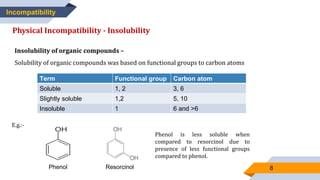
Solubility of organic compounds was based on functional groups to carbon atoms
Term Functional group Carbon atom
Soluble 1, 2 3, 6
Slightly soluble 1,2 5, 10
Insoluble 1 6 and >6
E.g.:-
Phenol Resorcinol
Phenol is less soluble when
compared to resorcinol due to
presence of less functional groups
compared to phenol.
9
Incompatibility
Physical Incompatibility - Immiscibility
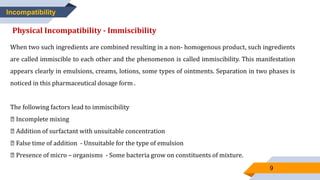
When two such ingredients are combined resulting in a non- homogenous product, such ingredients
are called immiscible to each other and the phenomenon is called immiscibility. This manifestation
appears clearly in emulsions, creams, lotions, some types of ointments. Separation in two phases is
noticed in this pharmaceutical dosage form .
The following factors lead to immiscibility
Incomplete mixing
Addition of surfactant with unsuitable concentration
False time of addition - Unsuitable for the type of emulsion
Presence of micro – organisms - Some bacteria grow on constituents of mixture.
10
Incompatibility Physical Incompatibility - Immiscibility
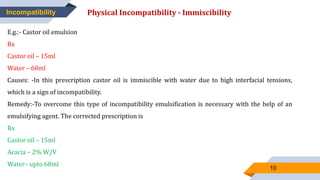
E.g.:- Castor oil emulsion
Rx
Castor oil – 15ml
Water – 60ml
Causes: -In this prescription castor oil is immiscible with water due to high interfacial tensions,
which is a sign of incompatibility.
Remedy:-To overcome this type of incompatibility emulsification is necessary with the help of an
emulsifying agent. The corrected prescription is
Rx
Castor oil – 15ml
Acacia – 2% W/V
Water– upto 60ml
11
Incompatibility
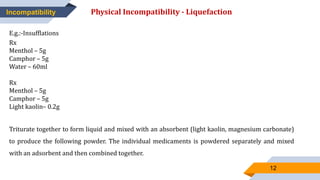
Physical Incompatibility - Liquefaction
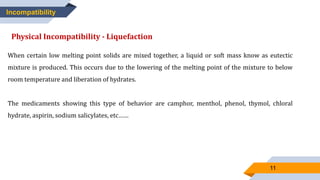
When certain low melting point solids are mixed together, a liquid or soft mass know as eutectic
mixture is produced. This occurs due to the lowering of the melting point of the mixture to below
room temperature and liberation of hydrates.
The medicaments showing this type of behavior are camphor, menthol, phenol, thymol, chloral
hydrate, aspirin, sodium salicylates, etc……
12
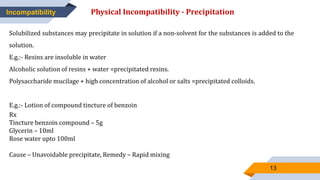
Incompatibility Physical Incompatibility - Liquefaction
E.g.:-Insufflations
Rx
Menthol – 5g
Camphor – 5g
Water – 60ml
Rx
Menthol – 5g
Camphor – 5g
Light kaolin– 0.2g
Triturate together to form liquid and mixed with an absorbent (light kaolin, magnesium carbonate)
to produce the following powder. The individual medicaments is powdered separately and mixed
with an adsorbent and then combined together.
13
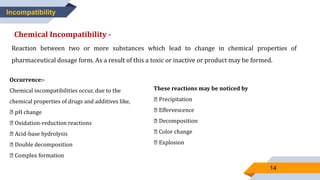
Incompatibility Physical Incompatibility - Precipitation
Solubilized substances may precipitate in solution if a non-solvent for the substances is added to the
solution.
E.g.:- Resins are insoluble in water
Alcoholic solution of resins + water =precipitated resins.
Polysaccharide mucilage + high concentration of alcohol or salts =precipitated colloids.
E.g.:- Lotion of compound tincture of benzoin
Rx
Tincture benzoin compound – 5g
Glycerin – 10ml
Rose water upto 100ml
Cause – Unavoidable precipitate, Remedy – Rapid mixing
14
Incompatibility
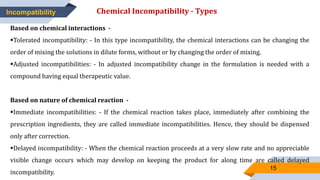
Chemical Incompatibility -
Reaction between two or more substances which lead to change in chemical properties of
pharmaceutical dosage form. As a result of this a toxic or inactive or product may be formed.
Occurrence:-
Chemical incompatibilities occur, due to the
chemical properties of drugs and additives like,
pH change
Oxidation-reduction reactions
Acid-base hydrolysis
Double decomposition
Complex formation
These reactions may be noticed by
Precipitation
Effervescence
Decomposition
Color change
Explosion
15
Incompatibility Chemical Incompatibility - Types
Based on chemical interactions -
Tolerated incompatibility: - In this type incompatibility, the chemical interactions can be changing the
order of mixing the solutions in dilute forms, without or by changing the order of mixing.
Adjusted incompatibilities: - In adjusted incompatibility change in the formulation is needed with a
compound having equal therapeutic value.
Based on nature of chemical reaction -
Immediate incompatibilities: - If the chemical reaction takes place, immediately after combining the
prescription ingredients, they are called immediate incompatibilities. Hence, they should be dispensed
only after correction.
Delayed incompatibility: - When the chemical reaction proceeds at a very slow rate and no appreciable
visible change occurs which may develop on keeping the product for along time are called delayed
incompatibility.
16
Incompatibility
Chemical Incompatibility - Types
Based on the prescriber -
Intentional:- When the prescriber knowingly prescribes the incompatible drugs.
Unidirectional:- When the prescriber prescribes the drugs without knowing that there is incompatibility
between the prescribed drugs.
Generally reaction between strong solution proceed at a faster rate and the precipitates are formed are
thick and do not diffuse readily. Reaction between the dilute solutions proceeds at a slow rate and the
precipitates formed are light and diffuse readily in the solution.
17
Incompatibility
Chemical Incompatibility -
Precipitate yielding interactions
The precipitates so formed may be diffusible or in-diffusible. The method A or B is followed in dispensing
the prescription yielding diffusible and in-diffusible precipitates respectively. The preparation should
contain a thickening agent if the precipitate is non-diffusible .
Method A: (For diffusible precipitates)
Method B: (For in-diffusible precipitates)
A secondary label ―SHAKE WELL BEFORE USE‖ should be fixed on the container whenever method A or
method B is followed in dispensing the prescription.
18
Incompatibility Chemical Incompatibility -
E.g.:-
Alkaloid incompatibility:-
1. Alkaloidal salts with alkaloid substances
2. Alkaloidal salts with soluble iodides
3. Alkaloidal salts with tannins
4. Alkaloid salts with salicylates
5. Alkaloid with soluble iodides and bromides.
E.g.:-
Soluble salicylates incompatibility:-
1.Soluble salicylates with ferric salts
2.Soluble salicylates with alkali bicarbonates
3.Soluble salicylates and benzoates with acids.
E.g.:-
Soluble iodides incompatibility:-
1.Oxidation of iodides with potassium chlorate
2.Oxidation of iodides with quinine sulphate.
19
Incompatibility Chemical Incompatibility -
E.g.:- Alkaloidal incompatibility
Rx
Quinine hydrochloride– 0.12g
Sodium salicylate – 4g
water upto -100ml
Cause – in-diffusible precipitates of quinine
salicylate, Remedy – Method -B
E.g.:- Salicylate incompatibility
Rx
Ferric chloride solution– 2 ml
Sodium salicylate – 3g
water upto -90ml
Cause – in-diffusible precipitates of quinine
salicylate, Remedy – Method -B
E.g.:- Iodide incompatibility
Rx
Quinine sulfate – 1.5g
Dil Sulfuric acid- 4 ml
Potassium iodide – 8 g
water up to -200ml
Cause – Iodosulphite of quinine (Herapathite) – Herapath reaction – olive green crystals,
Remedy – Prepare the mixture for 3 days only.
20
Incompatibility Chemical Incompatibility -
E.g.:-
Chemical incompatibility causing evolution of carbon dioxide gas:-
Miscellaneous incompatibilities:-
1.Potassium chlorate with oxdisable substances
2. Incompatibility of emulsifying agent
3. Color stability of dyes
4. Incompatibilities of liquorices liquid extract
21
Incompatibility Therapeutic Incompatibility -
It may occur as a result of prescribing certain drugs to a patient with the intention to produce a
specific degree of pharmacological action, but the intensity of action produced is different from that
intended by the prescriber.
It is divided into two groups. They are
Pharmacokinetics: It involves the effect of a drug on another from the point of view that includes
absorption, distribution, metabolism and excretion.
Pharmacodynamics: These are related to the pharmacological activity of the drugs.
E.g., Synergism, antagonism, altered cellular transport, effect on the receptor site.
22
Incompatibility
Therapeutic Incompatibility -
Therapeutic incompatibilities occurs due to following reasons
a. Error in dosage
b. Wrong dose or dosage form
c. Contra-indicated drugs
d. Synergistic and antagonistic drugs
e. Drug interactions
23
Incompatibility
Therapeutic Incompatibility - ERROR IN DOSAGE
Many therapeutic incompatibilities result from errors in writing or interpreting the prescription order.
The most serious type of the dosage error in the dispensing is overdose of a medication
E.g., Atropine sulphate capsules
Rx
Atropine sulphate - 0.005g
Phenobarbitone - 0.015g
Aspirin - 0.300g
Cause: Over Dose, Remedy: (referred back to the prescriber)
The recommended dose of atropine for a single capsule is 0.25 to 2mg .
24
Incompatibility
Therapeutic Incompatibility – WRONG DOSE OR DOSAGE FORM
There are certain drugs which have quite similar names and there is always a danger of dispensing the
wrong drug.
E.g.,
Prednisone and Prednisolone
Digoxin and Digitoxin
25
Incompatibility
Therapeutic Incompatibility – CONTRAINDICATED DRUGS
There are certain drugs which may be contra-indicated in a particular disease or a particular patient
who is allergic to it.
E.g.,
Corticosteroids are contra-indicated in the patients having peptic ulcers.
The penicillin and sulphur drugs are contra-indicated in the patients who are allergic.
Vasoconstrictors are contra-indicated in hypertensive patients.
Barbiturates and morphine should not be given to the asthmatic patients.
26
Incompatibility
Therapeutic Incompatibility – SYNERGISTIC & ANTAGONISTIC DRUGS
When two drugs are prescribed together, they tend to increase the activity of each other which is
known as SYNERGISM. When two drugs are prescribed together, they tend to decrease the activity of
each other which is known as ANTAGONISM.
E.g.,
A combination of aspirin and paracetamol increases the analgesic activity.
A combination of penicillin and streptomycin increases the antibacterial activity.
Amphetamines show its antagonists effect with the barbiturates.
27
Incompatibility
Therapeutic Incompatibility – DRUG INTERACTIONS
The effect of one drug is altered by the prior or simultaneous administration of another drug. The
drug interaction can usually be corrected by the proper adjustment of dosage if the suspected
interaction is detected.
E.g., Tetracycline capsules - 250mg capsules
Direction: Take one capsule every 6 hours with milk.
Causes:-Tetracycline is inactivated by calcium present in milk. So, it should not be taken with milk.
Remedy: In this prescription, the therapeutic incompatibility is unintentional. So, the prescription is referred
back to the prescriber to change the direction.
28
Thank you

Incompatibilities in prescriptions

  • 1.
    RATNAM INSTITUTE OFPHARMACY INCOMPATIBILITIES IN PRESCRIPTIONS By, MR. CH.PRAVEEN KUMAR M.Pharm., (Ph.D) ASSOCIATE PROFESSOR DEPARTMENT OF PHARMACEUTICS
  • 2.
    2 INTRODUCTION Incompatibility - Incompatibility occursas a result of mixing of two or more antagonistic substances and an undesirable product is formed, which may affect the safety, efficacy, appearance and stability of the pharmaceutical product. It is of three types. Physical, Chemical and Therapeutic incompatibilities.
  • 3.
    3 INTRODUCTION Incompatibility - Incompatibilities occurduring: Compounding Formulation Manufacturing Packaging Dispensing Storage Administration of drugs The incompatibilities may be detected by changes in the physical, chemical, and therapeutic qualities of the medicine.
  • 4.
    4 Incompatibility Physical Incompatibility - Whentwo or more than two substances are combined together, a physical change takes place and an unacceptable product is formed. Manifestations of physical incompatibility – Insolubility:-insolubility of prescribed agents in vehicle Immiscibility:-Immiscibility of two or more liquids Precipitation:-It occurs due to solvent is insoluble when it is added to solution Liquefaction:-Liquefaction of solids mixed in a dry state (called eutexia)
  • 5.
    5 Incompatibility Physical Incompatibility -Insolubility It means the inability of material to dissolve in a particular solvent system. The majority of incompatibilities is due to insolubility of the inorganic as well as organic compounds in particular solvents. The following factors affect the solubility of prescribed agent in vehicle and may render it less soluble. Change in pH Milling Surfactant Chemical reaction Complex formation Co-solvent
  • 6.
    6 Incompatibility Physical Incompatibility -Insolubility Insolubility of inorganic compounds – 1. Metals and their salts: Alkali metals – These cations are listed in decreasing order of solubility Alkaline earth metals – Water soluble salts with univalent anions, insoluble salts with divalent and trivalent anions . Boron compounds are water soluble, Mercurous salts are insoluble and mercuric salts are soluble in water. 2. Non metals: Sulphur and Iodine are commonly used. Sulphur is insoluble in water and common solvents. Iodine is made soluble in water in the presence of potassium iodide.
  • 7.
    7 Incompatibility Physical Incompatibility -Insolubility Insolubility of organic compounds – Organic compound contain polar and non polar parts except hydrocarbons. - Hydrocarbons are completely nonpolar and does not dissolves in water -Solubility of other organic compounds depend on polar and non-polar parts. Organic compound soluble in water by forming -Hydrogen bond or - Ionisation.
  • 8.
    8 Incompatibility Physical Incompatibility -Insolubility Insolubility of organic compounds – Solubility of organic compounds was based on functional groups to carbon atoms Term Functional group Carbon atom Soluble 1, 2 3, 6 Slightly soluble 1,2 5, 10 Insoluble 1 6 and >6 E.g.:- Phenol Resorcinol Phenol is less soluble when compared to resorcinol due to presence of less functional groups compared to phenol.
  • 9.
    9 Incompatibility Physical Incompatibility -Immiscibility When two such ingredients are combined resulting in a non- homogenous product, such ingredients are called immiscible to each other and the phenomenon is called immiscibility. This manifestation appears clearly in emulsions, creams, lotions, some types of ointments. Separation in two phases is noticed in this pharmaceutical dosage form . The following factors lead to immiscibility Incomplete mixing Addition of surfactant with unsuitable concentration False time of addition - Unsuitable for the type of emulsion Presence of micro – organisms - Some bacteria grow on constituents of mixture.
  • 10.
    10 Incompatibility Physical Incompatibility- Immiscibility E.g.:- Castor oil emulsion Rx Castor oil – 15ml Water – 60ml Causes: -In this prescription castor oil is immiscible with water due to high interfacial tensions, which is a sign of incompatibility. Remedy:-To overcome this type of incompatibility emulsification is necessary with the help of an emulsifying agent. The corrected prescription is Rx Castor oil – 15ml Acacia – 2% W/V Water– upto 60ml
  • 11.
    11 Incompatibility Physical Incompatibility -Liquefaction When certain low melting point solids are mixed together, a liquid or soft mass know as eutectic mixture is produced. This occurs due to the lowering of the melting point of the mixture to below room temperature and liberation of hydrates. The medicaments showing this type of behavior are camphor, menthol, phenol, thymol, chloral hydrate, aspirin, sodium salicylates, etc……
  • 12.
    12 Incompatibility Physical Incompatibility- Liquefaction E.g.:-Insufflations Rx Menthol – 5g Camphor – 5g Water – 60ml Rx Menthol – 5g Camphor – 5g Light kaolin– 0.2g Triturate together to form liquid and mixed with an absorbent (light kaolin, magnesium carbonate) to produce the following powder. The individual medicaments is powdered separately and mixed with an adsorbent and then combined together.
  • 13.
    13 Incompatibility Physical Incompatibility- Precipitation Solubilized substances may precipitate in solution if a non-solvent for the substances is added to the solution. E.g.:- Resins are insoluble in water Alcoholic solution of resins + water =precipitated resins. Polysaccharide mucilage + high concentration of alcohol or salts =precipitated colloids. E.g.:- Lotion of compound tincture of benzoin Rx Tincture benzoin compound – 5g Glycerin – 10ml Rose water upto 100ml Cause – Unavoidable precipitate, Remedy – Rapid mixing
  • 14.
    14 Incompatibility Chemical Incompatibility - Reactionbetween two or more substances which lead to change in chemical properties of pharmaceutical dosage form. As a result of this a toxic or inactive or product may be formed. Occurrence:- Chemical incompatibilities occur, due to the chemical properties of drugs and additives like, pH change Oxidation-reduction reactions Acid-base hydrolysis Double decomposition Complex formation These reactions may be noticed by Precipitation Effervescence Decomposition Color change Explosion
  • 15.
    15 Incompatibility Chemical Incompatibility- Types Based on chemical interactions - Tolerated incompatibility: - In this type incompatibility, the chemical interactions can be changing the order of mixing the solutions in dilute forms, without or by changing the order of mixing. Adjusted incompatibilities: - In adjusted incompatibility change in the formulation is needed with a compound having equal therapeutic value. Based on nature of chemical reaction - Immediate incompatibilities: - If the chemical reaction takes place, immediately after combining the prescription ingredients, they are called immediate incompatibilities. Hence, they should be dispensed only after correction. Delayed incompatibility: - When the chemical reaction proceeds at a very slow rate and no appreciable visible change occurs which may develop on keeping the product for along time are called delayed incompatibility.
  • 16.
    16 Incompatibility Chemical Incompatibility -Types Based on the prescriber - Intentional:- When the prescriber knowingly prescribes the incompatible drugs. Unidirectional:- When the prescriber prescribes the drugs without knowing that there is incompatibility between the prescribed drugs. Generally reaction between strong solution proceed at a faster rate and the precipitates are formed are thick and do not diffuse readily. Reaction between the dilute solutions proceeds at a slow rate and the precipitates formed are light and diffuse readily in the solution.
  • 17.
    17 Incompatibility Chemical Incompatibility - Precipitateyielding interactions The precipitates so formed may be diffusible or in-diffusible. The method A or B is followed in dispensing the prescription yielding diffusible and in-diffusible precipitates respectively. The preparation should contain a thickening agent if the precipitate is non-diffusible . Method A: (For diffusible precipitates) Method B: (For in-diffusible precipitates) A secondary label ―SHAKE WELL BEFORE USE‖ should be fixed on the container whenever method A or method B is followed in dispensing the prescription.
  • 18.
    18 Incompatibility Chemical Incompatibility- E.g.:- Alkaloid incompatibility:- 1. Alkaloidal salts with alkaloid substances 2. Alkaloidal salts with soluble iodides 3. Alkaloidal salts with tannins 4. Alkaloid salts with salicylates 5. Alkaloid with soluble iodides and bromides. E.g.:- Soluble salicylates incompatibility:- 1.Soluble salicylates with ferric salts 2.Soluble salicylates with alkali bicarbonates 3.Soluble salicylates and benzoates with acids. E.g.:- Soluble iodides incompatibility:- 1.Oxidation of iodides with potassium chlorate 2.Oxidation of iodides with quinine sulphate.
  • 19.
    19 Incompatibility Chemical Incompatibility- E.g.:- Alkaloidal incompatibility Rx Quinine hydrochloride– 0.12g Sodium salicylate – 4g water upto -100ml Cause – in-diffusible precipitates of quinine salicylate, Remedy – Method -B E.g.:- Salicylate incompatibility Rx Ferric chloride solution– 2 ml Sodium salicylate – 3g water upto -90ml Cause – in-diffusible precipitates of quinine salicylate, Remedy – Method -B E.g.:- Iodide incompatibility Rx Quinine sulfate – 1.5g Dil Sulfuric acid- 4 ml Potassium iodide – 8 g water up to -200ml Cause – Iodosulphite of quinine (Herapathite) – Herapath reaction – olive green crystals, Remedy – Prepare the mixture for 3 days only.
  • 20.
    20 Incompatibility Chemical Incompatibility- E.g.:- Chemical incompatibility causing evolution of carbon dioxide gas:- Miscellaneous incompatibilities:- 1.Potassium chlorate with oxdisable substances 2. Incompatibility of emulsifying agent 3. Color stability of dyes 4. Incompatibilities of liquorices liquid extract
  • 21.
    21 Incompatibility Therapeutic Incompatibility- It may occur as a result of prescribing certain drugs to a patient with the intention to produce a specific degree of pharmacological action, but the intensity of action produced is different from that intended by the prescriber. It is divided into two groups. They are Pharmacokinetics: It involves the effect of a drug on another from the point of view that includes absorption, distribution, metabolism and excretion. Pharmacodynamics: These are related to the pharmacological activity of the drugs. E.g., Synergism, antagonism, altered cellular transport, effect on the receptor site.
  • 22.
    22 Incompatibility Therapeutic Incompatibility - Therapeuticincompatibilities occurs due to following reasons a. Error in dosage b. Wrong dose or dosage form c. Contra-indicated drugs d. Synergistic and antagonistic drugs e. Drug interactions
  • 23.
    23 Incompatibility Therapeutic Incompatibility -ERROR IN DOSAGE Many therapeutic incompatibilities result from errors in writing or interpreting the prescription order. The most serious type of the dosage error in the dispensing is overdose of a medication E.g., Atropine sulphate capsules Rx Atropine sulphate - 0.005g Phenobarbitone - 0.015g Aspirin - 0.300g Cause: Over Dose, Remedy: (referred back to the prescriber) The recommended dose of atropine for a single capsule is 0.25 to 2mg .
  • 24.
    24 Incompatibility Therapeutic Incompatibility –WRONG DOSE OR DOSAGE FORM There are certain drugs which have quite similar names and there is always a danger of dispensing the wrong drug. E.g., Prednisone and Prednisolone Digoxin and Digitoxin
  • 25.
    25 Incompatibility Therapeutic Incompatibility –CONTRAINDICATED DRUGS There are certain drugs which may be contra-indicated in a particular disease or a particular patient who is allergic to it. E.g., Corticosteroids are contra-indicated in the patients having peptic ulcers. The penicillin and sulphur drugs are contra-indicated in the patients who are allergic. Vasoconstrictors are contra-indicated in hypertensive patients. Barbiturates and morphine should not be given to the asthmatic patients.
  • 26.
    26 Incompatibility Therapeutic Incompatibility –SYNERGISTIC & ANTAGONISTIC DRUGS When two drugs are prescribed together, they tend to increase the activity of each other which is known as SYNERGISM. When two drugs are prescribed together, they tend to decrease the activity of each other which is known as ANTAGONISM. E.g., A combination of aspirin and paracetamol increases the analgesic activity. A combination of penicillin and streptomycin increases the antibacterial activity. Amphetamines show its antagonists effect with the barbiturates.
  • 27.
    27 Incompatibility Therapeutic Incompatibility –DRUG INTERACTIONS The effect of one drug is altered by the prior or simultaneous administration of another drug. The drug interaction can usually be corrected by the proper adjustment of dosage if the suspected interaction is detected. E.g., Tetracycline capsules - 250mg capsules Direction: Take one capsule every 6 hours with milk. Causes:-Tetracycline is inactivated by calcium present in milk. So, it should not be taken with milk. Remedy: In this prescription, the therapeutic incompatibility is unintentional. So, the prescription is referred back to the prescriber to change the direction.
  • 28.