MONGOLIAN STUDIES
   IN MONGOLIA
  (brief introduction)

         Prof. J.Bat-Ireedui
The Institute for Mongolian Studies
 National University of Mongolia
Introduction
• The Mongolian Studies in Mongolia mainly
  runs its operations in relation with the state
  owned public schools such as the National
  University of Mongolia, the Mongolian
  Science Academy and the University of
  Education. Independent studies are also being
  done at private schools, namely Ikh Zasag,
  Otgon Tenger, Orkhon, Shikhi Hutag, Chinggis
  Khaan and Ulaanbaatar University etc.
Mongolian Studies
• Furthermore, there are many Mongolian and
  foreign non-government organizations working
  on Mongolian studies. For example, Mongolian
  organizations   include    the     International
  Association of Mongolian Studies, its secretarial
  office, the National Mongolian Studies
  Association and the Mongolian Tradition
  Academy, whereas international organizations
  include the American Mongolian Studies Centre,
  the Mongolian Studies Centre at the Ulaanbaatar
  University and the Anton Mostert Mongolian
  Studies Center.
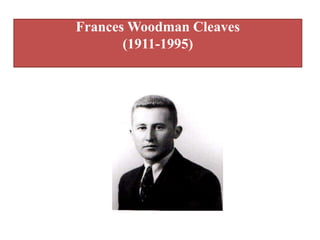
Frances Woodman Cleaves
       (1911-1995)
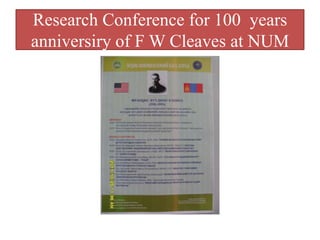
Research Conference for 100 years
anniversiry of F W Cleaves at NUM
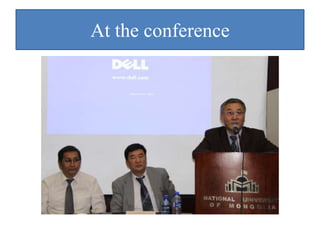
At the conference
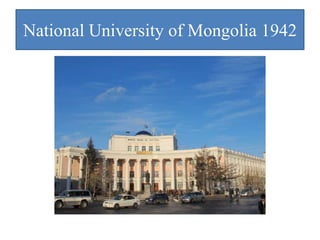
National University of Mongolia 1942
About NUM
• NUM established in 1942, the first higher education
  institution of the country was the source of other
  universities in Mongolia, we will celebrate 70 years
  anniversary next year.
• To become one of the world’s renowned universities is
  the goal that our community is aiming for. Research
  projects on Mongolian studies, biotechnology,
  information technology and new material technology
  are the most attractive area for the joint cooperation.
• Монгол судлал бол              МУИС-ийн судалгааны
  тэргүүлэх чиглэл мөн гэж МУИС-ийг 2020 хүртэл
  хөгжүүлэх the strategic plan д заасан.
School of Mongolian Language and Culture 1945

• The School of Mongolian Language and culture is
  one of the oldest faculties at the NUM
• There are almost 100 faculty numbers, 1033
  students, 900 undergraduate and 133 graduates.
• Published as part of the first academic research
  paper of the NUM in 1946, the first 2 articles
  dedicated to Mongolian studies were the initials
  of the school academic research.
Institute for Mongolian Studies
• The Institute for Mongolian Studies founded in
  2000 as Center of Mongolian Studies (CMS),, is
  designed basically to facilitate the Mongolian
  studies at the NUM and its activities are directed
  to coordinate the scientific and research works
  being conducted at the departments and units on
  the aspects of Mongolian studies, to provide an
  exchange of information and to introduce and
  distribute the best works to the Mongolian studies
  community both within and out of Mongolia.
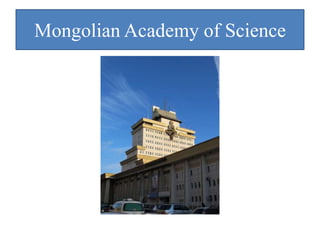
Mongolian Academy of Science
• There are 3 main research institute are
  Mongolian History, Philology, International
  Studies, and Archeology.
• Institute of Philology will celebrate 90 years
  anniversary this year.
• Institute of History is very active for last years.
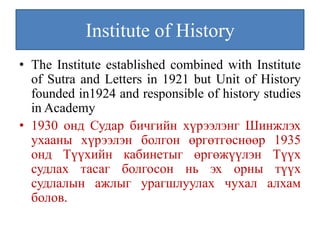
Institute of History
• The Institute established combined with Institute
  of Sutra and Letters in 1921 but Unit of History
  founded in1924 and responsible of history studies
  in Academy
• 1930 онд Судар бичгийн хүрээлэнг Шинжлэх
  ухааны хүрээлэн болгон өргөтгөснөөр 1935
  онд Түүхийн кабинетыг өргөжүүлэн Түүх
  судлах тасаг болгосон нь эх орны түүх
  судлалын ажлыг урагшлуулах чухал алхам
  болов.
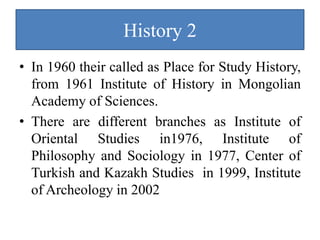
History 2
• In 1960 their called as Place for Study History,
  from 1961 Institute of History in Mongolian
  Academy of Sciences.
• There are different branches as Institute of
  Oriental Studies in1976, Institute of
  Philosophy and Sociology in 1977, Center of
  Turkish and Kazakh Studies in 1999, Institute
  of Archeology in 2002
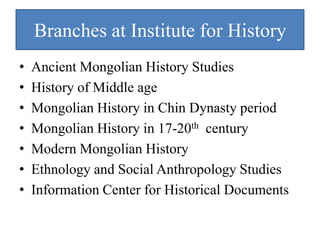
Branches at Institute for History
•   Ancient Mongolian History Studies
•   History of Middle age
•   Mongolian History in Chin Dynasty period
•   Mongolian History in 17-20th century
•   Modern Mongolian History
•   Ethnology and Social Anthropology Studies
•   Information Center for Historical Documents
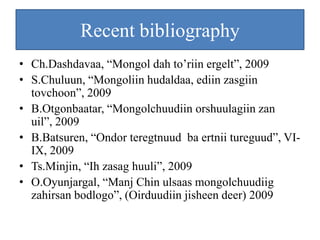
Recent bibliography
• Ch.Dashdavaa, “Mongol dah to’riin ergelt”, 2009
• S.Chuluun, “Mongoliin hudaldaa, ediin zasgiin
  tovchoon”, 2009
• B.Otgonbaatar, “Mongolchuudiin orshuulagiin zan
  uil”, 2009
• B.Batsuren, “Ondor teregtnuud ba ertnii tureguud”, VI-
  IX, 2009
• Ts.Minjin, “Ih zasag huuli”, 2009
• O.Oyunjargal, “Manj Chin ulsaas mongolchuudiig
  zahirsan bodlogo”, (Oirduudiin jisheen deer) 2009
Bibliography
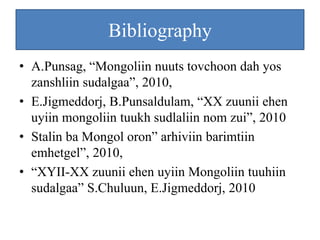
• A.Punsag, “Mongoliin nuuts tovchoon dah yos
  zanshliin sudalgaa”, 2010,
• E.Jigmeddorj, B.Punsaldulam, “XX zuunii ehen
  uyiin mongoliin tuukh sudlaliin nom zui”, 2010
• Stalin ba Mongol oron” arhiviin barimtiin
  emhetgel”, 2010,
• “XYII-XX zuunii ehen uyiin Mongoliin tuuhiin
  sudalgaa” S.Chuluun, E.Jigmeddorj, 2010
Bibliography
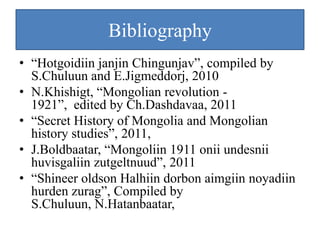
• “Hotgoidiin janjin Chingunjav”, compiled by
  S.Chuluun and E.Jigmeddorj, 2010
• N.Khishigt, “Mongolian revolution -
  1921”, edited by Ch.Dashdavaa, 2011
• “Secret History of Mongolia and Mongolian
  history studies”, 2011,
• J.Boldbaatar, “Mongoliin 1911 onii undesnii
  huvisgaliin zutgeltnuud”, 2011
• “Shineer oldson Halhiin dorbon aimgiin noyadiin
  hurden zurag”, Compiled by
  S.Chuluun, N.Hatanbaatar,
Bibliography
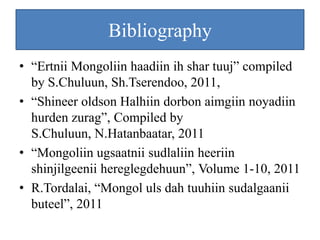
• “Ertnii Mongoliin haadiin ih shar tuuj” compiled
  by S.Chuluun, Sh.Tserendoo, 2011,
• “Shineer oldson Halhiin dorbon aimgiin noyadiin
  hurden zurag”, Compiled by
  S.Chuluun, N.Hatanbaatar, 2011
• “Mongoliin ugsaatnii sudlaliin heeriin
  shinjilgeenii hereglegdehuun”, Volume 1-10, 2011
• R.Tordalai, “Mongol uls dah tuuhiin sudalgaanii
  buteel”, 2011
Institute of Mongolian language and literature

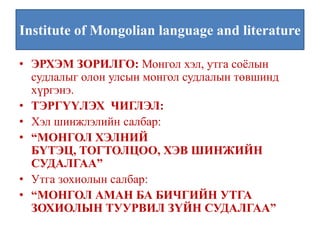
• ЭРХЭМ ЗОРИЛГО: Монгол хэл, утга соёлын
  судлалыг олон улсын монгол судлалын төвшинд
  хүргэнэ.
• ТЭРГҮҮЛЭХ ЧИГЛЭЛ:
• Хэл шинжлэлийн салбар:
• “МОНГОЛ ХЭЛНИЙ
  БҮТЭЦ, ТОГТОЛЦОО, ХЭВ ШИНЖИЙН
  СУДАЛГАА”
• Утга зохиолын салбар:
• “МОНГОЛ АМАН БА БИЧГИЙН УТГА
  ЗОХИОЛЫН ТУУРВИЛ ЗҮЙН СУДАЛГАА”
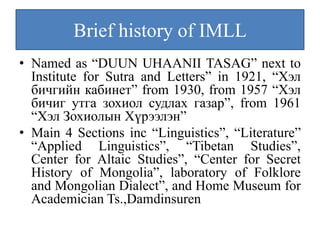
Brief history of IMLL
• Named as “DUUN UHAANII TASAG” next to
  Institute for Sutra and Letters” in 1921, “Хэл
  бичгийн кабинет” from 1930, from 1957 “Хэл
  бичиг утга зохиол судлах газар”, from 1961
  “Хэл Зохиолын Хүрээлэн”
• Main 4 Sections inc “Linguistics”, “Literature”
  “Applied Linguistics”, “Tibetan Studies”,
  Center for Altaic Studies”, “Center for Secret
  History of Mongolia”, laboratory of Folklore
  and Mongolian Dialect”, and Home Museum for
  Academician Ts.,Damdinsuren
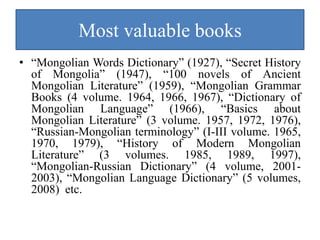
Most valuable books
• “Mongolian Words Dictionary” (1927), “Secret History
  of Mongolia” (1947), “100 novels of Ancient
  Mongolian Literature” (1959), “Mongolian Grammar
  Books (4 volume. 1964, 1966, 1967), “Dictionary of
  Mongolian Language” (1966), “Basics about
  Mongolian Literature” (3 volume. 1957, 1972, 1976),
  “Russian-Mongolian terminology” (I-III volume. 1965,
  1970, 1979), “History of Modern Mongolian
  Literature” (3 volumes. 1985, 1989, 1997),
  “Mongolian-Russian Dictionary” (4 volume, 2001-
  2003), “Mongolian Language Dictionary” (5 volumes,
  2008) etc.
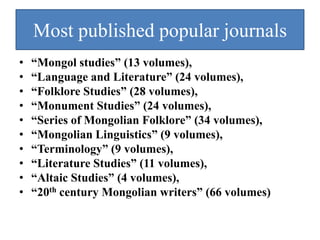
Most published popular journals
•   “Mongol studies” (13 volumes),
•   “Language and Literature” (24 volumes),
•   “Folklore Studies” (28 volumes),
•   “Monument Studies” (24 volumes),
•   “Series of Mongolian Folklore” (34 volumes),
•   “Mongolian Linguistics” (9 volumes),
•   “Terminology” (9 volumes),
•   “Literature Studies” (11 volumes),
•   “Altaic Studies” (4 volumes),
•   “20th century Mongolian writers” (66 volumes)
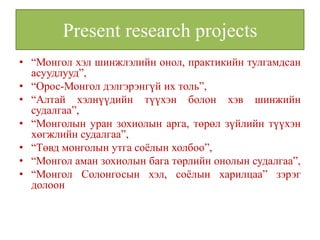
Present research projects
• “Монгол хэл шинжлэлийн онол, практикийн тулгамдсан
  асуудлууд”,
• “Орос-Монгол дэлгэрэнгүй их толь”,
• “Алтай хэлнүүдийн түүхэн болон хэв шинжийн
  судалгаа”,
• “Монголын уран зохиолын арга, төрөл зүйлийн түүхэн
  хөгжлийн судалгаа”,
• “Төвд монголын утга соёлын холбоо”,
• “Монгол аман зохиолын бага төрлийн онолын судалгаа”,
• “Монгол Солонгосын хэл, соёлын харилцаа” зэрэг
  долоон
Field work in country
• 1. Institute of Sutra and Literature (1921-1930)
  Headed           by         L.A.Amsterdamskay,
  B.Y.Vladimirtsov, V.A.Kazakevich, P.K.Kozlov,
  M.Puchkovskii,       B.Rinchen,     G.D.Sanjeev,
  E.Henish, J.Tseveen,
• 2. Institute of Science, Philology Unit (1931-
  1960) Headed by B.Rinchen, P.Pouha,
  K.V.Bytkina,
• 3. Institute of Philology, MAS (1961-2008)
  Headed by E.Vandui, J.Tumurtseren, D.Tsend,
  B.Sumyabaatar, and J.Tsoloo
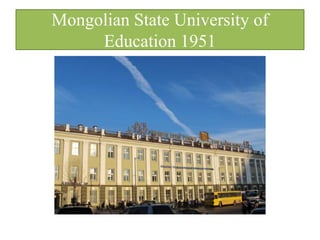
Mongolian State University of
     Education 1951
Department of Mongolian History

• The Department was established in 1951 and
  it’s first head was Prof. Jambiin Batmunh who
  was one of political leader in Mongolia..
• Main research focused on all ages of
  Mongolian history, Mongolian Archeology.
  Mongolian Historical Writings, Culture
  studies, Oirat Studies, and Mongolian History
  Biography Studies.
Faculty of Department of History
• Head, Department of Mongolian History
  (PhD), Prof. Ts,Gantulga,
• Scholars: Acc. Prof. Doctor (PhD),
  J.Gerelbadrakh, Ts.To’rbat, Na,Sukhbaatar,
  S.Enkhjin, U.Erdenetuya, Ch.Boldbaatar,
  G.Dariimaa, N.Bayartsetseg, A.Altanbagana,
  and O. Amgalan.
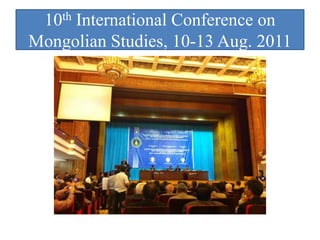
10th International Conference on
Mongolian Studies, 10-13 Aug. 2011
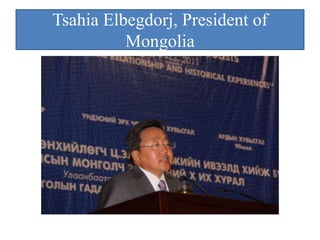
Tsahia Elbegdorj, President of
          Mongolia
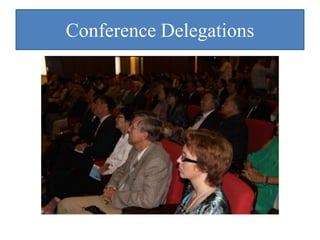
Conference Delegations
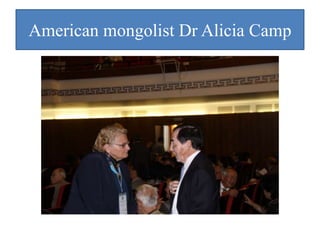
American mongolist Dr Alicia Camp
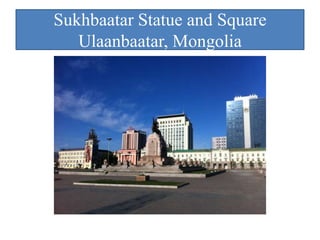
Sukhbaatar Statue and Square
   Ulaanbaatar, Mongolia
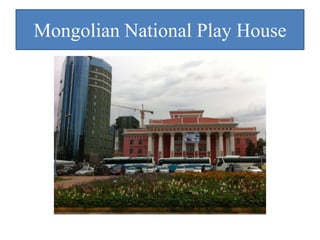
Mongolian National Play House
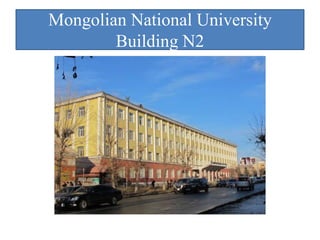
Mongolian National University
        Building N2
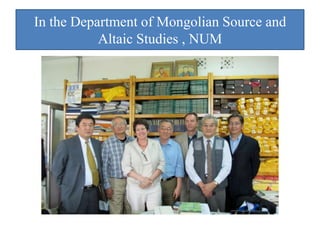
In the Department of Mongolian Source and
           Altaic Studies , NUM
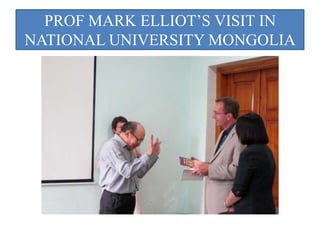
PROF MARK ELLIOT’S VISIT IN
NATIONAL UNIVERSITY MONGOLIA
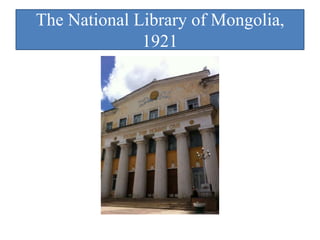
The National Library of Mongolia,
              1921
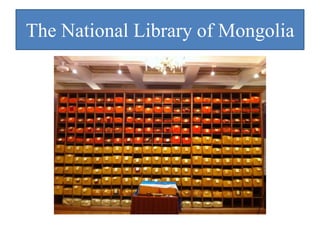
The National Library of Mongolia
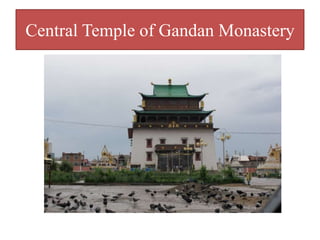
Central Temple of Gandan Monastery
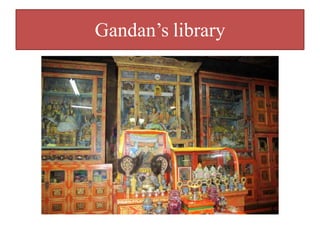
Gandan’s library
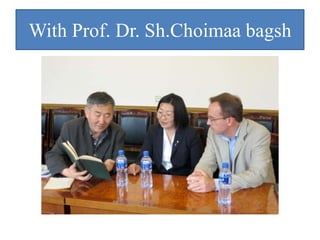
With Prof. Dr. Sh.Choimaa bagsh
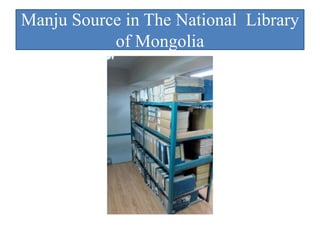
Manju Source in The National Library
           of Mongolia
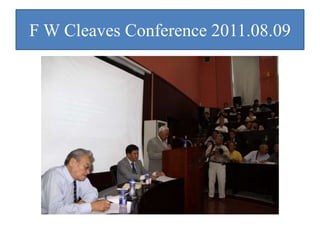
F W Cleaves Conference 2011.08.09
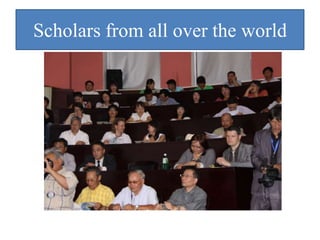
Scholars from all over the world
Photos by J.BAT-IREEDUI
THANK YOU FOR YOUR ATTENTION

Mongolian studies in mongolia

  • 1.
    MONGOLIAN STUDIES IN MONGOLIA (brief introduction) Prof. J.Bat-Ireedui The Institute for Mongolian Studies National University of Mongolia
  • 2.
    Introduction • The MongolianStudies in Mongolia mainly runs its operations in relation with the state owned public schools such as the National University of Mongolia, the Mongolian Science Academy and the University of Education. Independent studies are also being done at private schools, namely Ikh Zasag, Otgon Tenger, Orkhon, Shikhi Hutag, Chinggis Khaan and Ulaanbaatar University etc.
  • 3.
    Mongolian Studies • Furthermore,there are many Mongolian and foreign non-government organizations working on Mongolian studies. For example, Mongolian organizations include the International Association of Mongolian Studies, its secretarial office, the National Mongolian Studies Association and the Mongolian Tradition Academy, whereas international organizations include the American Mongolian Studies Centre, the Mongolian Studies Centre at the Ulaanbaatar University and the Anton Mostert Mongolian Studies Center.
  • 4.
  • 5.
    Research Conference for100 years anniversiry of F W Cleaves at NUM
  • 6.
  • 7.
  • 8.
    About NUM • NUMestablished in 1942, the first higher education institution of the country was the source of other universities in Mongolia, we will celebrate 70 years anniversary next year. • To become one of the world’s renowned universities is the goal that our community is aiming for. Research projects on Mongolian studies, biotechnology, information technology and new material technology are the most attractive area for the joint cooperation. • Монгол судлал бол МУИС-ийн судалгааны тэргүүлэх чиглэл мөн гэж МУИС-ийг 2020 хүртэл хөгжүүлэх the strategic plan д заасан.
  • 9.
    School of MongolianLanguage and Culture 1945 • The School of Mongolian Language and culture is one of the oldest faculties at the NUM • There are almost 100 faculty numbers, 1033 students, 900 undergraduate and 133 graduates. • Published as part of the first academic research paper of the NUM in 1946, the first 2 articles dedicated to Mongolian studies were the initials of the school academic research.
  • 10.
    Institute for MongolianStudies • The Institute for Mongolian Studies founded in 2000 as Center of Mongolian Studies (CMS),, is designed basically to facilitate the Mongolian studies at the NUM and its activities are directed to coordinate the scientific and research works being conducted at the departments and units on the aspects of Mongolian studies, to provide an exchange of information and to introduce and distribute the best works to the Mongolian studies community both within and out of Mongolia.
  • 11.
  • 12.
    Mongolian Academy ofScience • There are 3 main research institute are Mongolian History, Philology, International Studies, and Archeology. • Institute of Philology will celebrate 90 years anniversary this year. • Institute of History is very active for last years.
  • 13.
    Institute of History •The Institute established combined with Institute of Sutra and Letters in 1921 but Unit of History founded in1924 and responsible of history studies in Academy • 1930 онд Судар бичгийн хүрээлэнг Шинжлэх ухааны хүрээлэн болгон өргөтгөснөөр 1935 онд Түүхийн кабинетыг өргөжүүлэн Түүх судлах тасаг болгосон нь эх орны түүх судлалын ажлыг урагшлуулах чухал алхам болов.
  • 14.
    History 2 • In1960 their called as Place for Study History, from 1961 Institute of History in Mongolian Academy of Sciences. • There are different branches as Institute of Oriental Studies in1976, Institute of Philosophy and Sociology in 1977, Center of Turkish and Kazakh Studies in 1999, Institute of Archeology in 2002
  • 15.
    Branches at Institutefor History • Ancient Mongolian History Studies • History of Middle age • Mongolian History in Chin Dynasty period • Mongolian History in 17-20th century • Modern Mongolian History • Ethnology and Social Anthropology Studies • Information Center for Historical Documents
  • 16.
    Recent bibliography • Ch.Dashdavaa,“Mongol dah to’riin ergelt”, 2009 • S.Chuluun, “Mongoliin hudaldaa, ediin zasgiin tovchoon”, 2009 • B.Otgonbaatar, “Mongolchuudiin orshuulagiin zan uil”, 2009 • B.Batsuren, “Ondor teregtnuud ba ertnii tureguud”, VI- IX, 2009 • Ts.Minjin, “Ih zasag huuli”, 2009 • O.Oyunjargal, “Manj Chin ulsaas mongolchuudiig zahirsan bodlogo”, (Oirduudiin jisheen deer) 2009
  • 17.
    Bibliography • A.Punsag, “Mongoliinnuuts tovchoon dah yos zanshliin sudalgaa”, 2010, • E.Jigmeddorj, B.Punsaldulam, “XX zuunii ehen uyiin mongoliin tuukh sudlaliin nom zui”, 2010 • Stalin ba Mongol oron” arhiviin barimtiin emhetgel”, 2010, • “XYII-XX zuunii ehen uyiin Mongoliin tuuhiin sudalgaa” S.Chuluun, E.Jigmeddorj, 2010
  • 18.
    Bibliography • “Hotgoidiin janjinChingunjav”, compiled by S.Chuluun and E.Jigmeddorj, 2010 • N.Khishigt, “Mongolian revolution - 1921”, edited by Ch.Dashdavaa, 2011 • “Secret History of Mongolia and Mongolian history studies”, 2011, • J.Boldbaatar, “Mongoliin 1911 onii undesnii huvisgaliin zutgeltnuud”, 2011 • “Shineer oldson Halhiin dorbon aimgiin noyadiin hurden zurag”, Compiled by S.Chuluun, N.Hatanbaatar,
  • 19.
    Bibliography • “Ertnii Mongoliinhaadiin ih shar tuuj” compiled by S.Chuluun, Sh.Tserendoo, 2011, • “Shineer oldson Halhiin dorbon aimgiin noyadiin hurden zurag”, Compiled by S.Chuluun, N.Hatanbaatar, 2011 • “Mongoliin ugsaatnii sudlaliin heeriin shinjilgeenii hereglegdehuun”, Volume 1-10, 2011 • R.Tordalai, “Mongol uls dah tuuhiin sudalgaanii buteel”, 2011
  • 20.
    Institute of Mongolianlanguage and literature • ЭРХЭМ ЗОРИЛГО: Монгол хэл, утга соёлын судлалыг олон улсын монгол судлалын төвшинд хүргэнэ. • ТЭРГҮҮЛЭХ ЧИГЛЭЛ: • Хэл шинжлэлийн салбар: • “МОНГОЛ ХЭЛНИЙ БҮТЭЦ, ТОГТОЛЦОО, ХЭВ ШИНЖИЙН СУДАЛГАА” • Утга зохиолын салбар: • “МОНГОЛ АМАН БА БИЧГИЙН УТГА ЗОХИОЛЫН ТУУРВИЛ ЗҮЙН СУДАЛГАА”
  • 21.
    Brief history ofIMLL • Named as “DUUN UHAANII TASAG” next to Institute for Sutra and Letters” in 1921, “Хэл бичгийн кабинет” from 1930, from 1957 “Хэл бичиг утга зохиол судлах газар”, from 1961 “Хэл Зохиолын Хүрээлэн” • Main 4 Sections inc “Linguistics”, “Literature” “Applied Linguistics”, “Tibetan Studies”, Center for Altaic Studies”, “Center for Secret History of Mongolia”, laboratory of Folklore and Mongolian Dialect”, and Home Museum for Academician Ts.,Damdinsuren
  • 22.
    Most valuable books •“Mongolian Words Dictionary” (1927), “Secret History of Mongolia” (1947), “100 novels of Ancient Mongolian Literature” (1959), “Mongolian Grammar Books (4 volume. 1964, 1966, 1967), “Dictionary of Mongolian Language” (1966), “Basics about Mongolian Literature” (3 volume. 1957, 1972, 1976), “Russian-Mongolian terminology” (I-III volume. 1965, 1970, 1979), “History of Modern Mongolian Literature” (3 volumes. 1985, 1989, 1997), “Mongolian-Russian Dictionary” (4 volume, 2001- 2003), “Mongolian Language Dictionary” (5 volumes, 2008) etc.
  • 23.
    Most published popularjournals • “Mongol studies” (13 volumes), • “Language and Literature” (24 volumes), • “Folklore Studies” (28 volumes), • “Monument Studies” (24 volumes), • “Series of Mongolian Folklore” (34 volumes), • “Mongolian Linguistics” (9 volumes), • “Terminology” (9 volumes), • “Literature Studies” (11 volumes), • “Altaic Studies” (4 volumes), • “20th century Mongolian writers” (66 volumes)
  • 24.
    Present research projects •“Монгол хэл шинжлэлийн онол, практикийн тулгамдсан асуудлууд”, • “Орос-Монгол дэлгэрэнгүй их толь”, • “Алтай хэлнүүдийн түүхэн болон хэв шинжийн судалгаа”, • “Монголын уран зохиолын арга, төрөл зүйлийн түүхэн хөгжлийн судалгаа”, • “Төвд монголын утга соёлын холбоо”, • “Монгол аман зохиолын бага төрлийн онолын судалгаа”, • “Монгол Солонгосын хэл, соёлын харилцаа” зэрэг долоон
  • 25.
    Field work incountry • 1. Institute of Sutra and Literature (1921-1930) Headed by L.A.Amsterdamskay, B.Y.Vladimirtsov, V.A.Kazakevich, P.K.Kozlov, M.Puchkovskii, B.Rinchen, G.D.Sanjeev, E.Henish, J.Tseveen, • 2. Institute of Science, Philology Unit (1931- 1960) Headed by B.Rinchen, P.Pouha, K.V.Bytkina, • 3. Institute of Philology, MAS (1961-2008) Headed by E.Vandui, J.Tumurtseren, D.Tsend, B.Sumyabaatar, and J.Tsoloo
  • 26.
    Mongolian State Universityof Education 1951
  • 27.
    Department of MongolianHistory • The Department was established in 1951 and it’s first head was Prof. Jambiin Batmunh who was one of political leader in Mongolia.. • Main research focused on all ages of Mongolian history, Mongolian Archeology. Mongolian Historical Writings, Culture studies, Oirat Studies, and Mongolian History Biography Studies.
  • 28.
    Faculty of Departmentof History • Head, Department of Mongolian History (PhD), Prof. Ts,Gantulga, • Scholars: Acc. Prof. Doctor (PhD), J.Gerelbadrakh, Ts.To’rbat, Na,Sukhbaatar, S.Enkhjin, U.Erdenetuya, Ch.Boldbaatar, G.Dariimaa, N.Bayartsetseg, A.Altanbagana, and O. Amgalan.
  • 29.
    10th International Conferenceon Mongolian Studies, 10-13 Aug. 2011
  • 30.
  • 31.
  • 32.
  • 33.
    Sukhbaatar Statue andSquare Ulaanbaatar, Mongolia
  • 34.
  • 35.
  • 36.
    In the Departmentof Mongolian Source and Altaic Studies , NUM
  • 37.
    PROF MARK ELLIOT’SVISIT IN NATIONAL UNIVERSITY MONGOLIA
  • 38.
    The National Libraryof Mongolia, 1921
  • 39.
  • 40.
    Central Temple ofGandan Monastery
  • 41.
  • 42.
    With Prof. Dr.Sh.Choimaa bagsh
  • 43.
    Manju Source inThe National Library of Mongolia
  • 44.
    F W CleavesConference 2011.08.09
  • 45.
    Scholars from allover the world
  • 46.
    Photos by J.BAT-IREEDUI THANKYOU FOR YOUR ATTENTION

Editor's Notes

  • #31 Mr. TsahiaElbegdorjPresident of Mongolia