MAET Rouen, 2010
    Year 1
  Monday, June 27 - “Day Zero”
Who are we?


Mike                 Leigh
Who are you?
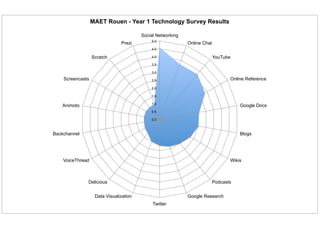
MAET Rouen - Year 1 Technology Survey Results

                                        Social Networking
                                            5.0
                               Prezi                        Online Chat
                                            4.5

                  Scratch                   4.0                           YouTube
                                            3.5

                                            3.0

    Screencasts                             2.5                                  Online Reference
                                            2.0

                                            1.5

                                            1.0
   Animoto                                                                           Google Docs
                                            0.5

                                            0.0


Backchannel                                                                          Blogs


    VoiceThread                                                                  Wikis


              Delicious                                                   Podcasts


                   Data Visualization                       Google Research
                                             Twitter
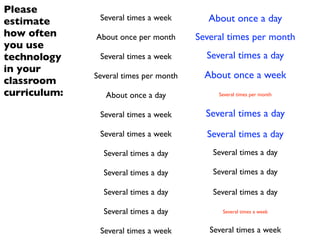
Please
estimate       Several times a week        About once a day
how often     About once per month      Several times per month
you use
technology     Several times a week       Several times a day
in your
              Several times per month     About once a week
classroom
curriculum:      About once a day            Several times per month


               Several times a week       Several times a day
               Several times a week       Several times a day
                Several times a day         Several times a day

                Several times a day         Several times a day

                Several times a day         Several times a day

                Several times a day           Several times a week


               Several times a week        Several times a week
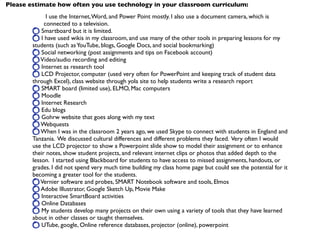
Please estimate how often you use technology in your classroom curriculum:
              I use the Internet, Word, and Power Point mostly. I also use a document camera, which is
             connected to a television.
            Smartboard but it is limited.
            I have used wikis in my classroom, and use many of the other tools in preparing lessons for my
        students (such as YouTube, blogs, Google Docs, and social bookmarking)
            Social networking (post assignments and tips on Facebook account)
            Video/audio recording and editing
            Internet as research tool
            LCD Projector, computer (used very often for PowerPoint and keeping track of student data
        through Excel), class website through yola site to help students write a research report
            SMART board (limited use), ELMO, Mac computers
            Moodle
            Internet Research
            Edu blogs
            Gohrw website that goes along with my text
            Webquests
            When I was in the classroom 2 years ago, we used Skype to connect with students in England and
        Tanzania. We discussed cultural differences and different problems they faced. Very often I would
        use the LCD projector to show a Powerpoint slide show to model their assignment or to enhance
        their notes, show student projects, and relevant internet clips or photos that added depth to the
        lesson. I started using Blackboard for students to have access to missed assignments, handouts, or
        grades. I did not spend very much time building my class home page but could see the potential for it
        becoming a greater tool for the students.
            Vernier software and probes, SMART Notebook software and tools, Elmos
            Adobe Illustrator, Google Sketch Up, Movie Make
            Interactive SmartBoard activities
            Online Databases
            My students develop many projects on their own using a variety of tools that they have learned
        about in other classes or taught themselves.
            UTube, google, Online reference databases, projector (online), powerpoint
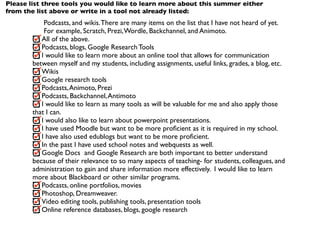
Please list three tools you would like to learn more about this summer either
from the list above or write in a tool not already listed:
            Podcasts, and wikis. There are many items on the list that I have not heard of yet.
            For example, Scratch, Prezi, Wordle, Backchannel, and Animoto.
           All of the above.
           Podcasts, blogs, Google Research Tools
           I would like to learn more about an online tool that allows for communication
        between myself and my students, including assignments, useful links, grades, a blog, etc.
           Wikis
           Google research tools
           Podcasts, Animoto, Prezi
           Podcasts, Backchannel, Antimoto
           I would like to learn as many tools as will be valuable for me and also apply those
        that I can.
           I would also like to learn about powerpoint presentations.
           I have used Moodle but want to be more proficient as it is required in my school.
           I have also used edublogs but want to be more proficient.
           In the past I have used school notes and webquests as well.
           Google Docs and Google Research are both important to better understand
        because of their relevance to so many aspects of teaching- for students, colleagues, and
        administration to gain and share information more effectively. I would like to learn
        more about Blackboard or other similar programs.
           Podcasts, online portfolios, movies
           Photoshop, Dreamweaver.
           Video editing tools, publishing tools, presentation tools
           Online reference databases, blogs, google research
Creativity?!?

This is an Ed Tech Program...
Teaching
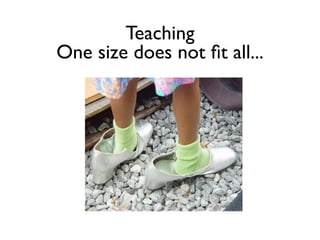
Teaching
One size does not fit all...
Teaching in the “New Ecology” of:
                     Information
                     Knowledge
                     Thinking
                     Learning
                     Teaching
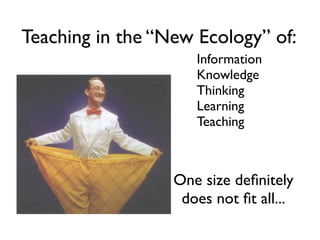
Teaching in the “New Ecology” of:
                     Information
                     Knowledge
                     Thinking
                     Learning
                     Teaching


                  One size definitely
                   does not fit all...
Challenges
Challenges                         Challenges


                                       Challenges
 Challenges

                                               Challenges
                          Challenges


       Challenges
                                       Challenges

Challenges
                    Challenges                       Challenges
Challenges
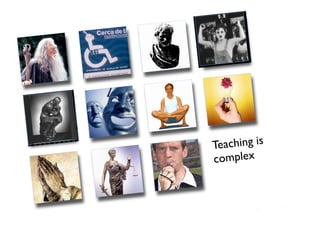
hin  g is
 Teac ned
   nst rai
co
ledgeable,
know ing iwise,
   easshble, s
 Tcec i
ac
        , lcexebral,
funnyp e r , fair,
  com
 b enevolent ,
 firm , flexible
 play ful, serious
      … & more
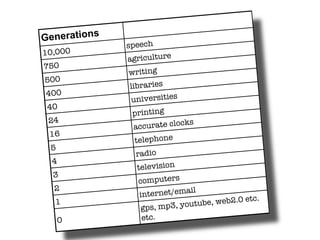
Generations
              speech
10,000
              agriculture
750
              writing
500
              libraries
400
               universities
 40
               printing
 24
               acc urate clocks
 16
                telephone
 5
                radio
  4
                 television
  3
                computers
  2                          ail
                internet/em
  1                               be , web2.0 etc.
                 gps , mp3, youtu
     0           etc.
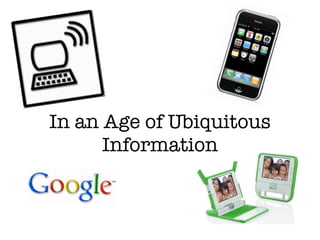
In an Age of Ubiquitous
      Information
We are preparing students for jobs:

-that don’t exist yet
-that use technologies that haven’t
been invented
-that will solve problems we don’t
even know about
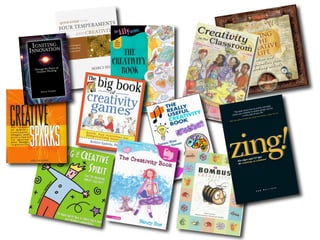
So, creativity can help...

    But, what is it?
Or something like this?
Little Miss Sunshine
9 step
 plan
9 step
 plan
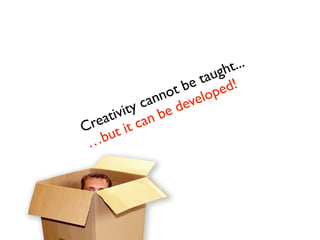
ht ...
                         ta ug
                 ot be
             a nn
      ivit yc
 re at
C
ht ...
                    ta ug
                  be ped!
                ot elo
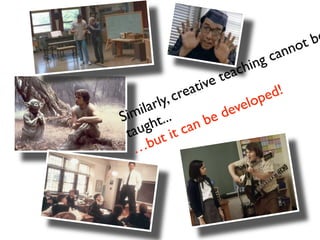
           ca nn ev
        ity be d
     tiv an
  ea it c
Cr ut
 … b
ot be
                                 ca nn
                        ch ing
                   et ea
              aetiv            d!
        rly, cr          lo pe
     ila .
  im t..            deve
S                be
  t   gh t can
    au t i
    …  bu
ot be
                                 ca nn
                        ch ing
                   et ea
              aetiv            d!
        rly, cr          lo pe
     ila .
  im t..            deve
S                be
  t   gh t can
    au t i
    …  bu
Examples of creative/artful
        teaching
Mike’s example of
Creative teaching
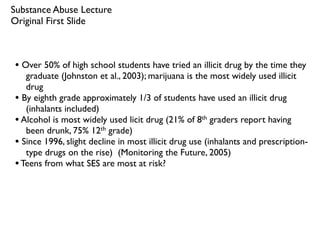
Substance Abuse Lecture
Original First Slide
Substance Abuse Lecture
Original First Slide


• Over 50% of high school students have tried an illicit drug by the time they
   graduate (Johnston et al., 2003); marijuana is the most widely used illicit
   drug
• By eighth grade approximately 1/3 of students have used an illicit drug
   (inhalants included)
• Alcohol is most widely used licit drug (21% of 8th graders report having
   been drunk, 75% 12th grade)
• Since 1996, slight decline in most illicit drug use (inhalants and prescription-
   type drugs on the rise) (Monitoring the Future, 2005)
• Teens from what SES are most at risk?
Substance Abuse Lecture
New First Slide
Substance Abuse Lecture
Rest of Class
Substance Abuse Lecture
Rest of Class


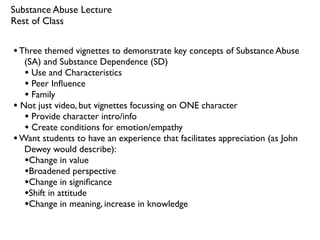
• Three themed vignettes to demonstrate key concepts of Substance Abuse
   (SA) and Substance Dependence (SD)
   • Use and Characteristics
   • Peer Influence
   • Family
• Not just video, but vignettes focussing on ONE character
   • Provide character intro/info
   • Create conditions for emotion/empathy
• Want students to have an experience that facilitates appreciation (as John
   Dewey would describe):
   •Change in value
   •Broadened perspective
   •Change in significance
   •Shift in attitude
   •Change in meaning, increase in knowledge
Substance Abuse Lecture
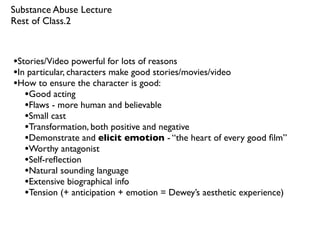
Rest of Class.2
Substance Abuse Lecture
Rest of Class.2


•Stories/Video powerful for lots of reasons
•In particular, characters make good stories/movies/video
•How to ensure the character is good:
   •Good acting
   •Flaws - more human and believable
   •Small cast
   •Transformation, both positive and negative
   •Demonstrate and elicit emotion - “the heart of every good film”
   •Worthy antagonist
   •Self-reflection
   •Natural sounding language
   •Extensive biographical info
   •Tension (+ anticipation + emotion = Dewey’s aesthetic experience)
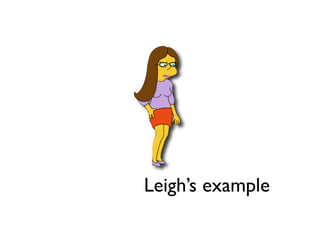
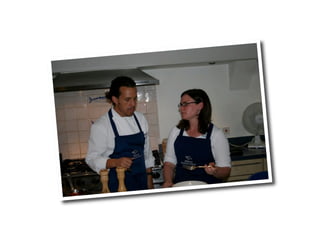
Leigh’s example
In small groups
Share examples of artful or creative
     teaching from your own
           experiences
           (doesn’t have to be big)
    a few minutes in groups & then share
What is common to these
       examples?
Attributes
          original
          valuable
           skillful
         effective
   suitable for context
        memorable
       inspirational
(emotion, insight, aesthetic)
          elegant
         coherent
Defining creativity
  * I know it when I see it!
Creativity
Creativity (by P. Mishra)
Novel


    Fresh,
unusual,
unique,

surprising,
startling,
astonishing,

      astounding,
germinal,

       trendsetting,
radical,

    revolutionary,
influential,

           pioneering…
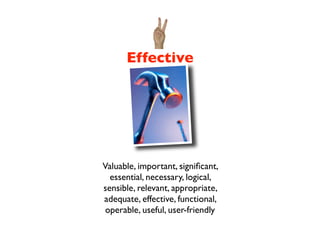
Effective


Valuable, important, significant,
  essential, necessary, logical,
sensible, relevant, appropriate,
adequate, effective, functional,
operable, useful, user-friendly
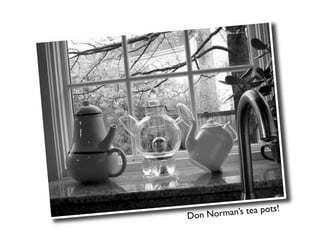
Don Norma n’s tea pots!
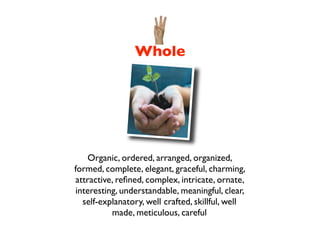
Whole


   Organic, ordered, arranged, organized,
formed, complete, elegant, graceful, charming,
attractive, refined, complex, intricate, ornate,
interesting, understandable, meaningful, clear,
  self-explanatory, well crafted, skillful, well
          made, meticulous, careful
Thus a creative product is

                 N
                 E
                 W
Thus a creative product is

                 Novel
                 Effective
                 Whole
creativity is a
 goal orientated process of
developing solutions that are
                     Novel
                     Effective
                     Whole
Think back to original
examples... are they NEW!
   (novel effective whole)
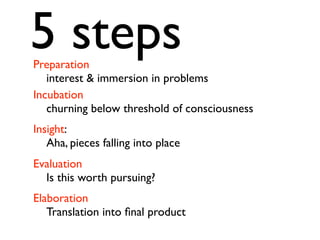
5 steps
Preparation
   interest & immersion in problems
Incubation
   churning below threshold of consciousness
Insight:
   Aha, pieces falling into place
Evaluation
  Is this worth pursuing?
Elaboration
   Translation into final product
Sure!*


* it does help us identify some myths!
Myth 1
Creativity is NOT about having
          a good idea!
...the best way to have
    a good idea is to
    have lots of ideas
      — Linus Pauling
Creativity
 is the
Myth 2
creativity is a big sudden
insight available only to
   people with special
         talents!
creativity is a big sudden
insight available only to
   people with special
         talents!

      Wrong!
Everyday Creativity...
Myth 3
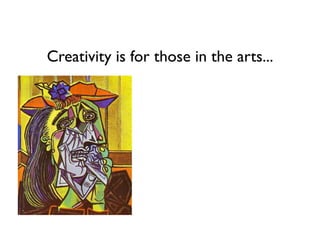
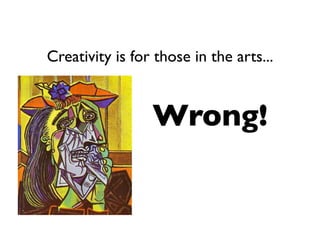
Creativity is for those in the arts...


                 Wrong!
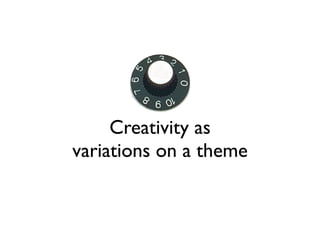
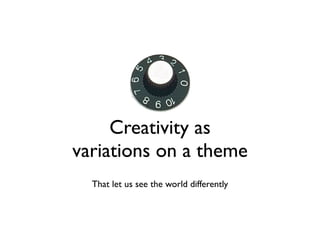
Creativity as
variations on a theme
Creativity as
variations on a theme
  That let us see the world differently
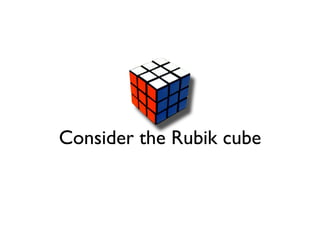
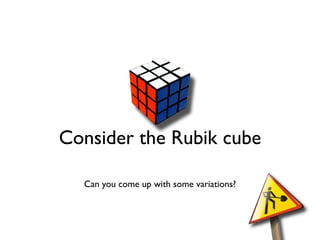
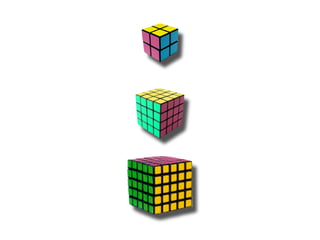
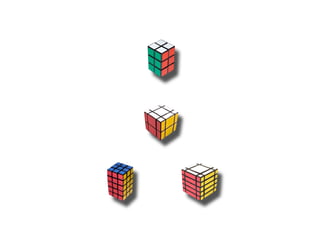
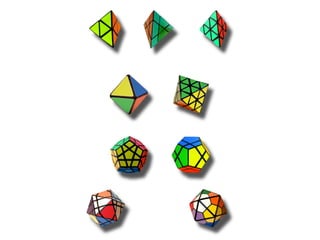
Consider the Rubik cube

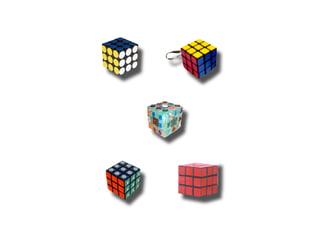
  Can you come up with some variations?
Superficial variations
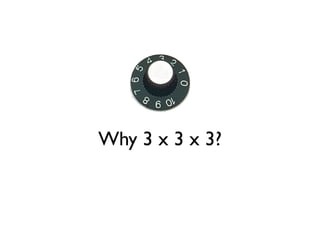
Why 3 x 3 x 3?
Why n x n x n?
Why four sides?
Objection!
 (I hear you say)
This is not real creativity!
But, creativity is nothing but...
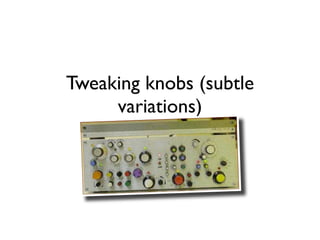
Tweaking knobs (subtle
     variations)
the right
Tweaking knobs
       ^
This is Spinal Tap
All right, sounds easy.

You need to be creative (tweak
 some knobs) to craft teaching
  with technology solutions...
Ah, but technology and
creativity have a two-way
      relationship...
...that is, technology often
requires creativity, but it can
    also enhance creativity.
Technology Requires
                                                                   Creativity


Producing the most important new products and
services depends on maintaining the worldwide
technological lead…But that kind of leadership
does not depend on technology alone. It
depends on a deep vein of creativity that is constantly
renewing itself, and on a myriad of people who can
imagine how people can use things that have
never been available before…

                                                             New Commission on the Skills of the American Workforce
                                                                                                              2006
Technology Enhances
                                                                      Creativity


Information technology confers leverage to creativity. By
abolishing the advantages of scale, it has leveled the
competitive playing field. It overturns the conventional
wisdom that knowledge is power. It's really creativity,
amplified, that creates that power... technology
provides a powerful amplifier for creativity.


                                                               Jamming: The Art and Discipline of Business Creativity
                                                                                                    John Kao (1997)
For example:
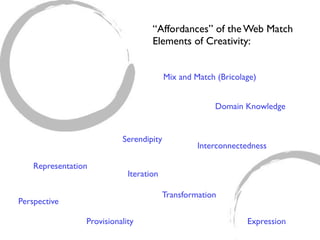
“Affordances” of the Web Match
                                    Elements of Creativity:


                                         Mix and Match (Bricolage)


                                                      Domain Knowledge


                           Serendipity
                                                  Interconnectedness

    Representation
                             Iteration

                                         Transformation
Perspective

                 Provisionality                                Expression
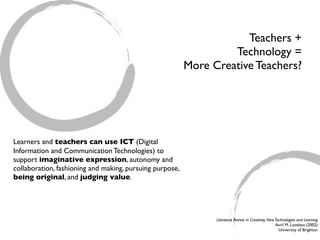
Teachers +
                                                                   Technology =
                                                          More Creative Teachers?


Learners and teachers can use ICT (Digital
Information and Communication Technologies) to
support imaginative expression, autonomy and
collaboration, fashioning and making, pursuing purpose,
being original, and judging value.


                                                                Literature Review in Creativity, New Technologies and Learning
                                                                                                     Avril M. Loveless (2002)
                                                                                                       University of Brighton
Teachers +
                                                                   Technology =
                                                          More Creative Teachers?


Learners and teachers can use ICT (Digital
Information and Communication Technologies) to
support imaginative expression, autonomy and
collaboration, fashioning and making, pursuing purpose,
being original, and judging value.


                                                                Literature Review in Creativity, New Technologies and Learning
                                                                                                     Avril M. Loveless (2002)
                                                                                                       University of Brighton
Teacher Creativity =
                                                         Student Performance


Research on teachers’ personality traits and behaviors
has produced few consistent findings (Schalock, 1979;
Druva & Anderson, 1983), with the exception of studies
finding a recurring positive relationship
between student learning and teachers’
“flexibility,” “creativity,” or
“adaptability” (Berliner & Tikunoff, 1976; Schalock,
1979; Walberg & Waxman, 1983).

                                                         Teacher Quality and Student Achievement: A Review of State Policy Evidence
                                                                                                Linda Darling-Hammond (1999)
                                                                                     Center for the Study of Teaching and Policy
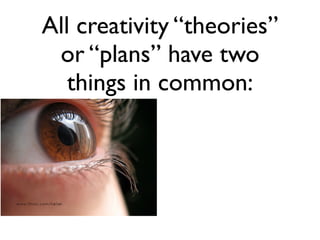
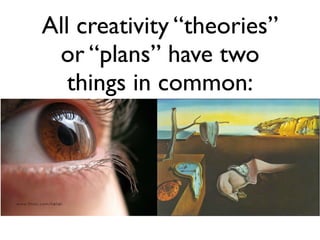
All creativity “theories”
 or “plans” have two
   things in common:
All creativity “theories”
 or “plans” have two
   things in common:
All creativity “theories”
 or “plans” have two
   things in common:
What is déjà vu?
déjà vu = making the
   strange familiar
Then, what is
  véjà du?
véjà du = making the
   familiar strange
Out of Classroom
    Activity!
Pair up and photograph an “everyday” item.
Take pictures that do NOT allow the viewer to
       easily determine what the item is.

      Take several, decide which is best

Upload photos to an online photo sharing site
              of your choice

      Send URL to deschry2@msu.edu

                 30 minutes

Monday Slides

  • 1.
    MAET Rouen, 2010 Year 1 Monday, June 27 - “Day Zero”
  • 2.
  • 3.
  • 4.
    MAET Rouen -Year 1 Technology Survey Results Social Networking 5.0 Prezi Online Chat 4.5 Scratch 4.0 YouTube 3.5 3.0 Screencasts 2.5 Online Reference 2.0 1.5 1.0 Animoto Google Docs 0.5 0.0 Backchannel Blogs VoiceThread Wikis Delicious Podcasts Data Visualization Google Research Twitter
  • 5.
    Please estimate Several times a week About once a day how often About once per month Several times per month you use technology Several times a week Several times a day in your Several times per month About once a week classroom curriculum: About once a day Several times per month Several times a week Several times a day Several times a week Several times a day Several times a day Several times a day Several times a day Several times a day Several times a day Several times a day Several times a day Several times a week Several times a week Several times a week
  • 6.
    Please estimate howoften you use technology in your classroom curriculum: I use the Internet, Word, and Power Point mostly. I also use a document camera, which is connected to a television. Smartboard but it is limited. I have used wikis in my classroom, and use many of the other tools in preparing lessons for my students (such as YouTube, blogs, Google Docs, and social bookmarking) Social networking (post assignments and tips on Facebook account) Video/audio recording and editing Internet as research tool LCD Projector, computer (used very often for PowerPoint and keeping track of student data through Excel), class website through yola site to help students write a research report SMART board (limited use), ELMO, Mac computers Moodle Internet Research Edu blogs Gohrw website that goes along with my text Webquests When I was in the classroom 2 years ago, we used Skype to connect with students in England and Tanzania. We discussed cultural differences and different problems they faced. Very often I would use the LCD projector to show a Powerpoint slide show to model their assignment or to enhance their notes, show student projects, and relevant internet clips or photos that added depth to the lesson. I started using Blackboard for students to have access to missed assignments, handouts, or grades. I did not spend very much time building my class home page but could see the potential for it becoming a greater tool for the students. Vernier software and probes, SMART Notebook software and tools, Elmos Adobe Illustrator, Google Sketch Up, Movie Make Interactive SmartBoard activities Online Databases My students develop many projects on their own using a variety of tools that they have learned about in other classes or taught themselves. UTube, google, Online reference databases, projector (online), powerpoint
  • 7.
    Please list threetools you would like to learn more about this summer either from the list above or write in a tool not already listed: Podcasts, and wikis. There are many items on the list that I have not heard of yet. For example, Scratch, Prezi, Wordle, Backchannel, and Animoto. All of the above. Podcasts, blogs, Google Research Tools I would like to learn more about an online tool that allows for communication between myself and my students, including assignments, useful links, grades, a blog, etc. Wikis Google research tools Podcasts, Animoto, Prezi Podcasts, Backchannel, Antimoto I would like to learn as many tools as will be valuable for me and also apply those that I can. I would also like to learn about powerpoint presentations. I have used Moodle but want to be more proficient as it is required in my school. I have also used edublogs but want to be more proficient. In the past I have used school notes and webquests as well. Google Docs and Google Research are both important to better understand because of their relevance to so many aspects of teaching- for students, colleagues, and administration to gain and share information more effectively. I would like to learn more about Blackboard or other similar programs. Podcasts, online portfolios, movies Photoshop, Dreamweaver. Video editing tools, publishing tools, presentation tools Online reference databases, blogs, google research
  • 8.
    Creativity?!? This is anEd Tech Program...
  • 9.
  • 10.
    Teaching One size doesnot fit all...
  • 11.
    Teaching in the“New Ecology” of: Information Knowledge Thinking Learning Teaching
  • 12.
    Teaching in the“New Ecology” of: Information Knowledge Thinking Learning Teaching One size definitely does not fit all...
  • 13.
  • 14.
    Challenges Challenges Challenges Challenges Challenges Challenges Challenges Challenges Challenges Challenges Challenges
  • 15.
  • 16.
    hin gis Teac ned nst rai co
  • 17.
    ledgeable, know ing iwise, easshble, s Tcec i ac , lcexebral, funnyp e r , fair, com b enevolent , firm , flexible play ful, serious … & more
  • 18.
    Generations speech 10,000 agriculture 750 writing 500 libraries 400 universities 40 printing 24 acc urate clocks 16 telephone 5 radio 4 television 3 computers 2 ail internet/em 1 be , web2.0 etc. gps , mp3, youtu 0 etc.
  • 19.
    In an Ageof Ubiquitous Information
  • 20.
    We are preparingstudents for jobs: -that don’t exist yet -that use technologies that haven’t been invented -that will solve problems we don’t even know about
  • 21.
    So, creativity canhelp... But, what is it?
  • 24.
  • 25.
  • 26.
  • 27.
  • 28.
    ht ... ta ug ot be a nn ivit yc re at C
  • 29.
    ht ... ta ug be ped! ot elo ca nn ev ity be d tiv an ea it c Cr ut … b
  • 30.
    ot be ca nn ch ing et ea aetiv d! rly, cr lo pe ila . im t.. deve S be t gh t can au t i … bu
  • 31.
    ot be ca nn ch ing et ea aetiv d! rly, cr lo pe ila . im t.. deve S be t gh t can au t i … bu
  • 32.
  • 33.
  • 34.
  • 35.
    Substance Abuse Lecture OriginalFirst Slide • Over 50% of high school students have tried an illicit drug by the time they graduate (Johnston et al., 2003); marijuana is the most widely used illicit drug • By eighth grade approximately 1/3 of students have used an illicit drug (inhalants included) • Alcohol is most widely used licit drug (21% of 8th graders report having been drunk, 75% 12th grade) • Since 1996, slight decline in most illicit drug use (inhalants and prescription- type drugs on the rise) (Monitoring the Future, 2005) • Teens from what SES are most at risk?
  • 36.
  • 37.
  • 38.
    Substance Abuse Lecture Restof Class • Three themed vignettes to demonstrate key concepts of Substance Abuse (SA) and Substance Dependence (SD) • Use and Characteristics • Peer Influence • Family • Not just video, but vignettes focussing on ONE character • Provide character intro/info • Create conditions for emotion/empathy • Want students to have an experience that facilitates appreciation (as John Dewey would describe): •Change in value •Broadened perspective •Change in significance •Shift in attitude •Change in meaning, increase in knowledge
  • 39.
  • 40.
    Substance Abuse Lecture Restof Class.2 •Stories/Video powerful for lots of reasons •In particular, characters make good stories/movies/video •How to ensure the character is good: •Good acting •Flaws - more human and believable •Small cast •Transformation, both positive and negative •Demonstrate and elicit emotion - “the heart of every good film” •Worthy antagonist •Self-reflection •Natural sounding language •Extensive biographical info •Tension (+ anticipation + emotion = Dewey’s aesthetic experience)
  • 41.
  • 44.
    In small groups Shareexamples of artful or creative teaching from your own experiences (doesn’t have to be big) a few minutes in groups & then share
  • 45.
    What is commonto these examples?
  • 46.
    Attributes original valuable skillful effective suitable for context memorable inspirational (emotion, insight, aesthetic) elegant coherent
  • 47.
    Defining creativity * I know it when I see it!
  • 48.
  • 49.
  • 50.
    Novel Fresh,
unusual,
unique,
 surprising,
startling,
astonishing,
 astounding,
germinal,
 trendsetting,
radical,
 revolutionary,
influential,
 pioneering…
  • 52.
    Effective Valuable, important, significant, essential, necessary, logical, sensible, relevant, appropriate, adequate, effective, functional, operable, useful, user-friendly
  • 53.
    Don Norma n’stea pots!
  • 54.
    Whole Organic, ordered, arranged, organized, formed, complete, elegant, graceful, charming, attractive, refined, complex, intricate, ornate, interesting, understandable, meaningful, clear, self-explanatory, well crafted, skillful, well made, meticulous, careful
  • 55.
    Thus a creativeproduct is
  • 56.
    Thus a creativeproduct is N E W
  • 57.
    Thus a creativeproduct is Novel Effective Whole
  • 58.
    creativity is a goal orientated process of developing solutions that are Novel Effective Whole
  • 59.
    Think back tooriginal examples... are they NEW! (novel effective whole)
  • 60.
    5 steps Preparation interest & immersion in problems Incubation churning below threshold of consciousness Insight: Aha, pieces falling into place Evaluation Is this worth pursuing? Elaboration Translation into final product
  • 61.
    Sure!* * it doeshelp us identify some myths!
  • 62.
  • 63.
    Creativity is NOTabout having a good idea!
  • 64.
    ...the best wayto have a good idea is to have lots of ideas — Linus Pauling
  • 65.
  • 66.
  • 67.
    creativity is abig sudden insight available only to people with special talents!
  • 68.
    creativity is abig sudden insight available only to people with special talents! Wrong!
  • 69.
  • 70.
  • 71.
    Creativity is forthose in the arts...
  • 72.
    Creativity is forthose in the arts... Wrong!
  • 73.
  • 74.
    Creativity as variations ona theme That let us see the world differently
  • 75.
  • 76.
    Consider the Rubikcube Can you come up with some variations?
  • 77.
  • 79.
    Why 3 x3 x 3?
  • 81.
    Why n xn x n?
  • 83.
  • 85.
  • 86.
    This is notreal creativity!
  • 87.
    But, creativity isnothing but...
  • 88.
  • 89.
  • 90.
  • 91.
    All right, soundseasy. You need to be creative (tweak some knobs) to craft teaching with technology solutions...
  • 92.
    Ah, but technologyand creativity have a two-way relationship...
  • 93.
    ...that is, technologyoften requires creativity, but it can also enhance creativity.
  • 94.
    Technology Requires Creativity Producing the most important new products and services depends on maintaining the worldwide technological lead…But that kind of leadership does not depend on technology alone. It depends on a deep vein of creativity that is constantly renewing itself, and on a myriad of people who can imagine how people can use things that have never been available before… New Commission on the Skills of the American Workforce 2006
  • 95.
    Technology Enhances Creativity Information technology confers leverage to creativity. By abolishing the advantages of scale, it has leveled the competitive playing field. It overturns the conventional wisdom that knowledge is power. It's really creativity, amplified, that creates that power... technology provides a powerful amplifier for creativity. Jamming: The Art and Discipline of Business Creativity John Kao (1997)
  • 96.
  • 97.
    “Affordances” of theWeb Match Elements of Creativity: Mix and Match (Bricolage) Domain Knowledge Serendipity Interconnectedness Representation Iteration Transformation Perspective Provisionality Expression
  • 98.
    Teachers + Technology = More Creative Teachers? Learners and teachers can use ICT (Digital Information and Communication Technologies) to support imaginative expression, autonomy and collaboration, fashioning and making, pursuing purpose, being original, and judging value. Literature Review in Creativity, New Technologies and Learning Avril M. Loveless (2002) University of Brighton
  • 99.
    Teachers + Technology = More Creative Teachers? Learners and teachers can use ICT (Digital Information and Communication Technologies) to support imaginative expression, autonomy and collaboration, fashioning and making, pursuing purpose, being original, and judging value. Literature Review in Creativity, New Technologies and Learning Avril M. Loveless (2002) University of Brighton
  • 100.
    Teacher Creativity = Student Performance Research on teachers’ personality traits and behaviors has produced few consistent findings (Schalock, 1979; Druva & Anderson, 1983), with the exception of studies finding a recurring positive relationship between student learning and teachers’ “flexibility,” “creativity,” or “adaptability” (Berliner & Tikunoff, 1976; Schalock, 1979; Walberg & Waxman, 1983). Teacher Quality and Student Achievement: A Review of State Policy Evidence Linda Darling-Hammond (1999) Center for the Study of Teaching and Policy
  • 101.
    All creativity “theories” or “plans” have two things in common:
  • 102.
    All creativity “theories” or “plans” have two things in common:
  • 103.
    All creativity “theories” or “plans” have two things in common:
  • 104.
  • 105.
    déjà vu =making the strange familiar
  • 106.
    Then, what is véjà du?
  • 107.
    véjà du =making the familiar strange
  • 108.
  • 109.
    Pair up andphotograph an “everyday” item. Take pictures that do NOT allow the viewer to easily determine what the item is. Take several, decide which is best Upload photos to an online photo sharing site of your choice Send URL to deschry2@msu.edu 30 minutes

Editor's Notes

  • #19 The web is 5000 days old! What are we preparing our students (our teachers) for?
  • #20 Talk to Google Immediacy Age of Free Information: -
  • #21 Richard Riley (frmr Sec of Ed) - Top 10 in-demand jobs in 2010 did not exist in 2004 Karl Fisch - Shift Happens, Did you Know
  • #31 jaime escalante mr. Keating Dewey Finn Mr. Holland Yoda
  • #32 Jaime Escalante Mr. Keating Dewey Finn Mr. Holland Yoda
  • #35 Given the possibility that students may perceive that they already know what they need to about substance abuse (given its relative “commonality”, e.g. students have seen movies about it, had related educational experiences, or may know somebody with substance abuse problems and associate all substance abuse issues with this one personal case), it is an especially appropriate lecture to target, since they may tune-out even more.  However, even if students are paying attention, research has demonstrated that “students of all ages hold quite stubbornly to their misconceptions, even after considerable instruction that explicitly contradicts their misconceptions”
  • #37 http://copyright.columbia.edu/fair-use-checklist
  • #38 students indicated that over the course of the class period they felt like the got to know Tracy well several critics agree that the part of Tracy is played very well (Snider, 2003; Stone, 2003/2004, Wood, 2003). Tracy is clearly flawed Tracy transformed overtly. Jackson (1999) described emotion as the filter through which Dewey expects all experiences are screened, as well as the key ingredient to hold the different elements of an experience together. Students recounted myriad emotions from Tracy, at times in great detail and depth in an open ended question about how they felt for her; indeed the character succeeded wildly in eliciting emotion from this particular class.
  • #45 In 1964, Supreme Court Justice Potter Stewart said this about pornography.
  • #51 http://www.jnd.org/dn.mss/emotion_design.html - The Design of Everyday Things" (Norman, 1988). the design of future things (most recent) but usability can’t be everything, all of these are original and effective (if all you want to do is brew and pour tea).
  • #52 This is the piece that is often missing. Besemer and O’quin: Organic Disordered – Ordered Arranged – Disarranged Organized – Disorganized Formless – Formed Incomplete - Complete Elegant Graceful – Awkward Repelling – Charming Coarse – Elegant Attractive – Unattractive Refined – Busy Complex Intricate – Straightforward Simple – Complex Plain – Ornate Complicated – Uncomplicated Boring – Interesting Understandable Meaningful – Meaningless Mystifying – Understandable Intelligible – Unintelligible Clear – Ambiguous Unexplained – Self explanatory Well-Crafted Skilful – Bungling Well made – Botched Crude – Well crafted Meticulous – Sloppy Careless – Careful In the context of teaching, this is the TPCK model. Takeing into account context, constraints, student differences, etc. does the creative solution result in a whole.
  • #57 Paddle Surfing for learning to surf Using Characters in your Video Integration Your examples of creative teaching/learning Your Tiny Tales
  • #61 On having many ideas!!!
  • #62 Linus Carl Pauling (February 28, 1901 – August 19, 1994) was an American chemist, peace activist, author, and educator. He was one of the most influential chemists in history and ranks among the most important scientists in any field of the 20th century[1][2]. Pauling was among the first scientists to work in the fields of quantum chemistry, molecular biology, and orthomolecular medicine. He is one of only 4 individuals to have won multiple Nobel Prizes.[3] He is one of only two people to have been awarded a Nobel Prize in two different fields (the Chemistry and Peace prizes), the other being Marie Curie (the Chemistry and Physics prizes), and the only person to have been awarded each of his prizes without sharing it with another recipient.[4]
  • #71 It might be best to view Creativity as: Metamagical Themas: Questing for the Essence of Mind and Pattern Gödel, Escher, Bach: An Eternal Golden Braid (commonly GEB) is a Pulitzer Prize-winning book by Douglas Hofstadter,[1]
  • #72 maybe think of theme as element, variable, characteristics...
  • #74 PAUSE
  • #86 elements, characteristics, themes, variables story of little boy and grand piano teaching the baby piano to play
  • #87 This is where seeing and re-seeing comes in. We practiced our observational skills in alphabits and veja du to avoid scenes like the following:
  • #92 50 years later, the new commission on the skills of the amercan workfoce is echoing what Guilford predicted: This is the idea that technology is often “repurposed” for new uses. Or, that technologies are created and then uses are derived. Military use to commercial use, to educational use. How much does the technology change? Not usually that much. But, how we use it changes a lot. This applies to software like Moodle or Wordpress, which have several updates, plug-ins available all along.
  • #93 Or, can technology actually enhance creativity? John Kao seems to think so… Knowledge isn’t power anymore. Knowledge is everywhere and instantly available. It is what you do with that knowledge that matters. That’s where creativity comes in. AND, the specific reason JP Guilford called for more creativity in schools, is that
  • #95 The, I looked a little deeper: Everybody uses it. And, the creative process is matched will with affordances of the Web: (quality of the Web that allow us, the users to do something) Csz chick-SENT-me-high DOMAIN KNOWLEDGE (needed for CT, available on WEB) Ward, et al, TRANSFORMATION to new forms (CT process , pictures to images to video on the WEB). Turkle ( Triiumph of tinkering Life on the Screen: Identity in the Age of the Interne, bricolage) - in that BRICOLUERS are comfortable exploring the Internet through the Web, trying one thing, then another, and making - Turkel talks about it specific to the Web. Douglas Hofstader (Fluid Concepts and Creative Analogies: Computer Models of the Fundamental Mechanisms of Thought, variations on a theme as the crux of creativity) TWEAK KNOBS (attributes) of an idea to get creative output. (Ward et al, connections associating or combining ideas and making connections ) Creating new connections in combination, Everything is INTERCONNECTED is some way on the Internet Ward et all talked about exploratory stage - evaluating the idea from different PERPSECTIVES or within different contexts Chase chance and creativity (Austin, 1978) - blind chance, SERENDIPTITY, luck of the diligent, self-induced luck - Web is full of opportunities to find this accidentally Most major theories of CT involve an iITERATIVE process, and GOOD web searching does too, Spiro. Geneplore Model of CT (Ward, Smith, and Finke, 1999) - Creative cognition: Generate Ideas: (1) retrieval of existing ideas from memory; (2) associating or combining those ideas; (3) the synthesis of new ideas; (4) transformation of existing ideas into new forms; (5) analogical transfer of ideas from one domain to another; and, (6) categorical reduction of ideas. The exploratory phase may include: (1) searching for novel or desirable attributes in an idea; (2) searching for metaphorical implication of an idea; (3) searching for functionality of an idea; (4) evaluating the idea from different perspectives or within different contexts; (5) the interpretation of ideas as possible solutions to problems; and, (6) identifying practical or conceptual limitations to an idea.
  • #96 So, is this true? Literature Review in Creativity, New Technologies and Learning for Future Lab, 21st century learning and innovation. Compares creativity and technology well. So, in considering all of these ideas, I wondered:
  • #97 So, is this true? Literature Review in Creativity, New Technologies and Learning for Future Lab, 21st century learning and innovation. Compares creativity and technology well. So, in considering all of these ideas, I wondered:
  • #98 In addition to the benefits of facilitating creativity in student, but may also help them perform well in when considering more traditional learning behavior. National consortium report on teacher quality and what states can to do improve it… So, if we all accept that teachers need to be more creative, what are some of the considerations for that goal? Well, for me, it was technology. I’m a former technology director, and saw how technology helped to bring about creative classroom projects. But, I wondered, can the technology itself help to plan the projects?
  • #99 DALI - The perceptions of memory - may be about ”the origins of our anxieties associated with time” Csikszentmihaly - Sparks of Genius - Root-Bernsteins Daniel Pink - How to think like Leonardo Davinci
  • #100 DALI - The perceptions of memory - may be about ”the origins of our anxieties associated with time” Csikszentmihaly - Sparks of Genius - Root-Bernsteins Daniel Pink - How to think like Leonardo Davinci
  • #101 DALI - The perceptions of memory - may be about ”the origins of our anxieties associated with time” Csikszentmihaly - Sparks of Genius - Root-Bernsteins Daniel Pink - How to think like Leonardo Davinci
  • #103 Something strange becomes abruptly or surprisingly familiar.
  • #107 Take as many pictures as you can. Try several different techniques, different angles, frames, and methods to disguise the item being photographed. Think about what your camera can do, (how much it can zoom in or zoom out, if you can insert it through openings to get interesting angles, etc.) to help you decide your item to be photographed. (For instance if your camera cannot take extremely closeups, choosing a small item may be the wrong way to go). You can use camera “features” too.