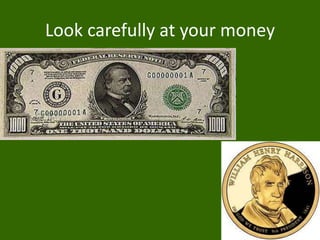
Look carefully at your money
Money vocabulary
• Liquidity
• Demand deposits
• balances in bank accounts
that depositors can access on
demand by writing a check.
• Central Bank
• Controlling bank of each
country, controls monetary
policy
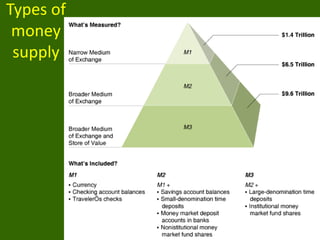
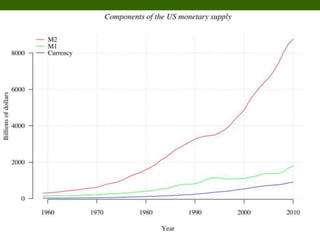
Types of
money
supply
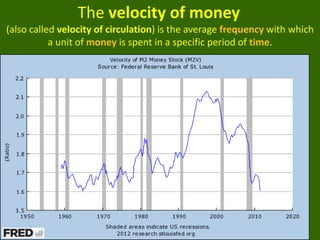
The velocity of money
(also called velocity of circulation) is the average frequency with which
a unit of money is spent in a specific period of time.
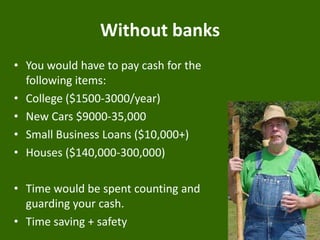
Without banks
• You would have to pay cash for the
following items:
• College ($1500-3000/year)
• New Cars $9000-35,000
• Small Business Loans ($10,000+)
• Houses ($140,000-300,000)
• Time would be spent counting and
guarding your cash.
• Time saving + safety
What if the bank goes out of business?

• $250,000 per US account
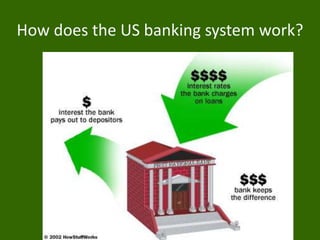
How does the US banking system work?
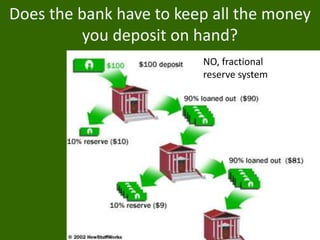
Does the bank have to keep all the money
you deposit on hand?
NO, fractional
reserve system
What is a Credit Union then?
• Smaller, regional, non-profit, theme based,
lower rates
Who regulates the banks?
• “The
Fed”
• 1913
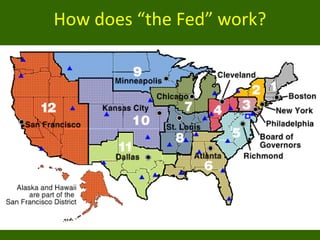
How does “the Fed” work?
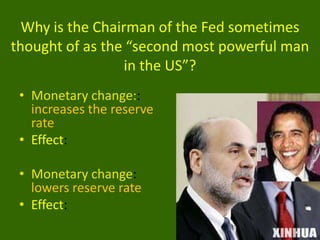
Why is the Chairman of the Fed sometimes
thought of as the “second most powerful man
in the US”?
• Monetary change::
increases the reserve
rate
• Effect:
• Monetary change:
lowers reserve rate
• Effect:
The Federal Reserve
System
•

The Structure of the Federal Reserve
System:
 The

primary elements in the Federal Reserve
System are:

1) The Board of Governors
2) The Regional Federal Reserve Banks

3) The Federal Open Market Committee
The Fed’s Organization

• The Fed is run by a Board of Governors, which has

seven members appointed by the President and
confirmed by the Senate.
• Among the seven members, the most important is
the chairman. The chairman directs the Fed staff,
presides over board meetings, and testifies about
Fed policy in front of Congressional Committees.
The Fed’s Organization
•

The Board of Governors
 Seven

members
 Appointed by the President
 Confirmed by the Senate
 Serve staggered 14-year terms so that one comes
vacant every two years.
 President appoints a member as chairman to serve
a four-year term.
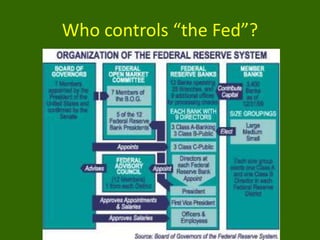
Who controls “the Fed”?
The Fed’s Organization
•

The Federal Open Market Committee (FOMC) is
made up of the following voting members:
The

chairman and the other six members of the
Board of Governors.
The president of the Federal Reserve Bank of New
York.
The presidents of the other regional Federal Reserve
banks (four vote on a yearly rotating basis).
The Fed’s Organization
The Federal Reserve Banks
12 District banks
Nine directors
Three

appointed by the Board of Governors.
Six are elected by the commercial banks in the
district.
The directors appoint the district president

which is approved by the Board of Governors.
The Federal Reserve System
The Federal Reserve Banks
The New York Fed implements
some of the Fed’s most important
policy decisions.
The Fed’s
Organization

•

The Federal Open Market Committee (FOMC)
Serves

as the main policy-making organ of the
Federal Reserve System.
Meets approximately every six weeks to review
the economy.
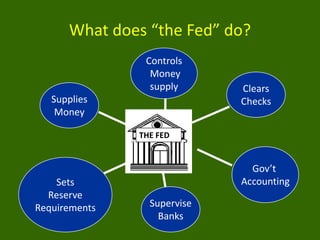
What does “the Fed” do?
Controls
Money
supply
Supplies
Money

Clears
Checks

THE FED

Sets
Reserve
Requirements

Gov’t
Accounting
Supervise
Banks
The Fed’s Organization

Monetary policy is conducted by
the Federal Open Market
Committee.
Open-Market Operations
•
•

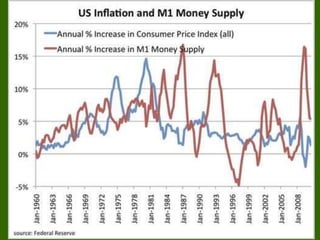
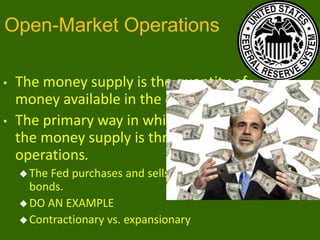
The money supply is the quantity of
money available in the economy.
The primary way in which the Fed changes
the money supply is through open-market
operations.
 The

Fed purchases and sells U.S. government
bonds.
 DO AN EXAMPLE
 Contractionary vs. expansionary
Fed’s Tools

• Open market operations
• Reserve Rate
• Discount Rate

• Lender of last resort
Open-Market
Operations

•

•

To increase the money supply, the Fed
buys government bonds from the
public.
To decrease the money supply, the Fed
sells government bonds to the public.
Changing the Discount
Rate
•

The discount rate is the interest rate the
Fed charges banks for loans.
Increasing

the discount rate decreases the money

supply.
Decreasing the discount rate increases the money
supply.

Mon fed monetary policy

  • 2.
  • 3.
    Money vocabulary • Liquidity •Demand deposits • balances in bank accounts that depositors can access on demand by writing a check. • Central Bank • Controlling bank of each country, controls monetary policy
  • 4.
  • 7.
    The velocity ofmoney (also called velocity of circulation) is the average frequency with which a unit of money is spent in a specific period of time.
  • 8.
    Without banks • Youwould have to pay cash for the following items: • College ($1500-3000/year) • New Cars $9000-35,000 • Small Business Loans ($10,000+) • Houses ($140,000-300,000) • Time would be spent counting and guarding your cash. • Time saving + safety
  • 9.
    What if thebank goes out of business? • $250,000 per US account
  • 10.
    How does theUS banking system work?
  • 11.
    Does the bankhave to keep all the money you deposit on hand? NO, fractional reserve system
  • 12.
    What is aCredit Union then? • Smaller, regional, non-profit, theme based, lower rates
  • 13.
    Who regulates thebanks? • “The Fed” • 1913
  • 14.
    How does “theFed” work?
  • 15.
    Why is theChairman of the Fed sometimes thought of as the “second most powerful man in the US”? • Monetary change:: increases the reserve rate • Effect: • Monetary change: lowers reserve rate • Effect:
  • 16.
    The Federal Reserve System • TheStructure of the Federal Reserve System:  The primary elements in the Federal Reserve System are: 1) The Board of Governors 2) The Regional Federal Reserve Banks 3) The Federal Open Market Committee
  • 17.
    The Fed’s Organization •The Fed is run by a Board of Governors, which has seven members appointed by the President and confirmed by the Senate. • Among the seven members, the most important is the chairman. The chairman directs the Fed staff, presides over board meetings, and testifies about Fed policy in front of Congressional Committees.
  • 18.
    The Fed’s Organization • TheBoard of Governors  Seven members  Appointed by the President  Confirmed by the Senate  Serve staggered 14-year terms so that one comes vacant every two years.  President appoints a member as chairman to serve a four-year term.
  • 19.
  • 20.
    The Fed’s Organization • TheFederal Open Market Committee (FOMC) is made up of the following voting members: The chairman and the other six members of the Board of Governors. The president of the Federal Reserve Bank of New York. The presidents of the other regional Federal Reserve banks (four vote on a yearly rotating basis).
  • 21.
    The Fed’s Organization TheFederal Reserve Banks 12 District banks Nine directors Three appointed by the Board of Governors. Six are elected by the commercial banks in the district. The directors appoint the district president which is approved by the Board of Governors.
  • 22.
    The Federal ReserveSystem The Federal Reserve Banks The New York Fed implements some of the Fed’s most important policy decisions.
  • 23.
    The Fed’s Organization • The FederalOpen Market Committee (FOMC) Serves as the main policy-making organ of the Federal Reserve System. Meets approximately every six weeks to review the economy.
  • 24.
    What does “theFed” do? Controls Money supply Supplies Money Clears Checks THE FED Sets Reserve Requirements Gov’t Accounting Supervise Banks
  • 25.
    The Fed’s Organization Monetarypolicy is conducted by the Federal Open Market Committee.
  • 26.
    Open-Market Operations • • The moneysupply is the quantity of money available in the economy. The primary way in which the Fed changes the money supply is through open-market operations.  The Fed purchases and sells U.S. government bonds.  DO AN EXAMPLE  Contractionary vs. expansionary
  • 27.
    Fed’s Tools • Openmarket operations • Reserve Rate • Discount Rate • Lender of last resort
  • 28.
    Open-Market Operations • • To increase themoney supply, the Fed buys government bonds from the public. To decrease the money supply, the Fed sells government bonds to the public.
  • 29.
    Changing the Discount Rate • Thediscount rate is the interest rate the Fed charges banks for loans. Increasing the discount rate decreases the money supply. Decreasing the discount rate increases the money supply.