Learning Unit #20
Federal Reserve System
Objectives of Learning Unit
 Structure of Federal Reserve System
 Functions of Federal Reserve System
 Independence of Federal Reserve System
 Balance sheet of Federal Reserve System
 Two Monetary Operations
Functions of Central Bank
 Each country has one central bank which is
responsible for
– Conducting monetary policy.
– Regulating an amount of money supply in economy.
– Supervising banks.
 In addition, a central bank may
– Regulate financial markets and financial institutions
other than banks.
– Control foreign exchanges and foreign reserves.
– Act as the government’s bank.
– Advising the government on the economic policy.
Federal Reserve System
 In the United States, the federal reserve system
(the Fed) acts as the central bank.
 In most developed countries there is only one
central bank. However, in the U.S. the Fed is
divided into various organizational components
for check and balance.
– The federal government have attempted to establish
a single central bank twice, but due to fear of
concentration of economic and monetary power, the
Congress abolished such institutions.
– In 1931 the Congress established the twelve regional
Federal Reserve banks.
Mission of Federal Reserve System
The Federal Reserve System is the central bank of the United
States. It was founded by Congress in 1913 to provide the nation
with a safer, more flexible, and more stable monetary and financial
system. Over the years, its role in banking and the economy has
expanded. Today, the Federal Reserve's duties fall into four
general areas:
– conducting the nation's monetary policy by influencing the
monetary and credit conditions in the economy in pursuit of
maximum employment, stable prices, and moderate long-term
interest rates
– supervising and regulating banking institutions to ensure the
safety and soundness of the nation's banking and financial
system and to protect the credit rights of consumers
– maintaining the stability of the financial system and containing
systemic risk that may arise in financial markets
– providing financial services to depository institutions, the U.S.
government, and foreign official institutions, including playing
a major role in operating the nation's payments system
From http://www.federalreserve.gov/aboutthefed/mission.htm
Functions of Federal Reserve System
Like any other central banks, the Federal Reserve
System performs various important functions
through its organizational components.
 Provide financial services to banks
– Clear checks
 Act as government’s bank
– Print new currencies and withdraw old ones
– Maintain government accounts
 Regulate banking and financial industries
 Conduct monetary policy
Organizational Components of the
Federal Reserve System
Three main organizational components of
the Federal Reserve System:
 Regional Federal Reserve banks
 Board of Governors
 Federal Open Market Committee
Regional Federal Reserve Banks
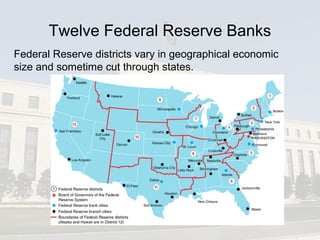
 The U.S. is divided into twelve Federal
Reserve districts.
– Each district has one Federal Reserve bank.
• Ex. Federal Reserve Bank of Richmond covers
states of Maryland, Virginia, North Carolina, and
South Carolina.
– By dividing into twelve districts, no one
Federal Reserve bank can dominate in the
U.S. economy.
• Federal Reserve Bank of New York covers only
the state of New York, but holds one-quarter of the
assets of the Federal Reserve System.
Twelve Federal Reserve Banks
Federal Reserve districts vary in geographical economic
size and sometime cut through states.
Organization of Federal Reserve Banks
 Each Federal Reserve Bank has the same
organizational structure.
– A quasi-public institution, which issued stocks
and were owned by the member commercial
banks in the district.
– Nine directors: six elected by the member
banks and three appointed by the Board of
Governors.
– One president of the bank is appointed by the
nine directors.
Functions of Federal Reserve Banks
 Federal Reserve banks perform
– Clearing checks
– Issuing new currency and withdrawing damaged
currency
– Setting a discount rate and making discount loans to
banks in their districts
– Examining bank holding companies and state-chartered
member banks
– Acting as liaisons between the business community
and the Federal Reserve System
– Collecting data on local business conditions
– Researching for the conduct of monetary policy
U.S. Dollar Bills
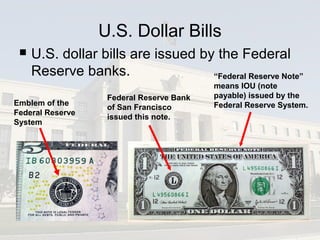
 U.S. dollar bills are issued by the Federal
Reserve banks.
Emblem of the
Federal Reserve
System
“Federal Reserve Note”
means IOU (note
payable) issued by the
Federal Reserve System.
Federal Reserve Bank
of San Francisco
issued this note.
Member banks
 All national banks are required to be members of
the Federal Reserve System.
– Currently, about 37% of the commercial banks are
members of the Federal Reserve System.
 Depository Institutions Deregulation and
Monetary Control Act of 1980
– Requires all depository institutions (member and
nonmember banks) to hold required reserves.
– Makes check-clearing services and the discount
window available for all depository institutions.
Board of Governors
 The Board of Governors acts like the
headquarter of the Federal Reserve
System.
– Located in Washington, D.C.
– Seven members of the Board of Governors are
appointed by the president of the United States
and confirmed by the Senate.
– Each member serves for nonrenewable 14-
year term and comes from different districts.
• Why 14-year term? To avoid political pressure from
the President and the Congress.
• Why from different districts? To prevent one district
over-representing its interest over other districts.
Chairman of Board of Governors
 The chairman of the Board of Governors is
chosen from the seven governors.
– Serves for renewable
four-year term.
– Acts like the CEO of
the Federal Reserve
System.
– Jerome Powell is the
current chairman.
Functions of Board of Governors
 The Board of Governors
– Sets the reserve requirement
– Approves the discount rate requested by the Federal
Reserve banks
– Advise the president of the United States, testifies in
Congress, and speaks for the Federal Reserve System for
the media.
– Represents the United States in negotiations with foreign
governments on economic matters
– Provides economic analysis for the conduct of monetary
policy
– Sets margin requirements
– Approves bank mergers and applications for new activities
and specifies the permissible activities of bank holding
companies
– Supervise the activities of foreign banks in the U.S.
Federal Open Market Committee
 The Federal Open Market Committee
– Meets eight times a year
– Makes decisions regarding the conduct of open
market operations, including setting a target rate on
federal funds
– Consists of twelve members: the seven members of
the Board of Governors, the president of the Federal
Reserve Bank of New York, and the presidents of four
other Federal Reserve banks.
– Directed by the chairman of the Board of Governors
Monetary Policy and FOMC
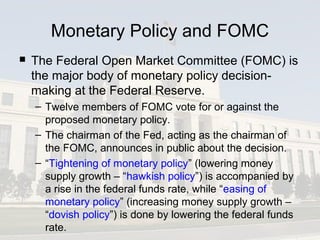
 The Federal Open Market Committee (FOMC) is
the major body of monetary policy decision-
making at the Federal Reserve.
– Twelve members of FOMC vote for or against the
proposed monetary policy.
– The chairman of the Fed, acting as the chairman of
the FOMC, announces in public about the decision.
– “Tightening of monetary policy” (lowering money
supply growth – “hawkish policy”) is accompanied by
a rise in the federal funds rate, while “easing of
monetary policy” (increasing money supply growth –
“dovish policy”) is done by lowering the federal funds
rate.
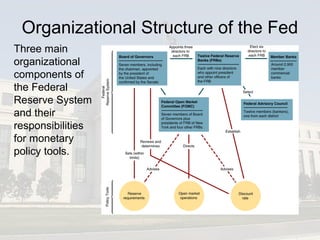
Organizational Structure of the Fed
Three main
organizational
components of
the Federal
Reserve System
and their
responsibilities
for monetary
policy tools.
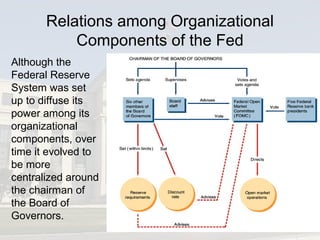
Relations among Organizational
Components of the Fed
Although the
Federal Reserve
System was set
up to diffuse its
power among its
organizational
components, over
time it evolved to
be more
centralized around
the chairman of
the Board of
Governors.
Independence of the Fed
The Federal Reserve System must be free
from any government direction or pressure
when it conducts monetary policy.
– Instrumental independence: the ability to set
monetary instruments
• Can the Fed change freely its instruments of
monetary policy?
– Goal independence: the ability to set the goals
of monetary policy
• Can the Fed set own goals of monetary policy? Can
the federal government set or influence the goals?
Why Independence of the Fed
Important?
The Federal Reserve System needs to be
independent from the federal government.
– The government should not influence the Fed’s decision
to maintaining stable financial system.
• Should the federal government make the Federal Reserve to
rescue a particular financial institution (e.g. Bear Stern,
Fannie Mae)?
– The government should not use the Fed as source of
free spending.
• Politicians do not like to raise taxes or cut expenditures to
balance the government budget, because such unpopular
policy may affect their election. Should they ask the Fed to
print more money or borrow free loans from the Fed, so the
government can spend more without raising taxes?
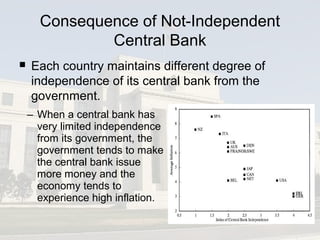
Consequence of Not-Independent
Central Bank
 Each country maintains different degree of
independence of its central bank from the
government.
– When a central bank has
very limited independence
from its government, the
government tends to make
the central bank issue
more money and the
economy tends to
experience high inflation.
Why not Independence of the Fed?
The Federal Reserve System should not be
completely independent from the federal
government.
– Because the officials at the Federal Reserve
System are not elected by the people of the
U.S., the federal government must make sure
that they do not act for their own gain or against
the welfare of the economy.
– The economic policy needs to be coordinated
between the federal government (fiscal policy)
and the Fed (monetary policy) to be effective.
Independence of the Fed: Reality
 The Federal Reserve System maintains its
independence from the federal government.
– The Board of Governors serves for 14 years, making
it free from influence of current president and
Congress.
– Its budget is not subject to the appropriation process.
 But, its independence is not complete.
– The chairman of the Board of Governors must testify
at the Congress twice a year, so the Congress can
keep eyes on the Fed.
– The Congress has power to change the structure of
the Fed if necessary.
– The president of the U.S. can appoint new chairman
every four years.
Instrumental and Goal Independence of
the Federal Reserve System
 The Federal Reserve System is not completely
independent from the federal government.
– Instrumental independence: The Federal Reserve
System can set freely its monetary instruments (e.g.
target rate of federal funds, discount rate). However,
the Congress sets what instruments available for the
Fed (e.g. the Fed’s ability on interest rate ceiling and
margin requirement is authorized by the legislation).
– Goal independence: The Congress established the
Federal Reserve System with mandate goals (e.g.
employment and price stability). However, there is
great degree of freedom on how and what the Fed is
going to achieve (e.g. the Fed can set own goal such
as target unemployment rate or inflation rate).
Disclaimer
Please do not copy, modify, or distribute this presentation
without author’s consent.
This presentation was created and owned by
Dr. Ryoichi Sakano
North Carolina A&T State University

Econ315 Money and Banking: Learning Unit #20

  • 1.
  • 2.
    Objectives of LearningUnit  Structure of Federal Reserve System  Functions of Federal Reserve System  Independence of Federal Reserve System  Balance sheet of Federal Reserve System  Two Monetary Operations
  • 3.
    Functions of CentralBank  Each country has one central bank which is responsible for – Conducting monetary policy. – Regulating an amount of money supply in economy. – Supervising banks.  In addition, a central bank may – Regulate financial markets and financial institutions other than banks. – Control foreign exchanges and foreign reserves. – Act as the government’s bank. – Advising the government on the economic policy.
  • 4.
    Federal Reserve System In the United States, the federal reserve system (the Fed) acts as the central bank.  In most developed countries there is only one central bank. However, in the U.S. the Fed is divided into various organizational components for check and balance. – The federal government have attempted to establish a single central bank twice, but due to fear of concentration of economic and monetary power, the Congress abolished such institutions. – In 1931 the Congress established the twelve regional Federal Reserve banks.
  • 5.
    Mission of FederalReserve System The Federal Reserve System is the central bank of the United States. It was founded by Congress in 1913 to provide the nation with a safer, more flexible, and more stable monetary and financial system. Over the years, its role in banking and the economy has expanded. Today, the Federal Reserve's duties fall into four general areas: – conducting the nation's monetary policy by influencing the monetary and credit conditions in the economy in pursuit of maximum employment, stable prices, and moderate long-term interest rates – supervising and regulating banking institutions to ensure the safety and soundness of the nation's banking and financial system and to protect the credit rights of consumers – maintaining the stability of the financial system and containing systemic risk that may arise in financial markets – providing financial services to depository institutions, the U.S. government, and foreign official institutions, including playing a major role in operating the nation's payments system From http://www.federalreserve.gov/aboutthefed/mission.htm
  • 6.
    Functions of FederalReserve System Like any other central banks, the Federal Reserve System performs various important functions through its organizational components.  Provide financial services to banks – Clear checks  Act as government’s bank – Print new currencies and withdraw old ones – Maintain government accounts  Regulate banking and financial industries  Conduct monetary policy
  • 7.
    Organizational Components ofthe Federal Reserve System Three main organizational components of the Federal Reserve System:  Regional Federal Reserve banks  Board of Governors  Federal Open Market Committee
  • 8.
    Regional Federal ReserveBanks  The U.S. is divided into twelve Federal Reserve districts. – Each district has one Federal Reserve bank. • Ex. Federal Reserve Bank of Richmond covers states of Maryland, Virginia, North Carolina, and South Carolina. – By dividing into twelve districts, no one Federal Reserve bank can dominate in the U.S. economy. • Federal Reserve Bank of New York covers only the state of New York, but holds one-quarter of the assets of the Federal Reserve System.
  • 9.
    Twelve Federal ReserveBanks Federal Reserve districts vary in geographical economic size and sometime cut through states.
  • 10.
    Organization of FederalReserve Banks  Each Federal Reserve Bank has the same organizational structure. – A quasi-public institution, which issued stocks and were owned by the member commercial banks in the district. – Nine directors: six elected by the member banks and three appointed by the Board of Governors. – One president of the bank is appointed by the nine directors.
  • 11.
    Functions of FederalReserve Banks  Federal Reserve banks perform – Clearing checks – Issuing new currency and withdrawing damaged currency – Setting a discount rate and making discount loans to banks in their districts – Examining bank holding companies and state-chartered member banks – Acting as liaisons between the business community and the Federal Reserve System – Collecting data on local business conditions – Researching for the conduct of monetary policy
  • 12.
    U.S. Dollar Bills U.S. dollar bills are issued by the Federal Reserve banks. Emblem of the Federal Reserve System “Federal Reserve Note” means IOU (note payable) issued by the Federal Reserve System. Federal Reserve Bank of San Francisco issued this note.
  • 13.
    Member banks  Allnational banks are required to be members of the Federal Reserve System. – Currently, about 37% of the commercial banks are members of the Federal Reserve System.  Depository Institutions Deregulation and Monetary Control Act of 1980 – Requires all depository institutions (member and nonmember banks) to hold required reserves. – Makes check-clearing services and the discount window available for all depository institutions.
  • 14.
    Board of Governors The Board of Governors acts like the headquarter of the Federal Reserve System. – Located in Washington, D.C. – Seven members of the Board of Governors are appointed by the president of the United States and confirmed by the Senate. – Each member serves for nonrenewable 14- year term and comes from different districts. • Why 14-year term? To avoid political pressure from the President and the Congress. • Why from different districts? To prevent one district over-representing its interest over other districts.
  • 15.
    Chairman of Boardof Governors  The chairman of the Board of Governors is chosen from the seven governors. – Serves for renewable four-year term. – Acts like the CEO of the Federal Reserve System. – Jerome Powell is the current chairman.
  • 16.
    Functions of Boardof Governors  The Board of Governors – Sets the reserve requirement – Approves the discount rate requested by the Federal Reserve banks – Advise the president of the United States, testifies in Congress, and speaks for the Federal Reserve System for the media. – Represents the United States in negotiations with foreign governments on economic matters – Provides economic analysis for the conduct of monetary policy – Sets margin requirements – Approves bank mergers and applications for new activities and specifies the permissible activities of bank holding companies – Supervise the activities of foreign banks in the U.S.
  • 17.
    Federal Open MarketCommittee  The Federal Open Market Committee – Meets eight times a year – Makes decisions regarding the conduct of open market operations, including setting a target rate on federal funds – Consists of twelve members: the seven members of the Board of Governors, the president of the Federal Reserve Bank of New York, and the presidents of four other Federal Reserve banks. – Directed by the chairman of the Board of Governors
  • 18.
    Monetary Policy andFOMC  The Federal Open Market Committee (FOMC) is the major body of monetary policy decision- making at the Federal Reserve. – Twelve members of FOMC vote for or against the proposed monetary policy. – The chairman of the Fed, acting as the chairman of the FOMC, announces in public about the decision. – “Tightening of monetary policy” (lowering money supply growth – “hawkish policy”) is accompanied by a rise in the federal funds rate, while “easing of monetary policy” (increasing money supply growth – “dovish policy”) is done by lowering the federal funds rate.
  • 19.
    Organizational Structure ofthe Fed Three main organizational components of the Federal Reserve System and their responsibilities for monetary policy tools.
  • 20.
    Relations among Organizational Componentsof the Fed Although the Federal Reserve System was set up to diffuse its power among its organizational components, over time it evolved to be more centralized around the chairman of the Board of Governors.
  • 21.
    Independence of theFed The Federal Reserve System must be free from any government direction or pressure when it conducts monetary policy. – Instrumental independence: the ability to set monetary instruments • Can the Fed change freely its instruments of monetary policy? – Goal independence: the ability to set the goals of monetary policy • Can the Fed set own goals of monetary policy? Can the federal government set or influence the goals?
  • 22.
    Why Independence ofthe Fed Important? The Federal Reserve System needs to be independent from the federal government. – The government should not influence the Fed’s decision to maintaining stable financial system. • Should the federal government make the Federal Reserve to rescue a particular financial institution (e.g. Bear Stern, Fannie Mae)? – The government should not use the Fed as source of free spending. • Politicians do not like to raise taxes or cut expenditures to balance the government budget, because such unpopular policy may affect their election. Should they ask the Fed to print more money or borrow free loans from the Fed, so the government can spend more without raising taxes?
  • 23.
    Consequence of Not-Independent CentralBank  Each country maintains different degree of independence of its central bank from the government. – When a central bank has very limited independence from its government, the government tends to make the central bank issue more money and the economy tends to experience high inflation.
  • 24.
    Why not Independenceof the Fed? The Federal Reserve System should not be completely independent from the federal government. – Because the officials at the Federal Reserve System are not elected by the people of the U.S., the federal government must make sure that they do not act for their own gain or against the welfare of the economy. – The economic policy needs to be coordinated between the federal government (fiscal policy) and the Fed (monetary policy) to be effective.
  • 25.
    Independence of theFed: Reality  The Federal Reserve System maintains its independence from the federal government. – The Board of Governors serves for 14 years, making it free from influence of current president and Congress. – Its budget is not subject to the appropriation process.  But, its independence is not complete. – The chairman of the Board of Governors must testify at the Congress twice a year, so the Congress can keep eyes on the Fed. – The Congress has power to change the structure of the Fed if necessary. – The president of the U.S. can appoint new chairman every four years.
  • 26.
    Instrumental and GoalIndependence of the Federal Reserve System  The Federal Reserve System is not completely independent from the federal government. – Instrumental independence: The Federal Reserve System can set freely its monetary instruments (e.g. target rate of federal funds, discount rate). However, the Congress sets what instruments available for the Fed (e.g. the Fed’s ability on interest rate ceiling and margin requirement is authorized by the legislation). – Goal independence: The Congress established the Federal Reserve System with mandate goals (e.g. employment and price stability). However, there is great degree of freedom on how and what the Fed is going to achieve (e.g. the Fed can set own goal such as target unemployment rate or inflation rate).
  • 27.
    Disclaimer Please do notcopy, modify, or distribute this presentation without author’s consent. This presentation was created and owned by Dr. Ryoichi Sakano North Carolina A&T State University