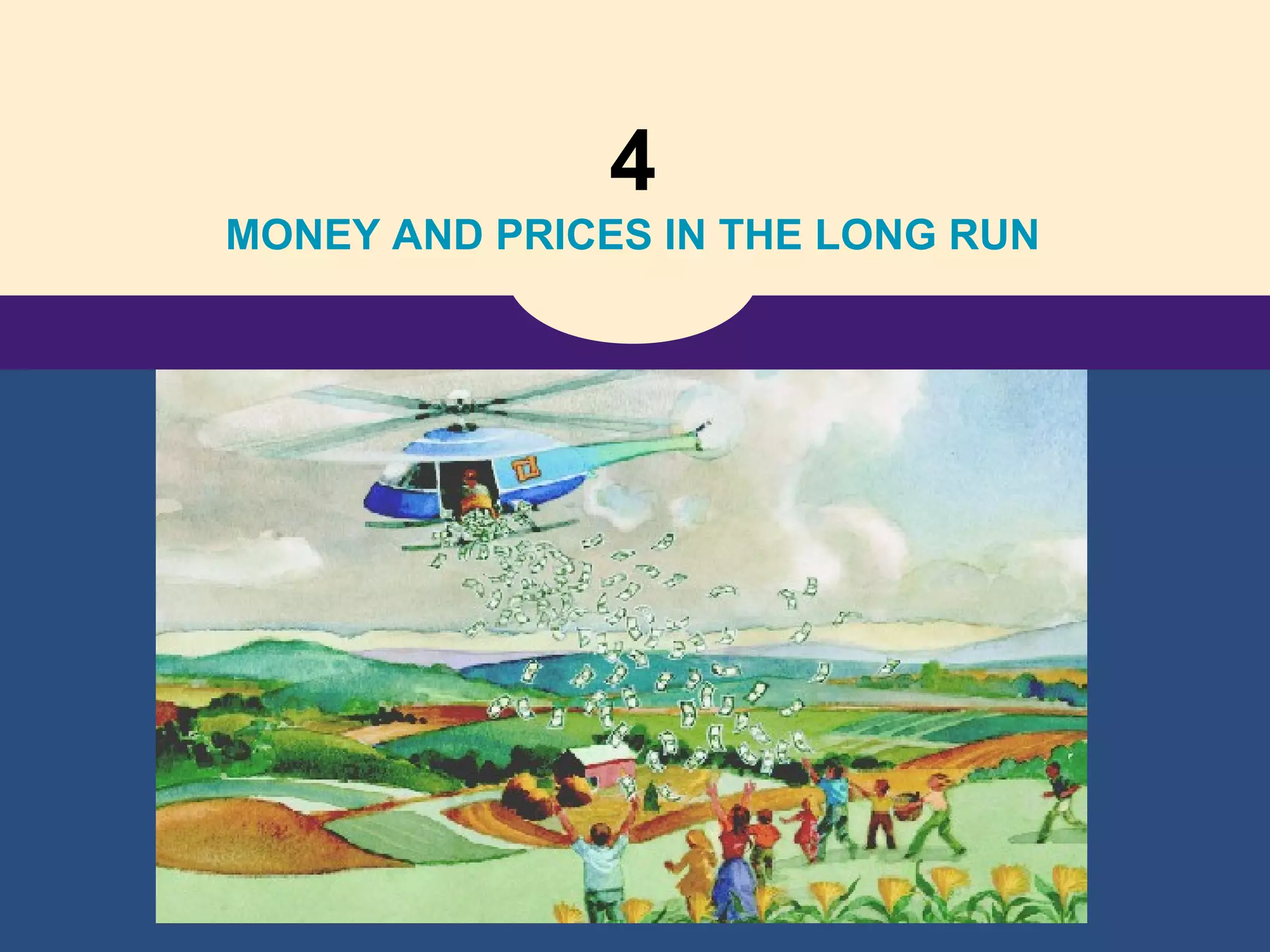
4
MONEY AND PRICES IN THE LONG RUN
Copyright © 2004 South-Western
99The Monetary
System
Copyright © 2004 South-Western
THE MEANING OF MONEY
• Money is the set of assets in an economy that
people regularly use to buy goods and services
from other people.
Copyright © 2004 South-Western
The Functions of Money
• Money has three functions in the economy:
• Medium of exchange
• Unit of account
• Store of value
Copyright © 2004 South-Western
The Functions of Money
• Medium of Exchange
• A medium of exchange is an item that buyers give
to sellers when they want to purchase goods and
services.
• A medium of exchange is anything that is readily
acceptable as payment.
Copyright © 2004 South-Western
The Functions of Money
• Unit of Account
• A unit of account is the yardstick people use to post
prices and record debts.
• Store of Value
• A store of value is an item that people can use to
transfer purchasing power from the present to the
future.
Copyright © 2004 South-Western
The Functions of Money
• Liquidity
• Liquidity is the ease with which an asset can be
converted into the economy’s medium of exchange.
Copyright © 2004 South-Western
The Kinds of Money
• Commodity money takes the form of a
commodity with intrinsic value.
• Examples: Gold, silver, cigarettes.
• Fiat money is used as money because of
government decree.
• It does not have intrinsic value.
• Examples: Coins, currency, check deposits.
Copyright © 2004 South-Western
Money in the U.S. Economy
• Currency is the paper bills and coins in the
hands of the public.
• Demand deposits are balances in bank accounts
that depositors can access on demand by
writing a check.
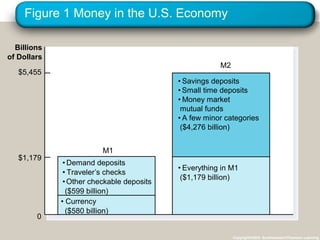
Figure 1 Money in the U.S. Economy
Copyright©2003 Southwestern/Thomson Learning
Billions
of Dollars
• Currency
($580 billion)
• Demand deposits
• Traveler’s checks
•Other checkable deposits
($599 billion)
• Everything in M1
($1,179 billion)
• Savings deposits
• Small time deposits
• Money market
mutual funds
• A few minor categories
($4,276 billion)
0
M1
$1,179
M2
$5,455
Copyright © 2004 South-Western
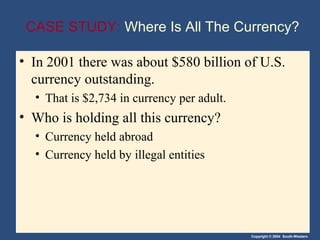
CASE STUDY: Where Is All The Currency?
• In 2001 there was about $580 billion of U.S.
currency outstanding.
• That is $2,734 in currency per adult.
• Who is holding all this currency?
• Currency held abroad
• Currency held by illegal entities
Copyright © 2004 South-Western
THE FEDERAL RESERVE
SYSTEM
• The Federal Reserve (Fed) serves as the
nation’s central bank.
• It is designed to oversee the banking system.
• It regulates the quantity of money in the economy.
Copyright © 2004 South-Western
THE FEDERAL RESERVE
SYSTEM
• The Fed was created in 1914 after a series of
bank failures convinced Congress that the
United States needed a central bank to ensure
the health of the nation’s banking system.
Copyright © 2004 South-Western
THE FEDERAL RESERVE
SYSTEM
• The Structure of the Federal Reserve System:
• The primary elements in the Federal Reserve
System are:
• 1) The Board of Governors
• 2) The Regional Federal Reserve Banks
• 3) The Federal Open Market Committee
Copyright © 2004 South-Western
The Fed’s Organization
• The Fed is run by a Board of Governors, which
has seven members appointed by the president
and confirmed by the Senate.
• Among the seven members, the most important
is the chairman.
• The chairman directs the Fed staff, presides over
board meetings, and testifies about Fed policy in
front of Congressional Committees.
Copyright © 2004 South-Western
The Fed’s Organization
• The Board of Governors
• Seven members
• Appointed by the president
• Confirmed by the Senate
• Serve staggered 14-year terms so that one comes
vacant every two years.
• President appoints a member as chairman to serve a
four-year term.
Copyright © 2004 South-Western
The Fed’s Organization
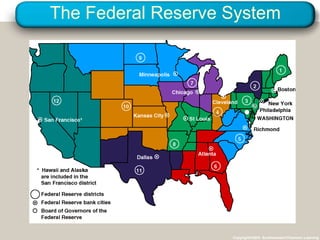
• The Federal Reserve System is made up of the
Federal Reserve Board in Washington, D.C.,
and twelve regional Federal Reserve Banks.
Copyright © 2004 South-Western
The Fed’s Organization
• The Federal Reserve Banks
• Twelve district banks
• Nine directors
• Three appointed by the Board of Governors.
• Six are elected by the commercial banks in the district.
• The directors appoint the district president, which is
approved by the Board of Governors.
The Federal Reserve System
Copyright©2003 Southwestern/Thomson Learning
Copyright © 2004 South-Western
The Fed’s Organization
• The Federal Reserve Banks
• The New York Fed implements some of the Fed’s
most important policy decisions.
Copyright © 2004 South-Western
The Fed’s Organization
• The Federal Open Market Committee (FOMC)
• Serves as the main policy-making organ of the
Federal Reserve System.
• Meets approximately every six weeks to review the
economy.
Copyright © 2004 South-Western
The Fed’s Organization
• The Federal Open Market Committee (FOMC)
is made up of the following voting members:
• The chairman and the other six members of the
Board of Governors.
• The president of the Federal Reserve Bank of New
York.
• The presidents of the other regional Federal Reserve
banks (four vote on a yearly rotating basis).
Copyright © 2004 South-Western
The Fed’s Organization
• Monetary policy is conducted by the Federal
Open Market Committee.
• Monetary policy is the setting of the money supply
by policymakers in the central bank
• The money supply refers to the quantity of money
available in the economy.
Copyright © 2004 South-Western
The Federal Open Market Committee
• Three Primary Functions of the Fed
• Regulates banks to ensure they follow federal laws
intended to promote safe and sound banking
practices.
• Acts as a banker’s bank, making loans to banks and
as a lender of last resort.
• Conducts monetary policy by controlling the money
supply.
Copyright © 2004 South-Western
The Federal Open Market Committee
• Open-Market Operations
• The money supply is the quantity of money
available in the economy.
• The primary way in which the Fed changes the
money supply is through open-market operations.
• The Fed purchases and sells U.S. government bonds.
Copyright © 2004 South-Western
The Federal Open Market Committee
• Open-Market Operations
• To increase the money supply, the Fed buys
government bonds from the public.
• To decrease the money supply, the Fed sells
government bonds to the public.
Copyright © 2004 South-Western
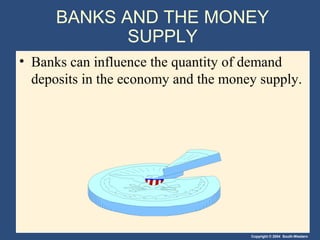
BANKS AND THE MONEY
SUPPLY
• Banks can influence the quantity of demand
deposits in the economy and the money supply.
Copyright © 2004 South-Western
BANKS AND THE MONEY
SUPPLY
• Reserves are deposits that banks have received
but have not loaned out.
• In a fractional-reserve banking system, banks
hold a fraction of the money deposited as
reserves and lend out the rest.
Copyright © 2004 South-Western
BANKS AND THE MONEY
SUPPLY
• Reserve Ratio
• The reserve ratio is the fraction of deposits that
banks hold as reserves.
Copyright © 2004 South-Western
Money Creation with Fractional-Reserve
Banking
• When a bank makes a loan from its reserves, the
money supply increases.
• The money supply is affected by the amount
deposited in banks and the amount that banks loan.
• Deposits into a bank are recorded as both assets and
liabilities.
• The fraction of total deposits that a bank has to keep as
reserves is called the reserve ratio.
• Loans become an asset to the bank.
Copyright © 2004 South-Western
Money Creation with Fractional-Reserve
Banking
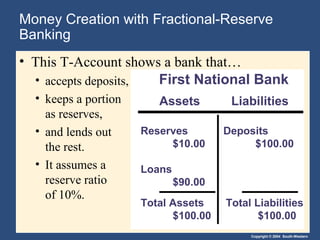
• This T-Account shows a bank that…
• accepts deposits,
• keeps a portion
as reserves,
• and lends out
the rest.
• It assumes a
reserve ratio
of 10%.
Assets Liabilities
First National Bank
Reserves
$10.00
Loans
$90.00
Deposits
$100.00
Total Assets
$100.00
Total Liabilities
$100.00
Copyright © 2004 South-Western
Money Creation with Fractional-Reserve
Banking
• When one bank loans money, that money is
generally deposited into another bank.
• This creates more deposits and more reserves to
be lent out.
• When a bank makes a loan from its reserves,
the money supply increases.
Copyright © 2004 South-Western
The Money Multiplier
• How much money is eventually created in this
economy?
Copyright © 2004 South-Western
The Money Multiplier
• The money multiplier is the amount of money
the banking system generates with each dollar
of reserves.
Copyright © 2004 South-Western
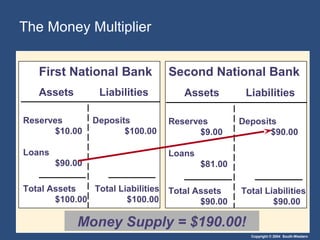
The Money Multiplier
Assets Liabilities
First National Bank
Reserves
$10.00
Loans
$90.00
Deposits
$100.00
Total Assets
$100.00
Total Liabilities
$100.00
Assets Liabilities
Second National Bank
Reserves
$9.00
Loans
$81.00
Deposits
$90.00
Total Assets
$90.00
Total Liabilities
$90.00
Money Supply = $190.00!
Copyright © 2004 South-Western
The Money Multiplier
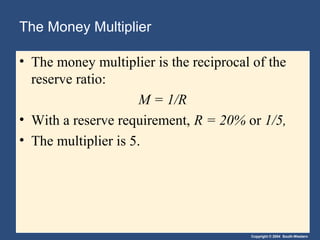
• The money multiplier is the reciprocal of the
reserve ratio:
M = 1/R
• With a reserve requirement, R = 20% or 1/5,
• The multiplier is 5.
Copyright © 2004 South-Western
The Fed’s Tools of Monetary Control
• The Fed has three tools in its monetary toolbox:
• Open-market operations
• Changing the reserve requirement
• Changing the discount rate
Copyright © 2004 South-Western
The Fed’s Tools of Monetary Control
• Open-Market Operations
• The Fed conducts open-market operations when it
buys government bonds from or sells government
bonds to the public:
• When the Fed buys government bonds, the money supply
increases.
• The money supply decreases when the Fed sells
government bonds.
Copyright © 2004 South-Western
The Fed’s Tools of Monetary Control
• Reserve Requirements
• The Fed also influences the money supply with
reserve requirements.
• Reserve requirements are regulations on the
minimum amount of reserves that banks must hold
against deposits.
Copyright © 2004 South-Western
The Fed’s Tools of Monetary Control
• Changing the Reserve Requirement
• The reserve requirement is the amount (%) of a
bank’s total reserves that may not be loaned out.
• Increasing the reserve requirement decreases the money
supply.
• Decreasing the reserve requirement increases the money
supply.
Copyright © 2004 South-Western
The Fed’s Tools of Monetary Control
• Changing the Discount Rate
• The discount rate is the interest rate the Fed charges
banks for loans.
• Increasing the discount rate decreases the money supply.
• Decreasing the discount rate increases the money supply.
Copyright © 2004 South-Western
Problems in Controlling the Money Supply
• The Fed’s control of the money supply is not
precise.
• The Fed must wrestle with two problems that
arise due to fractional-reserve banking.
• The Fed does not control the amount of money that
households choose to hold as deposits in banks.
• The Fed does not control the amount of money that
bankers choose to lend.
Copyright © 2004 South-Western
Summary
• The term money refers to assets that people
regularly use to buy goods and services.
• Money serves three functions in an economy:
as a medium of exchange, a unit of account,
and a store of value.
• Commodity money is money that has intrinsic
value.
• Fiat money is money without intrinsic value.
Copyright © 2004 South-Western
Summary
• The Federal Reserve, the central bank of the
United States, regulates the U.S. monetary
system.
• It controls the money supply through open-
market operations or by changing reserve
requirements or the discount rate.
Copyright © 2004 South-Western
Summary
• When banks loan out their deposits, they
increase the quantity of money in the economy.
• Because the Fed cannot control the amount
bankers choose to lend or the amount
households choose to deposit in banks, the
Fed’s control of the money supply is imperfect.

9 monetary system

  • 1.
    4 MONEY AND PRICESIN THE LONG RUN
  • 2.
    Copyright © 2004South-Western 99The Monetary System
  • 3.
    Copyright © 2004South-Western THE MEANING OF MONEY • Money is the set of assets in an economy that people regularly use to buy goods and services from other people.
  • 4.
    Copyright © 2004South-Western The Functions of Money • Money has three functions in the economy: • Medium of exchange • Unit of account • Store of value
  • 5.
    Copyright © 2004South-Western The Functions of Money • Medium of Exchange • A medium of exchange is an item that buyers give to sellers when they want to purchase goods and services. • A medium of exchange is anything that is readily acceptable as payment.
  • 6.
    Copyright © 2004South-Western The Functions of Money • Unit of Account • A unit of account is the yardstick people use to post prices and record debts. • Store of Value • A store of value is an item that people can use to transfer purchasing power from the present to the future.
  • 7.
    Copyright © 2004South-Western The Functions of Money • Liquidity • Liquidity is the ease with which an asset can be converted into the economy’s medium of exchange.
  • 8.
    Copyright © 2004South-Western The Kinds of Money • Commodity money takes the form of a commodity with intrinsic value. • Examples: Gold, silver, cigarettes. • Fiat money is used as money because of government decree. • It does not have intrinsic value. • Examples: Coins, currency, check deposits.
  • 9.
    Copyright © 2004South-Western Money in the U.S. Economy • Currency is the paper bills and coins in the hands of the public. • Demand deposits are balances in bank accounts that depositors can access on demand by writing a check.
  • 10.
    Figure 1 Moneyin the U.S. Economy Copyright©2003 Southwestern/Thomson Learning Billions of Dollars • Currency ($580 billion) • Demand deposits • Traveler’s checks •Other checkable deposits ($599 billion) • Everything in M1 ($1,179 billion) • Savings deposits • Small time deposits • Money market mutual funds • A few minor categories ($4,276 billion) 0 M1 $1,179 M2 $5,455
  • 11.
    Copyright © 2004South-Western CASE STUDY: Where Is All The Currency? • In 2001 there was about $580 billion of U.S. currency outstanding. • That is $2,734 in currency per adult. • Who is holding all this currency? • Currency held abroad • Currency held by illegal entities
  • 12.
    Copyright © 2004South-Western THE FEDERAL RESERVE SYSTEM • The Federal Reserve (Fed) serves as the nation’s central bank. • It is designed to oversee the banking system. • It regulates the quantity of money in the economy.
  • 13.
    Copyright © 2004South-Western THE FEDERAL RESERVE SYSTEM • The Fed was created in 1914 after a series of bank failures convinced Congress that the United States needed a central bank to ensure the health of the nation’s banking system.
  • 14.
    Copyright © 2004South-Western THE FEDERAL RESERVE SYSTEM • The Structure of the Federal Reserve System: • The primary elements in the Federal Reserve System are: • 1) The Board of Governors • 2) The Regional Federal Reserve Banks • 3) The Federal Open Market Committee
  • 15.
    Copyright © 2004South-Western The Fed’s Organization • The Fed is run by a Board of Governors, which has seven members appointed by the president and confirmed by the Senate. • Among the seven members, the most important is the chairman. • The chairman directs the Fed staff, presides over board meetings, and testifies about Fed policy in front of Congressional Committees.
  • 16.
    Copyright © 2004South-Western The Fed’s Organization • The Board of Governors • Seven members • Appointed by the president • Confirmed by the Senate • Serve staggered 14-year terms so that one comes vacant every two years. • President appoints a member as chairman to serve a four-year term.
  • 17.
    Copyright © 2004South-Western The Fed’s Organization • The Federal Reserve System is made up of the Federal Reserve Board in Washington, D.C., and twelve regional Federal Reserve Banks.
  • 18.
    Copyright © 2004South-Western The Fed’s Organization • The Federal Reserve Banks • Twelve district banks • Nine directors • Three appointed by the Board of Governors. • Six are elected by the commercial banks in the district. • The directors appoint the district president, which is approved by the Board of Governors.
  • 19.
    The Federal ReserveSystem Copyright©2003 Southwestern/Thomson Learning
  • 20.
    Copyright © 2004South-Western The Fed’s Organization • The Federal Reserve Banks • The New York Fed implements some of the Fed’s most important policy decisions.
  • 21.
    Copyright © 2004South-Western The Fed’s Organization • The Federal Open Market Committee (FOMC) • Serves as the main policy-making organ of the Federal Reserve System. • Meets approximately every six weeks to review the economy.
  • 22.
    Copyright © 2004South-Western The Fed’s Organization • The Federal Open Market Committee (FOMC) is made up of the following voting members: • The chairman and the other six members of the Board of Governors. • The president of the Federal Reserve Bank of New York. • The presidents of the other regional Federal Reserve banks (four vote on a yearly rotating basis).
  • 23.
    Copyright © 2004South-Western The Fed’s Organization • Monetary policy is conducted by the Federal Open Market Committee. • Monetary policy is the setting of the money supply by policymakers in the central bank • The money supply refers to the quantity of money available in the economy.
  • 24.
    Copyright © 2004South-Western The Federal Open Market Committee • Three Primary Functions of the Fed • Regulates banks to ensure they follow federal laws intended to promote safe and sound banking practices. • Acts as a banker’s bank, making loans to banks and as a lender of last resort. • Conducts monetary policy by controlling the money supply.
  • 25.
    Copyright © 2004South-Western The Federal Open Market Committee • Open-Market Operations • The money supply is the quantity of money available in the economy. • The primary way in which the Fed changes the money supply is through open-market operations. • The Fed purchases and sells U.S. government bonds.
  • 26.
    Copyright © 2004South-Western The Federal Open Market Committee • Open-Market Operations • To increase the money supply, the Fed buys government bonds from the public. • To decrease the money supply, the Fed sells government bonds to the public.
  • 27.
    Copyright © 2004South-Western BANKS AND THE MONEY SUPPLY • Banks can influence the quantity of demand deposits in the economy and the money supply.
  • 28.
    Copyright © 2004South-Western BANKS AND THE MONEY SUPPLY • Reserves are deposits that banks have received but have not loaned out. • In a fractional-reserve banking system, banks hold a fraction of the money deposited as reserves and lend out the rest.
  • 29.
    Copyright © 2004South-Western BANKS AND THE MONEY SUPPLY • Reserve Ratio • The reserve ratio is the fraction of deposits that banks hold as reserves.
  • 30.
    Copyright © 2004South-Western Money Creation with Fractional-Reserve Banking • When a bank makes a loan from its reserves, the money supply increases. • The money supply is affected by the amount deposited in banks and the amount that banks loan. • Deposits into a bank are recorded as both assets and liabilities. • The fraction of total deposits that a bank has to keep as reserves is called the reserve ratio. • Loans become an asset to the bank.
  • 31.
    Copyright © 2004South-Western Money Creation with Fractional-Reserve Banking • This T-Account shows a bank that… • accepts deposits, • keeps a portion as reserves, • and lends out the rest. • It assumes a reserve ratio of 10%. Assets Liabilities First National Bank Reserves $10.00 Loans $90.00 Deposits $100.00 Total Assets $100.00 Total Liabilities $100.00
  • 32.
    Copyright © 2004South-Western Money Creation with Fractional-Reserve Banking • When one bank loans money, that money is generally deposited into another bank. • This creates more deposits and more reserves to be lent out. • When a bank makes a loan from its reserves, the money supply increases.
  • 33.
    Copyright © 2004South-Western The Money Multiplier • How much money is eventually created in this economy?
  • 34.
    Copyright © 2004South-Western The Money Multiplier • The money multiplier is the amount of money the banking system generates with each dollar of reserves.
  • 35.
    Copyright © 2004South-Western The Money Multiplier Assets Liabilities First National Bank Reserves $10.00 Loans $90.00 Deposits $100.00 Total Assets $100.00 Total Liabilities $100.00 Assets Liabilities Second National Bank Reserves $9.00 Loans $81.00 Deposits $90.00 Total Assets $90.00 Total Liabilities $90.00 Money Supply = $190.00!
  • 36.
    Copyright © 2004South-Western The Money Multiplier • The money multiplier is the reciprocal of the reserve ratio: M = 1/R • With a reserve requirement, R = 20% or 1/5, • The multiplier is 5.
  • 37.
    Copyright © 2004South-Western The Fed’s Tools of Monetary Control • The Fed has three tools in its monetary toolbox: • Open-market operations • Changing the reserve requirement • Changing the discount rate
  • 38.
    Copyright © 2004South-Western The Fed’s Tools of Monetary Control • Open-Market Operations • The Fed conducts open-market operations when it buys government bonds from or sells government bonds to the public: • When the Fed buys government bonds, the money supply increases. • The money supply decreases when the Fed sells government bonds.
  • 39.
    Copyright © 2004South-Western The Fed’s Tools of Monetary Control • Reserve Requirements • The Fed also influences the money supply with reserve requirements. • Reserve requirements are regulations on the minimum amount of reserves that banks must hold against deposits.
  • 40.
    Copyright © 2004South-Western The Fed’s Tools of Monetary Control • Changing the Reserve Requirement • The reserve requirement is the amount (%) of a bank’s total reserves that may not be loaned out. • Increasing the reserve requirement decreases the money supply. • Decreasing the reserve requirement increases the money supply.
  • 41.
    Copyright © 2004South-Western The Fed’s Tools of Monetary Control • Changing the Discount Rate • The discount rate is the interest rate the Fed charges banks for loans. • Increasing the discount rate decreases the money supply. • Decreasing the discount rate increases the money supply.
  • 42.
    Copyright © 2004South-Western Problems in Controlling the Money Supply • The Fed’s control of the money supply is not precise. • The Fed must wrestle with two problems that arise due to fractional-reserve banking. • The Fed does not control the amount of money that households choose to hold as deposits in banks. • The Fed does not control the amount of money that bankers choose to lend.
  • 43.
    Copyright © 2004South-Western Summary • The term money refers to assets that people regularly use to buy goods and services. • Money serves three functions in an economy: as a medium of exchange, a unit of account, and a store of value. • Commodity money is money that has intrinsic value. • Fiat money is money without intrinsic value.
  • 44.
    Copyright © 2004South-Western Summary • The Federal Reserve, the central bank of the United States, regulates the U.S. monetary system. • It controls the money supply through open- market operations or by changing reserve requirements or the discount rate.
  • 45.
    Copyright © 2004South-Western Summary • When banks loan out their deposits, they increase the quantity of money in the economy. • Because the Fed cannot control the amount bankers choose to lend or the amount households choose to deposit in banks, the Fed’s control of the money supply is imperfect.