GROUP MEMBERS
FACILITATOR :
SIR IMRAN HUSSAIN PALWA
CONTENTS
 The evolution of money
 Definition of money
 What does money mean in economic?
 characteristics of money
 benefits of money
 A world without money
 Functions of money
 Different stages of evolution of money
 On which motives money is demanded
 Motives of holding cash
 Conclusion
 Answers of question
THE EVOLUTION OF MONEY
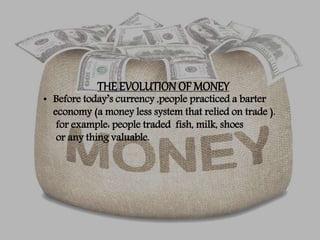
• Before today’s currency ,people practiced a barter
economy (a money less system that relied on trade ).
for example: people traded fish, milk, shoes
or any thing valuable.
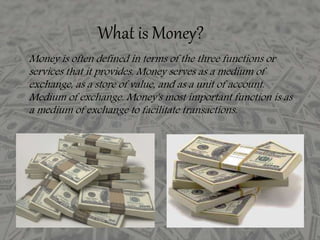
Money is often defined in terms of the three functions or
services that it provides. Money serves as a medium of
exchange, as a store of value, and as a unit of account.
Medium of exchange. Money's most important function is as
a medium of exchange to facilitate transactions.
What is Money?
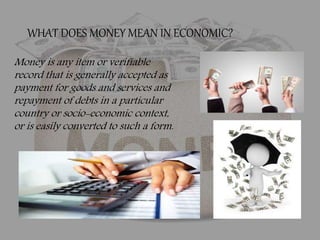
Money is any item or verifiable
record that is generally accepted as
payment for goods and services and
repayment of debts in a particular
country or socio-economic context,
or is easily converted to such a form.
WHAT DOES MONEY MEAN IN ECONOMIC?
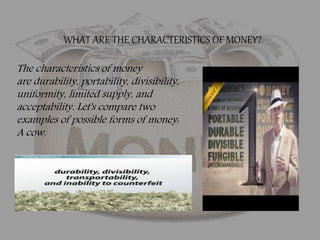
The characteristics of money
are durability, portability, divisibility,
uniformity, limited supply, and
acceptability. Let's compare two
examples of possible forms of money:
A cow.
WHAT ARE THE CHARACTERISTICS OF MONEY?
As you can see, money offers
consumers and businesses some very
basic and practical benefits. Money
was invented as an alternative to
bartering. The major benefit of
money is that it increases the
efficiency of an economy by
reducing transactions costs. When
people can use money instead of
bartering, this leads to more
specialization and
better division of labor within the
economy.
THE BENEFITS OF MONEY
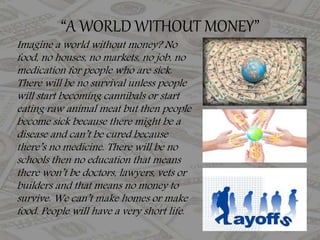
Imagine a world without money? No
food, no houses, no markets, no job, no
medication for people who are sick.
There will be no survival unless people
will start becoming cannibals or start
eating raw animal meat but then people
become sick because there might be a
disease and can’t be cured because
there’s no medicine. There will be no
schools then no education that means
there won’t be doctors, lawyers, vets or
builders and that means no money to
survive. We can’t make homes or make
food. People will have a very short life.
“A WORLD WITHOUT MONEY”
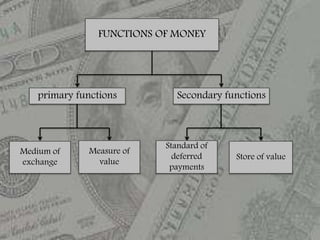
FUNCTIONS OF MONEY
Secondary functionsprimary functions
Store of value
Standard of
deferred
payments
Measure of
value
Medium of
exchange
1. PRIMARY FUNCTIONS:
Primary Functions include the most important functions of money, which it must
perform in every country, These are:
(i) Medium of Exchange:
Money, as a medium of exchange, means that it can be used to
make payments for all transactions of goods and services. It is
the most essential function of money. Money has the quality of
general acceptability So, all exchanges take place in terms of
money.
(ii) Measure of Value (Unit of Value):
Money as measure of value means that money works as a
common denomination, in which values of all goods and
services are expressed.
2. Secondary Functions:
These refer to those functions of money which are supplementary to the primary
functions. These functions are derived from primary functions and, therefore,
they are also known as ‘Derivative Functions’.
(i) Standard of Deferred Payments:
Money as a standard of deferred payments means that money acts as a
‘standard’ for payments, which are to be made in future. Every day, millions of
transactions take place in which payments are not made immediately. Money
encourages such transactions and helps in capital formation and economic
development of the economy.
(ii)Store of Value:
Under Barter system, it is very difficult to store goods for future use. Most of
the goods are perishable and their storage requires huge space and
transportation cost. But, money can be easily stored for future use. It is the
most convenient and economical means of storing earnings and wealth. It has
the merit of general acceptability and its value remains stable as compared to
other goods.
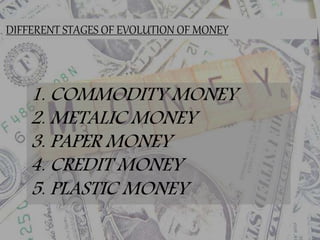
1. COMMODITY MONEY
2. METALIC MONEY
3. PAPER MONEY
4. CREDIT MONEY
5. PLASTIC MONEY
DIFFERENT STAGES OF EVOLUTION OF MONEY
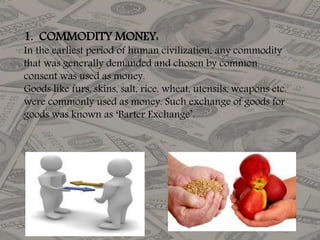
1. COMMODITY MONEY:
In the earliest period of human civilization, any commodity
that was generally demanded and chosen by common
consent was used as money.
Goods like furs, skins, salt, rice, wheat, utensils, weapons etc.
were commonly used as money. Such exchange of goods for
goods was known as ‘Barter Exchange’.
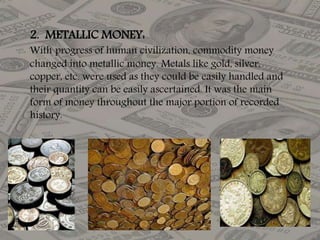
2. METALLIC MONEY:
With progress of human civilization, commodity money
changed into metallic money. Metals like gold, silver,
copper, etc. were used as they could be easily handled and
their quantity can be easily ascertained. It was the main
form of money throughout the major portion of recorded
history.
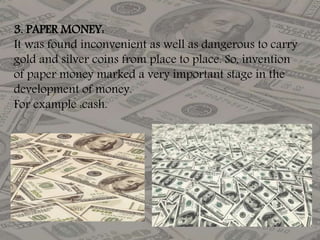
3. PAPER MONEY:
It was found inconvenient as well as dangerous to carry
gold and silver coins from place to place. So, invention
of paper money marked a very important stage in the
development of money.
For example :cash.
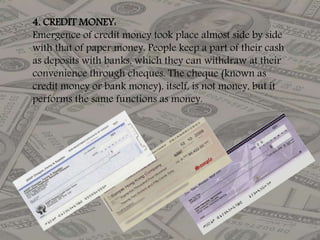
4. CREDIT MONEY:
Emergence of credit money took place almost side by side
with that of paper money. People keep a part of their cash
as deposits with banks, which they can withdraw at their
convenience through cheques. The cheque (known as
credit money or bank money), itself, is not money, but it
performs the same functions as money.
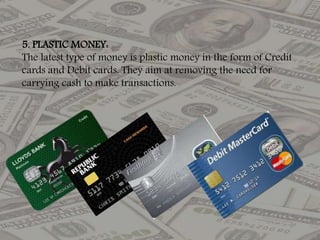
5. PLASTIC MONEY:
The latest type of money is plastic money in the form of Credit
cards and Debit cards. They aim at removing the need for
carrying cash to make transactions.
On which motives money is demanded?
(a) Transaction Motive;
(b) Precautionary Motive; and
(c) Speculative Motive.
MOTIVES OF HOLDING CASH
TRANSACTIONS MOTIVE:
This motive arises due to the necessity of having cash for various
disbursements like purchase of raw materials, payment of businesses
expenses ,payment of tax, payment of dividend etc.
PRECAUTIONARY MOTIVE:
Firm may require cash for payment of unexpected disbursements like
flood, strikes, increase in cost of raw materials etc.
SPECULATIVE MOTIVE:
Holding cash relates for investing in profitable opportunities as and
when they arise.
Therefore, it is concluded that if money not become alternate of barter
system there is not the value of a piece of paper.
Infact, economy become dull and worthless , there is no characteristics
about durability, portability and divisibility.
Moreover, the benefits become drawbacks there will be no transaction
cost because of barter system there will be no division of labour in the economy.
World have no importance of people without money, technology become layoff
people have short life to live.
Because of money we have its functions (primary and secondary)
besides, all these we have the idea of exchange, measurement of value and so on.
Furthermore, money has the evolution era by era . First commodity
money which is replace by its four more evolution. Metallic money, paper money,
credit money and plastic money .
And lastly, by business money is demanded by its motive. Transaction
motive, precautionary motive and speculative motive.
CONCLUSION
“If you have any
question please
ask one by one”
THANK
YOU

Presentation on money and banking

  • 2.
  • 3.
    CONTENTS  The evolutionof money  Definition of money  What does money mean in economic?  characteristics of money  benefits of money  A world without money  Functions of money  Different stages of evolution of money  On which motives money is demanded  Motives of holding cash  Conclusion  Answers of question
  • 5.
    THE EVOLUTION OFMONEY • Before today’s currency ,people practiced a barter economy (a money less system that relied on trade ). for example: people traded fish, milk, shoes or any thing valuable.
  • 6.
    Money is oftendefined in terms of the three functions or services that it provides. Money serves as a medium of exchange, as a store of value, and as a unit of account. Medium of exchange. Money's most important function is as a medium of exchange to facilitate transactions. What is Money?
  • 7.
    Money is anyitem or verifiable record that is generally accepted as payment for goods and services and repayment of debts in a particular country or socio-economic context, or is easily converted to such a form. WHAT DOES MONEY MEAN IN ECONOMIC?
  • 8.
    The characteristics ofmoney are durability, portability, divisibility, uniformity, limited supply, and acceptability. Let's compare two examples of possible forms of money: A cow. WHAT ARE THE CHARACTERISTICS OF MONEY?
  • 9.
    As you cansee, money offers consumers and businesses some very basic and practical benefits. Money was invented as an alternative to bartering. The major benefit of money is that it increases the efficiency of an economy by reducing transactions costs. When people can use money instead of bartering, this leads to more specialization and better division of labor within the economy. THE BENEFITS OF MONEY
  • 10.
    Imagine a worldwithout money? No food, no houses, no markets, no job, no medication for people who are sick. There will be no survival unless people will start becoming cannibals or start eating raw animal meat but then people become sick because there might be a disease and can’t be cured because there’s no medicine. There will be no schools then no education that means there won’t be doctors, lawyers, vets or builders and that means no money to survive. We can’t make homes or make food. People will have a very short life. “A WORLD WITHOUT MONEY”
  • 11.
    FUNCTIONS OF MONEY Secondaryfunctionsprimary functions Store of value Standard of deferred payments Measure of value Medium of exchange
  • 12.
    1. PRIMARY FUNCTIONS: PrimaryFunctions include the most important functions of money, which it must perform in every country, These are: (i) Medium of Exchange: Money, as a medium of exchange, means that it can be used to make payments for all transactions of goods and services. It is the most essential function of money. Money has the quality of general acceptability So, all exchanges take place in terms of money. (ii) Measure of Value (Unit of Value): Money as measure of value means that money works as a common denomination, in which values of all goods and services are expressed.
  • 13.
    2. Secondary Functions: Theserefer to those functions of money which are supplementary to the primary functions. These functions are derived from primary functions and, therefore, they are also known as ‘Derivative Functions’. (i) Standard of Deferred Payments: Money as a standard of deferred payments means that money acts as a ‘standard’ for payments, which are to be made in future. Every day, millions of transactions take place in which payments are not made immediately. Money encourages such transactions and helps in capital formation and economic development of the economy. (ii)Store of Value: Under Barter system, it is very difficult to store goods for future use. Most of the goods are perishable and their storage requires huge space and transportation cost. But, money can be easily stored for future use. It is the most convenient and economical means of storing earnings and wealth. It has the merit of general acceptability and its value remains stable as compared to other goods.
  • 14.
    1. COMMODITY MONEY 2.METALIC MONEY 3. PAPER MONEY 4. CREDIT MONEY 5. PLASTIC MONEY DIFFERENT STAGES OF EVOLUTION OF MONEY
  • 15.
    1. COMMODITY MONEY: Inthe earliest period of human civilization, any commodity that was generally demanded and chosen by common consent was used as money. Goods like furs, skins, salt, rice, wheat, utensils, weapons etc. were commonly used as money. Such exchange of goods for goods was known as ‘Barter Exchange’.
  • 16.
    2. METALLIC MONEY: Withprogress of human civilization, commodity money changed into metallic money. Metals like gold, silver, copper, etc. were used as they could be easily handled and their quantity can be easily ascertained. It was the main form of money throughout the major portion of recorded history.
  • 17.
    3. PAPER MONEY: Itwas found inconvenient as well as dangerous to carry gold and silver coins from place to place. So, invention of paper money marked a very important stage in the development of money. For example :cash.
  • 18.
    4. CREDIT MONEY: Emergenceof credit money took place almost side by side with that of paper money. People keep a part of their cash as deposits with banks, which they can withdraw at their convenience through cheques. The cheque (known as credit money or bank money), itself, is not money, but it performs the same functions as money.
  • 19.
    5. PLASTIC MONEY: Thelatest type of money is plastic money in the form of Credit cards and Debit cards. They aim at removing the need for carrying cash to make transactions.
  • 20.
    On which motivesmoney is demanded? (a) Transaction Motive; (b) Precautionary Motive; and (c) Speculative Motive.
  • 21.
    MOTIVES OF HOLDINGCASH TRANSACTIONS MOTIVE: This motive arises due to the necessity of having cash for various disbursements like purchase of raw materials, payment of businesses expenses ,payment of tax, payment of dividend etc. PRECAUTIONARY MOTIVE: Firm may require cash for payment of unexpected disbursements like flood, strikes, increase in cost of raw materials etc. SPECULATIVE MOTIVE: Holding cash relates for investing in profitable opportunities as and when they arise.
  • 22.
    Therefore, it isconcluded that if money not become alternate of barter system there is not the value of a piece of paper. Infact, economy become dull and worthless , there is no characteristics about durability, portability and divisibility. Moreover, the benefits become drawbacks there will be no transaction cost because of barter system there will be no division of labour in the economy. World have no importance of people without money, technology become layoff people have short life to live. Because of money we have its functions (primary and secondary) besides, all these we have the idea of exchange, measurement of value and so on. Furthermore, money has the evolution era by era . First commodity money which is replace by its four more evolution. Metallic money, paper money, credit money and plastic money . And lastly, by business money is demanded by its motive. Transaction motive, precautionary motive and speculative motive. CONCLUSION
  • 23.
    “If you haveany question please ask one by one”
  • 24.