Federal Reserve system
Syeda Mustajab Zahra
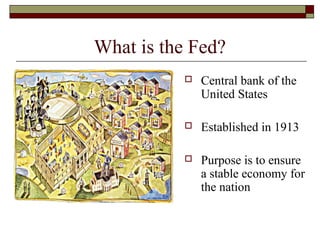
What is the Fed?
 Central bank of the
United States
 Established in 1913
 Purpose is to ensure
a stable economy for
the nation
U.S. Bank History
 First Bank of United States
 Est. after birth of U.S. (1791)
 Second Bank of U.S. (Est. 1816)
 Charters of both not renewed by President
Jackson (1836)
 De-centralized banking from 1836-1863
 1,400 bank institutions, up to 1,600 note types
 Inefficient, subject to counterfeiting
Move Toward Centralization
 Civil War: National Currency Act (1863)
 Reserves maintained / notes redeemed at principal
locations (main cites)
 Allowed for chartering of national banks
 Panic of 1907
 2nd
and 3rd
largest banks in country closed
 Depositors withdrew funds (run on banks)
Federal Reserve Established
 Establish Federal Reserve, 1913
 Purposes:
 To provide the country with an elastic currency
 Centralize bank reserves
 Provide multi-regional check
 Provide banking facilities for the federal
government
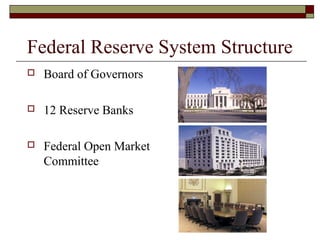
Federal Reserve System Structure
 Board of Governors
 12 Reserve Banks
 Federal Open Market
Committee
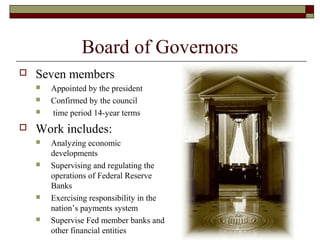
Board of Governors
 Seven members
 Appointed by the president
 Confirmed by the council
 time period 14-year terms
 Work includes:
 Analyzing economic
developments
 Supervising and regulating the
operations of Federal Reserve
Banks
 Exercising responsibility in the
nation’s payments system
 Supervise Fed member banks and
other financial entities
Federal Reserve Banks
 Operate a national payments system
 Distribute the nation’s currency and
coin
 Supervise and regulate member
banks and bank holding companies
 Contribute to monetary
policymaking through Bank
presidents’ participation in the
FOMC
Financial Services
 Supply currency and coin
to banking institutions
 Transfer funds
electronically (ACH,
Fedwire)
 Serve as bank for the U.S.
Treasury
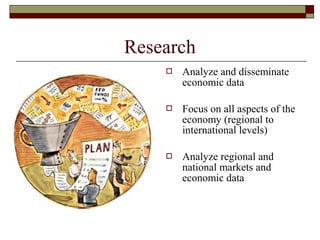
Research
 Analyze and disseminate
economic data
 Focus on all aspects of the
economy (regional to
international levels)
 Analyze regional and
national markets and
economic data
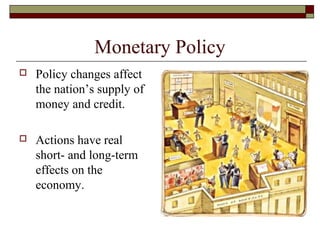
Monetary Policy
 Policy changes affect
the nation’s supply of
money and credit.
 Actions have real
short- and long-term
effects on the
economy.
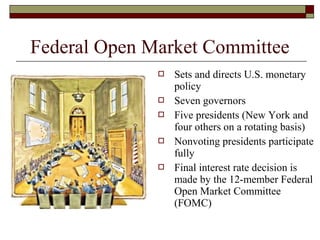
Federal Open Market Committee
 Sets and directs U.S. monetary
policy
 Seven governors
 Five presidents (New York and
four others on a rotating basis)
 Nonvoting presidents participate
fully
 Final interest rate decision is
made by the 12-member Federal
Open Market Committee
(FOMC)
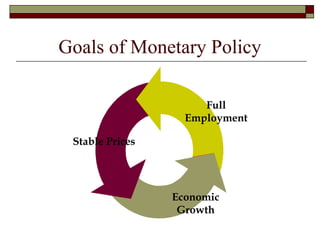
Goals of Monetary Policy
Stable Prices
Economic
Growth
Full
Employment
structured/Tools of Monetary Policy
 Discount Rate
 The interest rate charged by the Federal Reserve to banks
that borrow on a short-term (usually overnight) basis
 Reserve Requirements
 The amount of money banks must keep on reserve at the
Fed.
 Open Market Operations
 Buying and selling Treasury securities between the Fed
and selected financial institutions in the open market
 Most important tool; directed by the FOMC
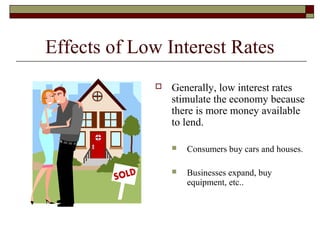
Effects of Low Interest Rates
 Generally, low interest rates
stimulate the economy because
there is more money available
to lend.
 Consumers buy cars and houses.
 Businesses expand, buy
equipment, etc..
Effects of High Interest Rates
 The Fed raises interest
rates as an effective of
inflation…
 Consumers pay more to
borrow money, dampening
spending.
 Businesses have difficulty
borrowing; unemployment
rises.
Thank you

Federal reserve presentation 1

  • 1.
  • 2.
    What is theFed?  Central bank of the United States  Established in 1913  Purpose is to ensure a stable economy for the nation
  • 3.
    U.S. Bank History First Bank of United States  Est. after birth of U.S. (1791)  Second Bank of U.S. (Est. 1816)  Charters of both not renewed by President Jackson (1836)  De-centralized banking from 1836-1863  1,400 bank institutions, up to 1,600 note types  Inefficient, subject to counterfeiting
  • 4.
    Move Toward Centralization Civil War: National Currency Act (1863)  Reserves maintained / notes redeemed at principal locations (main cites)  Allowed for chartering of national banks  Panic of 1907  2nd and 3rd largest banks in country closed  Depositors withdrew funds (run on banks)
  • 5.
    Federal Reserve Established Establish Federal Reserve, 1913  Purposes:  To provide the country with an elastic currency  Centralize bank reserves  Provide multi-regional check  Provide banking facilities for the federal government
  • 6.
    Federal Reserve SystemStructure  Board of Governors  12 Reserve Banks  Federal Open Market Committee
  • 7.
    Board of Governors Seven members  Appointed by the president  Confirmed by the council  time period 14-year terms  Work includes:  Analyzing economic developments  Supervising and regulating the operations of Federal Reserve Banks  Exercising responsibility in the nation’s payments system  Supervise Fed member banks and other financial entities
  • 8.
    Federal Reserve Banks Operate a national payments system  Distribute the nation’s currency and coin  Supervise and regulate member banks and bank holding companies  Contribute to monetary policymaking through Bank presidents’ participation in the FOMC
  • 9.
    Financial Services  Supplycurrency and coin to banking institutions  Transfer funds electronically (ACH, Fedwire)  Serve as bank for the U.S. Treasury
  • 10.
    Research  Analyze anddisseminate economic data  Focus on all aspects of the economy (regional to international levels)  Analyze regional and national markets and economic data
  • 11.
    Monetary Policy  Policychanges affect the nation’s supply of money and credit.  Actions have real short- and long-term effects on the economy.
  • 12.
    Federal Open MarketCommittee  Sets and directs U.S. monetary policy  Seven governors  Five presidents (New York and four others on a rotating basis)  Nonvoting presidents participate fully  Final interest rate decision is made by the 12-member Federal Open Market Committee (FOMC)
  • 13.
    Goals of MonetaryPolicy Stable Prices Economic Growth Full Employment
  • 14.
    structured/Tools of MonetaryPolicy  Discount Rate  The interest rate charged by the Federal Reserve to banks that borrow on a short-term (usually overnight) basis  Reserve Requirements  The amount of money banks must keep on reserve at the Fed.  Open Market Operations  Buying and selling Treasury securities between the Fed and selected financial institutions in the open market  Most important tool; directed by the FOMC
  • 15.
    Effects of LowInterest Rates  Generally, low interest rates stimulate the economy because there is more money available to lend.  Consumers buy cars and houses.  Businesses expand, buy equipment, etc..
  • 16.
    Effects of HighInterest Rates  The Fed raises interest rates as an effective of inflation…  Consumers pay more to borrow money, dampening spending.  Businesses have difficulty borrowing; unemployment rises.
  • 17.

Editor's Notes

  • #3 What is the Fed? The Federal Reserve is the central bank of the United States and its purpose is to help ensure a stable economy for the nation. Established as a result of the Federal Reserve Act, signed in 1913. Receives no congressionally appropriated funds. Its operations are financed primarily from the interest earned on the U.S. government securities it acquires in the course of its monetary policy actions. Another major source of income is derived from the fees received for certain services provided to depository institutions. After payment of certain expenses, all the net earnings of the Federal Reserve Banks are transferred to the U.S. Treasury. In 2004, for example, the Fed paid approximately $18.1 billion to the U.S. Treasury.
  • #7 The Board of Governors in Washington, D.C. oversees the activities of the twelve independently operated District Reserve Banks across the country. Each of the 12 Federal Reserve Banks is separately incorporated with a Board of Directors. The District Federal Reserve Banks, along with their 25 branches, are located in major cities across the country, giving the System a strong grass-roots foundation. The Federal Open Market Committee (FOMC) is the chief policymaking body of the Federal Reserve System.
  • #8 Seven members (governors) of the Federal Reserve Board are appointed by the President and subject to approval by the Senate. Structure provides for public accountability in the System, but because these governors serve staggered 14-year terms, the Board is insulated somewhat from short-term political pressure. Not one president can load the Board with candidates who will further a political agenda. The work of the Board includes: coordinating the activities of the regional Reserve Banks, analyzing domestic and international economic issues, exercising broad responsibility in the nation’s payments system, and administering laws regarding consumer credit protection.
  • #9 The Supervision & Regulation Division exists to promote the safety and soundness of the banking system, foster stability in financial markets, and ensure compliance with applicable laws and regulations. One of four federal regulatory agencies: Office of the Comptroller of the Currency (OCC) Federal Deposit Insurance Corporation (FDIC), Office of Thrift Supervision (OTS) Has oversight of bank holding companies and state-chartered banks that are members of the Federal Reserve System; examines the health of banks; analyzes proposed mergers and acquisitions of banks; and monitors banks’ management, capital levels, and quality of assets. Plays a major role in international banking activities overseeing U.S. banking organizations that conduct operations abroad; authorizing the establishment of foreign bank branches in the U.S.; establishing supervisory policy and practices regarding foreign lending of member banks. Responsible for implementing consumer protection laws, which cover almost all financial transactions involving consumers, including ATMs, credit cards, checking and savings accounts, and loans.
  • #10 The Financial Services Division is the operational area of the Bank. Responsible for supplying currency and coin to financial institutions. The Fed orders new currency from the Bureau of Engraving & Printing, and coin from the U.S. Mint, and is responsible for destroying unfit currency. As a provider of check clearing services, the Fed processes about 1/3 of all of the checks written in the U.S. The Automated Clearinghouse (or ACH) is an electronic form of payments processing, which you may be familiar with if you work and get your pay deposited directly into your account. Another example of electronic payments processing is FedWire, which is utilized primarily by financial institutions to transfer very large sums of money electronically. The Fed acts as the fiscal agent (bank) for the United States Treasury.
  • #11 The Research Division is comprised of economists at the Reserve Banks and the Board of Governors. The primary responsibility of the research economists is to prepare the Reserve Bank presidents for his or her participation in FOMC meetings. Members of the research staff gather, analyze and disseminate information about the economy. Focus on every aspect of the economy, from the regional level to the international level, and studies range from analyzing regional banking markets to designing and testing econometric forecasting models to predict the outcome of various economic scenarios. The economists are looking for key pieces of information that will contribute to better monetary policymaking.
  • #12 What is monetary policy? The Fed manages the nation’s money supply to keep inflation low and the economy growing at a sustainable rate. The actions that the Fed takes today influence the economy and the inflation rate for some time to come. Consequently, policymakers must be forward-looking and must take pre-emptive action to head off inflation before it gathers momentum
  • #13 The Federal Open Market Committee (FOMC) is the primary group responsible for formulating and implementing monetary policy. Seven Fed governors and the twelve Bank Presidents participate in the economic discussions at each meeting, with the Reserve Bank Presidents bringing to the table regional economic news gleaned from their local boards of directors and staff economists. Every president and each of the governors are given an opportunity to present their opinions. Twelve of the 19 members vote at the meetings—all seven governors and five of the Reserve Bank Presidents, with the president of the New York Fed always a voting member, because Open Market Operations are carried out at the trading desk of the New York Fed. The other four voting positions rotate yearly among the remaining eleven Reserve Bank presidents. Policy changes are decided by consensus and are announced immediately following each meeting.
  • #14 Monetary policy is designed to effectively promote the goals of maximum employment, stable prices, and sustainable economic growth. The Fed is consistently striving for a balance between oftentimes conflicting goals of monetary policy For example, if the economy is growing at too rapid a pace, the Fed may dampen that growth by influencing interest rates to rise, which may have the effect of putting some people out of work—a direct challenge to the goal of maximum employment.
  • #15 The tools the Fed utilizes to influence the economy (or affect the amount of funds in the banking system) are: Discount Rate: Rate of interest charged to banks that need to borrow from the Fed to cover temporary deposit drains (short-term “discount window” loans). Reserve Requirements: Portions of deposits that banks must hold in reserve, either in their vaults or on deposit at a Reserve bank. Federal Open Market Operations: The most frequently used and most flexible tool is that of Open Market Operations, which involves the buying and selling of U.S. government securities. This tool is directed by the FOMC and carried out at the domestic trading desk at the Federal Reserve Bank of New York
  • #16 Impact of Lowering Rates: The cost of borrowing money goes down. Induced consumer spending increases economic activity. Low interest rates cut the cost of capital for businesses and improve profit margins and encourages expansion.
  • #17 The Fed generally raises rates as an effective way to quell inflation (a sustained rise in the general price level). Inflation means that your money is worth less Impact of Raising Rates: Businesses have difficulty in obtaining loans for expansion; unemployment rises Consumers will pay higher interest rates on credit cards and mortgages, which can cool spending.