CENTRAL BANK AND ITS
FUNCTIONS
Jashanpreet Kaur
XII commerce
INTRODUCTION
 The Central bank plays an
important role in the Monetary
and Banking system of a country.
It is responsible for maintaining
financial severeignty and
economic stability of a country
especially in underdeveloped
countries.
What is a central bank ?
 Central Bank is the supreme monetary
institution which is at the apex of the Monetary
and Banking structure of a country.
 It is the leader of the money market and as
such it controls regulates and supervises the
commercial banks .
 It is the central monetary authority which
manages the currency and credit policy and
money supply of the government.
Defination of central bank
 De Kock-"a bank which constitutes the apex
of the monetary and banking structure of the
country.“
 Vera Smith-"the primary definition of central
bank is a banking system in which a single
bank has either a complete or residuary
monopoly of note issue.“
 Bank for International settelments-"the bank in
any country which has been entrusted the duty
of regulating the volume of currency and credit
in that country."
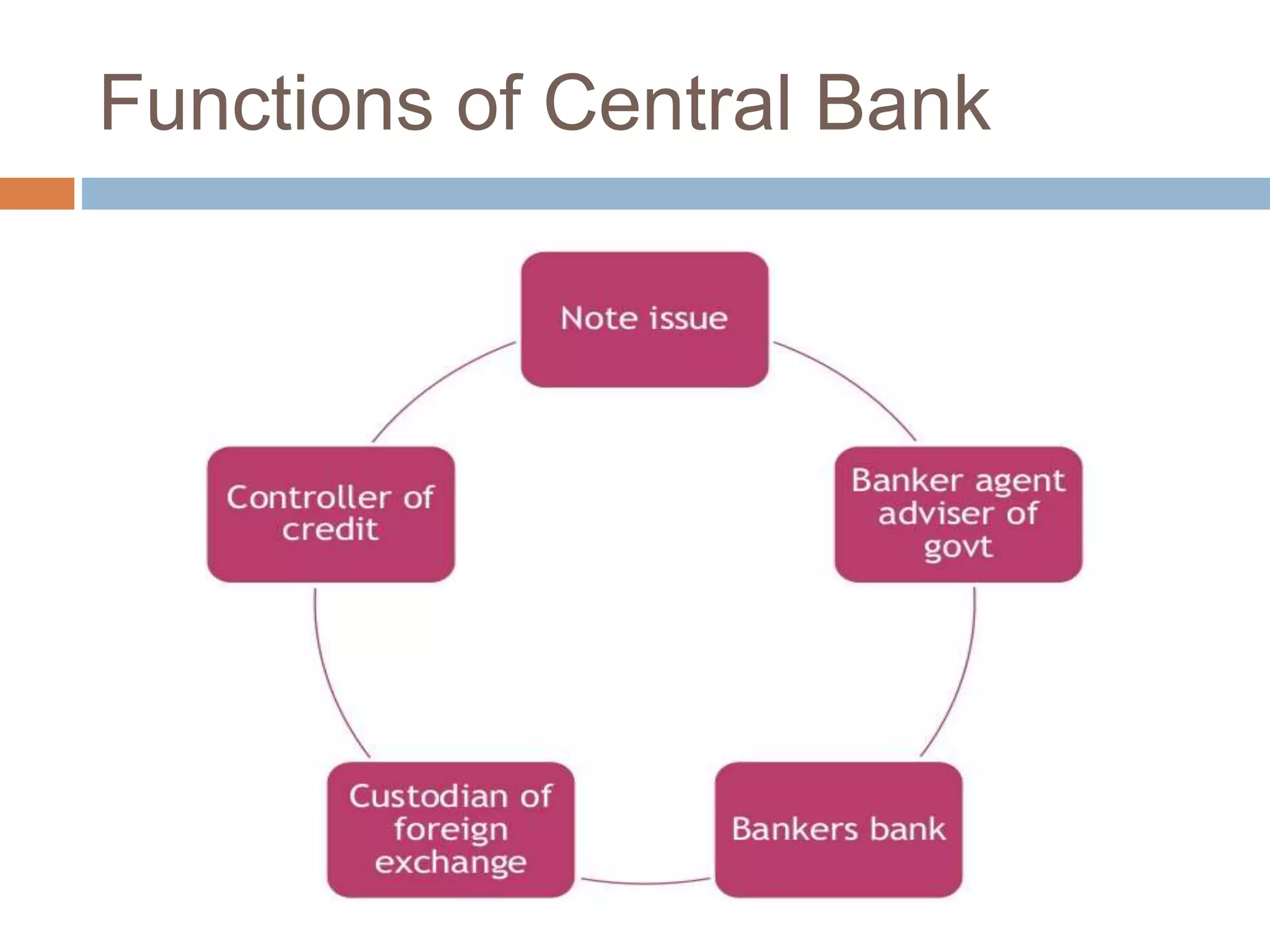
Functions of Central Bank
Functions of central bank
 Bank of note issue: The Central Bank has the
sole monopoly of note issue in every country.
The currency notes printed and issued
become unlimited legal tender throughout the
country
INDIAN CURRENCY NOTES
ISSUED BY CENTRAL BANK
Functions of central bank
 Banker ,Agent and Adviser to the Government : It
maintains the accounts of central as well as state
governments. It receives deposits from
government and makes short term advances to
the government. As an agent to the government it
collects taxes and other payments on behalf of the
government. It raises loans from public and thus
manages public debt. As a financial adviser to the
government, it gives advises to the government
on economic, financial and fiscal matters, such as
deficit financing, devaluation, trade policy, foreign
exchange policy etc.
Functions of central bank
 Bankers' Bank: The central bank acts as a
custodian of the cash reserves of commercial
banks.
 Lender of last resort: In case the commercial
banks are not able to meet their financial
requirements from other sources, they can
always approach central bank for financial
accomodation. The central bank accomodates
finances to the commercial banks by
rediscounting their eligible securities and
exchange bills.
Functions of central bank
 Clearing house: Since all banks have their
accounts with central bank ,it can easily settle
the claims of various banks against each other
with least use of cash.
 Custodian of foreign exchange reserves: this
function helps the central bank to overcome
the balance of payments difficulties and to
maintain stability in foreign exchange rates. In
order to minimise the fluctuations in foreign
exchange rates the central bank buys or sells
the foreign currencies in the market as the
value of foreign currencies falls or rises.
Functions of central bank
 Controller of credit: By controlling the credit
effectively the central bank establishes stability
not only in the internal price level but also in
foreign exchange rates. Such a stability is
necessary for economic growth and smooth
functioning of the economy.
 Developmental role: In the developing countries
apart from traditional functions, it performs
developmental and promotional functions. On one
hand it helps to develop money and capital
markets and on other hand it takes measures to
promote economic development and maintain
price and exchange stability.
Other functions
 (a) It maintains relations with International
institutions such as IMF World Bank.
 (b) It collects various types of statistics
providing current status of the economy.
 (c) It conducts surveys seminars and
publishes reports on other matters.
 (d) It helps in developing banking system and
banking habits in the country.
 (e) It extends training facilities to the staff
working in banking institutions.
Conclution
 In short the Central bank functions as
supreme monetary institution in the country by
acting as Banker to the government and to the
commercial banks ,a controller of monetary
system of the country and a promoter of
economic growth of the country. It performs
these functions without any profit motive and in
the interest of the general public.
Thank you

Central bank and its functions

  • 1.
    CENTRAL BANK ANDITS FUNCTIONS Jashanpreet Kaur XII commerce
  • 2.
    INTRODUCTION  The Centralbank plays an important role in the Monetary and Banking system of a country. It is responsible for maintaining financial severeignty and economic stability of a country especially in underdeveloped countries.
  • 4.
    What is acentral bank ?  Central Bank is the supreme monetary institution which is at the apex of the Monetary and Banking structure of a country.  It is the leader of the money market and as such it controls regulates and supervises the commercial banks .  It is the central monetary authority which manages the currency and credit policy and money supply of the government.
  • 5.
    Defination of centralbank  De Kock-"a bank which constitutes the apex of the monetary and banking structure of the country.“  Vera Smith-"the primary definition of central bank is a banking system in which a single bank has either a complete or residuary monopoly of note issue.“  Bank for International settelments-"the bank in any country which has been entrusted the duty of regulating the volume of currency and credit in that country."
  • 6.
  • 7.
    Functions of centralbank  Bank of note issue: The Central Bank has the sole monopoly of note issue in every country. The currency notes printed and issued become unlimited legal tender throughout the country
  • 8.
  • 9.
    Functions of centralbank  Banker ,Agent and Adviser to the Government : It maintains the accounts of central as well as state governments. It receives deposits from government and makes short term advances to the government. As an agent to the government it collects taxes and other payments on behalf of the government. It raises loans from public and thus manages public debt. As a financial adviser to the government, it gives advises to the government on economic, financial and fiscal matters, such as deficit financing, devaluation, trade policy, foreign exchange policy etc.
  • 10.
    Functions of centralbank  Bankers' Bank: The central bank acts as a custodian of the cash reserves of commercial banks.  Lender of last resort: In case the commercial banks are not able to meet their financial requirements from other sources, they can always approach central bank for financial accomodation. The central bank accomodates finances to the commercial banks by rediscounting their eligible securities and exchange bills.
  • 11.
    Functions of centralbank  Clearing house: Since all banks have their accounts with central bank ,it can easily settle the claims of various banks against each other with least use of cash.  Custodian of foreign exchange reserves: this function helps the central bank to overcome the balance of payments difficulties and to maintain stability in foreign exchange rates. In order to minimise the fluctuations in foreign exchange rates the central bank buys or sells the foreign currencies in the market as the value of foreign currencies falls or rises.
  • 12.
    Functions of centralbank  Controller of credit: By controlling the credit effectively the central bank establishes stability not only in the internal price level but also in foreign exchange rates. Such a stability is necessary for economic growth and smooth functioning of the economy.  Developmental role: In the developing countries apart from traditional functions, it performs developmental and promotional functions. On one hand it helps to develop money and capital markets and on other hand it takes measures to promote economic development and maintain price and exchange stability.
  • 13.
    Other functions  (a)It maintains relations with International institutions such as IMF World Bank.  (b) It collects various types of statistics providing current status of the economy.  (c) It conducts surveys seminars and publishes reports on other matters.  (d) It helps in developing banking system and banking habits in the country.  (e) It extends training facilities to the staff working in banking institutions.
  • 14.
    Conclution  In shortthe Central bank functions as supreme monetary institution in the country by acting as Banker to the government and to the commercial banks ,a controller of monetary system of the country and a promoter of economic growth of the country. It performs these functions without any profit motive and in the interest of the general public.
  • 15.