Molecular Machines
Achal Singh
M.tech Nanotechnology(2nd Sem)
Scholar No-2221050102
NT-560 Molecular Electronics and Bio-Molecules
Contents
Molecular machine
Molecular motors
Molecular switch
Other molecular machines
DNA machine
Molecular assembler
Drexler- Smalley Debate
References
Molecular machine
• Discrete number of molecular components
that have been designed to perform
• Mechanical-like movements (output)
• in response to specific stimuli (input).
• Molecules that simply mimic functions at the
macroscopic level. (like, switches and
motors)
• Molecular machines can be divided into two
broad categories:
• Synthetic
• Biological
Ref.-Yaabot
Molecular motors
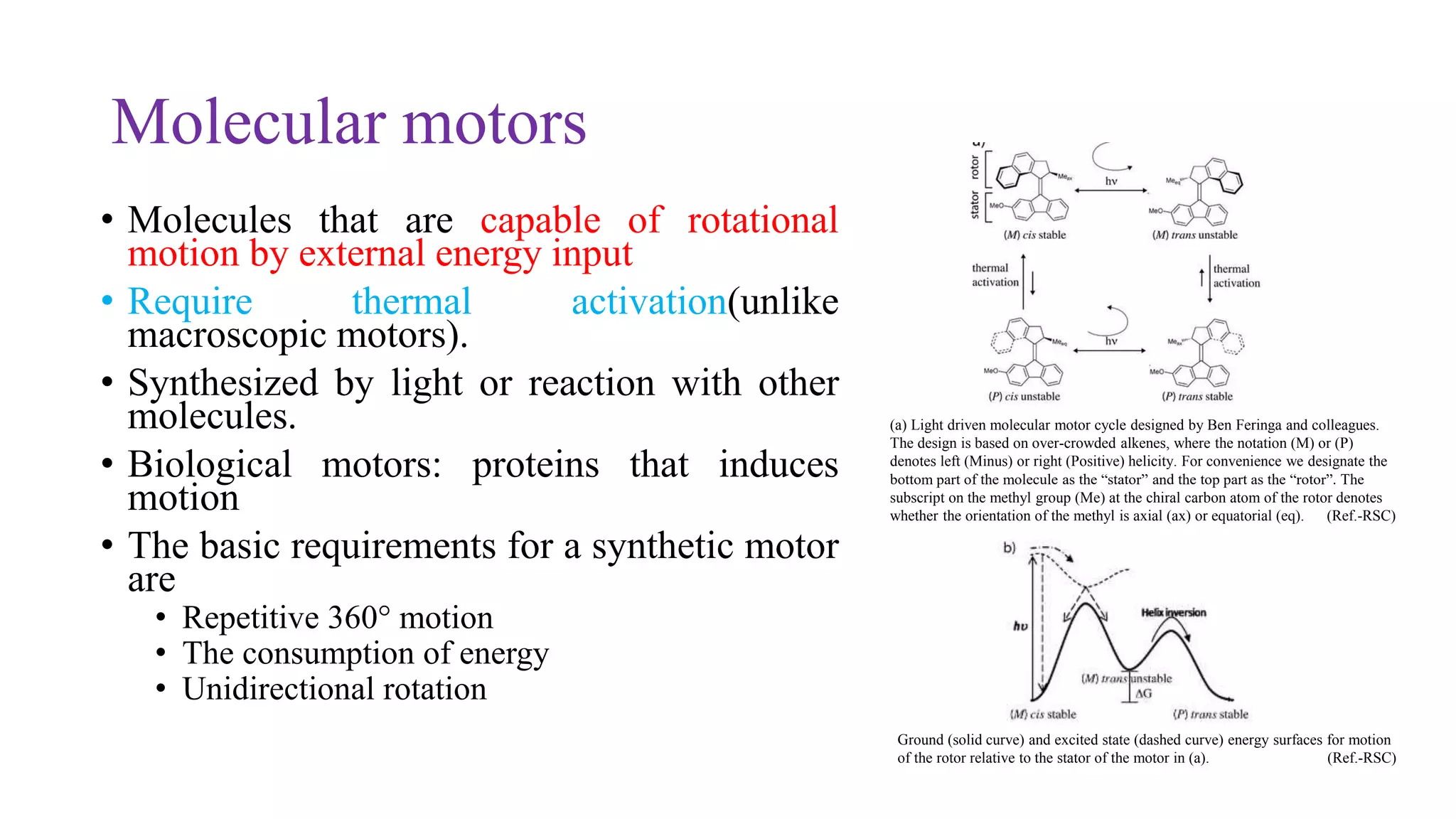
• Molecules that are capable of rotational
motion by external energy input
• Require thermal activation(unlike
macroscopic motors).
• Synthesized by light or reaction with other
molecules.
• Biological motors: proteins that induces
motion
• The basic requirements for a synthetic motor
are
• Repetitive 360° motion
• The consumption of energy
• Unidirectional rotation
(a) Light driven molecular motor cycle designed by Ben Feringa and colleagues.
The design is based on over-crowded alkenes, where the notation (M) or (P)
denotes left (Minus) or right (Positive) helicity. For convenience we designate the
bottom part of the molecule as the “stator” and the top part as the “rotor”. The
subscript on the methyl group (Me) at the chiral carbon atom of the rotor denotes
whether the orientation of the methyl is axial (ax) or equatorial (eq). (Ref.-RSC)
Ground (solid curve) and excited state (dashed curve) energy surfaces for motion
of the rotor relative to the stator of the motor in (a). (Ref.-RSC)
Molecular switch
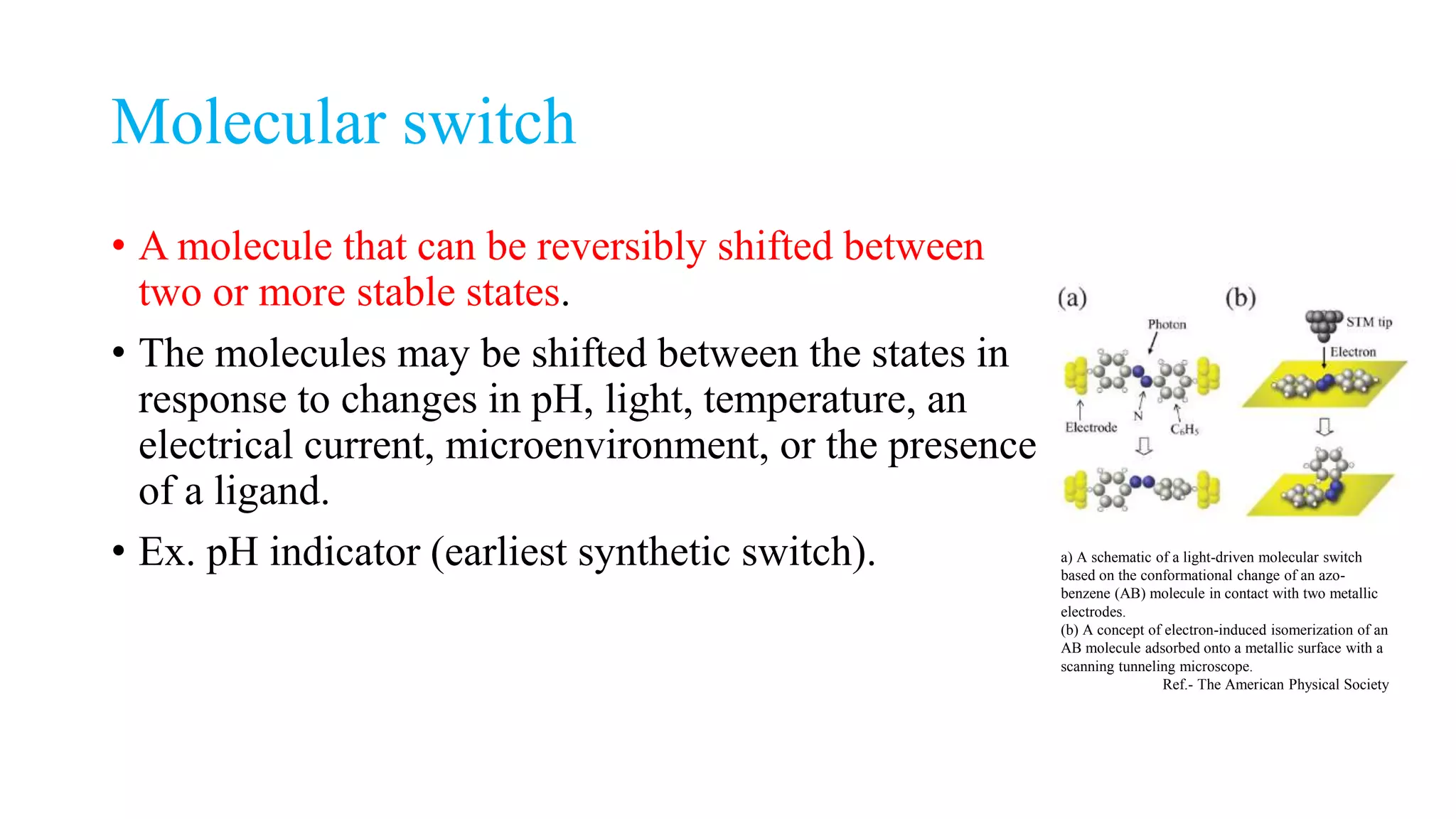
• A molecule that can be reversibly shifted between
two or more stable states.
• The molecules may be shifted between the states in
response to changes in pH, light, temperature, an
electrical current, microenvironment, or the presence
of a ligand.
• Ex. pH indicator (earliest synthetic switch). a) A schematic of a light-driven molecular switch
based on the conformational change of an azo-
benzene (AB) molecule in contact with two metallic
electrodes.
(b) A concept of electron-induced isomerization of an
AB molecule adsorbed onto a metallic surface with a
scanning tunneling microscope.
Ref.- The American Physical Society
Other molecular machines
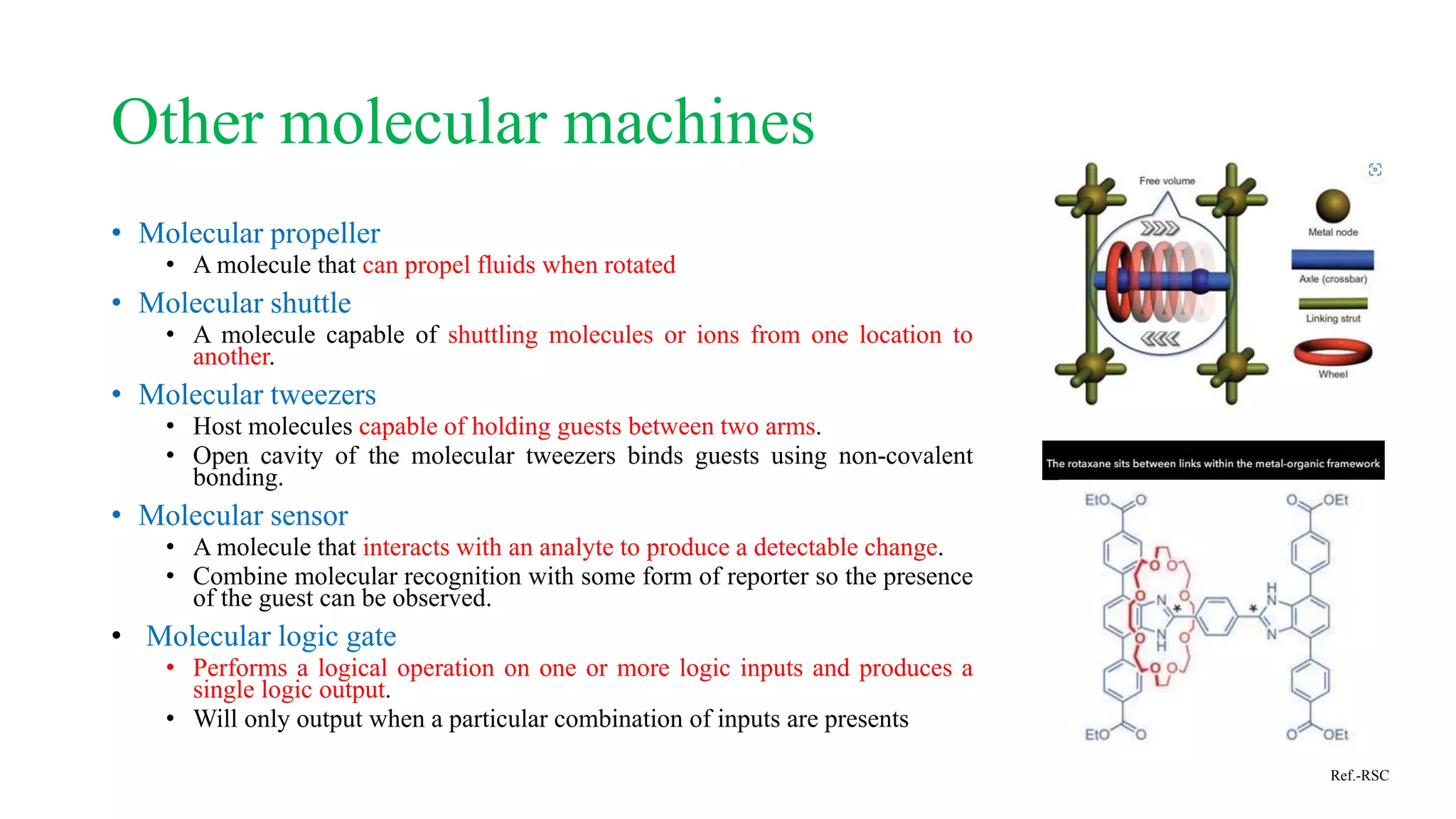
• Molecular propeller
• A molecule that can propel fluids when rotated
• Molecular shuttle
• A molecule capable of shuttling molecules or ions from one location to
another.
• Molecular tweezers
• Host molecules capable of holding guests between two arms.
• Open cavity of the molecular tweezers binds guests using non-covalent
bonding.
• Molecular sensor
• A molecule that interacts with an analyte to produce a detectable change.
• Combine molecular recognition with some form of reporter so the presence
of the guest can be observed.
• Molecular logic gate
• Performs a logical operation on one or more logic inputs and produces a
single logic output.
• Will only output when a particular combination of inputs are presents
Ref.-RSC
DNA machine
• A molecular machine constructed from
DNA
• DNA machines can be logically
designed since,
• DNA assembly of the double helix is
based on strict rules of base pairing,
• allows portions of the strand to be
predictably connected based on their
sequence.
a (Left): The design of DNA tweezers. a (right): The Holiday junction of
tweezers.
b: Schematic illustration of reversible regulation of target binding affinity
by the DNA tweezers.
c: There are two types of tweezers, A and B. Here we show the differences
between them.
Ref.-hustchina2015.github.io
Molecular assembler
• Proposed device able to guide chemical reactions by
positioning reactive molecules with atomic precision
• Molecular manufacturing
• Chemical synthesis of complex structures by mechanically
positioning reactive molecules, not by manipulating individual
atoms.
• Forms the basis of molecular self-assembly in nanotechnology.
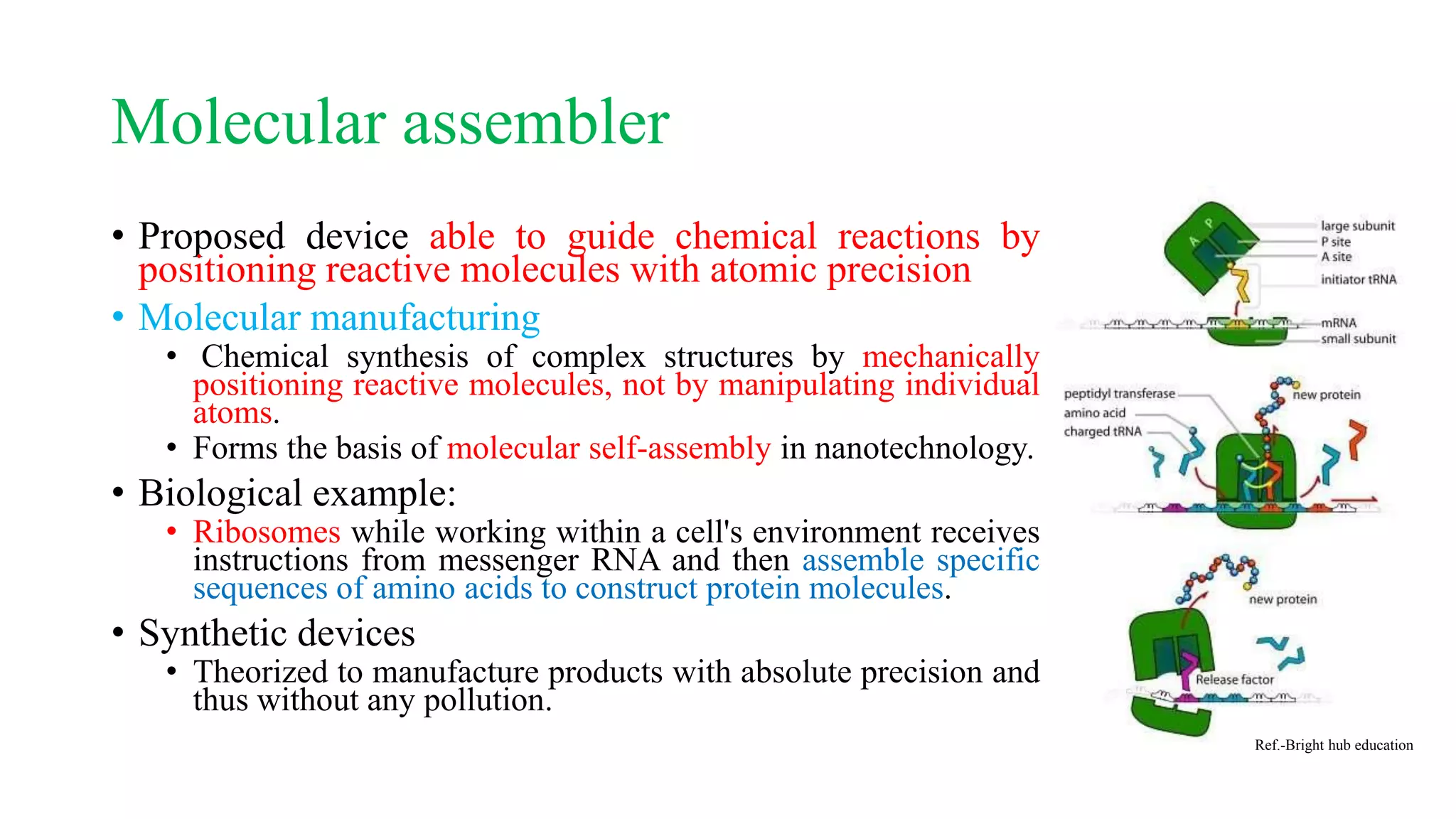
• Biological example:
• Ribosomes while working within a cell's environment receives
instructions from messenger RNA and then assemble specific
sequences of amino acids to construct protein molecules.
• Synthetic devices
• Theorized to manufacture products with absolute precision and
thus without any pollution.
Ref.-Bright hub education
Drexler- Smalley Debate
•Proposing development of
synthetic molecular assemblers as
inevitable.
Warning of regulations ASAP,
otherwise the Grey Goo or
ecophagy problem.
•Discrediting existence citing the
“Sticky Fingers” and “Fat
fingers” problem.
Suggestions to avoid hysteria
which can lead to hamper
nanotechnology development.
The Proposals
• Citing the existence of ribosomes
and other enzymes.
Non-requirement of “Smalley
Fingers” in computer controlled
assemblers.
• Ribosomes and enzymes require
water. What about unstable
elements in water ?
The cycle of energy for
Ribosomes like? Existence of
“Smalley finger” problem in
computer controlled nanobots!
The counters
•Citing Feynman’s “Plenty of
room at bottom”, though bio-
inspired the problem is more
mechanical(mechanosynthesis).
Existence of nanofactories,
mechanical assemblies eliminate
need of “fingers” to bond or hold!
•Chemistry requires fundamental
reactions and control, molecules
just can’t bond and propagate as
desired.
Even the nanorobots will require
a catalyst to control, hence the
“finger problem”!
The counter-
counters
Ref.-earthchronicles
References
Dr. Fozia Z. Haque, NT-550 Molecular Electronics and Biomolecules,
Motor Molecules-Lecture plan.

molecular machines.pptx

  • 1.
    Molecular Machines Achal Singh M.techNanotechnology(2nd Sem) Scholar No-2221050102 NT-560 Molecular Electronics and Bio-Molecules
  • 2.
    Contents Molecular machine Molecular motors Molecularswitch Other molecular machines DNA machine Molecular assembler Drexler- Smalley Debate References
  • 3.
    Molecular machine • Discretenumber of molecular components that have been designed to perform • Mechanical-like movements (output) • in response to specific stimuli (input). • Molecules that simply mimic functions at the macroscopic level. (like, switches and motors) • Molecular machines can be divided into two broad categories: • Synthetic • Biological Ref.-Yaabot
  • 4.
    Molecular motors • Moleculesthat are capable of rotational motion by external energy input • Require thermal activation(unlike macroscopic motors). • Synthesized by light or reaction with other molecules. • Biological motors: proteins that induces motion • The basic requirements for a synthetic motor are • Repetitive 360° motion • The consumption of energy • Unidirectional rotation (a) Light driven molecular motor cycle designed by Ben Feringa and colleagues. The design is based on over-crowded alkenes, where the notation (M) or (P) denotes left (Minus) or right (Positive) helicity. For convenience we designate the bottom part of the molecule as the “stator” and the top part as the “rotor”. The subscript on the methyl group (Me) at the chiral carbon atom of the rotor denotes whether the orientation of the methyl is axial (ax) or equatorial (eq). (Ref.-RSC) Ground (solid curve) and excited state (dashed curve) energy surfaces for motion of the rotor relative to the stator of the motor in (a). (Ref.-RSC)
  • 5.
    Molecular switch • Amolecule that can be reversibly shifted between two or more stable states. • The molecules may be shifted between the states in response to changes in pH, light, temperature, an electrical current, microenvironment, or the presence of a ligand. • Ex. pH indicator (earliest synthetic switch). a) A schematic of a light-driven molecular switch based on the conformational change of an azo- benzene (AB) molecule in contact with two metallic electrodes. (b) A concept of electron-induced isomerization of an AB molecule adsorbed onto a metallic surface with a scanning tunneling microscope. Ref.- The American Physical Society
  • 6.
    Other molecular machines •Molecular propeller • A molecule that can propel fluids when rotated • Molecular shuttle • A molecule capable of shuttling molecules or ions from one location to another. • Molecular tweezers • Host molecules capable of holding guests between two arms. • Open cavity of the molecular tweezers binds guests using non-covalent bonding. • Molecular sensor • A molecule that interacts with an analyte to produce a detectable change. • Combine molecular recognition with some form of reporter so the presence of the guest can be observed. • Molecular logic gate • Performs a logical operation on one or more logic inputs and produces a single logic output. • Will only output when a particular combination of inputs are presents Ref.-RSC
  • 7.
    DNA machine • Amolecular machine constructed from DNA • DNA machines can be logically designed since, • DNA assembly of the double helix is based on strict rules of base pairing, • allows portions of the strand to be predictably connected based on their sequence. a (Left): The design of DNA tweezers. a (right): The Holiday junction of tweezers. b: Schematic illustration of reversible regulation of target binding affinity by the DNA tweezers. c: There are two types of tweezers, A and B. Here we show the differences between them. Ref.-hustchina2015.github.io
  • 8.
    Molecular assembler • Proposeddevice able to guide chemical reactions by positioning reactive molecules with atomic precision • Molecular manufacturing • Chemical synthesis of complex structures by mechanically positioning reactive molecules, not by manipulating individual atoms. • Forms the basis of molecular self-assembly in nanotechnology. • Biological example: • Ribosomes while working within a cell's environment receives instructions from messenger RNA and then assemble specific sequences of amino acids to construct protein molecules. • Synthetic devices • Theorized to manufacture products with absolute precision and thus without any pollution. Ref.-Bright hub education
  • 9.
    Drexler- Smalley Debate •Proposingdevelopment of synthetic molecular assemblers as inevitable. Warning of regulations ASAP, otherwise the Grey Goo or ecophagy problem. •Discrediting existence citing the “Sticky Fingers” and “Fat fingers” problem. Suggestions to avoid hysteria which can lead to hamper nanotechnology development. The Proposals • Citing the existence of ribosomes and other enzymes. Non-requirement of “Smalley Fingers” in computer controlled assemblers. • Ribosomes and enzymes require water. What about unstable elements in water ? The cycle of energy for Ribosomes like? Existence of “Smalley finger” problem in computer controlled nanobots! The counters •Citing Feynman’s “Plenty of room at bottom”, though bio- inspired the problem is more mechanical(mechanosynthesis). Existence of nanofactories, mechanical assemblies eliminate need of “fingers” to bond or hold! •Chemistry requires fundamental reactions and control, molecules just can’t bond and propagate as desired. Even the nanorobots will require a catalyst to control, hence the “finger problem”! The counter- counters Ref.-earthchronicles
  • 10.
    References Dr. Fozia Z.Haque, NT-550 Molecular Electronics and Biomolecules, Motor Molecules-Lecture plan.