N.SHALINI
1ST YR BDS
DEPARTMENT OF PHYSIOLOGY
AMDECH
 The understanding of mechanism involved
in memory formation contributes to the
development of new and more effective
treatment of cognitive disorders, which is
important especially in this face of
population aging.
 Memory- Ability to recall the past or retention of
learned materials.
 Consequence of plastic abilities of brain.
 Dynamic, Multi-Phase process
 Essential human skill- Required throughout whole life
span.
 Memory formation- Complicated.
 Activated brain areas during memory formation is
diverse – Predominantly cerebral cortex and limbic
system especially hippocampus & amygdala.
 In psychology, memory - the process by
which information is encoded, stored, and
retrieved.
 Encoding - information from the outside
world to reach our senses in the forms of
chemical and physical stimuli.
 Storage is the second memory stage. It
entails- we maintain information over periods
of time.
 Finally the third process is the retrieval of
information that we have stored.
 Short Term Memory is memory for facts,
words , letters figures, numbers or other
information for a few seconds to minutes to
hours
 DURATION: Seconds to minutes to hours
 Neural basis of short term memory:
3 mechanisms
1) reverberating circuits-thalamo-cortical
2) post-tetanic potentiation
3) pre-synaptic facilitation or inhibition
 NEURAL BASIS: Consolidation of STM BY
enhancement of synaptic transmission
 Anatomic changes:
a) changes in number & shapes of dendritic spines
b) changes in number & length of dendritic branches
c) changes in number & size of synapses
The cortex becomes thicker in the process
 Physiological basis; Increased & sustained Neural
activity by long term potentiation (LTP)
& by sensitization
 The hippocampus is concerned with encoding or laying
down of Long Term Memory
 Short Term Memory in neocortex - entorhinal &
perirhinalcortex- hippocampus & amygdala ->processing
in ca1 region-- fornix mammilary bodies through
mammilo-thalamic tract of Vic D’Azyr- anterior nucleus of
Thalamus  Cingulate Gyrus  unknown projections
strengthening of connections in cortex
 ROLE OF REHEARSAL: Repetition of learnt
material enhances consolidation of STM
 ROLE OF EMOTION: Emotional concomitants
such as pain & pleasure enhance consolidation.
A stimulus associated with pain is more
effectively stored. This is brought about by
AMYGDALA.
 Changes occurring in memory formation- LONG
TERM POTENTIATION
 Long term modification of synaptic communication.
 Rate of firing of postsynaptic neurons α
stimulation from presynaptic neuron
 LTP, postsynaptic neuron fires at deviated rate,
even increased stimulation has subsided.
 Sensitive, bigger reaction-firing more action
potential-same stimulation.
 Glutamate- Neurotransmitter
 Binds to diff. ionotropic receptors – NMDA
(N-methyl-D-aspartate),AMPA (amino-
3hydroxy 5-methyl 4-isoxazolepropionate)
 Specific channels-memory formation
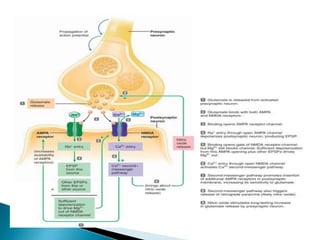
 NMDA channel- both glutamate &
depolarisation from another source to open.
 At –ve potentials, +vely charged Mg ions plug
the pore of NMDA channel.
 Glutamate may open the pore, ions cant
travel the channel due to Mg block.
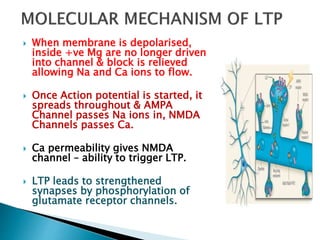
 When membrane is depolarised,
inside +ve Mg are no longer driven
into channel & block is relieved
allowing Na and Ca ions to flow.
 Once Action potential is started, it
spreads throughout & AMPA
Channel passes Na ions in, NMDA
Channels passes Ca.
 Ca permeability gives NMDA
channel – ability to trigger LTP.
 LTP leads to strengthened
synapses by phosphorylation of
glutamate receptor channels.
GLUTAMATE-
 Two main groups of glutamate receptors
 Metabotropic glutamate receptors
 Ionotropic glutamate receptors
 NMDA receptors and AMPA receptors and kainate
receptors
 They allow the passage of Na,K and in case of
NMDA receptors entry of Ca+.
FUNCTIONS-
 Glutamate and glutamate receptors modulate
memory process, encoding, formation ,retrieval
of memories, spatial recognition and
maintenance of consciousness.
 ACETYLCHOLINE
 Pre & post synaptic receptors- acetylcholine
receptors & muscarinic acetyl choline
receptors.
 Cholinergic antagonists influence- memory
performance.
 Muscarinic receptor antagonist- scopolamine
–used to induce amnesia & in treatment of
dementia.
 Habituation is caused by
continuous delicate stimulus,
divided by inter stimulus pause.
 Type of brain plasticity- induced
by homosynaptic depression in
the stimulus- response circuit &
other processes- increased
inhibition, decreased neuronal
excitability.
 Gradual reduction in strength of
response –
 Decrease in no. of vesicles
containing dopamine- imp. Role
in mechanism of habituation.
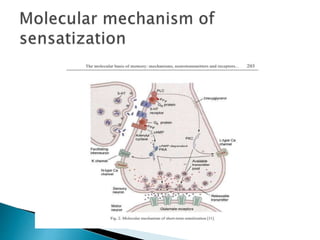
 Sensitization is
enhancing the strength
of response to primary
stimulus in one pathway
through another
stimulus- electric shock.
 Serotonin binds the
receptors - linked to G
protein- activation of
(cAMP) and (PKA) -
opening up of Ca
channels & influx of Ca
into the sensory neuron.
 PKC is a family of enzymes consisting of
many isozymes & one of them is PKCʓ.
 Gene responsible for encoding PKCʓ & also
for PKMʓ.
SIGNIFICANCE- PKMʓ at elevated level is
required to maintain long term memories.
 Plays an obligatory role in maintaining LTP
and spatial memory in the hippocampus.
 Sustaining memory in neocortex.
 Amnesia is inability to recall or recognize or
retrieve memories which has two broad forms:
retrograde and anterograde amnesia.
 Retrograde amnesia: failure to recall events before illness
 Anterograde amnesia: impaired ability to learn.
minor degree of cognitive impairment,
confabulation.
 Alzheimers Disease accounts for about two thirds
of the cases of senile dementia, which is a
generalized age related diminution of mental
abilities.
MOLECULAR BASIS OF MEMORY.pptx

MOLECULAR BASIS OF MEMORY.pptx

  • 1.
    N.SHALINI 1ST YR BDS DEPARTMENTOF PHYSIOLOGY AMDECH
  • 2.
     The understandingof mechanism involved in memory formation contributes to the development of new and more effective treatment of cognitive disorders, which is important especially in this face of population aging.
  • 3.
     Memory- Abilityto recall the past or retention of learned materials.  Consequence of plastic abilities of brain.  Dynamic, Multi-Phase process  Essential human skill- Required throughout whole life span.  Memory formation- Complicated.  Activated brain areas during memory formation is diverse – Predominantly cerebral cortex and limbic system especially hippocampus & amygdala.
  • 4.
     In psychology,memory - the process by which information is encoded, stored, and retrieved.  Encoding - information from the outside world to reach our senses in the forms of chemical and physical stimuli.  Storage is the second memory stage. It entails- we maintain information over periods of time.  Finally the third process is the retrieval of information that we have stored.
  • 6.
     Short TermMemory is memory for facts, words , letters figures, numbers or other information for a few seconds to minutes to hours  DURATION: Seconds to minutes to hours  Neural basis of short term memory: 3 mechanisms 1) reverberating circuits-thalamo-cortical 2) post-tetanic potentiation 3) pre-synaptic facilitation or inhibition
  • 7.
     NEURAL BASIS:Consolidation of STM BY enhancement of synaptic transmission  Anatomic changes: a) changes in number & shapes of dendritic spines b) changes in number & length of dendritic branches c) changes in number & size of synapses The cortex becomes thicker in the process  Physiological basis; Increased & sustained Neural activity by long term potentiation (LTP) & by sensitization
  • 8.
     The hippocampusis concerned with encoding or laying down of Long Term Memory  Short Term Memory in neocortex - entorhinal & perirhinalcortex- hippocampus & amygdala ->processing in ca1 region-- fornix mammilary bodies through mammilo-thalamic tract of Vic D’Azyr- anterior nucleus of Thalamus  Cingulate Gyrus  unknown projections strengthening of connections in cortex
  • 9.
     ROLE OFREHEARSAL: Repetition of learnt material enhances consolidation of STM  ROLE OF EMOTION: Emotional concomitants such as pain & pleasure enhance consolidation. A stimulus associated with pain is more effectively stored. This is brought about by AMYGDALA.
  • 10.
     Changes occurringin memory formation- LONG TERM POTENTIATION  Long term modification of synaptic communication.  Rate of firing of postsynaptic neurons α stimulation from presynaptic neuron  LTP, postsynaptic neuron fires at deviated rate, even increased stimulation has subsided.  Sensitive, bigger reaction-firing more action potential-same stimulation.
  • 11.
     Glutamate- Neurotransmitter Binds to diff. ionotropic receptors – NMDA (N-methyl-D-aspartate),AMPA (amino- 3hydroxy 5-methyl 4-isoxazolepropionate)  Specific channels-memory formation  NMDA channel- both glutamate & depolarisation from another source to open.  At –ve potentials, +vely charged Mg ions plug the pore of NMDA channel.  Glutamate may open the pore, ions cant travel the channel due to Mg block.
  • 12.
     When membraneis depolarised, inside +ve Mg are no longer driven into channel & block is relieved allowing Na and Ca ions to flow.  Once Action potential is started, it spreads throughout & AMPA Channel passes Na ions in, NMDA Channels passes Ca.  Ca permeability gives NMDA channel – ability to trigger LTP.  LTP leads to strengthened synapses by phosphorylation of glutamate receptor channels.
  • 14.
    GLUTAMATE-  Two maingroups of glutamate receptors  Metabotropic glutamate receptors  Ionotropic glutamate receptors  NMDA receptors and AMPA receptors and kainate receptors  They allow the passage of Na,K and in case of NMDA receptors entry of Ca+. FUNCTIONS-  Glutamate and glutamate receptors modulate memory process, encoding, formation ,retrieval of memories, spatial recognition and maintenance of consciousness.
  • 15.
     ACETYLCHOLINE  Pre& post synaptic receptors- acetylcholine receptors & muscarinic acetyl choline receptors.  Cholinergic antagonists influence- memory performance.  Muscarinic receptor antagonist- scopolamine –used to induce amnesia & in treatment of dementia.
  • 16.
     Habituation iscaused by continuous delicate stimulus, divided by inter stimulus pause.  Type of brain plasticity- induced by homosynaptic depression in the stimulus- response circuit & other processes- increased inhibition, decreased neuronal excitability.  Gradual reduction in strength of response –  Decrease in no. of vesicles containing dopamine- imp. Role in mechanism of habituation.  Sensitization is enhancing the strength of response to primary stimulus in one pathway through another stimulus- electric shock.  Serotonin binds the receptors - linked to G protein- activation of (cAMP) and (PKA) - opening up of Ca channels & influx of Ca into the sensory neuron.
  • 18.
     PKC isa family of enzymes consisting of many isozymes & one of them is PKCʓ.  Gene responsible for encoding PKCʓ & also for PKMʓ. SIGNIFICANCE- PKMʓ at elevated level is required to maintain long term memories.  Plays an obligatory role in maintaining LTP and spatial memory in the hippocampus.  Sustaining memory in neocortex.
  • 19.
     Amnesia isinability to recall or recognize or retrieve memories which has two broad forms: retrograde and anterograde amnesia.  Retrograde amnesia: failure to recall events before illness  Anterograde amnesia: impaired ability to learn. minor degree of cognitive impairment, confabulation.  Alzheimers Disease accounts for about two thirds of the cases of senile dementia, which is a generalized age related diminution of mental abilities.