Internationalization of HRM:
Socio-Cultural Context
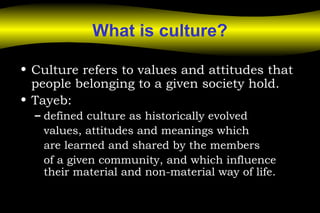
What is culture?
• Culture refers to values and attitudes that
people belonging to a given society hold.
• Tayeb:
– defined culture as historically evolved
values, attitudes and meanings which
are learned and shared by the members
of a given community, and which influence
their material and non-material way of life.
Culture and Employee Management
Issues.
1. Attitude to power and authority and
its implications for employee
management.
2. Tolerance for ambiguity and
attitude to risk and their implications
for employee management.
3. Interpersonal trust and its
implications for employee
management.
4. Individualism and collectivism and
their implications for employee
management.
5. Preference for certain leadership
behaviors and its implications for
employee management.
National Culture and specific HRM
issues
• Selection and recruitment
• Training
• Job expectations and motivation policies
• Performance appraisal, reward and
promotion policies
Business Imperatives and other non-
cultural influences on HRM
• Influence of non-cultural factors at individual
level
– Education
– Position for employee management style
Business Imperatives and other non-
cultural influences on HRM
• Influence of non-cultural factors at
organizational level.
– Market conditions
– Production technology and industry
– Size
– Organizational culture

Module01

  • 1.
  • 2.
    What is culture? •Culture refers to values and attitudes that people belonging to a given society hold. • Tayeb: – defined culture as historically evolved values, attitudes and meanings which are learned and shared by the members of a given community, and which influence their material and non-material way of life.
  • 3.
    Culture and EmployeeManagement Issues.
  • 4.
    1. Attitude topower and authority and its implications for employee management.
  • 5.
    2. Tolerance forambiguity and attitude to risk and their implications for employee management.
  • 6.
    3. Interpersonal trustand its implications for employee management.
  • 7.
    4. Individualism andcollectivism and their implications for employee management.
  • 8.
    5. Preference forcertain leadership behaviors and its implications for employee management.
  • 9.
    National Culture andspecific HRM issues • Selection and recruitment • Training • Job expectations and motivation policies • Performance appraisal, reward and promotion policies
  • 10.
    Business Imperatives andother non- cultural influences on HRM • Influence of non-cultural factors at individual level – Education – Position for employee management style
  • 11.
    Business Imperatives andother non- cultural influences on HRM • Influence of non-cultural factors at organizational level. – Market conditions – Production technology and industry – Size – Organizational culture