Content:
 Introduction
 Meaning
 Examples(Videos)
 Cross cultural motivation
 Impacts of cross culture
 Differences in culture
 Cross cultural competencies and knowledge
 Cross cultural behavior
 Cross cultural management
What is cross cultural Dynamics?
INTRODUCTION
What is culture?
 Culture can be defined as a shared system of values
beliefs and attitudes.
 Fred luthans defined culture as “the acquired knowledge
that people use to interpret experience and generate
social behavior.”
 It helps people to interact and communicate with other
members of society.
 Cross culture can refer to a company’s initiatives to
increase understanding of different groups, develop
effective communication or marketing efforts to reach
out to customers and clients outside its traditional
market.
Contd.
Introduction contd.
The trend of globalization providing opportunities
for Indian firms to reach foreign markets.
An organization consist of groups of people which
belong to several cultures.
We all belong to an entire collection of cultures,
which includes , national cultures, subcultures
(based on regions, tribes etc.), organizational or
corporate cultures, industry cultures, professional
or functional cultures.
Recognizing Culture
• Events:
- Rites
- Ceremonials
- Rituals
• Communications
- Myths
- Sagas
- Legends
- Stories
- Folktales
• Things
- Symbols
- Language
- Gestures
- Physical setting
- Artifacts
Really minor
distinctions
among these
Meaning
• Cross cultural dynamics means when in any
organization more than one cultured people
are working together and there is any clashes
due to this.
• In order to solve this the firms is required to
develop system and processes for managers to
handle cultural diversities.
PEOPLE’s relationship with
environment
o In many developed countries, people try to
dominate the environment by using
sophisticated equipment for farming and
insecticides and fertilizers to improve the yield
of crops. On the other hand, often accept the
environment as it is, and adjust their own
living condition, such as planting crops,
fishing, etc.
Cross Cultural Management
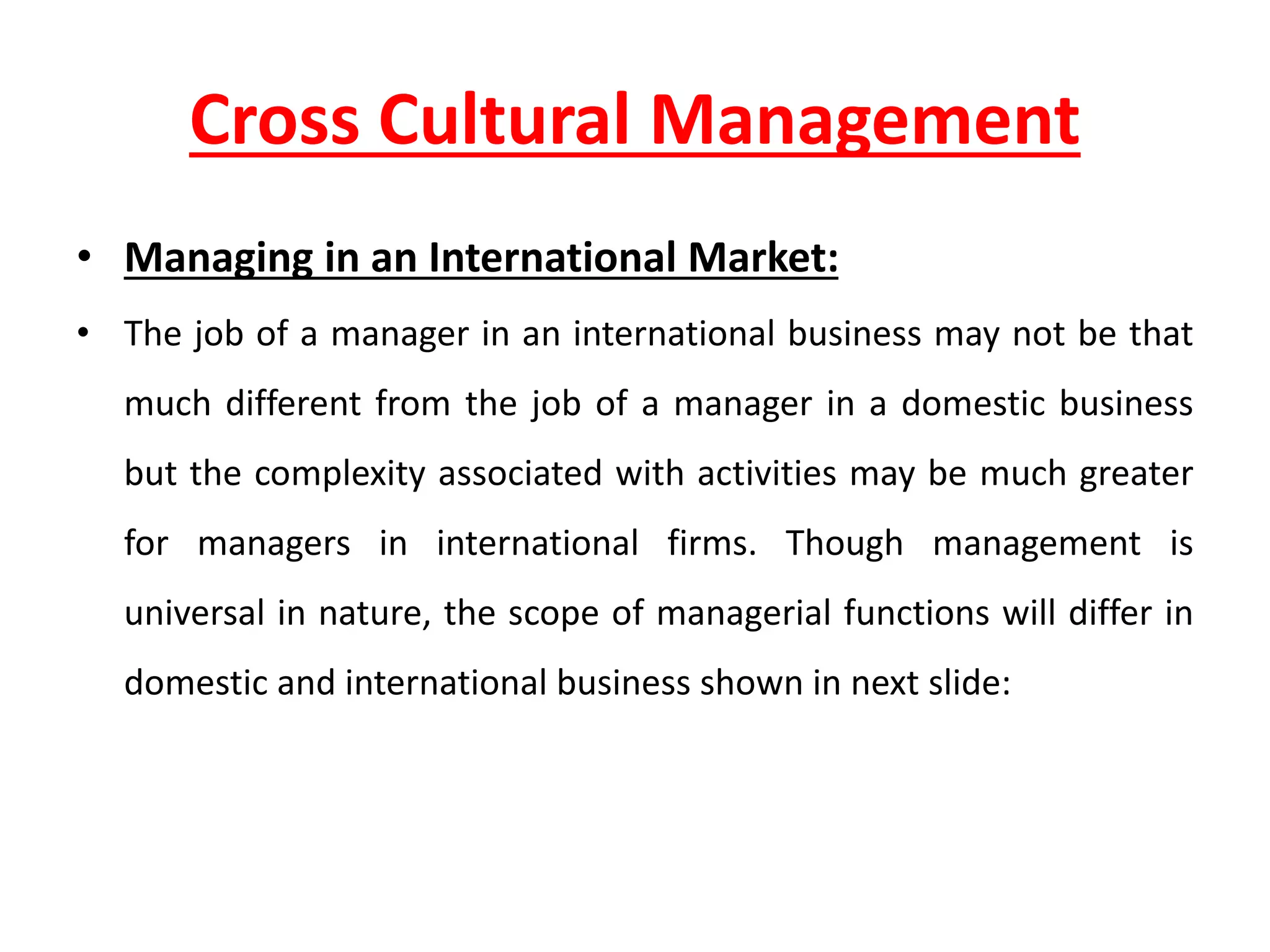
• Managing in an International Market:
• The job of a manager in an international business may not be that
much different from the job of a manager in a domestic business
but the complexity associated with activities may be much greater
for managers in international firms. Though management is
universal in nature, the scope of managerial functions will differ in
domestic and international business shown in next slide:
Scope of managerial functions in domestic and
international business
Managerial Functions Domestic Business International Business
1.Planning :
• Scanning the environment
for threats and opportunities
2. Organizing :
• Organization structure
• View of authority
3. Staffing :
• Sources Of managerial Talent
• Manager orientation
4.Leading :
• Leadership and motivation
• Communication lines
5. Controlling :
• Reporting System
• National Markets
• Structure for domestic
operations
• Similar
• National market
• Often ethnocentric
• Influenced by similar
culture
• Relatively short
• Similar requirement
• Worldwide markets
• Global structure
• Different
• Worldwide pool
• Geocentric
• Influenced by many
different cultures
• Network with long
distances
• Many different
requirements
Managerial attitudes in handling operations in
foreign countries
Howard Perlmutter and David D. Heenan
have identified three primary attitudes among
the managers of international companies:
• Ethnocentric
• Polycentric
• Geocentric
Managerial attitudes in handling operations in
foreign countries
Ethnocentric
Home country
methods are the
best
Polycentric
Host country
methods are the
best
Geocentric
Use the best
methods, no matter
what the source
Howard Perlmutter
and David D. Heenan
have identified three
primary attitudes
among the managers
of international
companies:
Ethnocentric:
Ethnocentric managers see foreign
countries and their people as inferior to those of
the home country. These managers believe that
the practices of the home country can be
exported along with its technology, goods and
services. They give very little freedom to the
local managers.
Polycentric:
Polycentric managers see all countries as
different and as hard to understand. Such
managers tend to leave their foreign offices
alone, believing local managers are most likely
to understand their own needs. They delegate
adequate authority to the local managers to
manage their affairs.
Geocentric:
Geocentric managers recognize similarities as
well as differences among countries. Such managers
attempt to draw on the most effective techniques
and practices, whenever they originate.
The modern multinational corporation has a
geocentric orientation, this means that the total
organization is viewed as an interdependent system
operating in many countries.
Skills required of the global manager:
Skills Description
1. Global perspective
2. Cultural responsiveness
3. Appreciate cultural synergies
4. Cultural adaptability
5. Cross-cultural communication
6. Cross-cultural collaboration
7. Acquire broad foreign
experience
• Broaden focus from one or two countries to a
global business perspective.
• Become familiar with many cultures.
• Learn the dynamics of multicultural
situations.
• Be able to live and work effectively in many
different cultures.
• Engage in cross cultural interaction everyday,
whether at home or in a foreign country.
• Work effectively in multi cultural teams
where everyone is equal.
• Move up the carrier ladder by going from
one foreign country to another, instead of
taking frequent home country assignments.
Book: Management and organisational behaviour by T.N. Chhabra, SUN
India Publications
https://www.slideshare.net/kohlisudeep18/cross-culture-dynamics
https://en.wikipedia.org/wiki/Cultural_Dynamics
https://www.youtube.com
https://videos.pexels.com
https://www.shutterstock.com
Crossculture dynamics by siba

Crossculture dynamics by siba

  • 2.
    Content:  Introduction  Meaning Examples(Videos)  Cross cultural motivation  Impacts of cross culture  Differences in culture  Cross cultural competencies and knowledge  Cross cultural behavior  Cross cultural management
  • 3.
    What is crosscultural Dynamics?
  • 4.
    INTRODUCTION What is culture? Culture can be defined as a shared system of values beliefs and attitudes.  Fred luthans defined culture as “the acquired knowledge that people use to interpret experience and generate social behavior.”  It helps people to interact and communicate with other members of society.  Cross culture can refer to a company’s initiatives to increase understanding of different groups, develop effective communication or marketing efforts to reach out to customers and clients outside its traditional market. Contd.
  • 5.
    Introduction contd. The trendof globalization providing opportunities for Indian firms to reach foreign markets. An organization consist of groups of people which belong to several cultures. We all belong to an entire collection of cultures, which includes , national cultures, subcultures (based on regions, tribes etc.), organizational or corporate cultures, industry cultures, professional or functional cultures.
  • 6.
    Recognizing Culture • Events: -Rites - Ceremonials - Rituals • Communications - Myths - Sagas - Legends - Stories - Folktales • Things - Symbols - Language - Gestures - Physical setting - Artifacts Really minor distinctions among these
  • 7.
    Meaning • Cross culturaldynamics means when in any organization more than one cultured people are working together and there is any clashes due to this. • In order to solve this the firms is required to develop system and processes for managers to handle cultural diversities.
  • 9.
    PEOPLE’s relationship with environment oIn many developed countries, people try to dominate the environment by using sophisticated equipment for farming and insecticides and fertilizers to improve the yield of crops. On the other hand, often accept the environment as it is, and adjust their own living condition, such as planting crops, fishing, etc.
  • 24.
    Cross Cultural Management •Managing in an International Market: • The job of a manager in an international business may not be that much different from the job of a manager in a domestic business but the complexity associated with activities may be much greater for managers in international firms. Though management is universal in nature, the scope of managerial functions will differ in domestic and international business shown in next slide:
  • 25.
    Scope of managerialfunctions in domestic and international business Managerial Functions Domestic Business International Business 1.Planning : • Scanning the environment for threats and opportunities 2. Organizing : • Organization structure • View of authority 3. Staffing : • Sources Of managerial Talent • Manager orientation 4.Leading : • Leadership and motivation • Communication lines 5. Controlling : • Reporting System • National Markets • Structure for domestic operations • Similar • National market • Often ethnocentric • Influenced by similar culture • Relatively short • Similar requirement • Worldwide markets • Global structure • Different • Worldwide pool • Geocentric • Influenced by many different cultures • Network with long distances • Many different requirements
  • 26.
    Managerial attitudes inhandling operations in foreign countries Howard Perlmutter and David D. Heenan have identified three primary attitudes among the managers of international companies: • Ethnocentric • Polycentric • Geocentric
  • 27.
    Managerial attitudes inhandling operations in foreign countries Ethnocentric Home country methods are the best Polycentric Host country methods are the best Geocentric Use the best methods, no matter what the source Howard Perlmutter and David D. Heenan have identified three primary attitudes among the managers of international companies:
  • 28.
    Ethnocentric: Ethnocentric managers seeforeign countries and their people as inferior to those of the home country. These managers believe that the practices of the home country can be exported along with its technology, goods and services. They give very little freedom to the local managers.
  • 29.
    Polycentric: Polycentric managers seeall countries as different and as hard to understand. Such managers tend to leave their foreign offices alone, believing local managers are most likely to understand their own needs. They delegate adequate authority to the local managers to manage their affairs.
  • 30.
    Geocentric: Geocentric managers recognizesimilarities as well as differences among countries. Such managers attempt to draw on the most effective techniques and practices, whenever they originate. The modern multinational corporation has a geocentric orientation, this means that the total organization is viewed as an interdependent system operating in many countries.
  • 31.
    Skills required ofthe global manager: Skills Description 1. Global perspective 2. Cultural responsiveness 3. Appreciate cultural synergies 4. Cultural adaptability 5. Cross-cultural communication 6. Cross-cultural collaboration 7. Acquire broad foreign experience • Broaden focus from one or two countries to a global business perspective. • Become familiar with many cultures. • Learn the dynamics of multicultural situations. • Be able to live and work effectively in many different cultures. • Engage in cross cultural interaction everyday, whether at home or in a foreign country. • Work effectively in multi cultural teams where everyone is equal. • Move up the carrier ladder by going from one foreign country to another, instead of taking frequent home country assignments.
  • 32.
    Book: Management andorganisational behaviour by T.N. Chhabra, SUN India Publications https://www.slideshare.net/kohlisudeep18/cross-culture-dynamics https://en.wikipedia.org/wiki/Cultural_Dynamics https://www.youtube.com https://videos.pexels.com https://www.shutterstock.com