What is
 Business
Statistics?
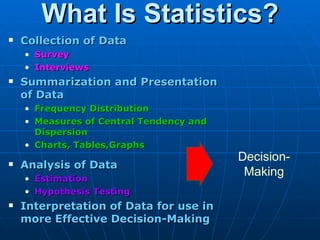
What Is Statistics?
   Collection of Data
    • Survey
    • Interviews
   Summarization and Presentation
    of Data
    • Frequency Distribution
    • Measures of Central Tendency and
      Dispersion
    • Charts, Tables,Graphs
                                         Decision-
   Analysis of Data
    • Estimation
                                          Making
    • Hypothesis Testing
   Interpretation of Data for use in
    more Effective Decision-Making
Descriptive Statistics

   Involves
    • Collecting Data
    • Summarizing Data
    • Presenting Data
   Purpose: Describe Data
Inferential Statistics
    Involves Samples
     • Estimation
     • Hypothesis Testing
    Purpose
     • Make Decisions About
       Population Characteristics
       Based on a Sample
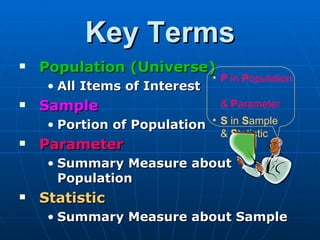
Key Terms
   Population (Universe)
                               • P in Population
     • All Items of Interest
   Sample                      & Parameter
     • Portion of Population • S in Sample
                                & Statistic
   Parameter
     • Summary Measure about
       Population
   Statistic
     • Summary Measure about Sample
Collection
    of
  Data
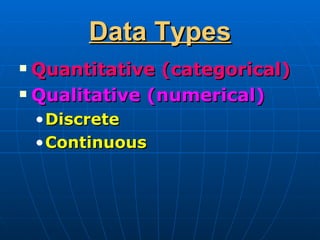
Data Types
 Quantitative (categorical)
 Qualitative (numerical)

    • Discrete
    • Continuous
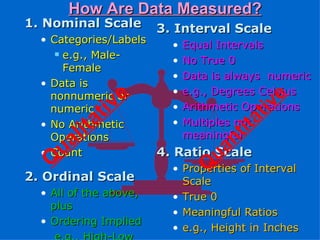
How Are Data Measured?
1. Nominal Scale       3. Interval Scale
   • Categories/Labels
                          • Equal Intervals
       e.g., Male-
                          • No True 0
        Female
                          • Data is always numeric
   • Data is
     nonnumeric or
                v e       • e.g., Degrees Celsius
                                                v e
     numeric
              ti                              ti
                          • Arithmetic Operations
                                           ta
          i ta
   • No Arithmetic
         l                              ti
                          • Multiples not
        a
     Operations                     n
                            meaningful
                                   a
      u
   • Count                       u
                       4. Ratio Scale
    Q                          Q
                          • Properties of Interval
2. Ordinal Scale            Scale
   • All of the above,    • True 0
     plus
                          • Meaningful Ratios
   • Ordering Implied
                          • e.g., Height in Inches
Summarization
     and
 Presentation
      of
    Data
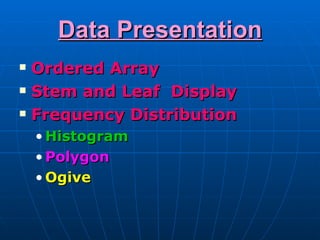
Data Presentation
   Ordered Array
   Stem and Leaf Display
   Frequency Distribution
    • Histogram
    • Polygon
    • Ogive
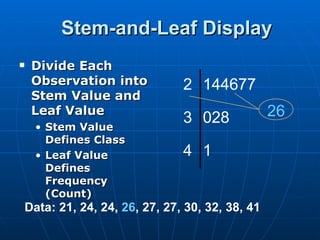
Stem-and-Leaf Display
   Divide Each
    Observation into         2 144677
    Stem Value and
    Leaf Value
                             3 028             26
    • Stem Value
      Defines Class
    • Leaf Value             4 1
      Defines
      Frequency
      (Count)
Data: 21, 24, 24, 26, 27, 27, 30, 32, 38, 41
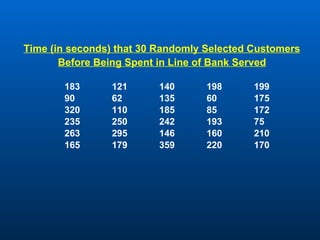
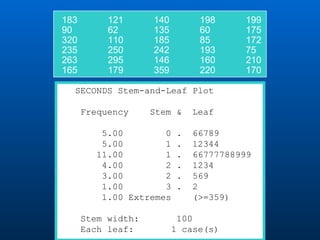
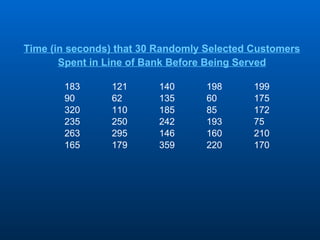
Time (in seconds) that 30 Randomly Selected Customers
       Before Being Spent in Line of Bank Served

       183      121      140       198      199
       90       62       135       60       175
       320      110      185       85       172
       235      250      242       193      75
       263      295      146       160      210
       165      179      359       220      170
183        121      140         198      199
90         62       135         60       175
320        110      185         85       172
235        250      242         193      75
263        295      146         160      210
165        179      359         220      170

  SECONDS Stem-and-Leaf Plot

      Frequency     Stem &     Leaf

         5.00        0     .   66789
         5.00        1     .   12344
        11.00        1     .   66777788999
         4.00        2     .   1234
         3.00        2     .   569
         1.00        3     .   2
         1.00 Extremes         (>=359)

      Stem width:          100
      Each leaf:          1 case(s)
Frequency Distribution Table
            Example
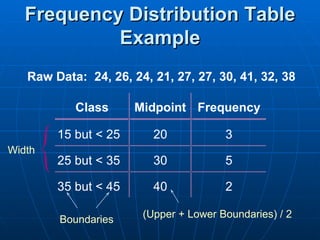
   Raw Data: 24, 26, 24, 21, 27, 27, 30, 41, 32, 38

           Class      Midpoint Frequency

        15 but < 25      20            3
Width
        25 but < 35      30            5

        35 but < 45      40            2

                       (Upper + Lower Boundaries) / 2
        Boundaries
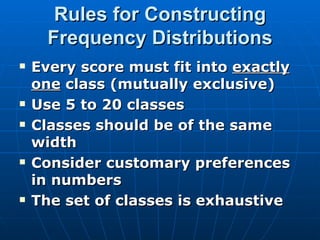
Rules for Constructing
      Frequency Distributions
   Every score must fit into exactly
    one class (mutually exclusive)
   Use 5 to 20 classes
   Classes should be of the same
    width
   Consider customary preferences
    in numbers
   The set of classes is exhaustive
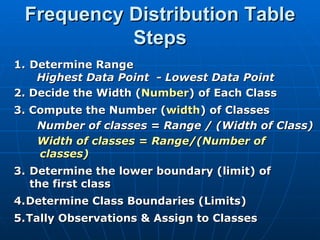
Frequency Distribution Table
           Steps
1. Determine Range
    Highest Data Point - Lowest Data Point
2. Decide the Width (Number) of Each Class
3. Compute the Number (width) of Classes
    Number of classes = Range / (Width of Class)
    Width of classes = Range/(Number of
    classes)
3. Determine the lower boundary (limit) of
   the first class
4. Determine Class Boundaries (Limits)
5. Tally Observations & Assign to Classes
Time (in seconds) that 30 Randomly Selected Customers
       Spent in Line of Bank Before Being Served

       183      121      140       198      199
       90       62       135       60       175
       320      110      185       85       172
       235      250      242       193      75
       263      295      146       160      210
       165      179      359       220      170
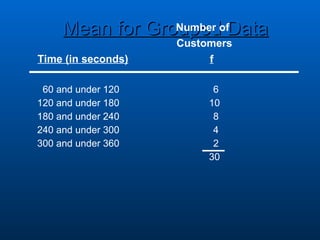
Mean for GroupedofData
                 Number
                    Customers
Time (in seconds)        f

 60 and under 120         6
120 and under 180        10
180 and under 240         8
240 and under 300         4
300 and under 360         2
                         30
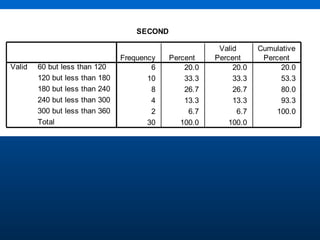
SECOND

                                                         Valid       Cumulative
                                Frequency    Percent    Percent       Percent
Valid   60 but less than 120            6        20.0        20.0         20.0
        120 but less than 180          10        33.3        33.3         53.3
        180 but less than 240           8        26.7        26.7         80.0
        240 but less than 300           4        13.3        13.3         93.3
        300 but less than 360           2         6.7          6.7       100.0
        Total                          30       100.0      100.0
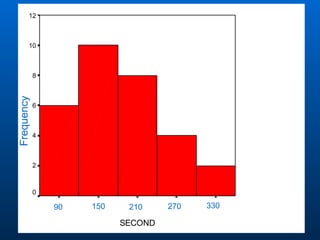
12


        10


            8
Frequency


            6


            4


            2                                   Std. Dev = 1.17
                                                Mean = 3

            0                                   N = 30.00
                1     2      3       4      5
                90   150    210     270   330

                           SECOND
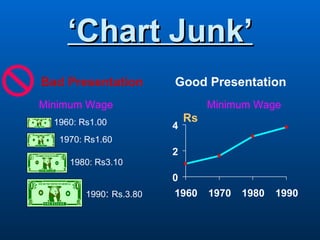
‘Chart Junk’
Bad Presentation         Good Presentation
Minimum Wage                      Minimum Wage
  1960: Rs1.00               Rs
                         4
   1970: Rs1.60
                         2
     1980: Rs3.10
                         0
         1990: Rs.3.80   1960     1970   1980   1990
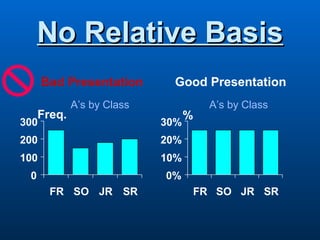
No Relative Basis
      Bad Presentation        Good Presentation
             A’s by Class             A’s by Class
     Freq.                        %
300                         30%
200                         20%
100                         10%
 0                          0%
       FR SO JR SR                FR SO JR SR
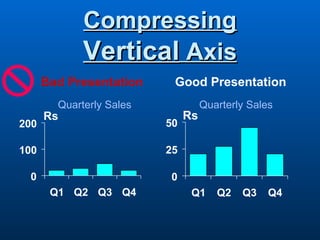
Compressing
             Vertical Axis
      Bad Presentation     Good Presentation
        Quarterly Sales             Quarterly Sales
      Rs                       Rs
200                       50

100                       25

 0                        0
       Q1 Q2 Q3 Q4              Q1     Q2   Q3    Q4
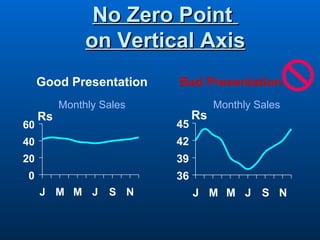
No Zero Point
               on Vertical Axis
     Good Presentation    Bad Presentation
          Monthly Sales             Monthly Sales
     Rs                        Rs
60                        45
40                        42
20                        39
0                         36
     J M M J       S N         J M M J S N
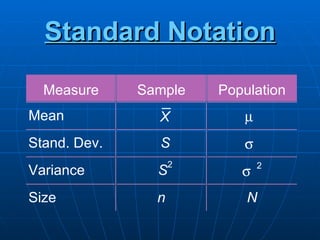
Standard Notation

  Measure     Sample    Population
Mean            X         µ
Stand. Dev.     S          σ
                    2          2
Variance        S          σ
Size            n           N
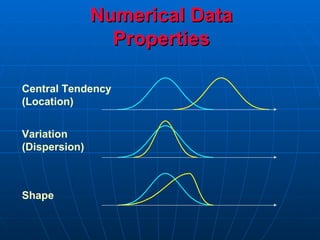
Numerical Data
                 Properties

Central Tendency
(Location)


Variation
(Dispersion)


Shape
Measures of Central
    Tendency
       for
 Ungrouped Data
     Raw Data
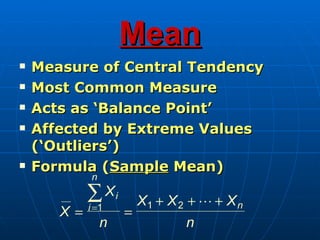
Mean
   Measure of Central Tendency
   Most Common Measure
   Acts as ‘Balance Point’
   Affected by Extreme Values
    (‘Outliers’)
   Formula (Sample Mean)
             n

            ∑ Xi         X1 + X 2 +  + X n
            i =1
       X=            =
                 n               n
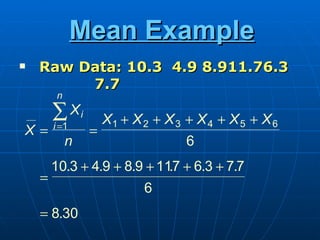
Mean Example
   Raw Data: 10.3 4.9 8.911.76.3
         7.7
         n

        ∑ Xi         X1 + X 2 + X 3 + X 4 + X 5 + X 6
        i =1
X=               =
             n                      6
        10.3 + 4.9 + 8.9 + 117 + 6.3 + 7.7
                             .
    =
                            6
    = 8.30
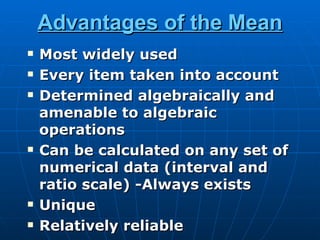
Advantages of the Mean
   Most widely used
   Every item taken into account
   Determined algebraically and
    amenable to algebraic
    operations
   Can be calculated on any set of
    numerical data (interval and
    ratio scale) -Always exists
   Unique
   Relatively reliable
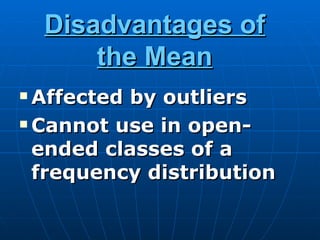
Disadvantages of
        the Mean
 Affected by outliers
 Cannot use in open-

  ended classes of a
  frequency distribution
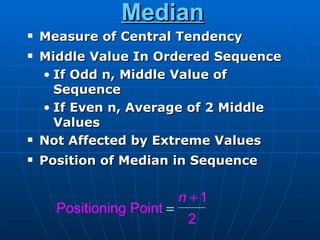
Median
   Measure of Central Tendency
   Middle Value In Ordered Sequence
    • If Odd n, Middle Value of
      Sequence
    • If Even n, Average of 2 Middle
      Values
   Not Affected by Extreme Values
   Position of Median in Sequence

                            n +1
      Positioning Point =
                g
                             2
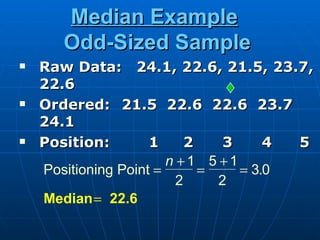
Median Example
       Odd-Sized Sample
   Raw Data: 24.1, 22.6, 21.5, 23.7,
    22.6
   Ordered: 21.5 22.6 22.6 23.7
    24.1
   Position:        1      2    3     4 5
                        n +1 5 +1
    Positioning Point =       =    = 3.0
                          2     2
    Median = 22.6
Median Example
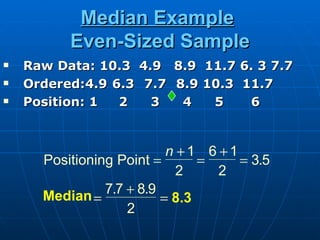
          Even-Sized Sample
   Raw Data: 10.3 4.9 8.9 11.7 6. 3 7.7
   Ordered:4.9 6.3 7.7 8.9 10.3 11.7
   Position: 1  2   3   4   5    6


                           n +1 6 +1
      Positioning Point =       =    = 3.5
                             2    2
      Median =  7.7 + 8.9
                          = 8.3
                    2
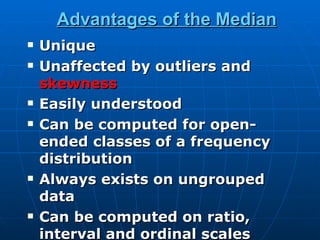
Advantages of the Median
   Unique
   Unaffected by outliers and
    skewness
   Easily understood
   Can be computed for open-
    ended classes of a frequency
    distribution
   Always exists on ungrouped
    data
   Can be computed on ratio,
    interval and ordinal scales
Disadvantages of
        Median
 Requires an ordered array
 No arithmetic properties
Mode
   Measure of Central Tendency
   Value That Occurs Most Often
   Not Affected by Extreme Values
   May Be No Mode or Several
    Modes
   May Be Used for Numerical &
    Categorical Data
Advantages of Mode
 Easily understood
 Not affected by outliers

 Useful with qualitative

  problems
 May indicate a bimodal

  distribution
Disadvantages of
         Mode
 May not exist
 Not unique

 No arithmetic

  properties
 Least accurate
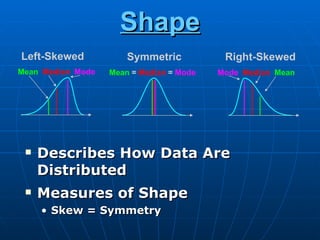
Shape
Left-Skewed            Symmetric           Right-Skewed
Mean Median Mode   Mean = Median = Mode   Mode Median Mean


    Describes How Data Are
     Distributed
    Measures of Shape
     • Skew = Symmetry
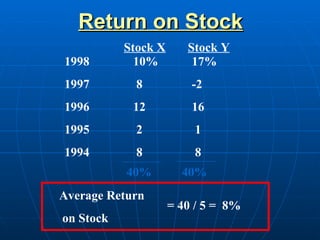
Return on Stock
           Stock X      Stock Y
1998         10%         17%
1997         8           -2
1996        12           16
1995         2           1
1994         8           8
           40%         40%
Average Return
                     = 40 / 5 = 8%
on Stock
Measures of
  Dispersion
      for
Ungrouped Data
   Raw Data
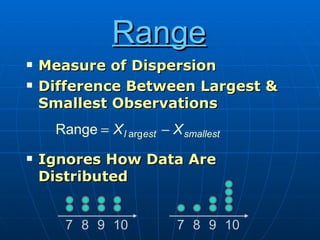
Range
   Measure of Dispersion
   Difference Between Largest &
    Smallest Observations
      Range = X l arg est − X smallest
   Ignores How Data Are
    Distributed


       7 8 9 10              7 8 9 10
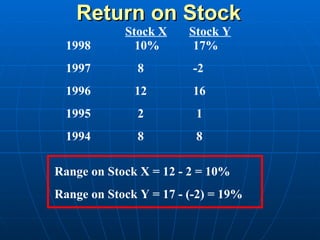
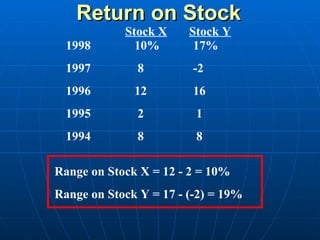
Return on Stock
            Stock X     Stock Y
  1998        10%        17%
  1997         8         -2
  1996        12         16
  1995         2         1
  1994         8         8

Range on Stock X = 12 - 2 = 10%
Range on Stock Y = 17 - (-2) = 19%
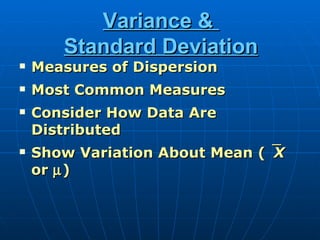
Variance &
       Standard Deviation
   Measures of Dispersion
   Most Common Measures
   Consider How Data Are
    Distributed
   Show Variation About Mean ( X
    or µ )
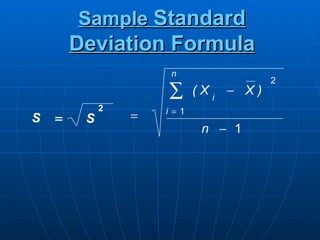
Sample Standard
        Deviation Formula
                      n
                                       2
                     ∑      (Xi − X)
             2       i =1
S   =    S       =
                             n − 1
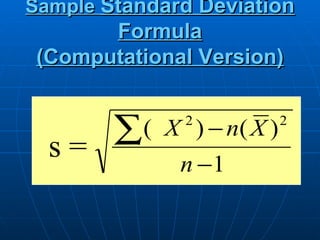
Sample Standard Deviation
       Formula
 (Computational Version)


  s= ∑(     X ) − n( X )
              2            2


              n −1
Return on Stock
            Stock X     Stock Y
  1998        10%        17%
  1997         8         -2
  1996        12         16
  1995         2         1
  1994         8         8

Range on Stock X = 12 - 2 = 10%
Range on Stock Y = 17 - (-2) = 19%
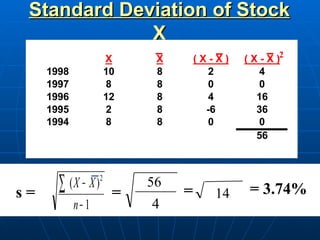
Standard Deviation of Stock
             X
                        X     X       (X-X)   ( X - X )2
     1998               10    8         2         4
     1997               8     8         0         0
     1996               12    8         4        16
     1995               2     8         -6       36
     1994               8     8         0         0
                                                 56


s=     ∑ (X − X )   2
                         =
                             56
                                  =      14    = 3.74%
            n− 1             4
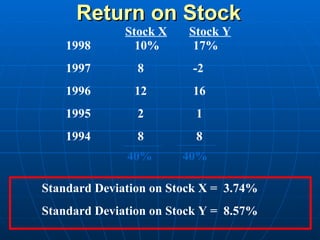
Return on Stock
              Stock X    Stock Y
    1998        10%       17%
    1997        8        -2
    1996       12        16
    1995        2         1
    1994        8         8
              40%       40%

Standard Deviation on Stock X = 3.74%
Standard Deviation on Stock Y = 8.57%
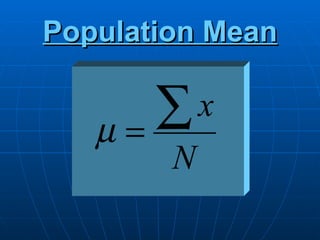
Population Mean


   µ=   ∑ x
        N
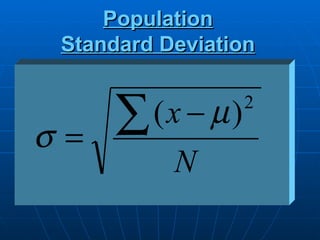
Population
 Standard Deviation


σ=   ∑ (x − µ)   2


           N
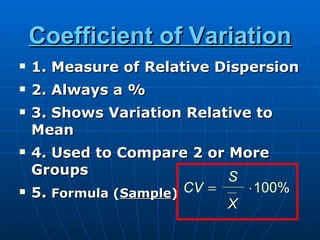
Coefficient of Variation
   1. Measure of Relative Dispersion
   2. Always a %
   3. Shows Variation Relative to
    Mean
   4. Used to Compare 2 or More
    Groups                   S
   5. Formula (Sample) CV =   ⋅100%
                             X
Population
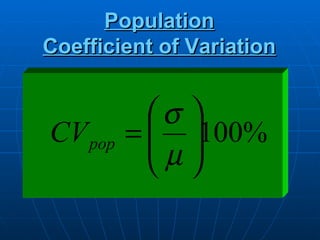
Coefficient of Variation


           σ 
CV pop   =  100%
           µ
            
Example
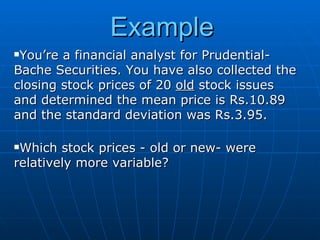
You’re a financial analyst for Prudential-
Bache Securities. You have also collected the
closing stock prices of 20 old stock issues
and determined the mean price is Rs.10.89
and the standard deviation was Rs.3.95.

Which stock prices - old or new- were
relatively more variable?
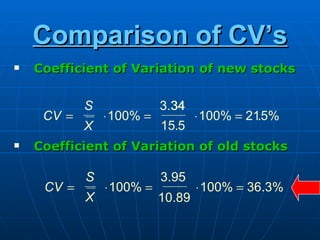
Comparison of CV’s
   Coefficient of Variation of new stocks

            S              3.34
                             34
     CV =       ⋅ 100% =           ⋅ 100% = 215%
                                              .
            X              15.5
   Coefficient of Variation of old stocks

            S              3.95
     CV =       ⋅ 100% =           ⋅ 100% = 36.3%
            X              10.89
Staisticsii

  • 1.
  • 3.
    What Is Statistics?  Collection of Data • Survey • Interviews  Summarization and Presentation of Data • Frequency Distribution • Measures of Central Tendency and Dispersion • Charts, Tables,Graphs Decision-  Analysis of Data • Estimation Making • Hypothesis Testing  Interpretation of Data for use in more Effective Decision-Making
  • 4.
    Descriptive Statistics  Involves • Collecting Data • Summarizing Data • Presenting Data  Purpose: Describe Data
  • 5.
    Inferential Statistics  Involves Samples • Estimation • Hypothesis Testing  Purpose • Make Decisions About Population Characteristics Based on a Sample
  • 6.
    Key Terms  Population (Universe) • P in Population • All Items of Interest  Sample & Parameter • Portion of Population • S in Sample & Statistic  Parameter • Summary Measure about Population  Statistic • Summary Measure about Sample
  • 7.
    Collection of Data
  • 8.
    Data Types  Quantitative(categorical)  Qualitative (numerical) • Discrete • Continuous
  • 9.
    How Are DataMeasured? 1. Nominal Scale 3. Interval Scale • Categories/Labels • Equal Intervals  e.g., Male- • No True 0 Female • Data is always numeric • Data is nonnumeric or v e • e.g., Degrees Celsius v e numeric ti ti • Arithmetic Operations ta i ta • No Arithmetic l ti • Multiples not a Operations n meaningful a u • Count u 4. Ratio Scale Q Q • Properties of Interval 2. Ordinal Scale Scale • All of the above, • True 0 plus • Meaningful Ratios • Ordering Implied • e.g., Height in Inches
  • 10.
    Summarization and Presentation of Data
  • 11.
    Data Presentation  Ordered Array  Stem and Leaf Display  Frequency Distribution • Histogram • Polygon • Ogive
  • 12.
    Stem-and-Leaf Display  Divide Each Observation into 2 144677 Stem Value and Leaf Value 3 028 26 • Stem Value Defines Class • Leaf Value 4 1 Defines Frequency (Count) Data: 21, 24, 24, 26, 27, 27, 30, 32, 38, 41
  • 13.
    Time (in seconds)that 30 Randomly Selected Customers Before Being Spent in Line of Bank Served 183 121 140 198 199 90 62 135 60 175 320 110 185 85 172 235 250 242 193 75 263 295 146 160 210 165 179 359 220 170
  • 14.
    183 121 140 198 199 90 62 135 60 175 320 110 185 85 172 235 250 242 193 75 263 295 146 160 210 165 179 359 220 170 SECONDS Stem-and-Leaf Plot Frequency Stem & Leaf 5.00 0 . 66789 5.00 1 . 12344 11.00 1 . 66777788999 4.00 2 . 1234 3.00 2 . 569 1.00 3 . 2 1.00 Extremes (>=359) Stem width: 100 Each leaf: 1 case(s)
  • 15.
    Frequency Distribution Table Example Raw Data: 24, 26, 24, 21, 27, 27, 30, 41, 32, 38 Class Midpoint Frequency 15 but < 25 20 3 Width 25 but < 35 30 5 35 but < 45 40 2 (Upper + Lower Boundaries) / 2 Boundaries
  • 16.
    Rules for Constructing Frequency Distributions  Every score must fit into exactly one class (mutually exclusive)  Use 5 to 20 classes  Classes should be of the same width  Consider customary preferences in numbers  The set of classes is exhaustive
  • 17.
    Frequency Distribution Table Steps 1. Determine Range Highest Data Point - Lowest Data Point 2. Decide the Width (Number) of Each Class 3. Compute the Number (width) of Classes Number of classes = Range / (Width of Class) Width of classes = Range/(Number of classes) 3. Determine the lower boundary (limit) of the first class 4. Determine Class Boundaries (Limits) 5. Tally Observations & Assign to Classes
  • 18.
    Time (in seconds)that 30 Randomly Selected Customers Spent in Line of Bank Before Being Served 183 121 140 198 199 90 62 135 60 175 320 110 185 85 172 235 250 242 193 75 263 295 146 160 210 165 179 359 220 170
  • 19.
    Mean for GroupedofData Number Customers Time (in seconds) f 60 and under 120 6 120 and under 180 10 180 and under 240 8 240 and under 300 4 300 and under 360 2 30
  • 20.
    SECOND Valid Cumulative Frequency Percent Percent Percent Valid 60 but less than 120 6 20.0 20.0 20.0 120 but less than 180 10 33.3 33.3 53.3 180 but less than 240 8 26.7 26.7 80.0 240 but less than 300 4 13.3 13.3 93.3 300 but less than 360 2 6.7 6.7 100.0 Total 30 100.0 100.0
  • 21.
    12 10 8 Frequency 6 4 2 Std. Dev = 1.17 Mean = 3 0 N = 30.00 1 2 3 4 5 90 150 210 270 330 SECOND
  • 22.
    ‘Chart Junk’ Bad Presentation Good Presentation Minimum Wage Minimum Wage 1960: Rs1.00 Rs 4 1970: Rs1.60 2 1980: Rs3.10 0 1990: Rs.3.80 1960 1970 1980 1990
  • 23.
    No Relative Basis Bad Presentation Good Presentation A’s by Class A’s by Class Freq. % 300 30% 200 20% 100 10% 0 0% FR SO JR SR FR SO JR SR
  • 24.
    Compressing Vertical Axis Bad Presentation Good Presentation Quarterly Sales Quarterly Sales Rs Rs 200 50 100 25 0 0 Q1 Q2 Q3 Q4 Q1 Q2 Q3 Q4
  • 25.
    No Zero Point on Vertical Axis Good Presentation Bad Presentation Monthly Sales Monthly Sales Rs Rs 60 45 40 42 20 39 0 36 J M M J S N J M M J S N
  • 26.
    Standard Notation Measure Sample Population Mean X µ Stand. Dev. S σ 2 2 Variance S σ Size n N
  • 27.
    Numerical Data Properties Central Tendency (Location) Variation (Dispersion) Shape
  • 28.
    Measures of Central Tendency for Ungrouped Data Raw Data
  • 29.
    Mean  Measure of Central Tendency  Most Common Measure  Acts as ‘Balance Point’  Affected by Extreme Values (‘Outliers’)  Formula (Sample Mean) n ∑ Xi X1 + X 2 +  + X n i =1 X= = n n
  • 30.
    Mean Example  Raw Data: 10.3 4.9 8.911.76.3 7.7 n ∑ Xi X1 + X 2 + X 3 + X 4 + X 5 + X 6 i =1 X= = n 6 10.3 + 4.9 + 8.9 + 117 + 6.3 + 7.7 . = 6 = 8.30
  • 31.
    Advantages of theMean  Most widely used  Every item taken into account  Determined algebraically and amenable to algebraic operations  Can be calculated on any set of numerical data (interval and ratio scale) -Always exists  Unique  Relatively reliable
  • 32.
    Disadvantages of the Mean  Affected by outliers  Cannot use in open- ended classes of a frequency distribution
  • 33.
    Median  Measure of Central Tendency  Middle Value In Ordered Sequence • If Odd n, Middle Value of Sequence • If Even n, Average of 2 Middle Values  Not Affected by Extreme Values  Position of Median in Sequence n +1 Positioning Point = g 2
  • 34.
    Median Example Odd-Sized Sample  Raw Data: 24.1, 22.6, 21.5, 23.7, 22.6  Ordered: 21.5 22.6 22.6 23.7 24.1  Position: 1 2 3 4 5 n +1 5 +1 Positioning Point = = = 3.0 2 2 Median = 22.6
  • 35.
    Median Example Even-Sized Sample  Raw Data: 10.3 4.9 8.9 11.7 6. 3 7.7  Ordered:4.9 6.3 7.7 8.9 10.3 11.7  Position: 1 2 3 4 5 6 n +1 6 +1 Positioning Point = = = 3.5 2 2 Median = 7.7 + 8.9 = 8.3 2
  • 36.
    Advantages of theMedian  Unique  Unaffected by outliers and skewness  Easily understood  Can be computed for open- ended classes of a frequency distribution  Always exists on ungrouped data  Can be computed on ratio, interval and ordinal scales
  • 37.
    Disadvantages of Median  Requires an ordered array  No arithmetic properties
  • 38.
    Mode  Measure of Central Tendency  Value That Occurs Most Often  Not Affected by Extreme Values  May Be No Mode or Several Modes  May Be Used for Numerical & Categorical Data
  • 39.
    Advantages of Mode Easily understood  Not affected by outliers  Useful with qualitative problems  May indicate a bimodal distribution
  • 40.
    Disadvantages of Mode  May not exist  Not unique  No arithmetic properties  Least accurate
  • 41.
    Shape Left-Skewed Symmetric Right-Skewed Mean Median Mode Mean = Median = Mode Mode Median Mean  Describes How Data Are Distributed  Measures of Shape • Skew = Symmetry
  • 42.
    Return on Stock Stock X Stock Y 1998 10% 17% 1997 8 -2 1996 12 16 1995 2 1 1994 8 8 40% 40% Average Return = 40 / 5 = 8% on Stock
  • 43.
    Measures of Dispersion for Ungrouped Data Raw Data
  • 44.
    Range  Measure of Dispersion  Difference Between Largest & Smallest Observations Range = X l arg est − X smallest  Ignores How Data Are Distributed 7 8 9 10 7 8 9 10
  • 45.
    Return on Stock Stock X Stock Y 1998 10% 17% 1997 8 -2 1996 12 16 1995 2 1 1994 8 8 Range on Stock X = 12 - 2 = 10% Range on Stock Y = 17 - (-2) = 19%
  • 46.
    Variance & Standard Deviation  Measures of Dispersion  Most Common Measures  Consider How Data Are Distributed  Show Variation About Mean ( X or µ )
  • 47.
    Sample Standard Deviation Formula n 2 ∑ (Xi − X) 2 i =1 S = S = n − 1
  • 48.
    Sample Standard Deviation Formula (Computational Version) s= ∑( X ) − n( X ) 2 2 n −1
  • 49.
    Return on Stock Stock X Stock Y 1998 10% 17% 1997 8 -2 1996 12 16 1995 2 1 1994 8 8 Range on Stock X = 12 - 2 = 10% Range on Stock Y = 17 - (-2) = 19%
  • 50.
    Standard Deviation ofStock X X X (X-X) ( X - X )2 1998 10 8 2 4 1997 8 8 0 0 1996 12 8 4 16 1995 2 8 -6 36 1994 8 8 0 0 56 s= ∑ (X − X ) 2 = 56 = 14 = 3.74% n− 1 4
  • 51.
    Return on Stock Stock X Stock Y 1998 10% 17% 1997 8 -2 1996 12 16 1995 2 1 1994 8 8 40% 40% Standard Deviation on Stock X = 3.74% Standard Deviation on Stock Y = 8.57%
  • 52.
    Population Mean µ= ∑ x N
  • 53.
  • 54.
    Coefficient of Variation  1. Measure of Relative Dispersion  2. Always a %  3. Shows Variation Relative to Mean  4. Used to Compare 2 or More Groups S  5. Formula (Sample) CV = ⋅100% X
  • 55.
    Population Coefficient of Variation σ  CV pop =  100% µ  
  • 56.
    Example You’re a financialanalyst for Prudential- Bache Securities. You have also collected the closing stock prices of 20 old stock issues and determined the mean price is Rs.10.89 and the standard deviation was Rs.3.95. Which stock prices - old or new- were relatively more variable?
  • 57.
    Comparison of CV’s  Coefficient of Variation of new stocks S 3.34 34 CV = ⋅ 100% = ⋅ 100% = 215% . X 15.5  Coefficient of Variation of old stocks S 3.95 CV = ⋅ 100% = ⋅ 100% = 36.3% X 10.89