PERCEPTION
• It is the process of receiving information about
& making sense of the world around us.
• It involves deciding which information to
notice, how to categorise this information, &
how to interpret it within the framework of our
existing knowledge.
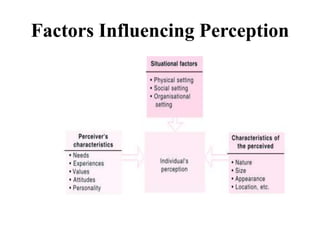
Factors Influencing Perception
FEATURES OF
PERCEPTION Sensory Experience: Perception is our sensory experience of the world
around us and involves both the recognition of environment stimuli and
actions in response to these stimuli.
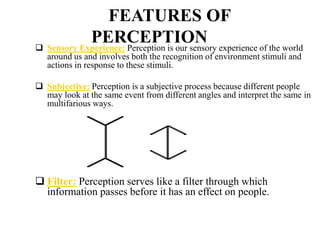
 Subjective: Perception is a subjective process because different people
may look at the same event from different angles and interpret the same in
multifarious ways.
 Filter: Perception serves like a filter through which
information passes before it has an effect on people.
Unique Interpretation: Perception is a unique
interpretation of the situation.
Basis of Human Behavior: There can be no behavior
without perception and perception lies at the base of
every individual behavior.
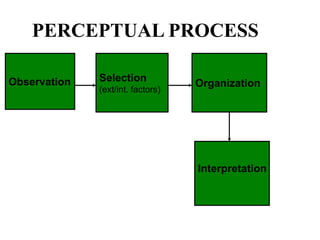
PERCEPTUAL PROCESS
Selection
(ext/int. factors)
Organization
Interpretation
Observation
I. PERCEPTUAL SELECTION
It is a tendency to filter out information
that is discomforting, that seems irrelevant,
or that contradicts one’s values and beliefs.
ATTENTION FACTORS IN
SELECTION
1. EXTERNAL FACTORS
2. INTERNAL FACTORS
EXTERNAL FACTORS
1. SIZE
2. INTENSITY
3. CONTRAST
4. REPETITION
5. MOTION
6. NOVELTY AND
FAMIIARITY
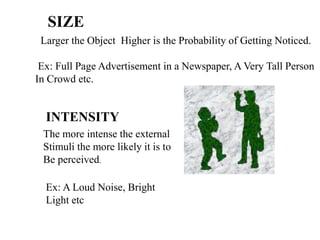
Larger the Object Higher is the Probability of Getting Noticed.
Ex: Full Page Advertisement in a Newspaper, A Very Tall Person
In Crowd etc.
SIZE
INTENSITY
The more intense the external
Stimuli the more likely it is to
Be perceived.
Ex: A Loud Noise, Bright
Light etc
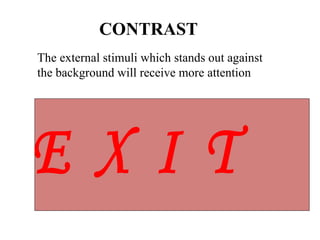
CONTRAST
The external stimuli which stands out against
the background will receive more attention
REPETITION
A repeated stimuli is more attention drawing
than a single one
Ex: Same advertisement or different advertisement
but for the same product shown again & again.
MOTION
An animated sign attracts more attention than a
billboard
NOVELTY AND FAMILIARITY
A new and unique stimulus will often
be perceived more readily than those
Observed on a regular basis.
Ex: an elephant walking along a city street is
noticed instantly.
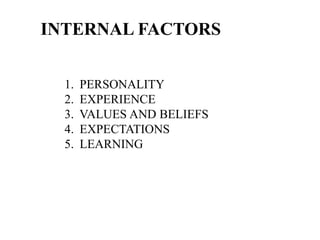
INTERNAL FACTORS
1. PERSONALITY
2. EXPERIENCE
3. VALUES AND BELIEFS
4. EXPECTATIONS
5. LEARNING

Module 2 --perception

  • 1.
    PERCEPTION • It isthe process of receiving information about & making sense of the world around us. • It involves deciding which information to notice, how to categorise this information, & how to interpret it within the framework of our existing knowledge.
  • 2.
  • 3.
    FEATURES OF PERCEPTION SensoryExperience: Perception is our sensory experience of the world around us and involves both the recognition of environment stimuli and actions in response to these stimuli.  Subjective: Perception is a subjective process because different people may look at the same event from different angles and interpret the same in multifarious ways.  Filter: Perception serves like a filter through which information passes before it has an effect on people.
  • 4.
    Unique Interpretation: Perceptionis a unique interpretation of the situation. Basis of Human Behavior: There can be no behavior without perception and perception lies at the base of every individual behavior.
  • 5.
  • 6.
    I. PERCEPTUAL SELECTION Itis a tendency to filter out information that is discomforting, that seems irrelevant, or that contradicts one’s values and beliefs.
  • 7.
    ATTENTION FACTORS IN SELECTION 1.EXTERNAL FACTORS 2. INTERNAL FACTORS EXTERNAL FACTORS 1. SIZE 2. INTENSITY 3. CONTRAST 4. REPETITION 5. MOTION 6. NOVELTY AND FAMIIARITY
  • 8.
    Larger the ObjectHigher is the Probability of Getting Noticed. Ex: Full Page Advertisement in a Newspaper, A Very Tall Person In Crowd etc. SIZE INTENSITY The more intense the external Stimuli the more likely it is to Be perceived. Ex: A Loud Noise, Bright Light etc
  • 9.
    CONTRAST The external stimuliwhich stands out against the background will receive more attention
  • 10.
    REPETITION A repeated stimuliis more attention drawing than a single one Ex: Same advertisement or different advertisement but for the same product shown again & again. MOTION An animated sign attracts more attention than a billboard
  • 11.
    NOVELTY AND FAMILIARITY Anew and unique stimulus will often be perceived more readily than those Observed on a regular basis. Ex: an elephant walking along a city street is noticed instantly.
  • 12.
    INTERNAL FACTORS 1. PERSONALITY 2.EXPERIENCE 3. VALUES AND BELIEFS 4. EXPECTATIONS 5. LEARNING