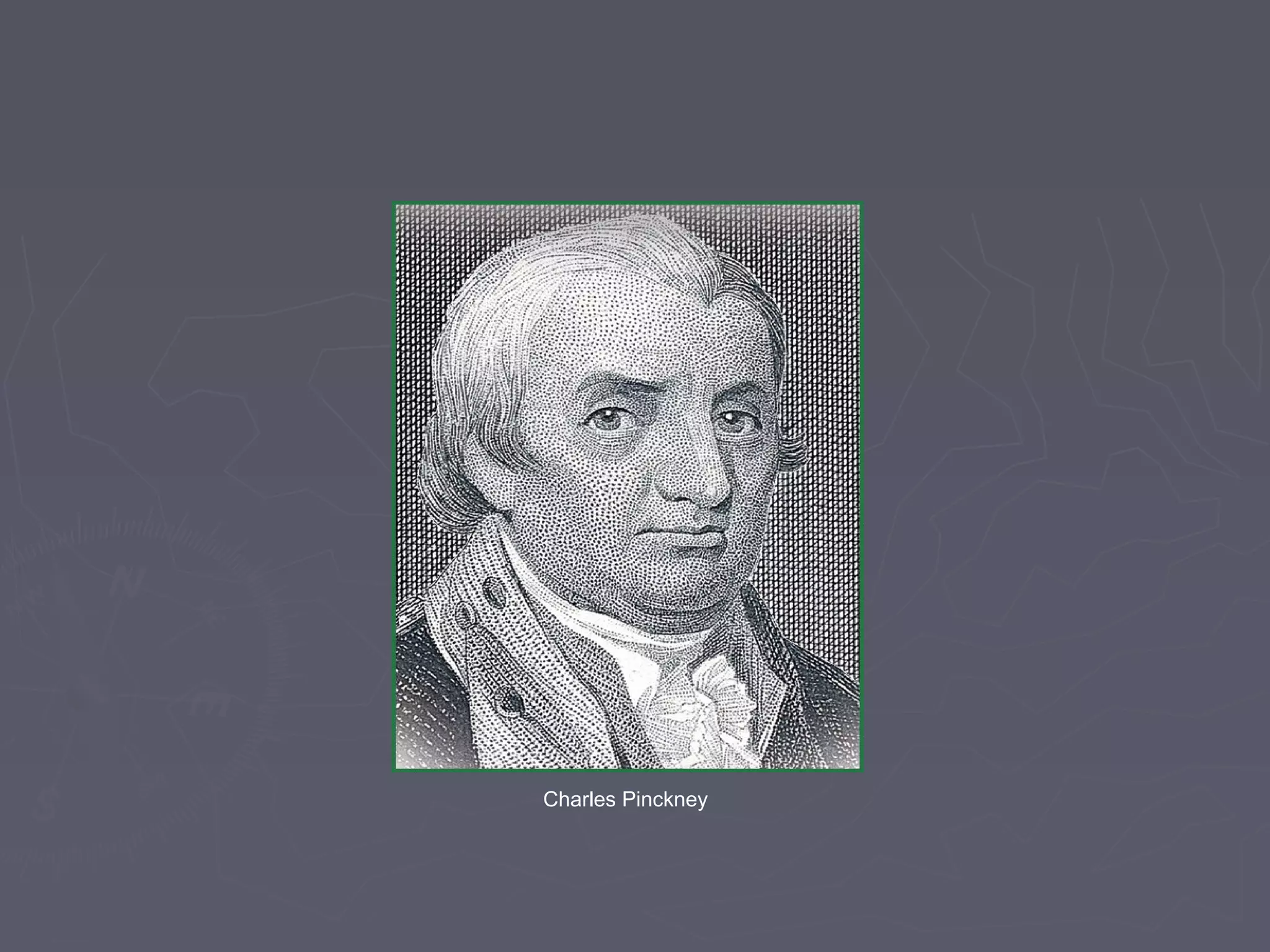
Charles Pinckney
Who Attended the Constitutional
Convention?
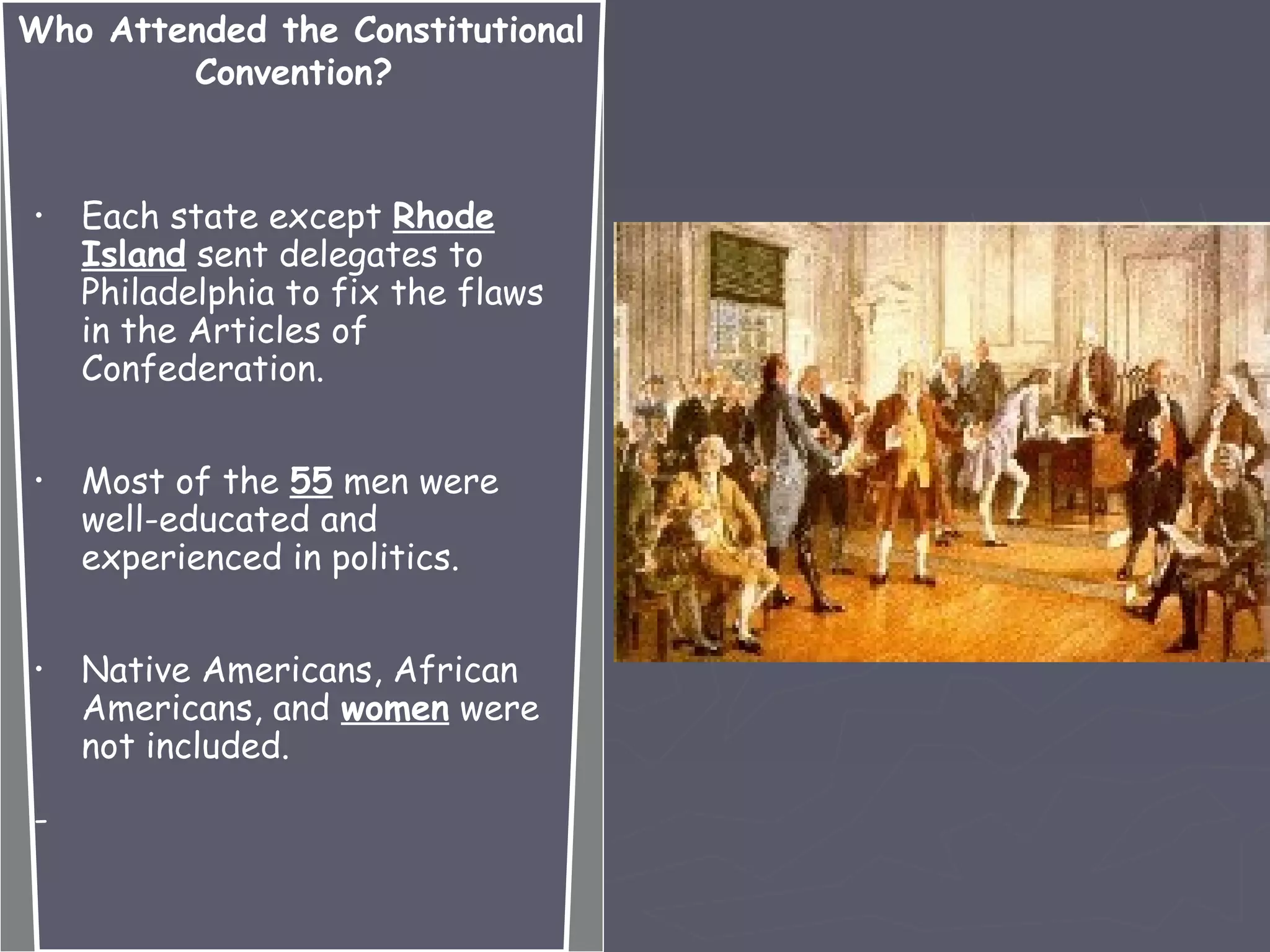
• Each state except Rhode
Island sent delegates to
Philadelphia to fix the flaws
in the Articles of
Confederation.
• Most of the 55 men were
well-educated and
experienced in politics.
• Native Americans, African
Americans, and women were
not included.
-
Who Attended the
Constitutional Convention?
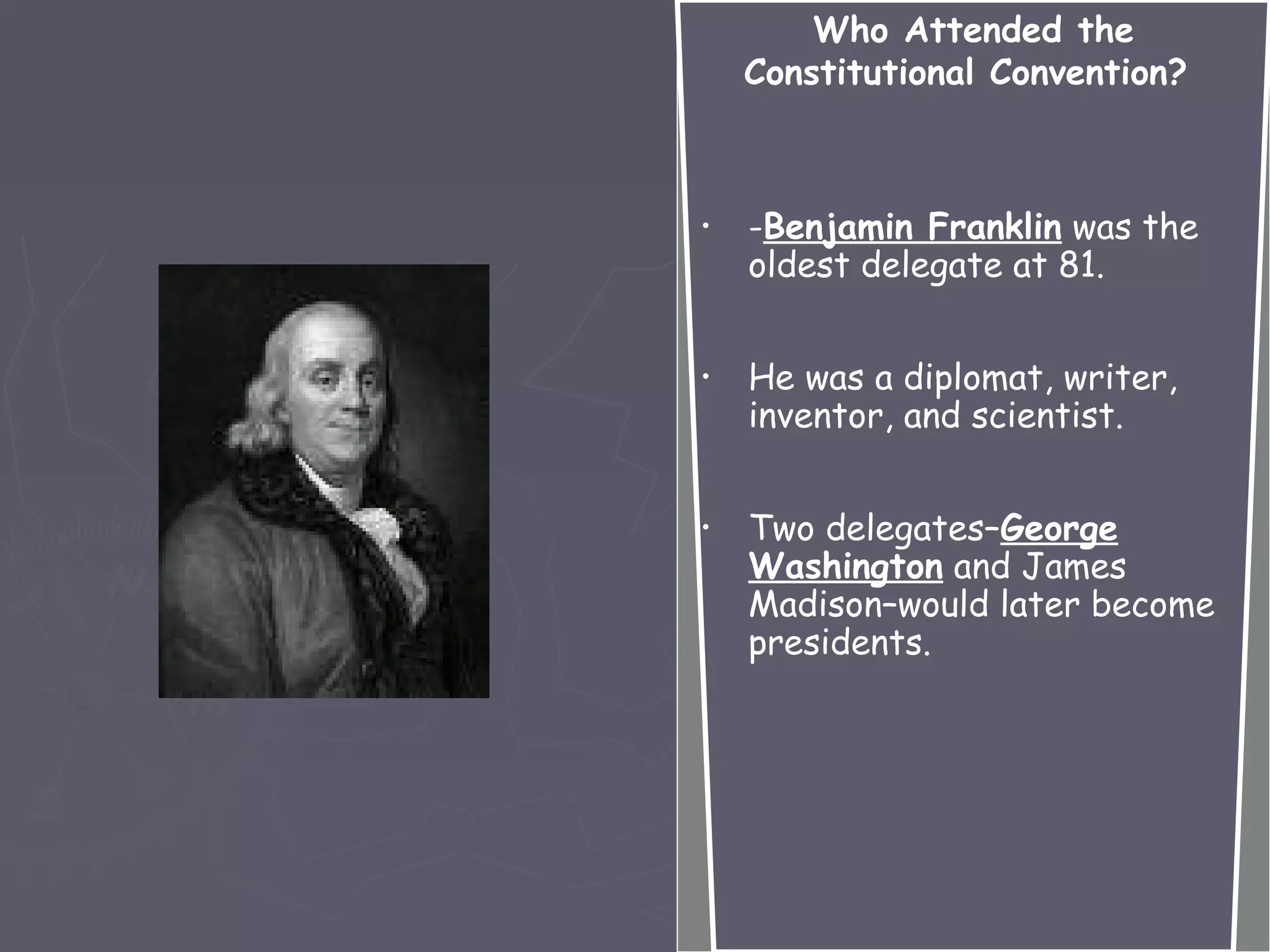
• -Benjamin Franklin was the
oldest delegate at 81.
• He was a diplomat, writer,
inventor, and scientist.
• Two delegates–George
Washington and James
Madison–would later become
presidents.
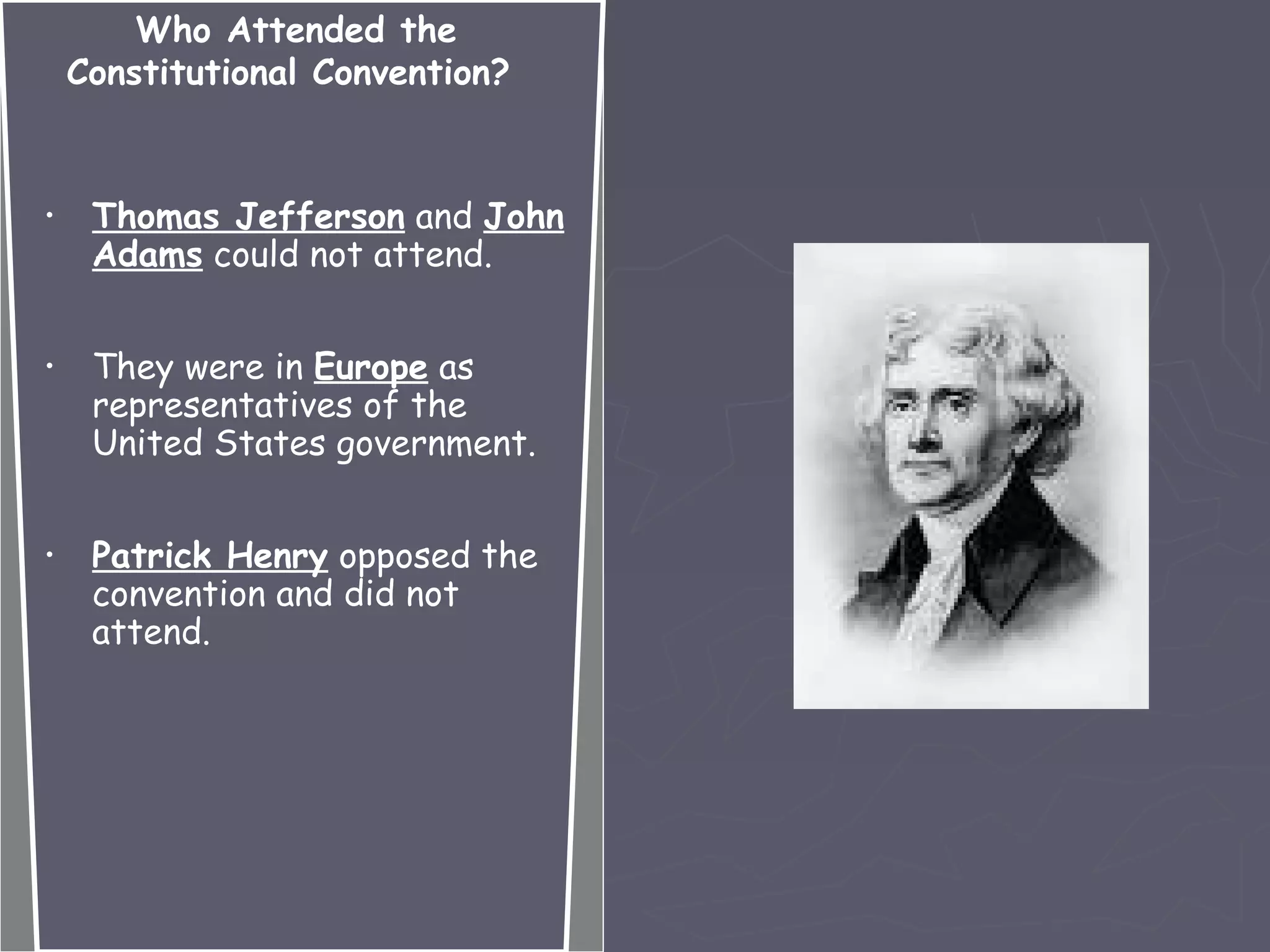
• Thomas Jefferson and John
Adams could not attend.
• They were in Europe as
representatives of the
United States government.
• Patrick Henry opposed the
convention and did not
attend.
Who Attended the
Constitutional Convention?
What Decisions Where Made?
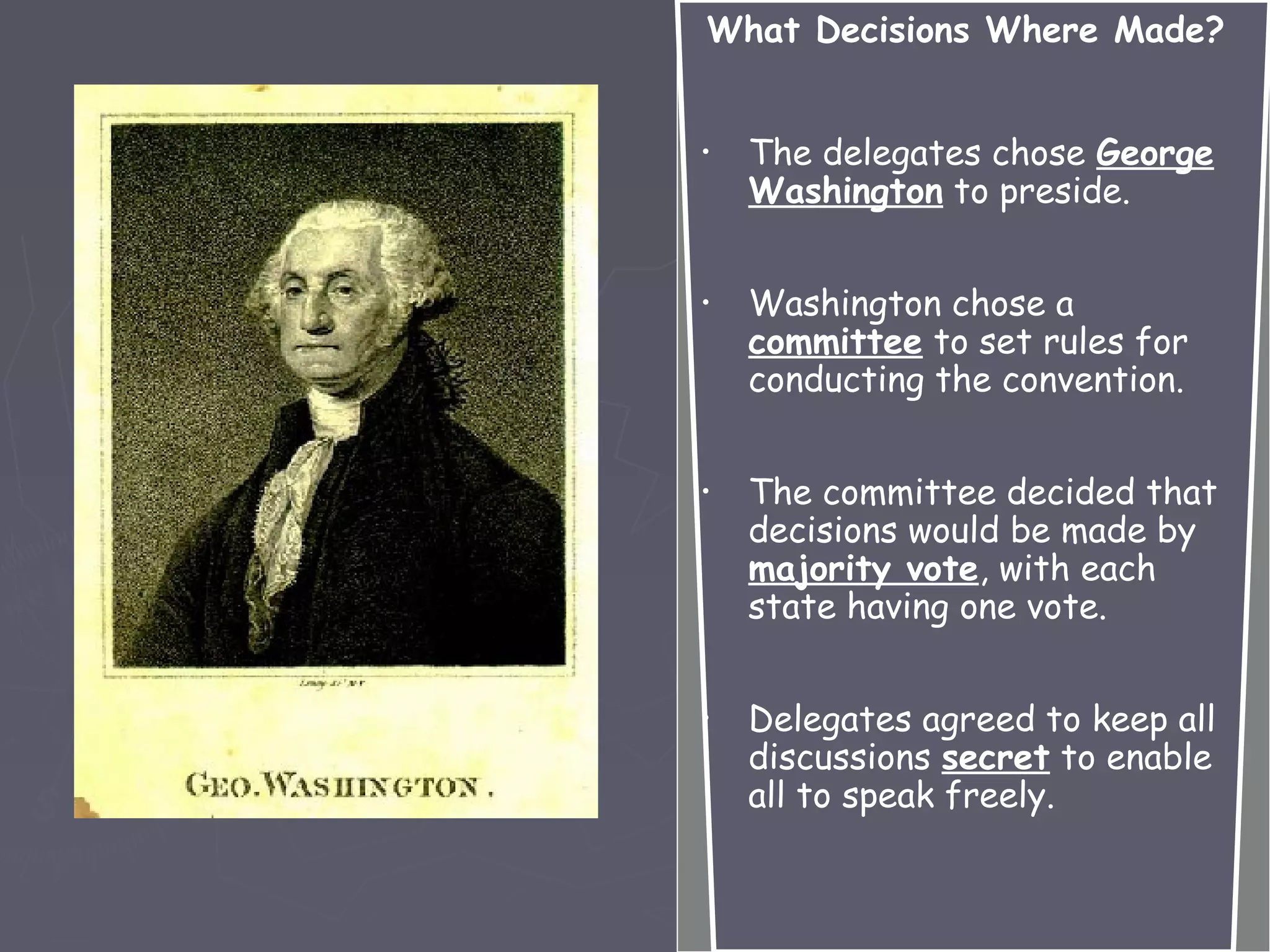
• The delegates chose George
Washington to preside.
• Washington chose a
committee to set rules for
conducting the convention.
• The committee decided that
decisions would be made by
majority vote, with each
state having one vote.
• Delegates agreed to keep all
discussions secret to enable
all to speak freely.
• No formal records were kept.
•
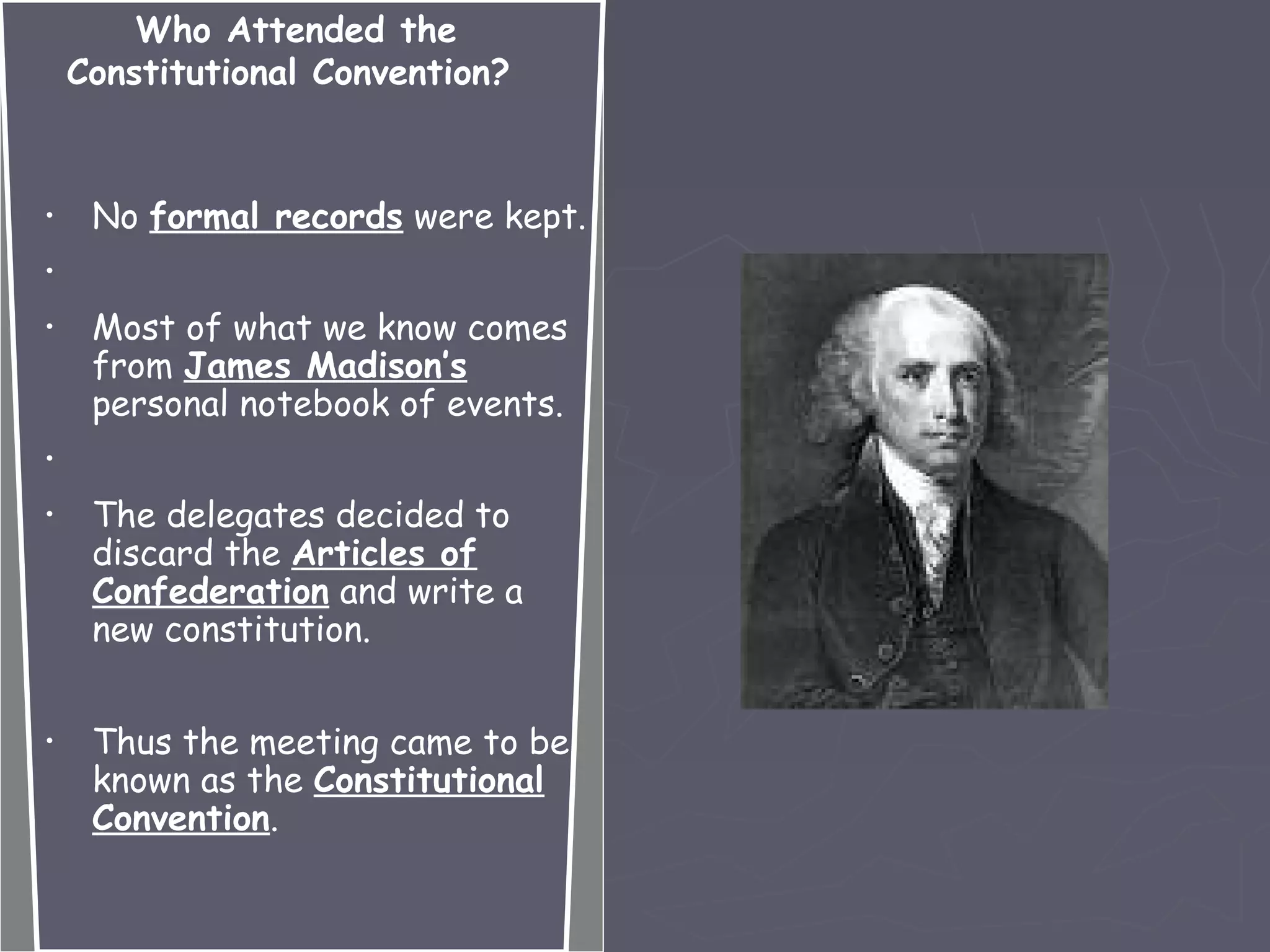
• Most of what we know comes
from James Madison’s
personal notebook of events.
•
• The delegates decided to
discard the Articles of
Confederation and write a
new constitution.
• Thus the meeting came to be
known as the Constitutional
Convention.
Who Attended the
Constitutional Convention?
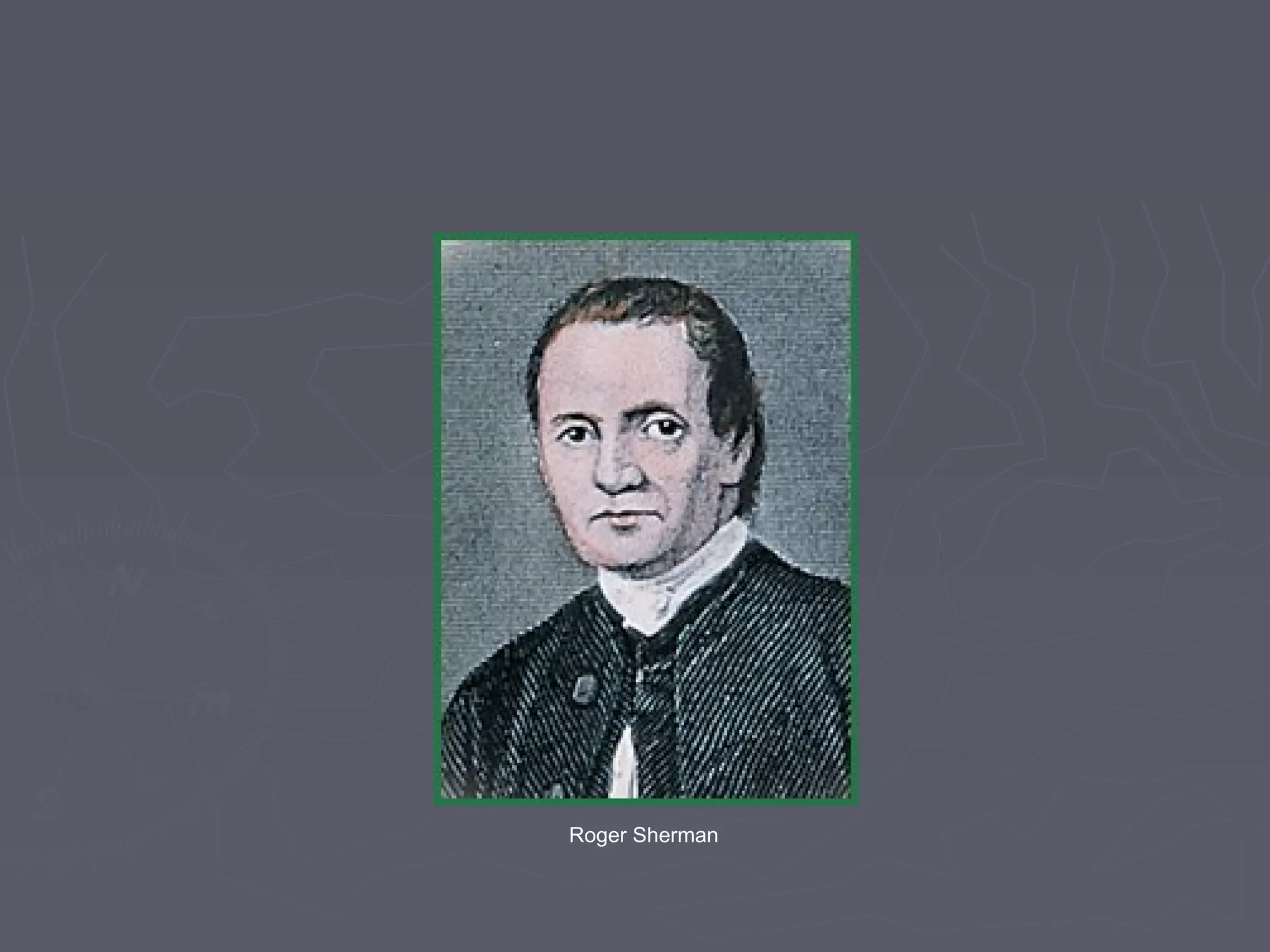
Roger Sherman
What Were the Two
Opposing Plans?
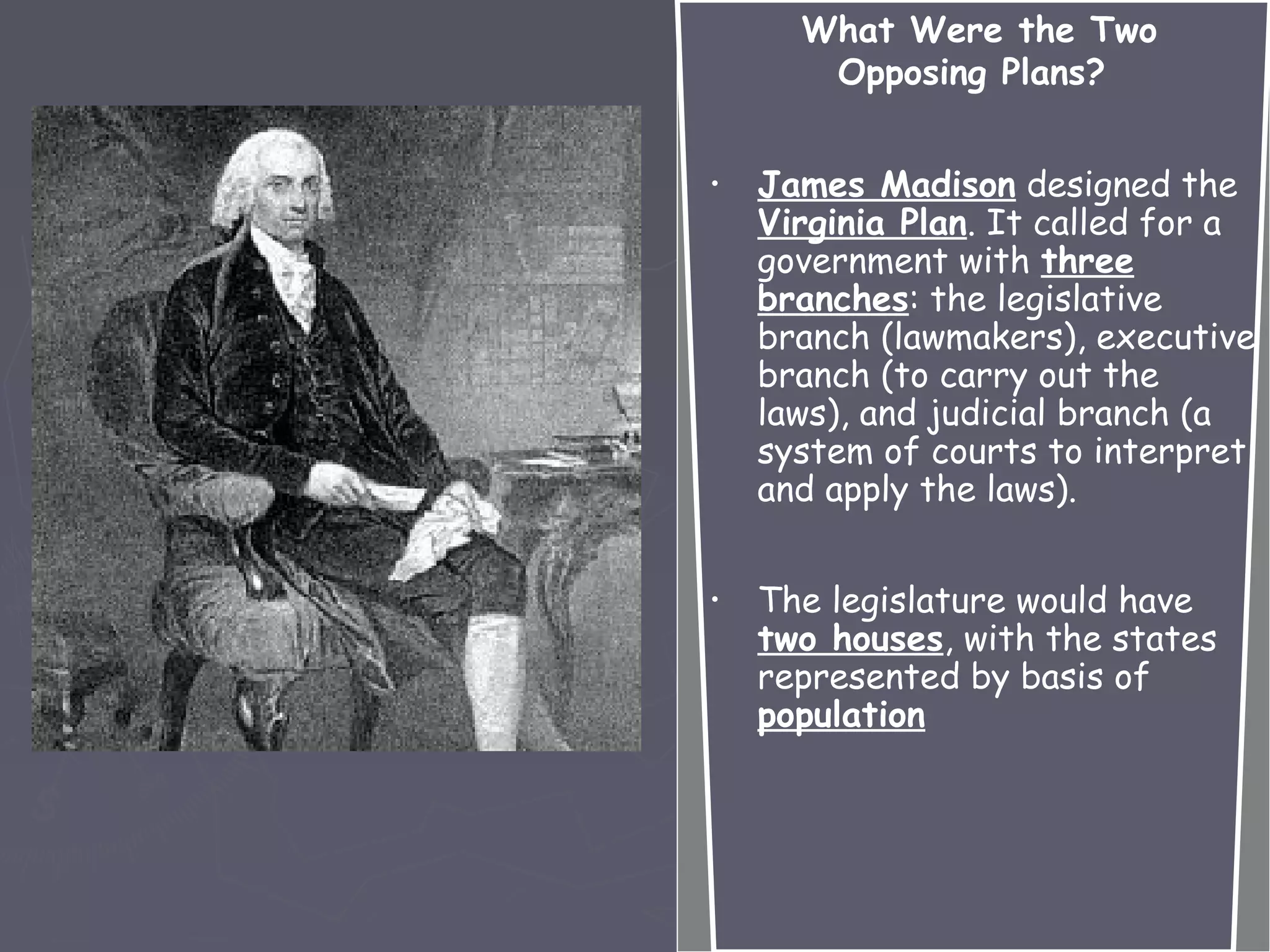
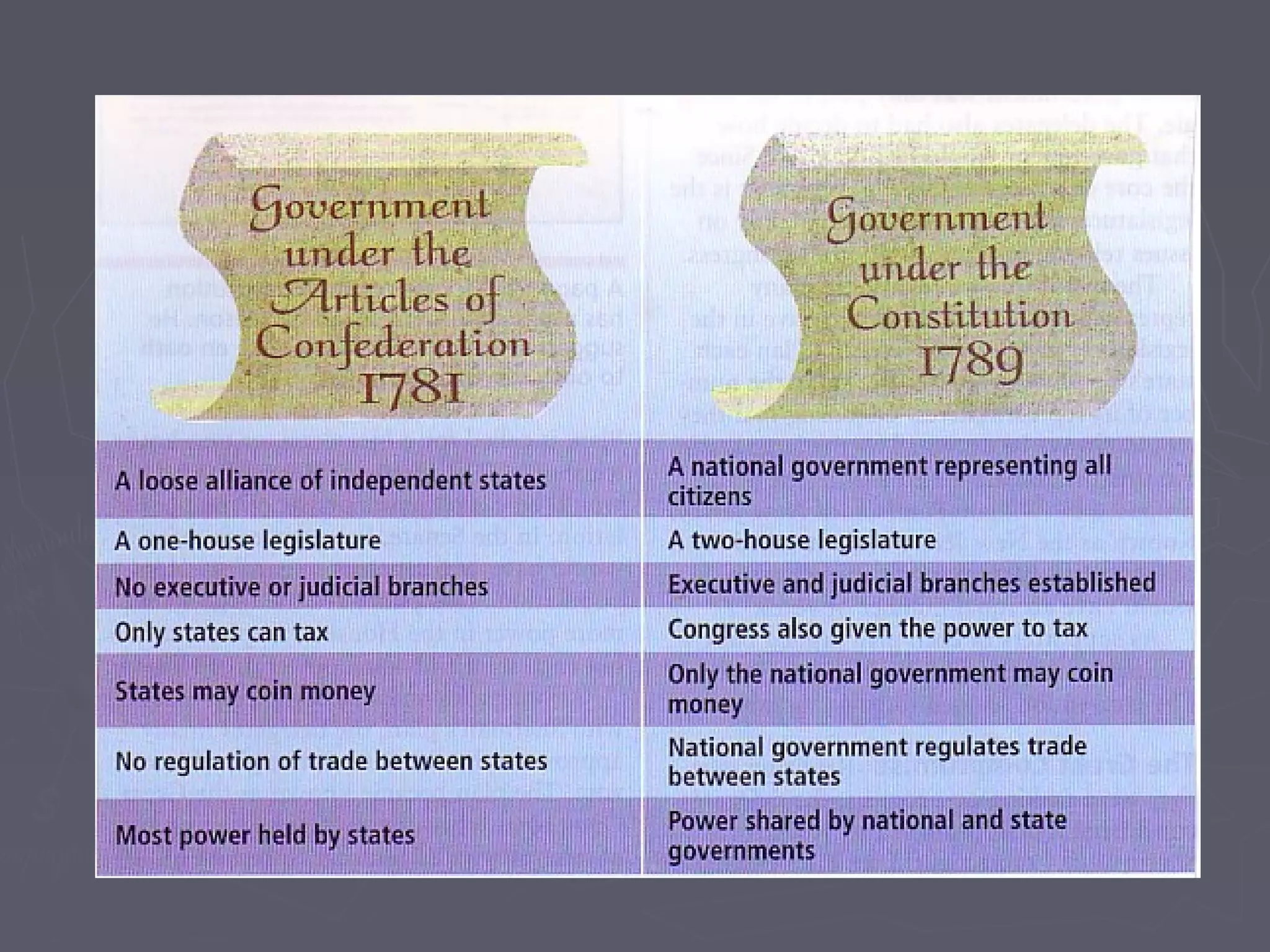
• James Madison designed the
Virginia Plan. It called for a
government with three
branches: the legislative
branch (lawmakers), executive
branch (to carry out the
laws), and judicial branch (a
system of courts to interpret
and apply the laws).
• The legislature would have
two houses, with the states
represented by basis of
population
What Were the Two Opposing
Plans?
• The Virginia Plan appealed
to the large states.
• The small states feared a
government dominated by
large states would ignore
their interests.
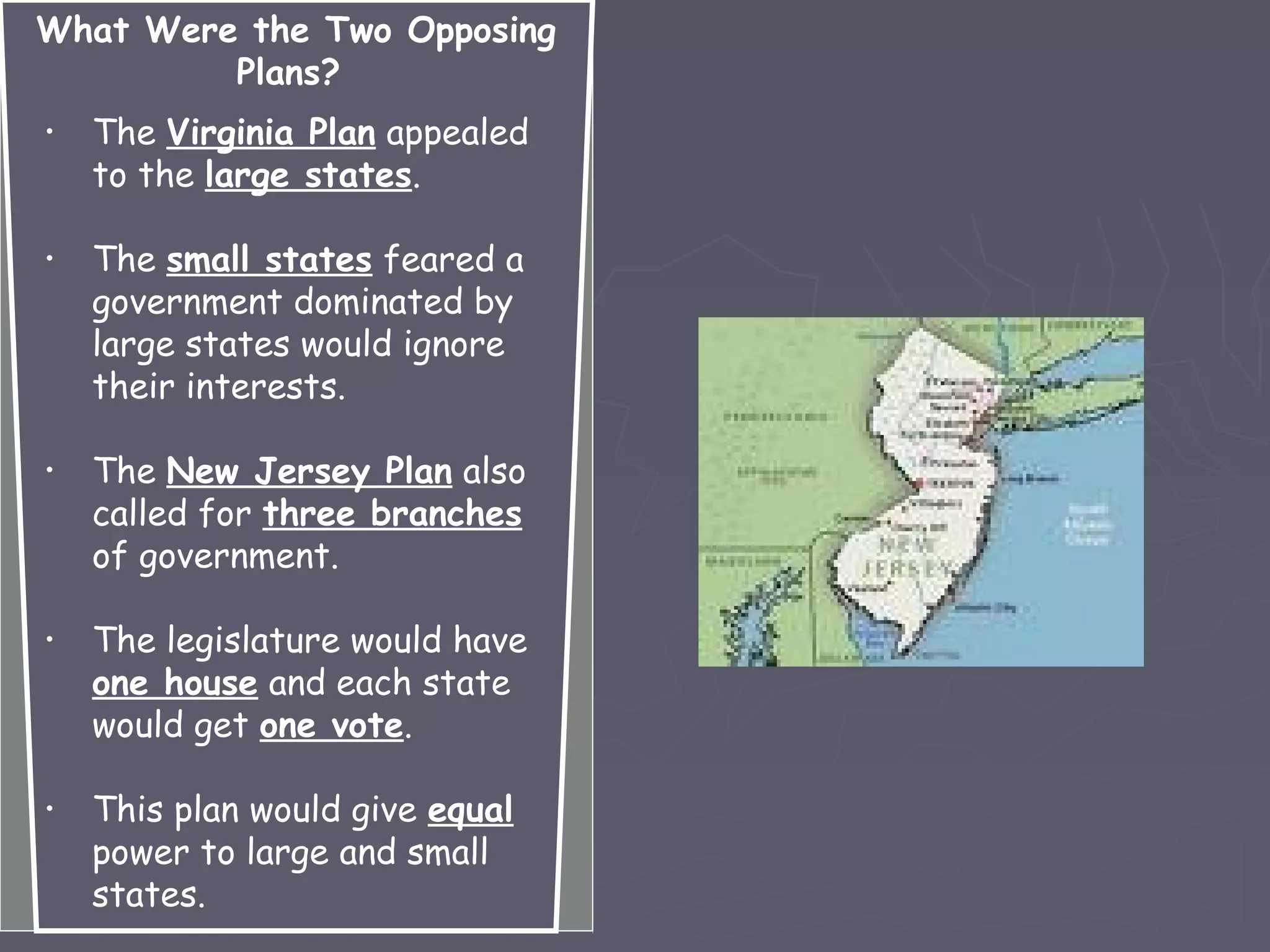
• The New Jersey Plan also
called for three branches
of government.
• The legislature would have
one house and each state
would get one vote.
• This plan would give equal
power to large and small
states.
What Compromises Were Made?
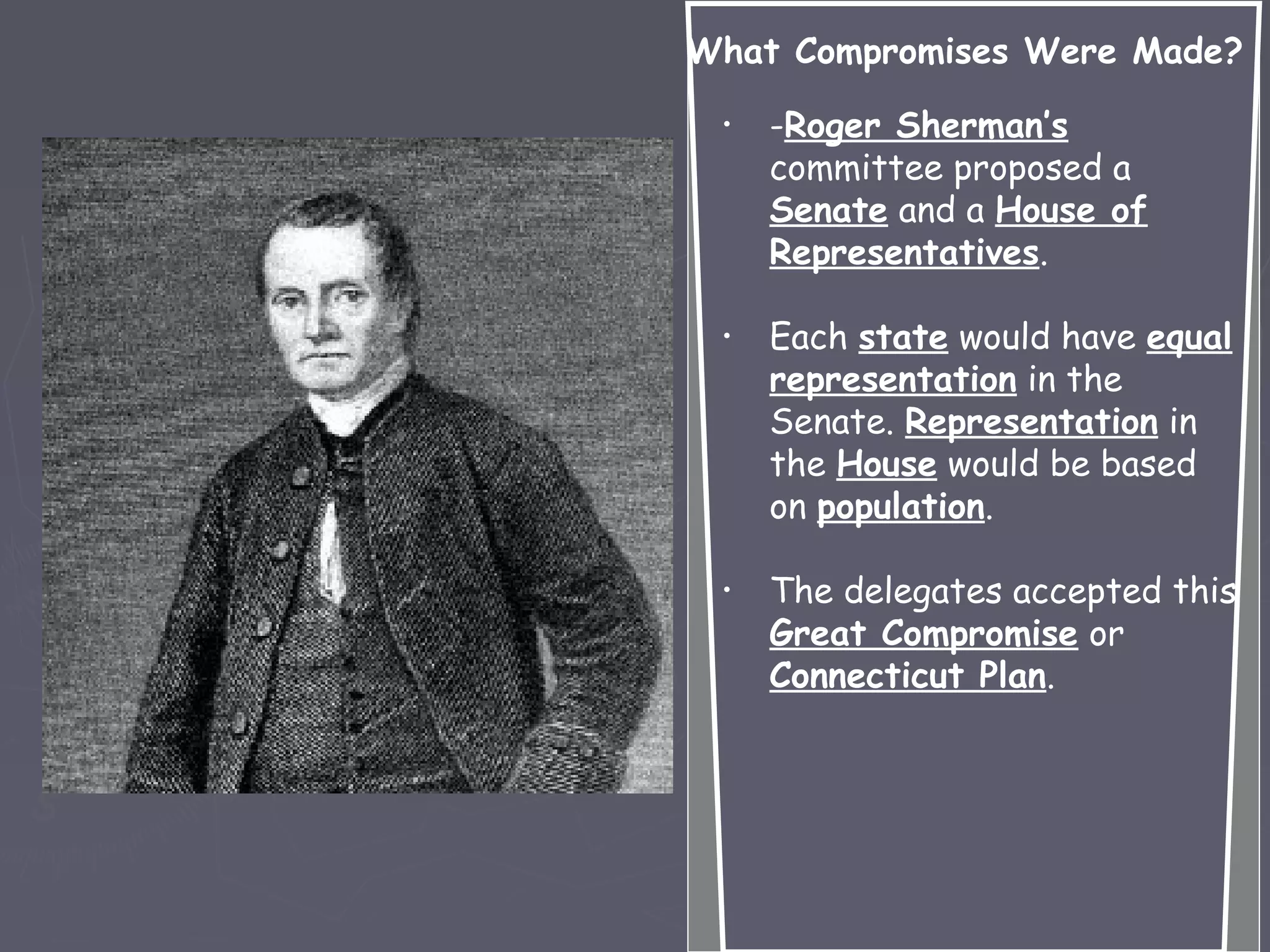
• -Roger Sherman’s
committee proposed a
Senate and a House of
Representatives.
• Each state would have equal
representation in the
Senate. Representation in
the House would be based
on population.
• The delegates accepted this
Great Compromise or
Connecticut Plan.
What Compromises Were Made?
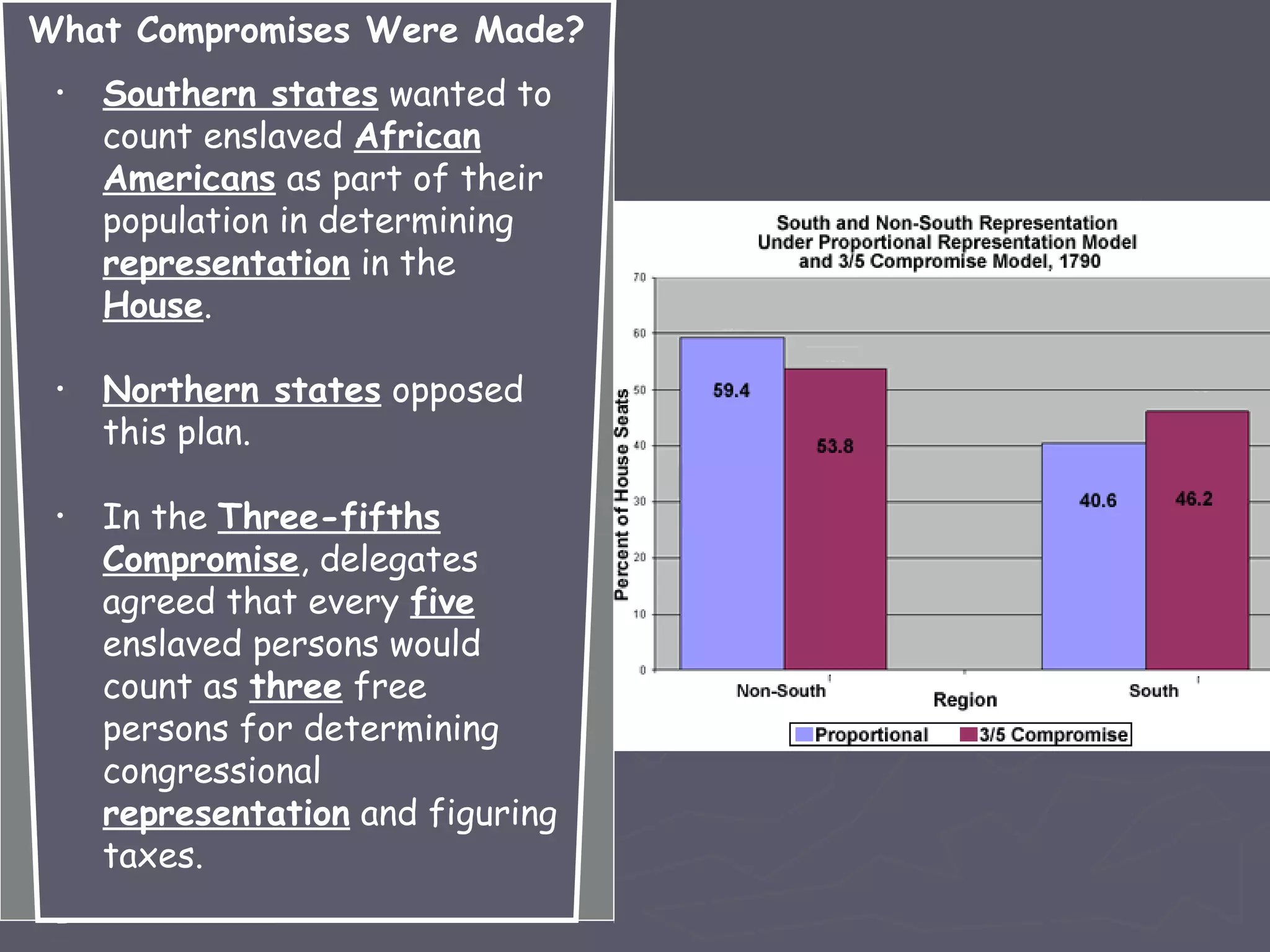
• Southern states wanted to
count enslaved African
Americans as part of their
population in determining
representation in the
House.
• Northern states opposed
this plan.
• In the Three-fifths
Compromise, delegates
agreed that every five
enslaved persons would
count as three free
persons for determining
congressional
representation and figuring
taxes.
-
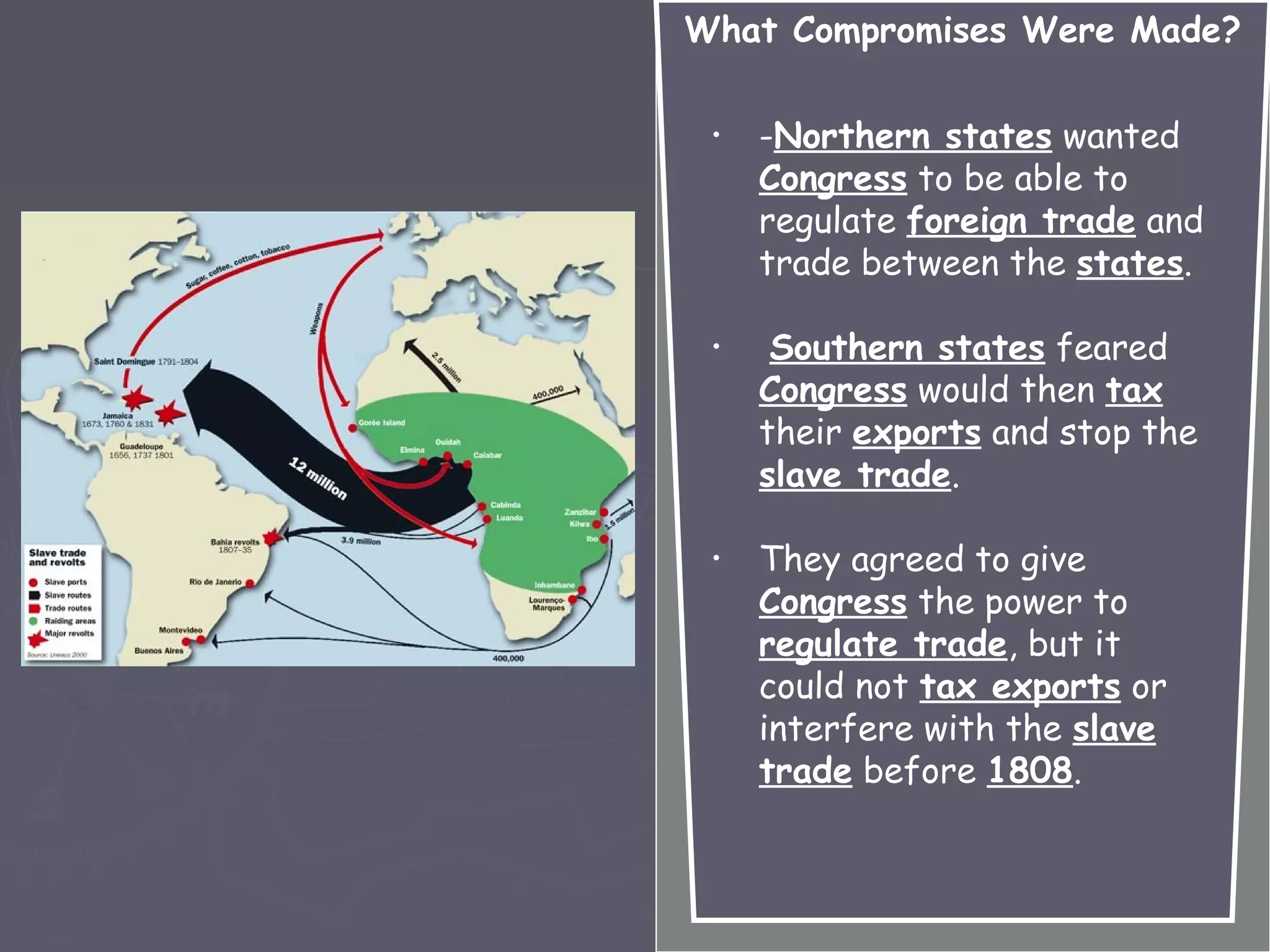
• -Northern states wanted
Congress to be able to
regulate foreign trade and
trade between the states.
• Southern states feared
Congress would then tax
their exports and stop the
slave trade.
• They agreed to give
Congress the power to
regulate trade, but it
could not tax exports or
interfere with the slave
trade before 1808.
What Compromises Were Made?
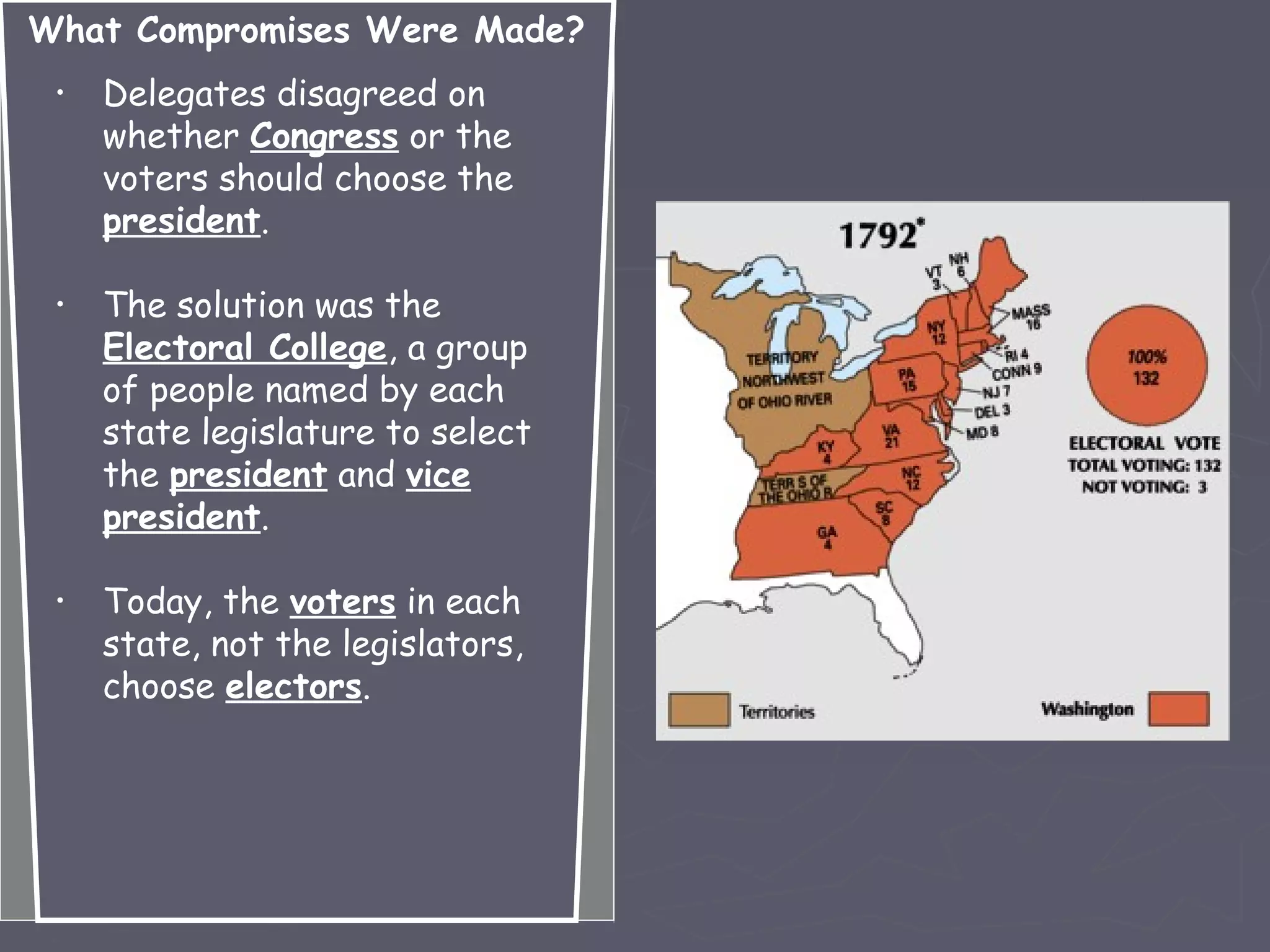
• Delegates disagreed on
whether Congress or the
voters should choose the
president.
• The solution was the
Electoral College, a group
of people named by each
state legislature to select
the president and vice
president.
• Today, the voters in each
state, not the legislators,
choose electors.
What Compromises Were Made?
Approving the Constitution
• Ratification required at least
9 of 13 state conventions to
vote “yes.”
• Supporters of the
constitution called
themselves Federalists to
emphasize that the
Constitution would create a
system of federalism, a form
of government in which
power is divided between the
federal, or national,
government and the states.
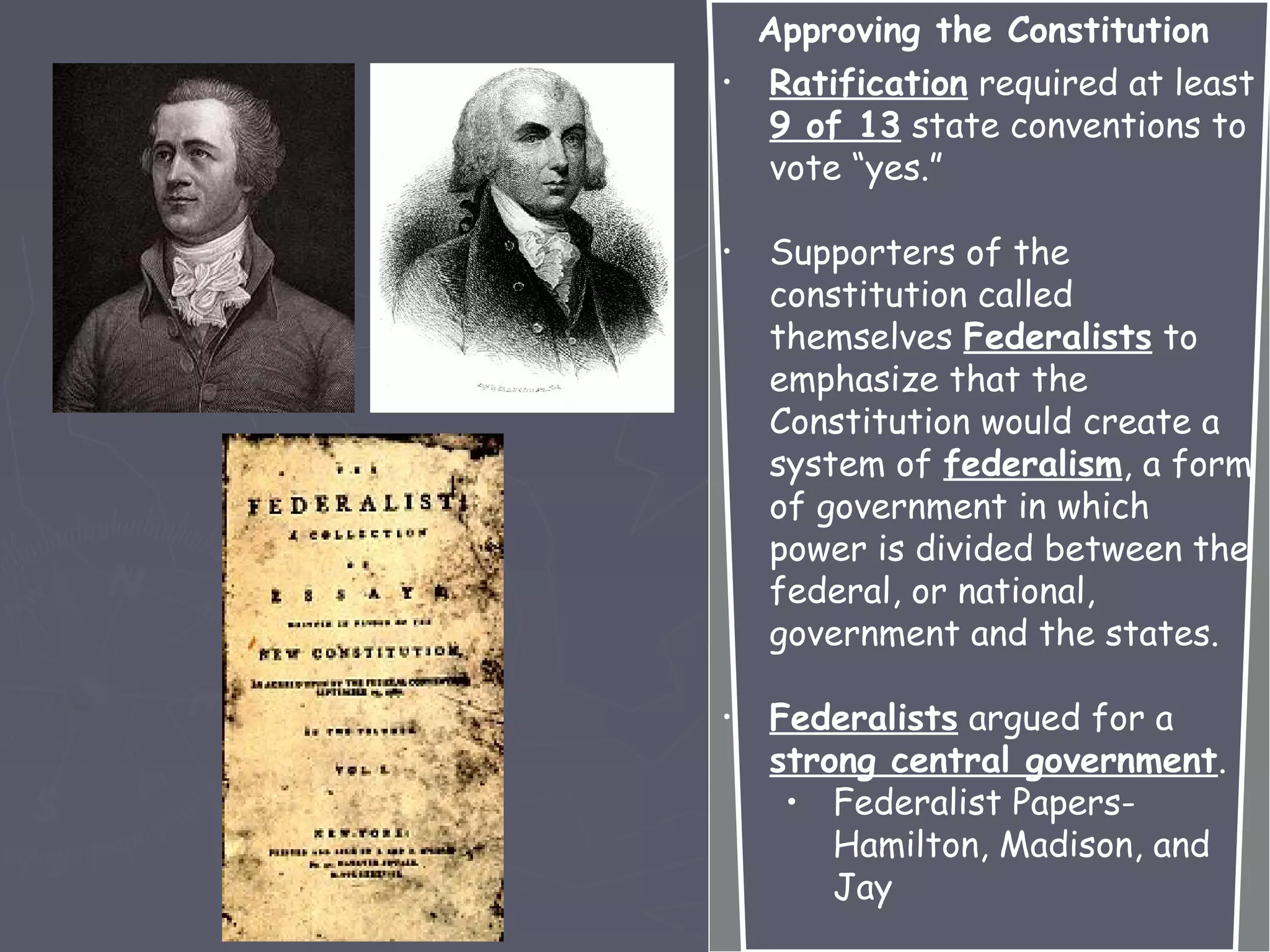
• Federalists argued for a
strong central government.
• Federalist Papers-
Hamilton, Madison, and
Jay
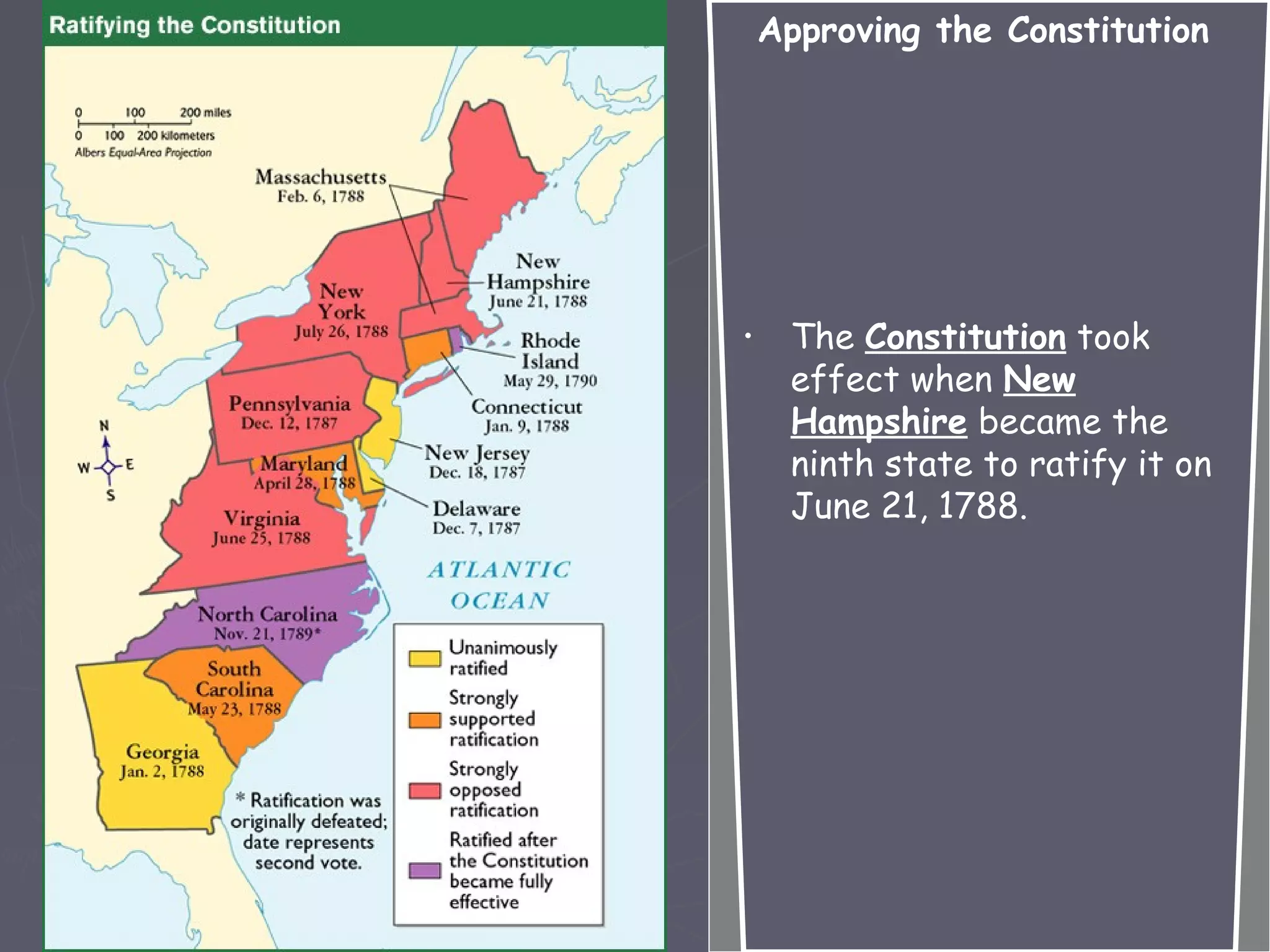
• The Constitution took
effect when New
Hampshire became the
ninth state to ratify it on
June 21, 1788.
Approving the Constitution
Module five constitutional convention

Module five constitutional convention

  • 2.
  • 3.
    Who Attended theConstitutional Convention? • Each state except Rhode Island sent delegates to Philadelphia to fix the flaws in the Articles of Confederation. • Most of the 55 men were well-educated and experienced in politics. • Native Americans, African Americans, and women were not included. -
  • 4.
    Who Attended the ConstitutionalConvention? • -Benjamin Franklin was the oldest delegate at 81. • He was a diplomat, writer, inventor, and scientist. • Two delegates–George Washington and James Madison–would later become presidents.
  • 5.
    • Thomas Jeffersonand John Adams could not attend. • They were in Europe as representatives of the United States government. • Patrick Henry opposed the convention and did not attend. Who Attended the Constitutional Convention?
  • 6.
    What Decisions WhereMade? • The delegates chose George Washington to preside. • Washington chose a committee to set rules for conducting the convention. • The committee decided that decisions would be made by majority vote, with each state having one vote. • Delegates agreed to keep all discussions secret to enable all to speak freely.
  • 7.
    • No formalrecords were kept. • • Most of what we know comes from James Madison’s personal notebook of events. • • The delegates decided to discard the Articles of Confederation and write a new constitution. • Thus the meeting came to be known as the Constitutional Convention. Who Attended the Constitutional Convention?
  • 8.
  • 9.
    What Were theTwo Opposing Plans? • James Madison designed the Virginia Plan. It called for a government with three branches: the legislative branch (lawmakers), executive branch (to carry out the laws), and judicial branch (a system of courts to interpret and apply the laws). • The legislature would have two houses, with the states represented by basis of population
  • 10.
    What Were theTwo Opposing Plans? • The Virginia Plan appealed to the large states. • The small states feared a government dominated by large states would ignore their interests. • The New Jersey Plan also called for three branches of government. • The legislature would have one house and each state would get one vote. • This plan would give equal power to large and small states.
  • 11.
    What Compromises WereMade? • -Roger Sherman’s committee proposed a Senate and a House of Representatives. • Each state would have equal representation in the Senate. Representation in the House would be based on population. • The delegates accepted this Great Compromise or Connecticut Plan.
  • 12.
    What Compromises WereMade? • Southern states wanted to count enslaved African Americans as part of their population in determining representation in the House. • Northern states opposed this plan. • In the Three-fifths Compromise, delegates agreed that every five enslaved persons would count as three free persons for determining congressional representation and figuring taxes. -
  • 13.
    • -Northern stateswanted Congress to be able to regulate foreign trade and trade between the states. • Southern states feared Congress would then tax their exports and stop the slave trade. • They agreed to give Congress the power to regulate trade, but it could not tax exports or interfere with the slave trade before 1808. What Compromises Were Made?
  • 14.
    • Delegates disagreedon whether Congress or the voters should choose the president. • The solution was the Electoral College, a group of people named by each state legislature to select the president and vice president. • Today, the voters in each state, not the legislators, choose electors. What Compromises Were Made?
  • 15.
    Approving the Constitution •Ratification required at least 9 of 13 state conventions to vote “yes.” • Supporters of the constitution called themselves Federalists to emphasize that the Constitution would create a system of federalism, a form of government in which power is divided between the federal, or national, government and the states. • Federalists argued for a strong central government. • Federalist Papers- Hamilton, Madison, and Jay
  • 16.
    • The Constitutiontook effect when New Hampshire became the ninth state to ratify it on June 21, 1788. Approving the Constitution