The Road to the ConstitutionBy: Laura BirgeEwen and Donable, Winding Road, 2/27/11, Creative Commons Attribution
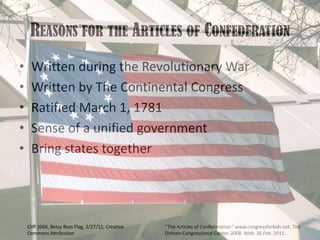
Reasons for the Articles of ConfederationWritten during the Revolutionary WarWritten by The Continental CongressRatified March 1, 1781Sense of a unified governmentBring states together“The Articles of Confederation.” www.congressforkids.net. The Dirksen Congressional Center, 2008. Web. 26 Feb. 2011. Cliff 1066, Betsy Ross Flag, 2/27/11, Creative Commons Attribution
Problems with the Articles of Confederation Weak governmentPurposefully  Could notenforce lawsSteve Cherrier, Flying Eagle 2, 2/27/11, Creative Commons Attribution, No Derivative Works“The Articles of Confederation and Perpetual Union.”  www.earlyamerica.com.  Archiving Early America, n.d. Web.  25 Feb. 2011.
Money ProblemsCould not collect taxesCan’t raise money All States had own currencyBankrupt in 1786 State money = other state money?“The Making of the Constitution.” www.socialstudiesforkids.com. Social Studies for Kida, n.d. Web. 26 Feb. 2011.Alancleaver_2000, Piggy Bank, 2/27/11, Creative Commons Attribution
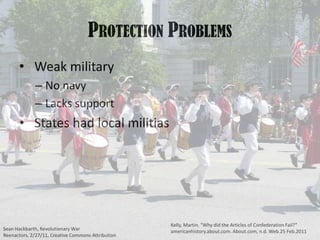
Protection Problems Weak militaryNo navyLacks support States had local militiasKelly, Martin. “Why did the Articles of Confederation Fail?” americanhistory.about.com. About.com, n.d. Web.25 Feb.2011Sean Hackbarth, Revolutionary War Reenactors, 2/27/11, Creative Commons Attribution
 Trade Problems States taxed other states goods Bad feelings between north and south Decline in trade Little respect from other nationsLinder, Doug. “The Constitutional Convention of 1787.” Law2.umkc.edu. The University of Missouri-Kansas City School of Law, 2011. Web. 26 Feb. 2011.Jessica Burmann, DSC7319, 2/27/22, Attribution and Non Commercial
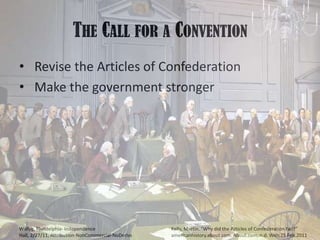
The Call for a Convention Revise the Articles of Confederation Make the government strongerKelly, Martin. “Why did the Articles of Confederation Fail?” americanhistory.about.com. About.com, n.d. Web.25 Feb.2011Wallyg, Philidelphia- Independence Hall, 2/27/11, Attribution-NonCommercial-NoDerivs
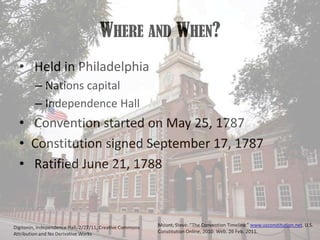
Where and When?  Held in PhiladelphiaNations capital	Independence Hall Convention started on May 25, 1787Constitution signed September 17, 1787 Ratified June 21, 1788Mount, Steve. “The Convention Timeline.” www.usconstitution.net. U.S. Constitution Online, 2010. Web. 26 Feb. 2011.Digitonin, Independence Hall, 2/27/11, Creative Commons Attribution and No Derivative Works
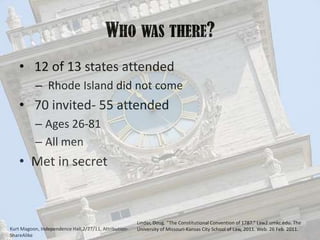
Who was there? 12 of 13 states attended Rhode Island did not come 70 invited- 55 attendedAges 26-81All menMet in secret Linder, Doug. “The Constitutional Convention of 1787.” Law2.umkc.edu. The University of Missouri-Kansas City School of Law, 2011. Web. 26 Feb. 2011.Kurt Magoon, Independence Hall,2/27/11, Attribution-ShareAlike
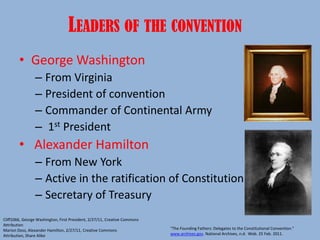
Leaders of the conventionGeorge WashingtonFrom VirginiaPresident of conventionCommander of Continental Army 1st President Alexander HamiltonFrom New YorkActive in the ratification of ConstitutionSecretary of TreasuryCliff1066, George Washington, First President, 2/27/11, Creative Commons AttributionMarion Doss, Alexander Hamilton, 2/27/11, Creative Commons Attribution, Share Alike“The Founding Fathers: Delegates to the Constitutional Convention.” www.archives.gov. National Archives, n.d.  Web. 25 Feb. 2011.
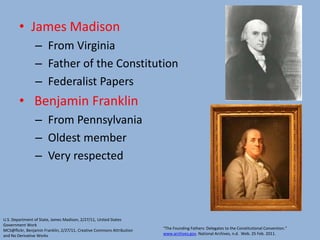
James Madison From Virginia Father of the Constitution Federalist Papers Benjamin Franklin From Pennsylvania Oldest member Very respectedU.S. Department of State, James Madison, 2/27/11, United States Government WorkMCS@flickr, Benjamin Franklin, 2/27/11, Creative Commons Attribution and No Derivative Works“The Founding Fathers: Delegates to the Constitutional Convention.” www.archives.gov. National Archives, n.d.  Web. 25 Feb. 2011.
The Decision for a New Constitution Articles had many things wrong with it Could not be fixed Some states would not have attendedMount, Steve. “The Constutional Topic: The Annapolis Conference.” www.usconstitution.net. U.S. Constitution Online, 2010. Web. 26 Feb. 2011. Diablodale, Liberty Bell, 2/27/11, Creative Commons Attribution and No Derivative Works
Disagreements over the Constitution  How it was set uprepresentation Small states vs. big statesRosie O’Beirne, Stock Photo of the Consitution of the United States and Feather Quill, 2/27/11, Creative Commons Attribution and No Derivative WorksLinder, Doug. “The Constitutional Convention of 1787.” Law2.umkc.edu. The University of Missouri-Kansas City School of Law, 2011. Web. 26 Feb. 2011.
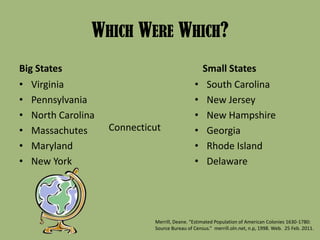
Which Were Which?Big StatesSmall StatesVirginiaPennsylvaniaNorth CarolinaMassachutes MarylandNew YorkSouth CarolinaNew JerseyNew HampshireGeorgiaRhode IslandDelawareConnecticutMerrill, Deane. “Estimated Population of American Colonies 1630-1780: Source Bureau of Census.”  merrill.oln.net, n.p, 1998. Web.  25 Feb. 2011. 
Virginia Plan Proposed by Edmund Randolph House elected by the peopleSenate elected by state legislaturesBoth represented proportionallyMount, Steve. “Constitutional Topic: Madison and the Virginia Plan.” www.usconstitution.net. U.S. Constitution Online, 2010. Web. 26 Feb. 2011.Peter Fitzgerald, State Capital building, 2/27/11, Attribution-ShareAlike
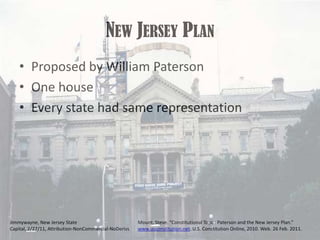
New Jersey PlanProposed by William PatersonOne houseEvery state had same representationMount, Steve. “Constitutional Topic: Paterson and the New Jersey Plan.” www.usconstitution.net. U.S. Constitution Online, 2010. Web. 26 Feb. 2011.  Jimmywayne, New Jersey State Capital, 2/27/11, Attribution-NonCommercial-NoDerivs
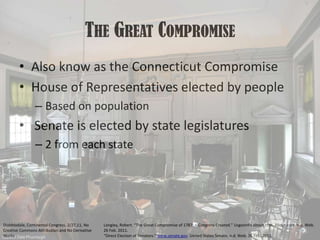
The Great CompromiseAlso know as the Connecticut CompromiseHouse of Representatives elected by peopleBased on population Senate is elected by state legislatures	2 from each stateLongley, Robert. “The Great Compromise of 1787: A Congress Created.” Usgovinfo.about.com. About.com. n.d. Web. 26 Feb. 2011.“Direct Election of Senators.” www.senate.gov. United States Senate, n.d. Web. 26 Feb. 2011.Diabblodale, Continental Congress, 2/27,11, No Creative Commons Attribution and No Derivative Works
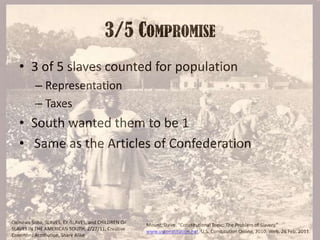
3/5 Compromise3 of 5 slaves counted for populationRepresentationTaxesSouth wanted them to be 1 Same as the Articles of ConfederationOkinawa Soba, SLAVES, EX-SLAVES, and CHILDREN OF SLAVES IN THE AMERICAN SOUTH, 2/27/11, Creative Commons Attribution, Share AlikeMount, Steve. “Constitutional Topic: The Problem of Slavery.” www.usconstitution.net. U.S. Constitution Online, 2010. Web. 26 Feb. 2011.
What did we Learn?Articles of Confederation were weak Constitutional Convention is calledConstitution written Arguments over representation and slavesThe Great Compromise and 3/5 Compromise“The Articles of Confederation and Perpetual Union.”  www.earlyamerica.com.  Archiving Early America, n.d. Web.  25 Feb. 2011.Kelly, Martin. “Why did the Articles of Confederation Fail?” americanhistory.about.com. About.com, n.d. Web.25 Feb.2011Mount, Steve. “Constitutional Topic: Madison and the Virginia Plan.” www.usconstitution.net. U.S. Constitution Online, 2010. Web. 26 Feb. 2011.Jcoleman, American Flag, 2/27/11, Attribution-NonCommercial-NoDerivs

The Road to the Constitution

  • 1.
    The Road tothe ConstitutionBy: Laura BirgeEwen and Donable, Winding Road, 2/27/11, Creative Commons Attribution
  • 2.
    Reasons for theArticles of ConfederationWritten during the Revolutionary WarWritten by The Continental CongressRatified March 1, 1781Sense of a unified governmentBring states together“The Articles of Confederation.” www.congressforkids.net. The Dirksen Congressional Center, 2008. Web. 26 Feb. 2011. Cliff 1066, Betsy Ross Flag, 2/27/11, Creative Commons Attribution
  • 3.
    Problems with theArticles of Confederation Weak governmentPurposefully Could notenforce lawsSteve Cherrier, Flying Eagle 2, 2/27/11, Creative Commons Attribution, No Derivative Works“The Articles of Confederation and Perpetual Union.” www.earlyamerica.com. Archiving Early America, n.d. Web. 25 Feb. 2011.
  • 4.
    Money ProblemsCould notcollect taxesCan’t raise money All States had own currencyBankrupt in 1786 State money = other state money?“The Making of the Constitution.” www.socialstudiesforkids.com. Social Studies for Kida, n.d. Web. 26 Feb. 2011.Alancleaver_2000, Piggy Bank, 2/27/11, Creative Commons Attribution
  • 5.
    Protection Problems WeakmilitaryNo navyLacks support States had local militiasKelly, Martin. “Why did the Articles of Confederation Fail?” americanhistory.about.com. About.com, n.d. Web.25 Feb.2011Sean Hackbarth, Revolutionary War Reenactors, 2/27/11, Creative Commons Attribution
  • 6.
    Trade ProblemsStates taxed other states goods Bad feelings between north and south Decline in trade Little respect from other nationsLinder, Doug. “The Constitutional Convention of 1787.” Law2.umkc.edu. The University of Missouri-Kansas City School of Law, 2011. Web. 26 Feb. 2011.Jessica Burmann, DSC7319, 2/27/22, Attribution and Non Commercial
  • 7.
    The Call fora Convention Revise the Articles of Confederation Make the government strongerKelly, Martin. “Why did the Articles of Confederation Fail?” americanhistory.about.com. About.com, n.d. Web.25 Feb.2011Wallyg, Philidelphia- Independence Hall, 2/27/11, Attribution-NonCommercial-NoDerivs
  • 8.
    Where and When? Held in PhiladelphiaNations capital Independence Hall Convention started on May 25, 1787Constitution signed September 17, 1787 Ratified June 21, 1788Mount, Steve. “The Convention Timeline.” www.usconstitution.net. U.S. Constitution Online, 2010. Web. 26 Feb. 2011.Digitonin, Independence Hall, 2/27/11, Creative Commons Attribution and No Derivative Works
  • 9.
    Who was there?12 of 13 states attended Rhode Island did not come 70 invited- 55 attendedAges 26-81All menMet in secret Linder, Doug. “The Constitutional Convention of 1787.” Law2.umkc.edu. The University of Missouri-Kansas City School of Law, 2011. Web. 26 Feb. 2011.Kurt Magoon, Independence Hall,2/27/11, Attribution-ShareAlike
  • 10.
    Leaders of theconventionGeorge WashingtonFrom VirginiaPresident of conventionCommander of Continental Army 1st President Alexander HamiltonFrom New YorkActive in the ratification of ConstitutionSecretary of TreasuryCliff1066, George Washington, First President, 2/27/11, Creative Commons AttributionMarion Doss, Alexander Hamilton, 2/27/11, Creative Commons Attribution, Share Alike“The Founding Fathers: Delegates to the Constitutional Convention.” www.archives.gov. National Archives, n.d. Web. 25 Feb. 2011.
  • 11.
    James Madison FromVirginia Father of the Constitution Federalist Papers Benjamin Franklin From Pennsylvania Oldest member Very respectedU.S. Department of State, James Madison, 2/27/11, United States Government WorkMCS@flickr, Benjamin Franklin, 2/27/11, Creative Commons Attribution and No Derivative Works“The Founding Fathers: Delegates to the Constitutional Convention.” www.archives.gov. National Archives, n.d. Web. 25 Feb. 2011.
  • 12.
    The Decision fora New Constitution Articles had many things wrong with it Could not be fixed Some states would not have attendedMount, Steve. “The Constutional Topic: The Annapolis Conference.” www.usconstitution.net. U.S. Constitution Online, 2010. Web. 26 Feb. 2011. Diablodale, Liberty Bell, 2/27/11, Creative Commons Attribution and No Derivative Works
  • 13.
    Disagreements over theConstitution How it was set uprepresentation Small states vs. big statesRosie O’Beirne, Stock Photo of the Consitution of the United States and Feather Quill, 2/27/11, Creative Commons Attribution and No Derivative WorksLinder, Doug. “The Constitutional Convention of 1787.” Law2.umkc.edu. The University of Missouri-Kansas City School of Law, 2011. Web. 26 Feb. 2011.
  • 14.
    Which Were Which?BigStatesSmall StatesVirginiaPennsylvaniaNorth CarolinaMassachutes MarylandNew YorkSouth CarolinaNew JerseyNew HampshireGeorgiaRhode IslandDelawareConnecticutMerrill, Deane. “Estimated Population of American Colonies 1630-1780: Source Bureau of Census.” merrill.oln.net, n.p, 1998. Web. 25 Feb. 2011. 
  • 15.
    Virginia Plan Proposedby Edmund Randolph House elected by the peopleSenate elected by state legislaturesBoth represented proportionallyMount, Steve. “Constitutional Topic: Madison and the Virginia Plan.” www.usconstitution.net. U.S. Constitution Online, 2010. Web. 26 Feb. 2011.Peter Fitzgerald, State Capital building, 2/27/11, Attribution-ShareAlike
  • 16.
    New Jersey PlanProposedby William PatersonOne houseEvery state had same representationMount, Steve. “Constitutional Topic: Paterson and the New Jersey Plan.” www.usconstitution.net. U.S. Constitution Online, 2010. Web. 26 Feb. 2011.  Jimmywayne, New Jersey State Capital, 2/27/11, Attribution-NonCommercial-NoDerivs
  • 17.
    The Great CompromiseAlsoknow as the Connecticut CompromiseHouse of Representatives elected by peopleBased on population Senate is elected by state legislatures 2 from each stateLongley, Robert. “The Great Compromise of 1787: A Congress Created.” Usgovinfo.about.com. About.com. n.d. Web. 26 Feb. 2011.“Direct Election of Senators.” www.senate.gov. United States Senate, n.d. Web. 26 Feb. 2011.Diabblodale, Continental Congress, 2/27,11, No Creative Commons Attribution and No Derivative Works
  • 18.
    3/5 Compromise3 of5 slaves counted for populationRepresentationTaxesSouth wanted them to be 1 Same as the Articles of ConfederationOkinawa Soba, SLAVES, EX-SLAVES, and CHILDREN OF SLAVES IN THE AMERICAN SOUTH, 2/27/11, Creative Commons Attribution, Share AlikeMount, Steve. “Constitutional Topic: The Problem of Slavery.” www.usconstitution.net. U.S. Constitution Online, 2010. Web. 26 Feb. 2011.
  • 19.
    What did weLearn?Articles of Confederation were weak Constitutional Convention is calledConstitution written Arguments over representation and slavesThe Great Compromise and 3/5 Compromise“The Articles of Confederation and Perpetual Union.” www.earlyamerica.com. Archiving Early America, n.d. Web. 25 Feb. 2011.Kelly, Martin. “Why did the Articles of Confederation Fail?” americanhistory.about.com. About.com, n.d. Web.25 Feb.2011Mount, Steve. “Constitutional Topic: Madison and the Virginia Plan.” www.usconstitution.net. U.S. Constitution Online, 2010. Web. 26 Feb. 2011.Jcoleman, American Flag, 2/27/11, Attribution-NonCommercial-NoDerivs