Module 6 
Comparison-Contrasting 
Organization 
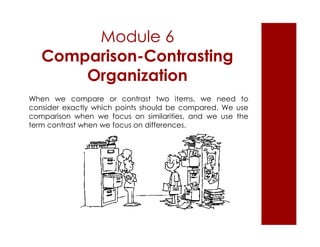
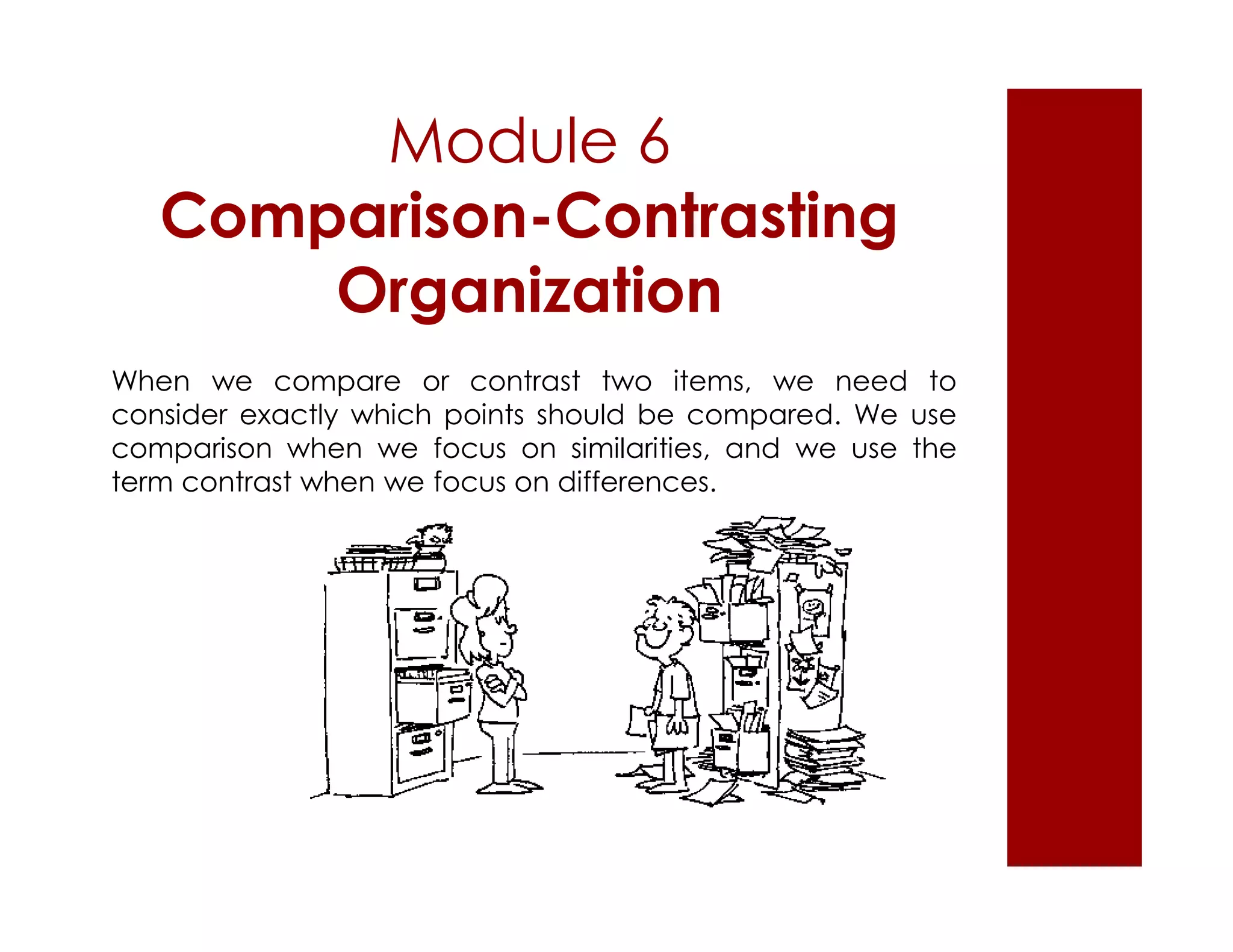
When we compare or contrast two items, we need to 
consider exactly which points should be compared. We use 
comparison when we focus on similarities, and we use the 
term contrast when we focus on differences.
Choosing a Two-Part Topic 
You must think carefully before creating the topic sentence 
of that paragraph. 
You must choose a two-part topic that has a sufficient 
number of points to compare or contrast. 
But you should avoid selecting two-part topics that have too 
many points to compare or contrast that you would not be 
able to discuss them in one paragraph. 
Example of Topic 
Spanish word “río” and English 
Too 
word “river” 
specific. 
The United States and Europe. Too broad 
Traveling by train in Europe and 
Better 
traveling by train in the United 
topic 
States
Choosing a Two-Part Topic 
Once you have chosen a two-part topic that is not too 
limiting and not too broad, you must remember that a good 
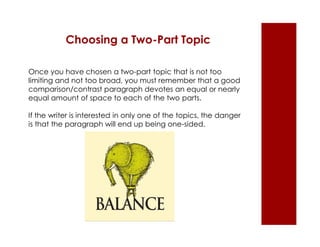
comparison/contrast paragraph devotes an equal or nearly 
equal amount of space to each of the two parts. 
If the writer is interested in only one of the topics, the danger 
is that the paragraph will end up being one-sided.
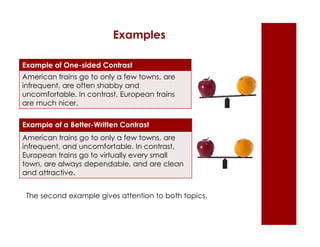
Examples 
Example of One-sided Contrast 
American trains go to only a few towns, are 
infrequent, are often shabby and 
uncomfortable. In contrast, European trains 
are much nicer. 
Example of a Better-Written Contrast 
American trains go to only a few towns, are 
infrequent, and uncomfortable. In contrast, 
European trains go to virtually every small 
town, are always dependable, and are clean 
and attractive. 
The second example gives attention to both topics.
Achieving Coherence 
There are two methods for ordering material when 
writing a comparison/contrast paragraph. One way is 
called block organization, and the other is called 
point-by-point organization.
Point-by-Point Method 
When you use the point-by-point method, you 
compare or contrast point 1 of topic 1 and then point 
1 of topic 2. Then you go on to your second points for 
each of the two topics. You continue until you have 
covered all the points.
Example – Paragraph 
Here is a paragraph from Julius Lester’s All is Well. In this paragraph, the 
writer uses the point-by point method to compare the difficulties of 
being a boy in our society a generation ago with the difficulties of being 
a girl at the same time. 
I know that it was difficult being a girl as it was a boy, if 
not more so. While I stood paralyzed at one end of a dance 
floor trying to find the courage to ask a girl for dance, most of 
the girls waited in terror at the other, afraid that no one, not 
even I, would ask them. And while I resented having to ask a girl 
for a date, wasn’t it also horrible to be the one who waited for 
the phone to ring? And how many of those girls laughed at me 
making a fool of myself on the baseball diamond would have 
gladly given up their places on the sideline for mine on the field.
Notice how, after the opening topic sentence, the writer 
uses half of the sentence to describe a boy’s situation 
growing up, and the other half to describe a girl’s 
experience. 
This technique is often used in longer pieces of writing in 
which many points of comparison are made. This method 
helps the reader keep the comparison or contrast carefully 
in mind at each point.
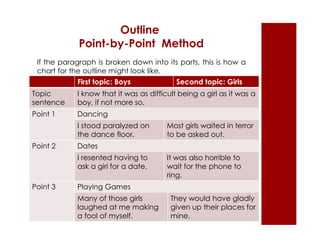
Outline 
Point-by-Point Method 
If the paragraph is broken down into its parts, this is how a 
chart for the outline might look like. 
First topic: Boys Second topic: Girls 
Topic 
sentence 
I know that it was as difficult being a girl as it was a 
boy, if not more so. 
Point 1 Dancing 
I stood paralyzed on 
the dance floor. 
Most girls waited in terror 
to be asked out. 
Point 2 Dates 
I resented having to 
ask a girl for a date. 
It was also horrible to 
wait for the phone to 
ring. 
Point 3 Playing Games 
Many of those girls 
laughed at me making 
a fool of myself. 
They would have gladly 
given up their places for 
mine.
Block Method 
The other method for ordering material in a paragraph of 
comparison and contrast is known as the block method. 
When you use this method, you present all the facts and 
supporting details about one part of your topic, and then 
you give all the facts and supporting details about the 
other part.
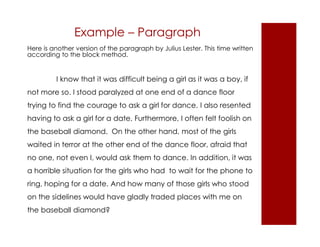
Example – Paragraph 
Here is another version of the paragraph by Julius Lester. This time written 
according to the block method. 
I know that it was difficult being a girl as it was a boy, if 
not more so. I stood paralyzed at one end of a dance floor 
trying to find the courage to ask a girl for dance. I also resented 
having to ask a girl for a date. Furthermore, I often felt foolish on 
the baseball diamond. On the other hand, most of the girls 
waited in terror at the other end of the dance floor, afraid that 
no one, not even I, would ask them to dance. In addition, it was 
a horrible situation for the girls who had to wait for the phone to 
ring, hoping for a date. And how many of those girls who stood 
on the sidelines would have gladly traded places with me on 
the baseball diamond?
Notice how the first half of this version presents all of the 
details about the boy, and the second part of the 
paragraph presents all of the information about girls. This 
method is often used in shorter pieces because the reader 
will easily remember three or four short points.
Organization 
Block Method 
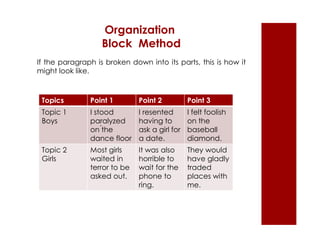
If the paragraph is broken down into its parts, this is how it 
might look like. 
Topics Point 1 Point 2 Point 3 
Topic 1 
Boys 
I stood 
paralyzed 
on the 
dance floor 
I resented 
having to 
ask a girl for 
a date. 
I felt foolish 
on the 
baseball 
diamond. 
Topic 2 
Girls 
Most girls 
waited in 
terror to be 
asked out. 
It was also 
horrible to 
wait for the 
phone to 
ring. 
They would 
have gladly 
traded 
places with 
me. 
.

English 2 - Module 6 lesson 3

  • 1.
    Module 6 Comparison-Contrasting Organization When we compare or contrast two items, we need to consider exactly which points should be compared. We use comparison when we focus on similarities, and we use the term contrast when we focus on differences.
  • 2.
    Choosing a Two-PartTopic You must think carefully before creating the topic sentence of that paragraph. You must choose a two-part topic that has a sufficient number of points to compare or contrast. But you should avoid selecting two-part topics that have too many points to compare or contrast that you would not be able to discuss them in one paragraph. Example of Topic Spanish word “río” and English Too word “river” specific. The United States and Europe. Too broad Traveling by train in Europe and Better traveling by train in the United topic States
  • 3.
    Choosing a Two-PartTopic Once you have chosen a two-part topic that is not too limiting and not too broad, you must remember that a good comparison/contrast paragraph devotes an equal or nearly equal amount of space to each of the two parts. If the writer is interested in only one of the topics, the danger is that the paragraph will end up being one-sided.
  • 4.
    Examples Example ofOne-sided Contrast American trains go to only a few towns, are infrequent, are often shabby and uncomfortable. In contrast, European trains are much nicer. Example of a Better-Written Contrast American trains go to only a few towns, are infrequent, and uncomfortable. In contrast, European trains go to virtually every small town, are always dependable, and are clean and attractive. The second example gives attention to both topics.
  • 5.
    Achieving Coherence Thereare two methods for ordering material when writing a comparison/contrast paragraph. One way is called block organization, and the other is called point-by-point organization.
  • 6.
    Point-by-Point Method Whenyou use the point-by-point method, you compare or contrast point 1 of topic 1 and then point 1 of topic 2. Then you go on to your second points for each of the two topics. You continue until you have covered all the points.
  • 7.
    Example – Paragraph Here is a paragraph from Julius Lester’s All is Well. In this paragraph, the writer uses the point-by point method to compare the difficulties of being a boy in our society a generation ago with the difficulties of being a girl at the same time. I know that it was difficult being a girl as it was a boy, if not more so. While I stood paralyzed at one end of a dance floor trying to find the courage to ask a girl for dance, most of the girls waited in terror at the other, afraid that no one, not even I, would ask them. And while I resented having to ask a girl for a date, wasn’t it also horrible to be the one who waited for the phone to ring? And how many of those girls laughed at me making a fool of myself on the baseball diamond would have gladly given up their places on the sideline for mine on the field.
  • 8.
    Notice how, afterthe opening topic sentence, the writer uses half of the sentence to describe a boy’s situation growing up, and the other half to describe a girl’s experience. This technique is often used in longer pieces of writing in which many points of comparison are made. This method helps the reader keep the comparison or contrast carefully in mind at each point.
  • 9.
    Outline Point-by-Point Method If the paragraph is broken down into its parts, this is how a chart for the outline might look like. First topic: Boys Second topic: Girls Topic sentence I know that it was as difficult being a girl as it was a boy, if not more so. Point 1 Dancing I stood paralyzed on the dance floor. Most girls waited in terror to be asked out. Point 2 Dates I resented having to ask a girl for a date. It was also horrible to wait for the phone to ring. Point 3 Playing Games Many of those girls laughed at me making a fool of myself. They would have gladly given up their places for mine.
  • 10.
    Block Method Theother method for ordering material in a paragraph of comparison and contrast is known as the block method. When you use this method, you present all the facts and supporting details about one part of your topic, and then you give all the facts and supporting details about the other part.
  • 11.
    Example – Paragraph Here is another version of the paragraph by Julius Lester. This time written according to the block method. I know that it was difficult being a girl as it was a boy, if not more so. I stood paralyzed at one end of a dance floor trying to find the courage to ask a girl for dance. I also resented having to ask a girl for a date. Furthermore, I often felt foolish on the baseball diamond. On the other hand, most of the girls waited in terror at the other end of the dance floor, afraid that no one, not even I, would ask them to dance. In addition, it was a horrible situation for the girls who had to wait for the phone to ring, hoping for a date. And how many of those girls who stood on the sidelines would have gladly traded places with me on the baseball diamond?
  • 12.
    Notice how thefirst half of this version presents all of the details about the boy, and the second part of the paragraph presents all of the information about girls. This method is often used in shorter pieces because the reader will easily remember three or four short points.
  • 13.
    Organization Block Method If the paragraph is broken down into its parts, this is how it might look like. Topics Point 1 Point 2 Point 3 Topic 1 Boys I stood paralyzed on the dance floor I resented having to ask a girl for a date. I felt foolish on the baseball diamond. Topic 2 Girls Most girls waited in terror to be asked out. It was also horrible to wait for the phone to ring. They would have gladly traded places with me. .