Module 6 
Comparison and Contrast is a technique that we use everyday. 
We compare and contrast products and prices when we shop. 
A job applicant compares and contrasts job offers. 
Information taken from: 
Butler, L. Fundamentals of Academic Writing. Longman 
Hogue, A. (2008). First Steps in Academic Writing. Longman.
Contrasting 
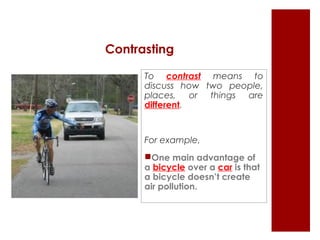
To contrast means to 
discuss how two people, 
places, or things are 
different. 
For example, 
One main advantage of 
a bicycle over a car is that 
a bicycle doesn’t create 
air pollution.
Model Paragraph – Questions 
Read and analyze the following paragraph, and answer 
these questions: 
1. What two things does the paragraph talk about? 
2. Is the paragraph mostly comparing or contrasting? How 
do you know?
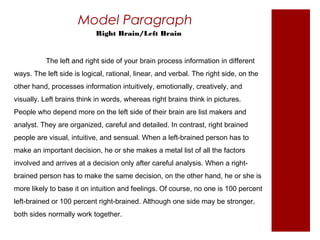
Model Paragraph 
Right Brain/Left Brain 
The left and right side of your brain process information in different 
ways. The left side is logical, rational, linear, and verbal. The right side, on the 
other hand, processes information intuitively, emotionally, creatively, and 
visually. Left brains think in words, whereas right brains think in pictures. 
People who depend more on the left side of their brain are list makers and 
analyst. They are organized, careful and detailed. In contrast, right brained 
people are visual, intuitive, and sensual. When a left-brained person has to 
make an important decision, he or she makes a metal list of all the factors 
involved and arrives at a decision only after careful analysis. When a right-brained 
person has to make the same decision, on the other hand, he or she is 
more likely to base it on intuition and feelings. Of course, no one is 100 percent 
left-brained or 100 percent right-brained. Although one side may be stronger, 
both sides normally work together.
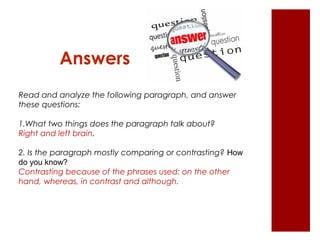
Answers 
Read and analyze the following paragraph, and answer 
these questions: 
1.What two things does the paragraph talk about? 
Right and left brain. 
2. Is the paragraph mostly comparing or contrasting? How 
do you know? 
Contrasting because of the phrases used: on the other 
hand, whereas, in contrast and although.
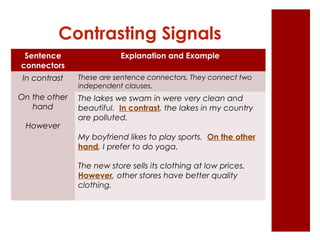
Contrasting Signals 
Sentence 
connectors 
Explanation and Example 
In contrast 
On the other 
hand 
However 
These are sentence connectors. They connect two 
independent clauses. 
The lakes we swam in were very clean and 
beautiful. In contrast, the lakes in my country 
are polluted. 
My boyfriend likes to play sports. On the other 
hand, I prefer to do yoga. 
The new store sells its clothing at low prices. 
However, other stores have better quality 
clothing.
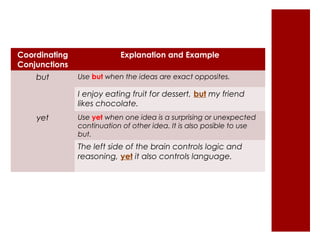
Coordinating 
Conjunctions 
Explanation and Example 
but Use but when the ideas are exact opposites. 
I enjoy eating fruit for dessert, but my friend 
likes chocolate. 
yet Use yet when one idea is a surprising or unexpected 
continuation of other idea. It is also posible to use 
but. 
The left side of the brain controls logic and 
reasoning, yet it also controls language.
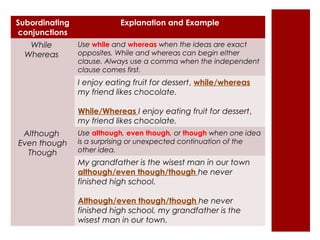
Subordinating 
conjunctions 
Explanation and Example 
While 
Whereas 
Use while and whereas when the ideas are exact 
opposites. While and whereas can begin either 
clause. Always use a comma when the independent 
clause comes first. 
I enjoy eating fruit for dessert, while/whereas 
my friend likes chocolate. 
While/Whereas I enjoy eating fruit for dessert, 
my friend likes chocolate. 
Although 
Even though 
Though 
Use although, even though, or though when one idea 
is a surprising or unexpected continuation of the 
other idea. 
My grandfather is the wisest man in our town 
although/even though/though he never 
finished high school. 
Although/even though/though he never 
finished high school, my grandfather is the 
wisest man in our town.
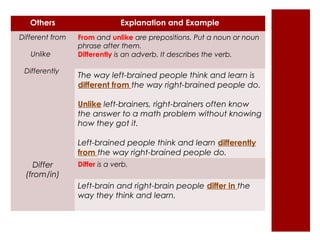
Others Explanation and Example 
Different from 
Unlike 
Differently 
From and unlike are prepositions. Put a noun or noun 
phrase after them. 
Differently is an adverb. It describes the verb. 
The way left-brained people think and learn is 
different from the way right-brained people do. 
Unlike left-brainers, right-brainers often know 
the answer to a math problem without knowing 
how they got it. 
Left-brained people think and learn differently 
from the way right-brained people do. 
Differ 
(from/in) 
Differ is a verb. 
Left-brain and right-brain people differ in the 
way they think and learn.
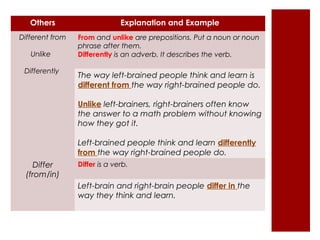
Others Explanation and Example 
Different from 
Unlike 
Differently 
From and unlike are prepositions. Put a noun or noun 
phrase after them. 
Differently is an adverb. It describes the verb. 
The way left-brained people think and learn is 
different from the way right-brained people do. 
Unlike left-brainers, right-brainers often know 
the answer to a math problem without knowing 
how they got it. 
Left-brained people think and learn differently 
from the way right-brained people do. 
Differ 
(from/in) 
Differ is a verb. 
Left-brain and right-brain people differ in the 
way they think and learn.

English 2 - Module 6 lesson 2

  • 1.
    Module 6 Comparisonand Contrast is a technique that we use everyday. We compare and contrast products and prices when we shop. A job applicant compares and contrasts job offers. Information taken from: Butler, L. Fundamentals of Academic Writing. Longman Hogue, A. (2008). First Steps in Academic Writing. Longman.
  • 2.
    Contrasting To contrastmeans to discuss how two people, places, or things are different. For example, One main advantage of a bicycle over a car is that a bicycle doesn’t create air pollution.
  • 3.
    Model Paragraph –Questions Read and analyze the following paragraph, and answer these questions: 1. What two things does the paragraph talk about? 2. Is the paragraph mostly comparing or contrasting? How do you know?
  • 4.
    Model Paragraph RightBrain/Left Brain The left and right side of your brain process information in different ways. The left side is logical, rational, linear, and verbal. The right side, on the other hand, processes information intuitively, emotionally, creatively, and visually. Left brains think in words, whereas right brains think in pictures. People who depend more on the left side of their brain are list makers and analyst. They are organized, careful and detailed. In contrast, right brained people are visual, intuitive, and sensual. When a left-brained person has to make an important decision, he or she makes a metal list of all the factors involved and arrives at a decision only after careful analysis. When a right-brained person has to make the same decision, on the other hand, he or she is more likely to base it on intuition and feelings. Of course, no one is 100 percent left-brained or 100 percent right-brained. Although one side may be stronger, both sides normally work together.
  • 5.
    Answers Read andanalyze the following paragraph, and answer these questions: 1.What two things does the paragraph talk about? Right and left brain. 2. Is the paragraph mostly comparing or contrasting? How do you know? Contrasting because of the phrases used: on the other hand, whereas, in contrast and although.
  • 6.
    Contrasting Signals Sentence connectors Explanation and Example In contrast On the other hand However These are sentence connectors. They connect two independent clauses. The lakes we swam in were very clean and beautiful. In contrast, the lakes in my country are polluted. My boyfriend likes to play sports. On the other hand, I prefer to do yoga. The new store sells its clothing at low prices. However, other stores have better quality clothing.
  • 7.
    Coordinating Conjunctions Explanationand Example but Use but when the ideas are exact opposites. I enjoy eating fruit for dessert, but my friend likes chocolate. yet Use yet when one idea is a surprising or unexpected continuation of other idea. It is also posible to use but. The left side of the brain controls logic and reasoning, yet it also controls language.
  • 8.
    Subordinating conjunctions Explanationand Example While Whereas Use while and whereas when the ideas are exact opposites. While and whereas can begin either clause. Always use a comma when the independent clause comes first. I enjoy eating fruit for dessert, while/whereas my friend likes chocolate. While/Whereas I enjoy eating fruit for dessert, my friend likes chocolate. Although Even though Though Use although, even though, or though when one idea is a surprising or unexpected continuation of the other idea. My grandfather is the wisest man in our town although/even though/though he never finished high school. Although/even though/though he never finished high school, my grandfather is the wisest man in our town.
  • 9.
    Others Explanation andExample Different from Unlike Differently From and unlike are prepositions. Put a noun or noun phrase after them. Differently is an adverb. It describes the verb. The way left-brained people think and learn is different from the way right-brained people do. Unlike left-brainers, right-brainers often know the answer to a math problem without knowing how they got it. Left-brained people think and learn differently from the way right-brained people do. Differ (from/in) Differ is a verb. Left-brain and right-brain people differ in the way they think and learn.
  • 10.
    Others Explanation andExample Different from Unlike Differently From and unlike are prepositions. Put a noun or noun phrase after them. Differently is an adverb. It describes the verb. The way left-brained people think and learn is different from the way right-brained people do. Unlike left-brainers, right-brainers often know the answer to a math problem without knowing how they got it. Left-brained people think and learn differently from the way right-brained people do. Differ (from/in) Differ is a verb. Left-brain and right-brain people differ in the way they think and learn.