Foundations of Machine Learning
Sudeshna Sarkar
IIT Kharagpur
Module 2: Linear Regression and Decision Tree
Part B: Introduction to Decision Tree
Definition
• A decision tree is a classifier in the form of a
tree structure with two types of nodes:
– Decision node: Specifies a choice or test of
some attribute, with one branch for each
outcome
– Leaf node: Indicates classification of an example
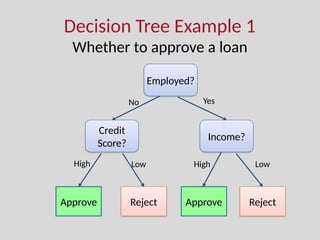
Decision Tree Example 1
Whether to approve a loan
Employed?
Credit
Score?
Income?
Approve Approve
Reject Reject
No Yes
High High
Low Low
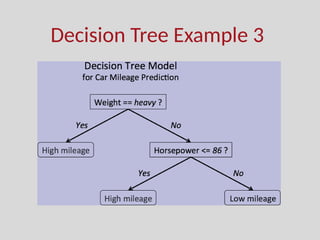
Decision Tree Example 3
Issues
• Given some training examples, what decision tree
should be generated?
• One proposal: prefer the smallest tree that is
consistent with the data (Bias)
– the tree with the least depth?
– the tree with the fewest nodes?
• Possible method:
– search the space of decision trees for the smallest decision
tree that fits the data
Example Data
Action Author Thread Length Where
e1 skips known new long Home
e2 reads unknown new short Work
e3 skips unknown old long Work
e4 skips known old long home
e5 reads known new short home
e6 skips known old long work
e7 ??? known new short work
e8 ??? unknown new short work
Training Examples:
New Examples:
Possible splits
length
long short
skips 9
reads 9
Skips 7
Reads 0
Skips 2
Reads 9
thread
new old
skips 9
reads 9
Skips 3
Reads 7
Skips 6
Reads 2
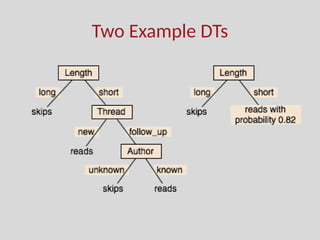
Two Example DTs
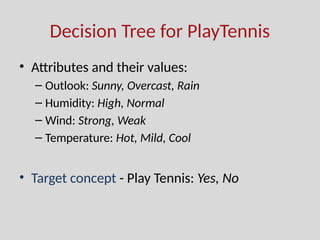
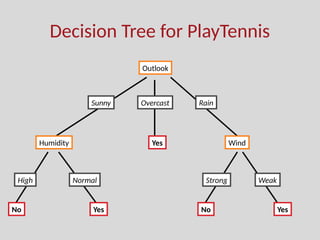
Decision Tree for PlayTennis
• Attributes and their values:
– Outlook: Sunny, Overcast, Rain
– Humidity: High, Normal
– Wind: Strong, Weak
– Temperature: Hot, Mild, Cool
• Target concept - Play Tennis: Yes, No
Decision Tree for PlayTennis
Outlook
Sunny Overcast Rain
Humidity
High Normal
Wind
Strong Weak
No Yes
Yes
Yes
No
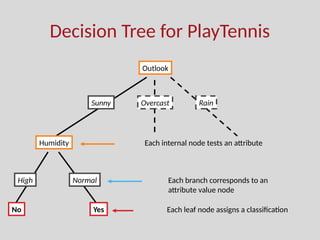
Decision Tree for PlayTennis
Outlook
Sunny Overcast Rain
Humidity
High Normal
No Yes
Each internal node tests an attribute
Each branch corresponds to an
attribute value node
Each leaf node assigns a classification
No
Decision Tree for PlayTennis
Outlook
Sunny Overcast Rain
Humidity
High Normal
Wind
Strong Weak
No Yes
Yes
Yes
No
Outlook Temperature Humidity Wind PlayTennis
Sunny Hot High Weak ?
Decision Tree
Outlook
Sunny Overcast Rain
Humidity
High Normal
Wind
Strong Weak
No Yes
Yes
Yes
No
decision trees represent disjunctions of conjunctions
(Outlook=Sunny  Humidity=Normal)
 (Outlook=Overcast)
 (Outlook=Rain  Wind=Weak)
Searching for a good tree
• How should you go about building a decision tree?
• The space of decision trees is too big for systematic
search.
• Stop and
– return the a value for the target feature or
– a distribution over target feature values
• Choose a test (e.g. an input feature) to split on.
– For each value of the test, build a subtree for those examples
with this value for the test.
Top-Down Induction of Decision Trees ID3
1. A  the “best” decision attribute for next node
2. Assign A as decision attribute for node
3. For each value of A create new descendant
4. Sort training examples to leaf node according to the
attribute value of the branch
5. If all training examples are perfectly classified (same
value of target attribute) stop, else iterate over new
leaf nodes.
1. Which node to proceed with?
2. When to stop?
Choices
• When to stop
– no more input features
– all examples are classified the same
– too few examples to make an informative split
• Which test to split on
– split gives smallest error.
– With multi-valued features
• split on all values or
• split values into half.
machine learning decision tree algorithm

  • 1.
    Foundations of MachineLearning Sudeshna Sarkar IIT Kharagpur Module 2: Linear Regression and Decision Tree Part B: Introduction to Decision Tree
  • 2.
    Definition • A decisiontree is a classifier in the form of a tree structure with two types of nodes: – Decision node: Specifies a choice or test of some attribute, with one branch for each outcome – Leaf node: Indicates classification of an example
  • 3.
    Decision Tree Example1 Whether to approve a loan Employed? Credit Score? Income? Approve Approve Reject Reject No Yes High High Low Low
  • 4.
  • 5.
    Issues • Given sometraining examples, what decision tree should be generated? • One proposal: prefer the smallest tree that is consistent with the data (Bias) – the tree with the least depth? – the tree with the fewest nodes? • Possible method: – search the space of decision trees for the smallest decision tree that fits the data
  • 6.
    Example Data Action AuthorThread Length Where e1 skips known new long Home e2 reads unknown new short Work e3 skips unknown old long Work e4 skips known old long home e5 reads known new short home e6 skips known old long work e7 ??? known new short work e8 ??? unknown new short work Training Examples: New Examples:
  • 7.
    Possible splits length long short skips9 reads 9 Skips 7 Reads 0 Skips 2 Reads 9 thread new old skips 9 reads 9 Skips 3 Reads 7 Skips 6 Reads 2
  • 8.
  • 9.
    Decision Tree forPlayTennis • Attributes and their values: – Outlook: Sunny, Overcast, Rain – Humidity: High, Normal – Wind: Strong, Weak – Temperature: Hot, Mild, Cool • Target concept - Play Tennis: Yes, No
  • 10.
    Decision Tree forPlayTennis Outlook Sunny Overcast Rain Humidity High Normal Wind Strong Weak No Yes Yes Yes No
  • 11.
    Decision Tree forPlayTennis Outlook Sunny Overcast Rain Humidity High Normal No Yes Each internal node tests an attribute Each branch corresponds to an attribute value node Each leaf node assigns a classification
  • 12.
    No Decision Tree forPlayTennis Outlook Sunny Overcast Rain Humidity High Normal Wind Strong Weak No Yes Yes Yes No Outlook Temperature Humidity Wind PlayTennis Sunny Hot High Weak ?
  • 13.
    Decision Tree Outlook Sunny OvercastRain Humidity High Normal Wind Strong Weak No Yes Yes Yes No decision trees represent disjunctions of conjunctions (Outlook=Sunny  Humidity=Normal)  (Outlook=Overcast)  (Outlook=Rain  Wind=Weak)
  • 14.
    Searching for agood tree • How should you go about building a decision tree? • The space of decision trees is too big for systematic search. • Stop and – return the a value for the target feature or – a distribution over target feature values • Choose a test (e.g. an input feature) to split on. – For each value of the test, build a subtree for those examples with this value for the test.
  • 15.
    Top-Down Induction ofDecision Trees ID3 1. A  the “best” decision attribute for next node 2. Assign A as decision attribute for node 3. For each value of A create new descendant 4. Sort training examples to leaf node according to the attribute value of the branch 5. If all training examples are perfectly classified (same value of target attribute) stop, else iterate over new leaf nodes. 1. Which node to proceed with? 2. When to stop?
  • 16.
    Choices • When tostop – no more input features – all examples are classified the same – too few examples to make an informative split • Which test to split on – split gives smallest error. – With multi-valued features • split on all values or • split values into half.