Increasing Student Interest
and Response Rates
Will Miller, Ph.D.
Director of Institutional Research
and Effectiveness
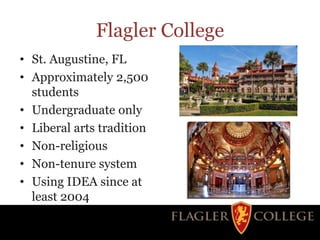
Flagler College
• St. Augustine, FL
• Approximately 2,500
students
• Undergraduate only
• Liberal arts tradition
• Non-religious
• Non-tenure system
• Using IDEA since at
least 2004
Old Approach to Evaluations
• Prior to Fall 2014
– Veteran faculty
• Select two courses (one upper/one lower)
• Paper/pencil administration
• One attempt—controlled by faculty
– New and adjunct faculty
• All courses evaluated
• Paper/pencil administration
• One attempt—controlled by faculty
Results with the Old Approach
• Received a high response rate given that
students were a captured audience
– However, there were significant administrative costs
– Concerns about faculty role in administration
– Concerns about thoughtfulness of students
• Especially with written comments
• Additionally, even with the high response rate,
we were only evaluating 50% of courses chosen
by faculty
Approach to Evaluations
• Beginning in Fall 2014
– All faculty
• All courses evaluated
• Online administration through Campus Labs
• Multiple approaches
Some Faculty Respond
• “Students will never
take the survey
online.”
• “Not every student
has the capability to
complete this online.”
• “They’ll all sit
together and talk
negatively about me.”
The Response Rate Issue
• Biggest concern going online
• Campus-wide conversation on how to
assure response rates are where we want
them to be ( > 70%)
The Punitive Approach
• Student can’t access grades
– Or at least not as quickly
• Student can’t register for next term
• Student can’t graduate
– The Bachelor of Arts degree is awarded to students who meet the
following conditions:
• Faculty revolt
Why We Went Another
Direction
• Student Autonomy
– From the moment freshmen arrive, we preach
student autonomy
– Thus, it is our job to demonstrate to them
WHY they should complete course evaluations
Results
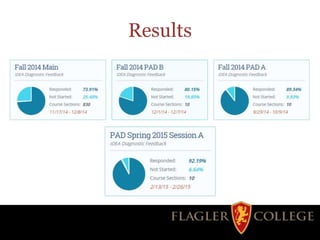
Results
• Faculty satisfaction (and, in some cases,
lack thereof)
– Comments
– Response rates
– Less loss of class time
– Customization options
Method
• Faculty are told to set aside a day and time
to still complete the evaluations in class, if
they wish, along with talking points
– Loaner tablets available if they know students
will need them
• Significant effort spent designing a
communication plan to reach ALL
students
Communication Plan
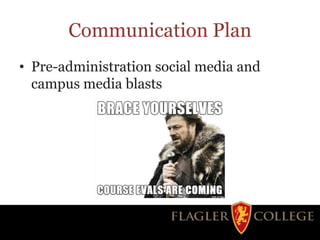
• Pre-administration social media and
campus media blasts
Communication Plan
• Initial e-mail at beginning of
administration
– Serious tone
– Discusses importance of course evaluations
and student responsibility in completing them
– KEY: reminding them to follow faculty
instruction. We leave administrations open
for 2-3 weeks and allow faculty to provide
guidance on timing when relevant.
Sample Language
• These results are used by the institution to improve
teaching and assure students are receiving the best
instruction possible. Each semester IDEA results are
looked at by faculty, department chairs, and
administrators. Your honest feedback helps us in our
efforts to continually improve instruction. Please take
these evaluations seriously as they are our only
opportunity to measure your satisfaction or
dissatisfaction with your courses this semester.
Communication Plan
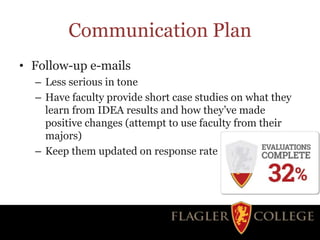
• Follow-up e-mails
– Less serious in tone
– Have faculty provide short case studies on what they
learn from IDEA results and how they’ve made
positive changes (attempt to use faculty from their
majors)
– Keep them updated on response rate
Communication Plan
• Follow-up e-mails
– Sample language
• I know you’re tired of hearing from my office about these, but they really are
important. It will take less than 5 minutes per course to complete and will
help us do a better job teaching you effectively. We’ve extended the deadline
till December 7 for you to complete these and really hope you will take the
time to complete them. However, the sooner you complete them, the sooner
we can stop reminding you.
• Yes, it’s us again. Looks like you still haven't completed course evaluations
for the following courses: ECO 331 (A): International Economics We won't
notify you anymore about this. Just reminding you that your ability to
evaluate these courses will close on Sunday night at midnight. Log in now
(even from a mobile device) to do your part.
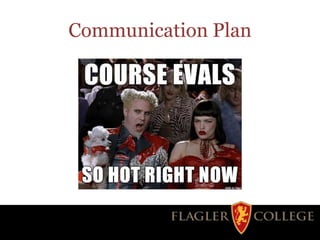
Communication Plan
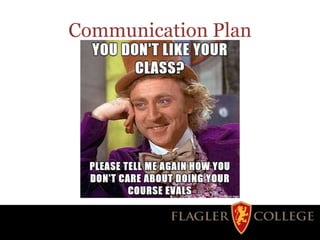
Communication Plan
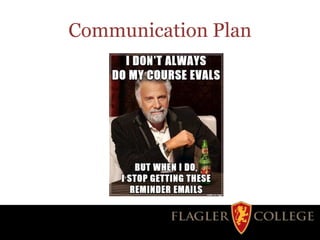
Communication Plan
Communication Plan
Tricks
• Redirect to a different URL
– www.flagler.edu/courseevaluations
• Easier for faculty and students to remember
• Having students help in crafting
messaging
• Appropriate seriousness in each message
• Subject lines of e-mails!
– Pretty please! (responses and comments)
Conclusion
• It IS possible to have high response rates
without taking draconian control over
elements of student lives
– Faculty will be happier
– Students will be happier
Questions and Discussion

Increasing Student Interest and Response Rates

  • 1.
    Increasing Student Interest andResponse Rates Will Miller, Ph.D. Director of Institutional Research and Effectiveness
  • 2.
    Flagler College • St.Augustine, FL • Approximately 2,500 students • Undergraduate only • Liberal arts tradition • Non-religious • Non-tenure system • Using IDEA since at least 2004
  • 3.
    Old Approach toEvaluations • Prior to Fall 2014 – Veteran faculty • Select two courses (one upper/one lower) • Paper/pencil administration • One attempt—controlled by faculty – New and adjunct faculty • All courses evaluated • Paper/pencil administration • One attempt—controlled by faculty
  • 4.
    Results with theOld Approach • Received a high response rate given that students were a captured audience – However, there were significant administrative costs – Concerns about faculty role in administration – Concerns about thoughtfulness of students • Especially with written comments • Additionally, even with the high response rate, we were only evaluating 50% of courses chosen by faculty
  • 5.
    Approach to Evaluations •Beginning in Fall 2014 – All faculty • All courses evaluated • Online administration through Campus Labs • Multiple approaches
  • 6.
    Some Faculty Respond •“Students will never take the survey online.” • “Not every student has the capability to complete this online.” • “They’ll all sit together and talk negatively about me.”
  • 7.
    The Response RateIssue • Biggest concern going online • Campus-wide conversation on how to assure response rates are where we want them to be ( > 70%)
  • 8.
    The Punitive Approach •Student can’t access grades – Or at least not as quickly • Student can’t register for next term • Student can’t graduate – The Bachelor of Arts degree is awarded to students who meet the following conditions: • Faculty revolt
  • 9.
    Why We WentAnother Direction • Student Autonomy – From the moment freshmen arrive, we preach student autonomy – Thus, it is our job to demonstrate to them WHY they should complete course evaluations
  • 10.
  • 11.
    Results • Faculty satisfaction(and, in some cases, lack thereof) – Comments – Response rates – Less loss of class time – Customization options
  • 12.
    Method • Faculty aretold to set aside a day and time to still complete the evaluations in class, if they wish, along with talking points – Loaner tablets available if they know students will need them • Significant effort spent designing a communication plan to reach ALL students
  • 13.
    Communication Plan • Pre-administrationsocial media and campus media blasts
  • 14.
    Communication Plan • Initiale-mail at beginning of administration – Serious tone – Discusses importance of course evaluations and student responsibility in completing them – KEY: reminding them to follow faculty instruction. We leave administrations open for 2-3 weeks and allow faculty to provide guidance on timing when relevant.
  • 15.
    Sample Language • Theseresults are used by the institution to improve teaching and assure students are receiving the best instruction possible. Each semester IDEA results are looked at by faculty, department chairs, and administrators. Your honest feedback helps us in our efforts to continually improve instruction. Please take these evaluations seriously as they are our only opportunity to measure your satisfaction or dissatisfaction with your courses this semester.
  • 16.
    Communication Plan • Follow-upe-mails – Less serious in tone – Have faculty provide short case studies on what they learn from IDEA results and how they’ve made positive changes (attempt to use faculty from their majors) – Keep them updated on response rate
  • 17.
    Communication Plan • Follow-upe-mails – Sample language • I know you’re tired of hearing from my office about these, but they really are important. It will take less than 5 minutes per course to complete and will help us do a better job teaching you effectively. We’ve extended the deadline till December 7 for you to complete these and really hope you will take the time to complete them. However, the sooner you complete them, the sooner we can stop reminding you. • Yes, it’s us again. Looks like you still haven't completed course evaluations for the following courses: ECO 331 (A): International Economics We won't notify you anymore about this. Just reminding you that your ability to evaluate these courses will close on Sunday night at midnight. Log in now (even from a mobile device) to do your part.
  • 18.
  • 19.
  • 20.
  • 21.
  • 22.
    Tricks • Redirect toa different URL – www.flagler.edu/courseevaluations • Easier for faculty and students to remember • Having students help in crafting messaging • Appropriate seriousness in each message • Subject lines of e-mails! – Pretty please! (responses and comments)
  • 23.
    Conclusion • It ISpossible to have high response rates without taking draconian control over elements of student lives – Faculty will be happier – Students will be happier
  • 24.