Structural Isomers and Stereoisomers
Module-3, S1
Chemistry
18CYB101J
Stereochemistry
 Stereochemistry deals with three dimensional representation of molecule in space.
 This has sweeping implications in biological systems. For example, most drugs are
often composed of a single stereoisomer of a compound.
 Among stereoisomers one may have positive effects on the body and another
stereoisomer may not or could even be toxic.
 An example of this is the drug thalidomide which was used during the 1950s to
suppress the morning sickness. The drug unfortunately, was prescribed as a mixture
of stereoisomers, and while one stereoisomer actively worked on controlling
morning sickness, the other stereoisomer caused serious birth defects.
Chemistry
18CYB101J
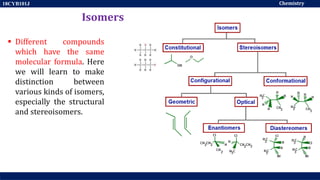
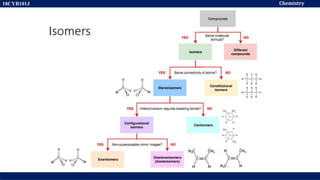
Isomers
 Different compounds
which have the same
molecular formula. Here
we will learn to make
distinction between
various kinds of isomers,
especially the structural
and stereoisomers.
Chemistry
18CYB101J
Chemistry
18CYB101J
Terminology used in Stereochemistry
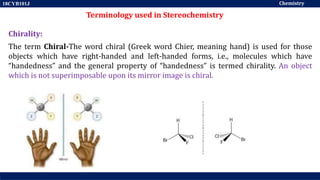
Chirality:
The term Chiral-The word chiral (Greek word Chier, meaning hand) is used for those
objects which have right-handed and left-handed forms, i.e., molecules which have
“handedness” and the general property of “handedness” is termed chirality. An object
which is not superimposable upon its mirror image is chiral.
Chemistry
18CYB101J
Terminology used in Stereochemistry
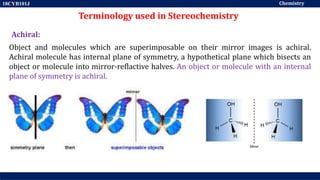
Achiral:
Object and molecules which are superimposable on their mirror images is achiral.
Achiral molecule has internal plane of symmetry, a hypothetical plane which bisects an
object or molecule into mirror-reflactive halves. An object or molecule with an internal
plane of symmetry is achiral.
Chemistry
18CYB101J
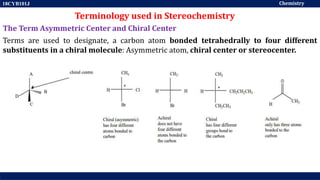
The Term Asymmetric Center and Chiral Center
Terminology used in Stereochemistry
Terms are used to designate, a carbon atom bonded tetrahedrally to four different
substituents in a chiral molecule: Asymmetric atom, chiral center or stereocenter.
Chemistry
18CYB101J
Structural Isomers
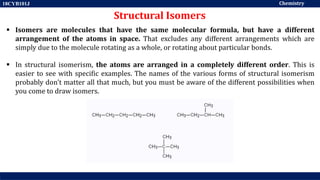
 Isomers are molecules that have the same molecular formula, but have a different
arrangement of the atoms in space. That excludes any different arrangements which are
simply due to the molecule rotating as a whole, or rotating about particular bonds.
 In structural isomerism, the atoms are arranged in a completely different order. This is
easier to see with specific examples. The names of the various forms of structural isomerism
probably don't matter all that much, but you must be aware of the different possibilities when
you come to draw isomers.
Chemistry
18CYB101J
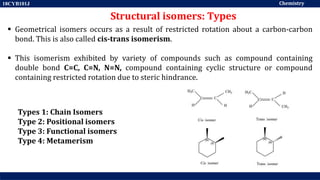
Structural isomers: Types
Types 1: Chain Isomers
Type 2: Positional isomers
Type 3: Functional isomers
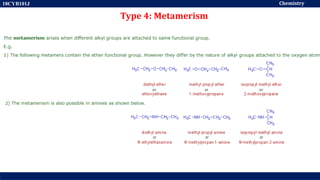
Type 4: Metamerism
 Geometrical isomers occurs as a result of restricted rotation about a carbon-carbon
bond. This is also called cis-trans isomerism.
 This isomerism exhibited by variety of compounds such as compound containing
double bond C=C, C=N, N=N, compound containing cyclic structure or compound
containing restricted rotation due to steric hindrance.
Chemistry
18CYB101J
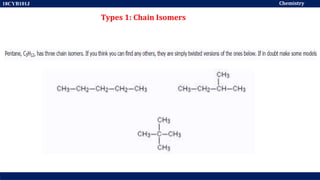
Types 1: Chain Isomers
Chemistry
18CYB101J
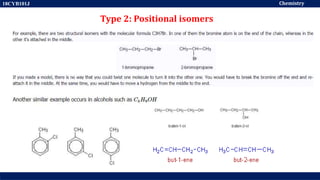
Type 2: Positional isomers
Chemistry
18CYB101J
Type 3: Functional isomers
Chemistry
18CYB101J
Type 4: Metamerism
Chemistry
18CYB101J
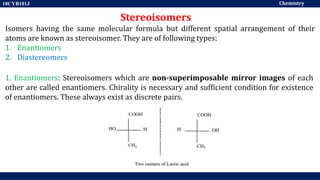
Stereoisomers
Isomers having the same molecular formula but different spatial arrangement of their
atoms are known as stereoisomer. They are of following types:
1. Enantiomers
2. Diastereomers
1. Enantiomers: Stereoisomers which are non-superimposable mirror images of each
other are called enantiomers. Chirality is necessary and sufficient condition for existence
of enantiomers. These always exist as discrete pairs.
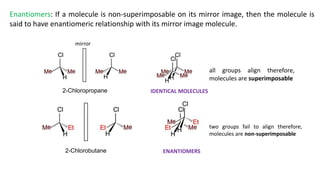
Enantiomers: If a molecule is non-superimposable on its mirror image, then the molecule is
said to have enantiomeric relationship with its mirror image molecule.
mirror
2-Chloropropane
2-Chlorobutane
all groups align therefore,
molecules are superimposable
two groups fail to align therefore,
molecules are non-superimposable
IDENTICAL MOLECULES
ENANTIOMERS
Chemistry
18CYB101J
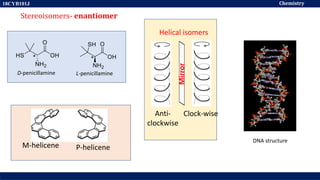
Stereoisomers- enantiomer
Mirror
Clock-wise
Anti-
clockwise
M-helicene P-helicene
Helical isomers
DNA structure
D-penicillamine L-penicillamine
* *
Chemistry
18CYB101J
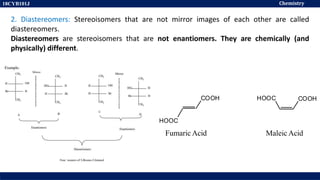
2. Diastereomers: Stereoisomers that are not mirror images of each other are called
diastereomers.
Diastereomers are stereoisomers that are not enantiomers. They are chemically (and
physically) different.
HOOC COOH
Maleic Acid
COOH
HOOC
Fumaric Acid
Chemistry
18CYB101J
Representation of Three Dimensional Molecules
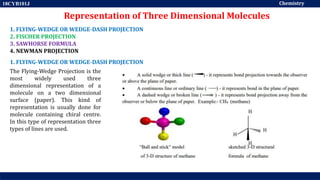
1. FLYING-WEDGE OR WEDGE-DASH PROJECTION
2. FISCHER PROJECTION
3. SAWHORSE FORMULA
4. NEWMAN PROJECTION
1. FLYING-WEDGE OR WEDGE-DASH PROJECTION
The Flying-Wedge Projection is the
most widely used three
dimensional representation of a
molecule on a two dimensional
surface (paper). This kind of
representation is usually done for
molecule containing chiral centre.
In this type of representation three
types of lines are used.
Chemistry
18CYB101J
Representation of Three Dimensional Molecules
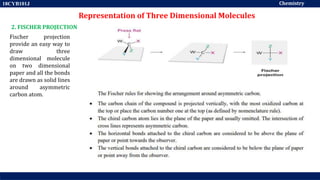
2. FISCHER PROJECTION
Fischer projection
provide an easy way to
draw three
dimensional molecule
on two dimensional
paper and all the bonds
are drawn as solid lines
around asymmetric
carbon atom.
Chemistry
18CYB101J
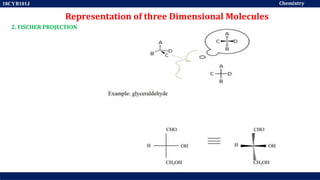
Representation of three Dimensional Molecules
2. FISCHER PROJECTION
Chemistry
18CYB101J
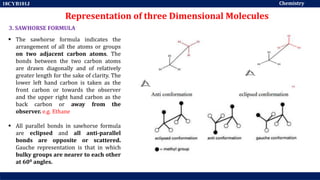
3. SAWHORSE FORMULA
 The sawhorse formula indicates the
arrangement of all the atoms or groups
on two adjacent carbon atoms. The
bonds between the two carbon atoms
are drawn diagonally and of relatively
greater length for the sake of clarity. The
lower left hand carbon is taken as the
front carbon or towards the observer
and the upper right hand carbon as the
back carbon or away from the
observer. e.g. Ethane
 All parallel bonds in sawhorse formula
are eclipsed and all anti-parallel
bonds are opposite or scattered.
Gauche representation is that in which
bulky groups are nearer to each other
at 600 angles.
Representation of three Dimensional Molecules
Chemistry
18CYB101J
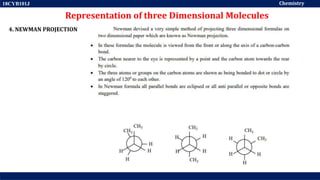
4. NEWMAN PROJECTION
Representation of three Dimensional Molecules
Chemistry
18CYB101J
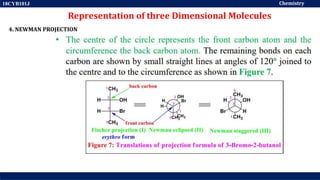
4. NEWMAN PROJECTION
Representation of three Dimensional Molecules

Module 3_S1_Structural Isomers and Stereoisomers.pptx

  • 1.
    Structural Isomers andStereoisomers Module-3, S1
  • 2.
    Chemistry 18CYB101J Stereochemistry  Stereochemistry dealswith three dimensional representation of molecule in space.  This has sweeping implications in biological systems. For example, most drugs are often composed of a single stereoisomer of a compound.  Among stereoisomers one may have positive effects on the body and another stereoisomer may not or could even be toxic.  An example of this is the drug thalidomide which was used during the 1950s to suppress the morning sickness. The drug unfortunately, was prescribed as a mixture of stereoisomers, and while one stereoisomer actively worked on controlling morning sickness, the other stereoisomer caused serious birth defects.
  • 3.
    Chemistry 18CYB101J Isomers  Different compounds whichhave the same molecular formula. Here we will learn to make distinction between various kinds of isomers, especially the structural and stereoisomers.
  • 4.
  • 5.
    Chemistry 18CYB101J Terminology used inStereochemistry Chirality: The term Chiral-The word chiral (Greek word Chier, meaning hand) is used for those objects which have right-handed and left-handed forms, i.e., molecules which have “handedness” and the general property of “handedness” is termed chirality. An object which is not superimposable upon its mirror image is chiral.
  • 6.
    Chemistry 18CYB101J Terminology used inStereochemistry Achiral: Object and molecules which are superimposable on their mirror images is achiral. Achiral molecule has internal plane of symmetry, a hypothetical plane which bisects an object or molecule into mirror-reflactive halves. An object or molecule with an internal plane of symmetry is achiral.
  • 7.
    Chemistry 18CYB101J The Term AsymmetricCenter and Chiral Center Terminology used in Stereochemistry Terms are used to designate, a carbon atom bonded tetrahedrally to four different substituents in a chiral molecule: Asymmetric atom, chiral center or stereocenter.
  • 8.
    Chemistry 18CYB101J Structural Isomers  Isomersare molecules that have the same molecular formula, but have a different arrangement of the atoms in space. That excludes any different arrangements which are simply due to the molecule rotating as a whole, or rotating about particular bonds.  In structural isomerism, the atoms are arranged in a completely different order. This is easier to see with specific examples. The names of the various forms of structural isomerism probably don't matter all that much, but you must be aware of the different possibilities when you come to draw isomers.
  • 9.
    Chemistry 18CYB101J Structural isomers: Types Types1: Chain Isomers Type 2: Positional isomers Type 3: Functional isomers Type 4: Metamerism  Geometrical isomers occurs as a result of restricted rotation about a carbon-carbon bond. This is also called cis-trans isomerism.  This isomerism exhibited by variety of compounds such as compound containing double bond C=C, C=N, N=N, compound containing cyclic structure or compound containing restricted rotation due to steric hindrance.
  • 10.
  • 11.
  • 12.
  • 13.
  • 14.
    Chemistry 18CYB101J Stereoisomers Isomers having thesame molecular formula but different spatial arrangement of their atoms are known as stereoisomer. They are of following types: 1. Enantiomers 2. Diastereomers 1. Enantiomers: Stereoisomers which are non-superimposable mirror images of each other are called enantiomers. Chirality is necessary and sufficient condition for existence of enantiomers. These always exist as discrete pairs.
  • 15.
    Enantiomers: If amolecule is non-superimposable on its mirror image, then the molecule is said to have enantiomeric relationship with its mirror image molecule. mirror 2-Chloropropane 2-Chlorobutane all groups align therefore, molecules are superimposable two groups fail to align therefore, molecules are non-superimposable IDENTICAL MOLECULES ENANTIOMERS
  • 16.
  • 17.
    Chemistry 18CYB101J 2. Diastereomers: Stereoisomersthat are not mirror images of each other are called diastereomers. Diastereomers are stereoisomers that are not enantiomers. They are chemically (and physically) different. HOOC COOH Maleic Acid COOH HOOC Fumaric Acid
  • 18.
    Chemistry 18CYB101J Representation of ThreeDimensional Molecules 1. FLYING-WEDGE OR WEDGE-DASH PROJECTION 2. FISCHER PROJECTION 3. SAWHORSE FORMULA 4. NEWMAN PROJECTION 1. FLYING-WEDGE OR WEDGE-DASH PROJECTION The Flying-Wedge Projection is the most widely used three dimensional representation of a molecule on a two dimensional surface (paper). This kind of representation is usually done for molecule containing chiral centre. In this type of representation three types of lines are used.
  • 19.
    Chemistry 18CYB101J Representation of ThreeDimensional Molecules 2. FISCHER PROJECTION Fischer projection provide an easy way to draw three dimensional molecule on two dimensional paper and all the bonds are drawn as solid lines around asymmetric carbon atom.
  • 20.
    Chemistry 18CYB101J Representation of threeDimensional Molecules 2. FISCHER PROJECTION
  • 21.
    Chemistry 18CYB101J 3. SAWHORSE FORMULA The sawhorse formula indicates the arrangement of all the atoms or groups on two adjacent carbon atoms. The bonds between the two carbon atoms are drawn diagonally and of relatively greater length for the sake of clarity. The lower left hand carbon is taken as the front carbon or towards the observer and the upper right hand carbon as the back carbon or away from the observer. e.g. Ethane  All parallel bonds in sawhorse formula are eclipsed and all anti-parallel bonds are opposite or scattered. Gauche representation is that in which bulky groups are nearer to each other at 600 angles. Representation of three Dimensional Molecules
  • 22.
  • 23.