Paula Nottingham
Module 3 BAPP Arts WBS3760
Session 2 Thinking Creatively
about your professional
inquiry 15/3/17
Finding connections
and patterns in the
images and actions…
Starting the analysis –
how do you tell others
what you found out?
Drafting the inquiry is a
creative process.
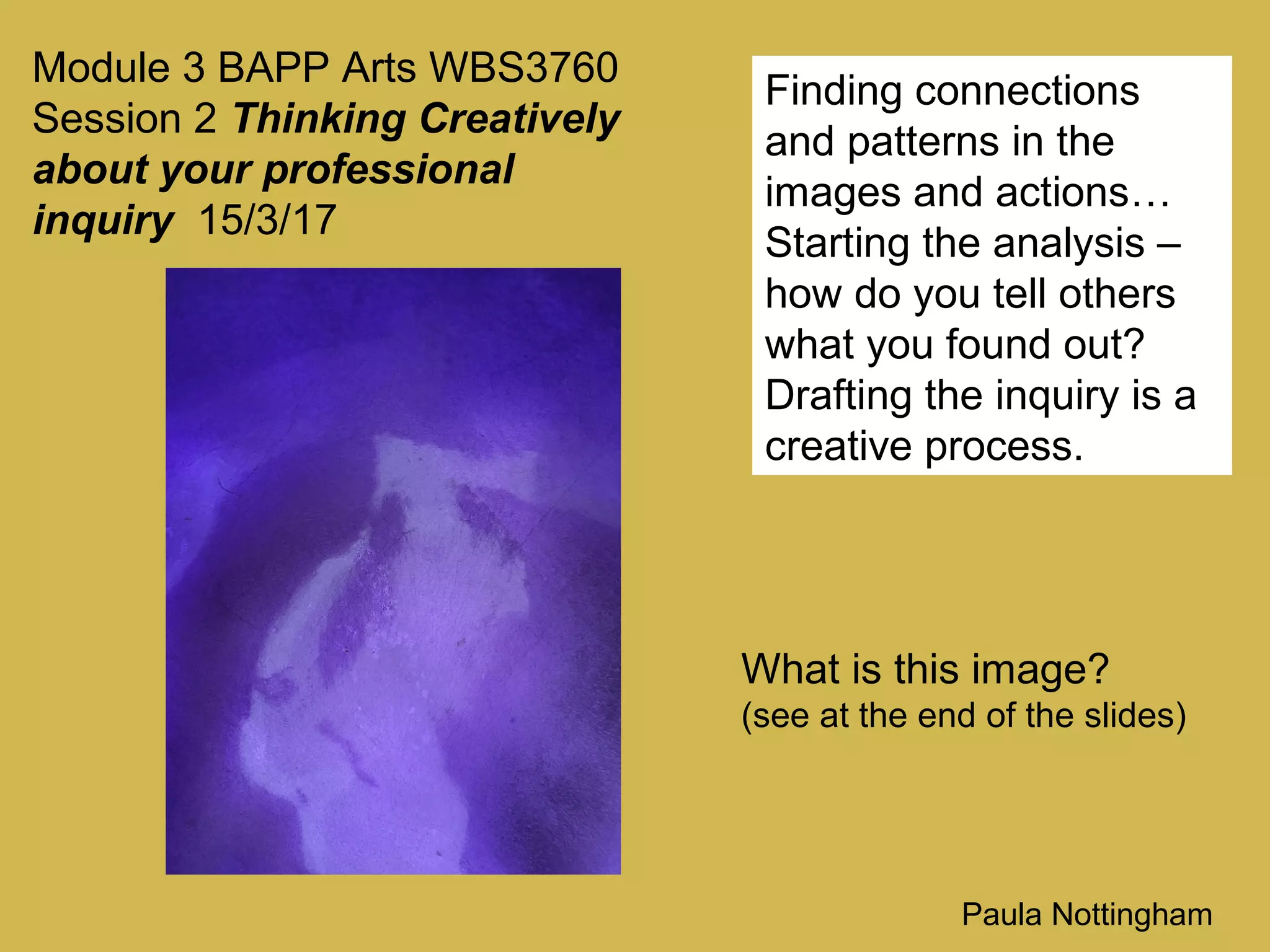
What is this image?
(see at the end of the slides)
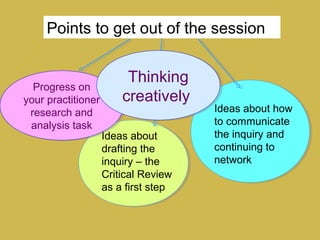
Points to get out of the session
Ideas about how
to communicate
the inquiry and
continuing to
network
Ideas about
drafting the
inquiry – the
Critical Review
as a first step
Progress on
your practitioner
research and
analysis task
Progress on
your practitioner
research and
analysis task
Thinking
creatively
Thinking
creatively
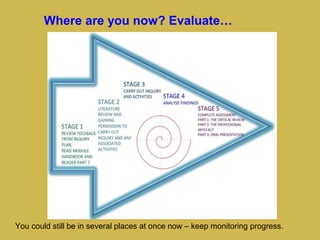
Where are you now? Evaluate…
You could still be in several places at once now – keep monitoring progress.
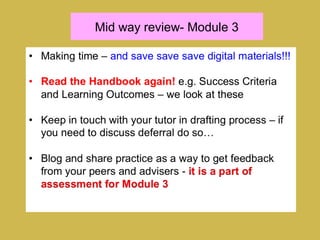
Mid way review- Module 3
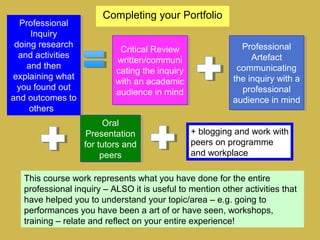
Completing your Portfolio
This course work represents what you have done for the entire
professional inquiry – ALSO it is useful to mention other activities that
have helped you to understand your topic/area – e.g. going to
performances you have been a art of or have seen, workshops,
training – relate and reflect on your entire experience!
Critical Review
written/communi
cating the inquiry
with an academic
audience in mind
Critical Review
written/communi
cating the inquiry
with an academic
audience in mind
Professional
Artefact
communicating
the inquiry with a
professional
audience in mind
Professional
Artefact
communicating
the inquiry with a
professional
audience in mind
Oral
Presentation
for tutors and
peers
Oral
Presentation
for tutors and
peers
+ blogging and work with
peers on programme
and workplace
Professional
Inquiry
doing research
and activities
and then
explaining what
you found out
and outcomes to
others
Professional
Inquiry
doing research
and activities
and then
explaining what
you found out
and outcomes to
others
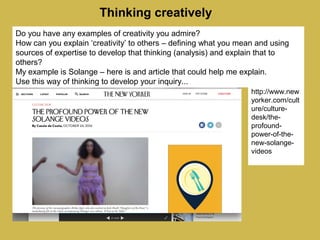
Thinking creatively
Do you have any examples of creativity you admire?
How can you explain ‘creativity’ to others – defining what you mean and using
sources of expertise to develop that thinking (analysis) and explain that to
others?
My example is Solange – here is and article that could help me explain.
Use this way of thinking to develop your inquiry...
http://www.new
yorker.com/cult
ure/culture-
desk/the-
profound-
power-of-the-
new-solange-
videos
Thinking creatively in your inquiry
Twyla Thwarp suggests in The Creative
Habit (2003, p. 196) that “A groove is the
best place in the world. It’s where I strive
to be, because when you’re in it you have
the freedom to explore, where everything
you question leads you to new avenues
and new routes, everything you touch
miraculously touches something and
transforms it for the better.”
Anne West suggests in Mapping
(2011, p. 224) Communicating
with an audience is the
culminating step in the process. It
involves shifting form reading
our work to writing and
speaking about it. We now
become authors, which implies
responsibility and action. In giving
voice to our work, we embrace
and sift all previous raw material,
moving it to a higher level of
synthesis while offering it to others
for their consideration.”
Mihaly Csikszenrmihalyi talks about ‘flow’ and
suggests that emersing yourself in a ‘domain’
that you truly love will allow the “foundations for
creativity” to be in place”. (2006)
https://www.ted.com/talks/mihaly_csikszentmihalyi_on_
flow?language=en
Pronounced Chick – sent – me - high
http://annewest.net
http://www.twylatharp.org
As a creative professional – embed ideas about creativity in your inquiry analysis
– here are some examples
Thinking creatively
http://www.normanjackson.co.uk/creati
vity.html
Norman Jackson - an
advocate for life wide
learning
https://www.ted.com/talks/ken_robinson_how_to_escape_educa
tion_s_death_valley?language=en
Ken Robinson - an advocate
for creative education
https://www.ted.com/playlists/125/tv_special_ted_talks_educatio
Can you think of more ?
You probably have some
creative ideas that help you
think about your inquiry from
things you have done or the
literature your have reviewed
?
Ted talks – advocates
e.g. seeing and exhibition of
Banksy (visual artist) that talked
about the changes in contemporary
culture that could be compared
to dance practice (Taz)
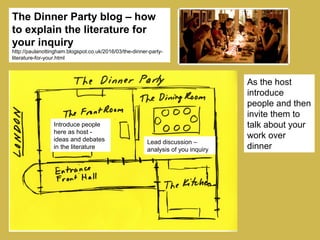
The Dinner Party blog – how
to explain the literature for
your inquiry
http://paulanottingham.blogspot.co.uk/2016/03/the-dinner-party-
literature-for-your.html
As the host
introduce
people and then
invite them to
talk about your
work over
dinner
Introduce people
here as host -
ideas and debates
in the literature
Lead discussion –
analysis of you inquiry
Try this exercise!
Use talking to start your writing
Tell someone else (or think aloud) an example from your
‘emerging findings’ (what people have told your about your
topic in your practitioner research). Try this for 4 minutes…
…………………………………………………………………
Use your experience (interpretation of something that is common or
exceptional) and your literature to talk about what you found out.
Writing with style and purpose
After you have started a draft – and then continue to edit
this. In a formal writing style you say what you mean first
and then explain – use your sources to define terms and
as the experts ‘see’ the issues that you have explored in
your inquiry
4 main Headings (see Handbook for details)
Introduction, Evaluation of the Inquiry Process, Analysis of the
Findings - data, literature and experience, Critical Reflection
Remember that you can add visual elements to show what
you mean – like diagrams and or illustrations to the text
Start the bibliography as you do this writing using Harvard
style (remember you can use Cite Them Right) and
there is information up on UniHub (Library and Teaching
Enhancement Unit)
Effective Writing
Drafting is a creative Process!
When you start writing the ideas do not always come out in
an orderly fashion – but your job is to reorder them (like
Strunk and White suggest) to make sense of the argument.
In you own drafting and editing processes – reordering and
‘shaping’ the text strives to make it more meaningful and
more concise. Use paragraphs as units to bring out
meaning. ADD details so others will understand the points
you are making.
Effective Writing- try to edit with purpose to say
what you mean in fewer words…
Strunk and White example on the issue of wordiness (1959, p. 19)
Wordy version :
Macbeth was very ambitious. This led him to wish to become king of
Scotland. The witches told him that this wish of his would come true. The
kind of Scotland at this time was Duncan. Encouraged by his wife,
Macbeth murdered Duncan. He was thus enabled to succeed Duncan.
He was thus enabled to succeed Duncan as king, (51 words)
More concise version:
Encouraged by his wife, Macbeth achieved his ambition and realized the
prediction of the witches by murdering Duncan and becoming king of
Scotland in his place, (26 words)
The Elements of Style (1959) Strunk and White
Example using Literature
Here is a quote about performance and motivation in dance – the quote
will be discussed on the next slide…
Lazaroff, Elizabeth M (2001) ‘Performance and Motivation in Dance
Education’, Arts Education Policy Review, 103, 2; pp.23-26.
Motivation is the internal process that initiates, guides, and
perpetuates behaviour over time. Motivation is a crucial
issue in education, as in other fields concerned with
mobilizing others to act, because it is the core of biological,
cognitive and social regulation (Ryan and Deci 2000). The
task of teaching is to promote cognitive, behavioural, and
affective results from students. How to motivate learners to
achieve the desired ends or discourage them from
undesirable outcomes is a central problem for a teacher in
any field.
When you are looking at literature you are looking for meaning – so is
this saying motivation is fundamental or an added extra to the process of
education? So if I could say in my writing:
I was interested in developing an understanding of motivation for
teaching dance. Lazaroff suggests motivation is essential to education
and cites Ryan and Deci (2000) to say that “it is at the core of biological,
cognitive and social regulation” (2001, p. 26). Using the dance teacher
‘David’ as an example, Lazaroff suggested techniques such as
“modelling and repetition, the verbal directions including praise and
corrections, music, group learning, and intense physical activity” (2001,
p.25). I wanted to embed these techniques as examples of good practice
in the dance class and incorporated this thinking into an intervention that
I helped plan in my workplace….
I may not totally agree with Lazaroff about everything e.g. about
discouraging students from “undesirable outcomes” - that point might be
contradicted by another literature source – so part of a ‘debate’ in the
literature.
Looking Ahead to the next Task
Week 4 OR 5 OR 6 (this might depend on where you are in
the process!): Send adviser 1-2 paragraphs as a sample
of your inquiry analysis. Formative feedback will be given
on the structure, the quality of the arguments and the
quality of the supporting evidence discussed.
This task is getting everyone into the mindset of being able
to take an ‘emerging’ finding (what you found out from
someone in your practitioner research) and to think about
what it means.
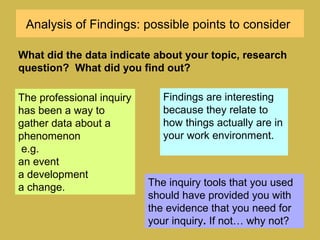
Analysis of Findings: possible points to consider
The professional inquiry
has been a way to
gather data about a
phenomenon
e.g.
an event
a development
a change.
What did the data indicate about your topic, research
question? What did you find out?
The inquiry tools that you used
should have provided you with
the evidence that you need for
your inquiry. If not… why not?
Findings are interesting
because they relate to
how things actually are in
your work environment.
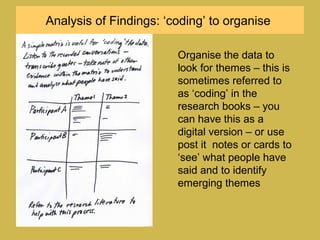
Analysis of Findings: ‘coding’ to organise
Organise the data to
look for themes – this is
sometimes referred to
as ‘coding’ in the
research books – you
can have this as a
digital version – or use
post it notes or cards to
‘see’ what people have
said and to identify
emerging themes
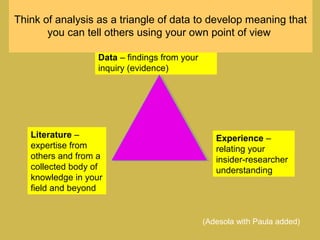
Data – findings from your
inquiry (evidence)
Experience –
relating your
insider-researcher
understanding
Literature –
expertise from
others and from a
collected body of
knowledge in your
field and beyond
Think of analysis as a triangle of data to develop meaning that
you can tell others using your own point of view
(Adesola with Paula added)
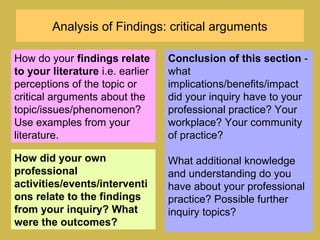
Analysis of Findings: critical arguments
How do your findings relate
to your literature i.e. earlier
perceptions of the topic or
critical arguments about the
topic/issues/phenomenon?
Use examples from your
literature.
Conclusion of this section -
what
implications/benefits/impact
did your inquiry have to your
professional practice? Your
workplace? Your community
of practice?
What additional knowledge
and understanding do you
have about your professional
practice? Possible further
inquiry topics?
How did your own
professional
activities/events/interventi
ons relate to the findings
from your inquiry? What
were the outcomes?
Professional Artefact
The Artefact is another way of explaining your inquiry that includes the outputs from the
inquiry (so what you ‘do’ is in the inquiry itself). There will be more later on this but for now it
might be good to think bout who your professional audience might be… who are you talking to
to explain what you have done and found out?
You can be creative about this process, think about a format that might be unique. Make sure
to leave enough time to do what you want to do!
Think back to the ideas around professional communication? Think about images you will
need and permissions and copyright… if they are not your images how can you incorporate
them into your own work?
MORE ON the ARTEFACT IN NEXT SESSION
Talk to your tutor if needed…
Blasts from the Past
Analysing document (revisited from Reader 6)
Documents are a bit different than literature. A document
could be something that an author has not written to
critique something – but a text (including audio-visual and
visual) that exists as a part of your job, e.g. it could be a
policy document from an educational context or a contract.
You might also have documents given to you by someone
you interview as an example of how they work – e.g. a
script.
Advice is in the Reader on how to ‘analyse’ documents for
meaning. ALSO USE RESEARCH LITERATURE
Analysing Observations (revisited)
The data is gathered and displayed as descriptions, quotes,
diagrams to show relationships, quantitative charts/displays
to show quantitative data, audio, audio-visual, and
photographic evidence, etc.
Your observations record what has happened sensitively
and appropriately to issues of ethics, permission and
confidentiality.
You need to report an understanding of the context for the
event or meeting that was observed in order to draw
conclusions from the data.
Analysing interviews and focus groups (revisited)
The analysis of data collected from interviews can be
complex. It has been collected within a certain context and
must be analysed with that in mind.
The qualitative researcher can categorise (code) data
that has emerged into themes. Quotes can be selected
because they typify the data (common responses) or there
might be some statements that are significant though only
said once (significant).
The data is organised so that comparisons, contrasts and
insights can be made with the aim of finding the meaning
of the evidence presented.
Analysing the survey/questionnaire data (revisited)
The framework for data analysis of replies determined in advance.
Coding your questionnaire: There are five steps involved in the
coding process (Survey Monkey can export this data):
1. Develop the coding frame for both pre-coded (closed) and open
questions.
2. Create a codebook and coding instructions.
3. Code the questionnaires.
4. Transfer the values to a computer (as in an Excel spreadsheet).
5. Check and clean the data (you can make simple graphs with the
data).
Interpretation involves identifying significant results, trends, patterns,
similarities and differences and offering an explanation for them. This
can be expressed in the form of numbers or words in your findings.
1. Q&A from Module 3 BAPP
1. The questions that you ask in the interview survey, should you
comment on each answer? (i.e. the Interview has 14 questions and
the Survey has 24 questions). How many graphs do you put in?
Often there is not space to look at every response, so you may want to
focus on the most significant findings and the ones that most
participants used (more common) – in some cases these might be
the same BUT in the interviews only a few might have brought up
important issues that you want to talk about. You can use your
appendices to show findings that you were unable to spend much
time on in your analysis and refer the reader when needed.
Put in the number of graphs (data) or quotes (data) that relate to your
main points of analysis.
2. Q&A from Module 3 BAPP
2. Does it matter if the information you’ve gathered is rubbish as long
as you comment that it is rubbish?
Difficult one… in this process you try to ask the right interview/survey
etc. questions to gather the data that you need to address your
research questions or hypothesis. However, there might be some
of the questions that did not lead to data that you expected or that
was useful as findings. In this case, you rely on the data that has
been useful and comment within the evaluation and perhaps in the
critical learning sections about the process BUT some unexpected
data is genuine so should be reported as a part of the inquiry.
Think this through – if your inquiry process has not allowed you to
explore the specific issues in your inquiry topic using primary
evidence from other people and literature, you need to discuss this
with your adviser.
3. Q&A from Module 3 BAPP
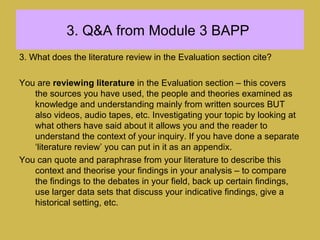
3. What does the literature review in the Evaluation section cite?
You are reviewing literature in the Evaluation section – this covers
the sources you have used, the people and theories examined as
knowledge and understanding mainly from written sources BUT
also videos, audio tapes, etc. Investigating your topic by looking at
what others have said about it allows you and the reader to
understand the context of your inquiry. If you have done a separate
‘literature review’ you can put in it as an appendix.
You can quote and paraphrase from your literature to describe this
context and theorise your findings in your analysis – to compare
the findings to the debates in your field, back up certain findings,
use larger data sets that discuss your indicative findings, give a
historical setting, etc.
4. Q&A from Module 3 BAPP
4. How much do we mention the Professional Artefact in the Critical
Review?
Yes, it is appropriate to mention the Professional Artefact in your
Critical Review, especially in your analysis or critical reflection.
You might also consider an explanatory section to your artefact–
we discussed the addition of a cover or written insert often found in
CDs to show what they are about and give credits.
The final ‘shape’ of the artefact and how it is explained is up to you, but
it would make sense to cover this explanation somewhere in the
work you submit.
5. Q&A from Module 3 BAPP
5. What is the difference between the inquiry and the professional
artefact?
The inquiry is the process you have used for exploring a research
question or hypothesis – the topic area that you have focused on
during the module. Your inquiry includes your practitioner research
and might include a workshop or teaching intervention, but the
process of questioning and exploring the topic would have
informed your practice in order for you to do that activity.
The professional artefact exhibits the knowledge and understanding
from the inquiry findings, like the critical review, but will be some a
form of communication that is ‘speaking’ to your own community of
practice – it can be a ‘work in progress’ you have made for a
professional audience.
6. Q&A from Module 3 BAPP
5. What is the difference between an ‘opinion’ and an ‘interpretation’?
Be aware that in different academic cultures (arts and humanities) the
term ‘opinion’ might represent something else.
It might be helpful to think of an opinion as a personally held belief that
could be used in your critical reflection and an interpretation as an
analysis based on evidence – evidence that comes from the data
you have gathered through your practitioner research and inquiry
work (both the literature and the ‘tool’ like interview or survey) – so
in your analysis section you will be interpreting your findings using
critical thinking that relies on judgement e.g. what did you find out
and what did it mean? based on evidence form your inquiry.
7. New questions…
• Who can be a part of a SIG?
– This does not just need to be for people who are doing similar
topics – anyone can join in and talk to others on the course
about their work!
• Are the inquiry questions different than the interview questions?
– Yes the inquiry questions are your questions – what you ask
people is related to this but it helps you to see other people’s
interpretations
• Literature – time range
– You can look at older literature to give you a perspective about
changes – but look also for what has been written on your topic
in the last 5 years so you will get up-to-date practice
7. New questions from March 2017…
• How do you present data like interviews?
– in the text you can add this ‘data’ as quotes where you want to bring out a point
you are making form the thematic findings – do explain these in your own words
as well as needed (indented text does not need quotation marks but you can add
the anonymised source e.g.
Performers are the salt of the earth, they are generous with their time and
make friends easily” (Performer A).
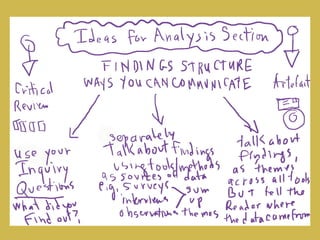
• How do you structure the analysis?
– Look for patterns in your inquiry - your voice should be the loudest in the text as
you develop the themes and analysis – so whether this is through your themes
as headings, your main inquiry questions, or through the way you collected the
data inc. a summary (see Megan’s blog of a conversation abut this)
• How do you include your peer conversations in your SIGs?
– This peer input can be put after your interpretation of the data – the interviews-
how that might compare to the bigger picture – your literature- and as a part of
making sense of the analysis
7. New questions from March 2017…
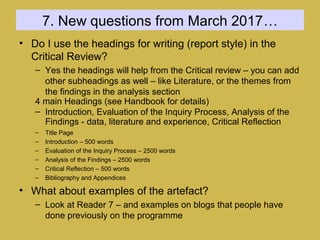
• Do I use the headings for writing (report style) in the
Critical Review?
– Yes the headings will help from the Critical review – you can add
other subheadings as well – like Literature, or the themes from
the findings in the analysis section
4 main Headings (see Handbook for details)
– Introduction, Evaluation of the Inquiry Process, Analysis of the
Findings - data, literature and experience, Critical Reflection
– Title Page
– Introduction – 500 words
– Evaluation of the Inquiry Process – 2500 words
– Analysis of the Findings – 2500 words
– Critical Reflection – 500 words
– Bibliography and Appendices
• What about examples of the artefact?
– Look at Reader 7 – and examples on blogs that people have
done previously on the programme
Points to get out of the session
Develop the ideas
using your community
– peer review is a
powerful arts and
academic process
Creatively draft your
Introduction and Evaluation
sections of the Critical
Review
Examine what you
found out using the 1st
analysis task and
discuss with your
tutor
Examine what you
found out using the 1st
analysis task and
discuss with your
tutor
Think creatively
about the inquiry
and communicating
it to others
Think creatively
about the inquiry
and communicating
it to others
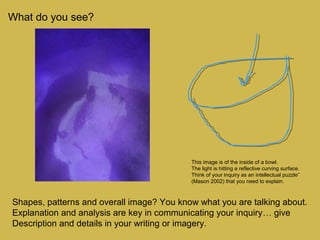
What do you see?
Shapes, patterns and overall image? You know what you are talking about.
Explanation and analysis are key in communicating your inquiry… give
Description and details in your writing or imagery.
This image is of the inside of a bowl.
The light is hitting a reflective curving surface.
Think of your inquiry as an intellectual puzzle”
(Mason 2002) that you need to explain.

Final m3 session 2 15.3.17

  • 1.
    Paula Nottingham Module 3BAPP Arts WBS3760 Session 2 Thinking Creatively about your professional inquiry 15/3/17 Finding connections and patterns in the images and actions… Starting the analysis – how do you tell others what you found out? Drafting the inquiry is a creative process. What is this image? (see at the end of the slides)
  • 2.
    Points to getout of the session Ideas about how to communicate the inquiry and continuing to network Ideas about drafting the inquiry – the Critical Review as a first step Progress on your practitioner research and analysis task Progress on your practitioner research and analysis task Thinking creatively Thinking creatively
  • 3.
    Where are younow? Evaluate… You could still be in several places at once now – keep monitoring progress.
  • 4.
  • 5.
    Completing your Portfolio Thiscourse work represents what you have done for the entire professional inquiry – ALSO it is useful to mention other activities that have helped you to understand your topic/area – e.g. going to performances you have been a art of or have seen, workshops, training – relate and reflect on your entire experience! Critical Review written/communi cating the inquiry with an academic audience in mind Critical Review written/communi cating the inquiry with an academic audience in mind Professional Artefact communicating the inquiry with a professional audience in mind Professional Artefact communicating the inquiry with a professional audience in mind Oral Presentation for tutors and peers Oral Presentation for tutors and peers + blogging and work with peers on programme and workplace Professional Inquiry doing research and activities and then explaining what you found out and outcomes to others Professional Inquiry doing research and activities and then explaining what you found out and outcomes to others
  • 6.
    Thinking creatively Do youhave any examples of creativity you admire? How can you explain ‘creativity’ to others – defining what you mean and using sources of expertise to develop that thinking (analysis) and explain that to others? My example is Solange – here is and article that could help me explain. Use this way of thinking to develop your inquiry... http://www.new yorker.com/cult ure/culture- desk/the- profound- power-of-the- new-solange- videos
  • 7.
    Thinking creatively inyour inquiry Twyla Thwarp suggests in The Creative Habit (2003, p. 196) that “A groove is the best place in the world. It’s where I strive to be, because when you’re in it you have the freedom to explore, where everything you question leads you to new avenues and new routes, everything you touch miraculously touches something and transforms it for the better.” Anne West suggests in Mapping (2011, p. 224) Communicating with an audience is the culminating step in the process. It involves shifting form reading our work to writing and speaking about it. We now become authors, which implies responsibility and action. In giving voice to our work, we embrace and sift all previous raw material, moving it to a higher level of synthesis while offering it to others for their consideration.” Mihaly Csikszenrmihalyi talks about ‘flow’ and suggests that emersing yourself in a ‘domain’ that you truly love will allow the “foundations for creativity” to be in place”. (2006) https://www.ted.com/talks/mihaly_csikszentmihalyi_on_ flow?language=en Pronounced Chick – sent – me - high http://annewest.net http://www.twylatharp.org As a creative professional – embed ideas about creativity in your inquiry analysis – here are some examples
  • 8.
    Thinking creatively http://www.normanjackson.co.uk/creati vity.html Norman Jackson- an advocate for life wide learning https://www.ted.com/talks/ken_robinson_how_to_escape_educa tion_s_death_valley?language=en Ken Robinson - an advocate for creative education https://www.ted.com/playlists/125/tv_special_ted_talks_educatio Can you think of more ? You probably have some creative ideas that help you think about your inquiry from things you have done or the literature your have reviewed ? Ted talks – advocates e.g. seeing and exhibition of Banksy (visual artist) that talked about the changes in contemporary culture that could be compared to dance practice (Taz)
  • 9.
    The Dinner Partyblog – how to explain the literature for your inquiry http://paulanottingham.blogspot.co.uk/2016/03/the-dinner-party- literature-for-your.html As the host introduce people and then invite them to talk about your work over dinner Introduce people here as host - ideas and debates in the literature Lead discussion – analysis of you inquiry
  • 10.
    Try this exercise! Usetalking to start your writing Tell someone else (or think aloud) an example from your ‘emerging findings’ (what people have told your about your topic in your practitioner research). Try this for 4 minutes… ………………………………………………………………… Use your experience (interpretation of something that is common or exceptional) and your literature to talk about what you found out.
  • 11.
    Writing with styleand purpose After you have started a draft – and then continue to edit this. In a formal writing style you say what you mean first and then explain – use your sources to define terms and as the experts ‘see’ the issues that you have explored in your inquiry 4 main Headings (see Handbook for details) Introduction, Evaluation of the Inquiry Process, Analysis of the Findings - data, literature and experience, Critical Reflection Remember that you can add visual elements to show what you mean – like diagrams and or illustrations to the text Start the bibliography as you do this writing using Harvard style (remember you can use Cite Them Right) and there is information up on UniHub (Library and Teaching Enhancement Unit)
  • 12.
    Effective Writing Drafting isa creative Process! When you start writing the ideas do not always come out in an orderly fashion – but your job is to reorder them (like Strunk and White suggest) to make sense of the argument. In you own drafting and editing processes – reordering and ‘shaping’ the text strives to make it more meaningful and more concise. Use paragraphs as units to bring out meaning. ADD details so others will understand the points you are making.
  • 13.
    Effective Writing- tryto edit with purpose to say what you mean in fewer words… Strunk and White example on the issue of wordiness (1959, p. 19) Wordy version : Macbeth was very ambitious. This led him to wish to become king of Scotland. The witches told him that this wish of his would come true. The kind of Scotland at this time was Duncan. Encouraged by his wife, Macbeth murdered Duncan. He was thus enabled to succeed Duncan. He was thus enabled to succeed Duncan as king, (51 words) More concise version: Encouraged by his wife, Macbeth achieved his ambition and realized the prediction of the witches by murdering Duncan and becoming king of Scotland in his place, (26 words) The Elements of Style (1959) Strunk and White
  • 14.
    Example using Literature Hereis a quote about performance and motivation in dance – the quote will be discussed on the next slide… Lazaroff, Elizabeth M (2001) ‘Performance and Motivation in Dance Education’, Arts Education Policy Review, 103, 2; pp.23-26. Motivation is the internal process that initiates, guides, and perpetuates behaviour over time. Motivation is a crucial issue in education, as in other fields concerned with mobilizing others to act, because it is the core of biological, cognitive and social regulation (Ryan and Deci 2000). The task of teaching is to promote cognitive, behavioural, and affective results from students. How to motivate learners to achieve the desired ends or discourage them from undesirable outcomes is a central problem for a teacher in any field.
  • 15.
    When you arelooking at literature you are looking for meaning – so is this saying motivation is fundamental or an added extra to the process of education? So if I could say in my writing: I was interested in developing an understanding of motivation for teaching dance. Lazaroff suggests motivation is essential to education and cites Ryan and Deci (2000) to say that “it is at the core of biological, cognitive and social regulation” (2001, p. 26). Using the dance teacher ‘David’ as an example, Lazaroff suggested techniques such as “modelling and repetition, the verbal directions including praise and corrections, music, group learning, and intense physical activity” (2001, p.25). I wanted to embed these techniques as examples of good practice in the dance class and incorporated this thinking into an intervention that I helped plan in my workplace…. I may not totally agree with Lazaroff about everything e.g. about discouraging students from “undesirable outcomes” - that point might be contradicted by another literature source – so part of a ‘debate’ in the literature.
  • 16.
    Looking Ahead tothe next Task Week 4 OR 5 OR 6 (this might depend on where you are in the process!): Send adviser 1-2 paragraphs as a sample of your inquiry analysis. Formative feedback will be given on the structure, the quality of the arguments and the quality of the supporting evidence discussed. This task is getting everyone into the mindset of being able to take an ‘emerging’ finding (what you found out from someone in your practitioner research) and to think about what it means.
  • 17.
    Analysis of Findings:possible points to consider The professional inquiry has been a way to gather data about a phenomenon e.g. an event a development a change. What did the data indicate about your topic, research question? What did you find out? The inquiry tools that you used should have provided you with the evidence that you need for your inquiry. If not… why not? Findings are interesting because they relate to how things actually are in your work environment.
  • 18.
    Analysis of Findings:‘coding’ to organise Organise the data to look for themes – this is sometimes referred to as ‘coding’ in the research books – you can have this as a digital version – or use post it notes or cards to ‘see’ what people have said and to identify emerging themes
  • 19.
    Data – findingsfrom your inquiry (evidence) Experience – relating your insider-researcher understanding Literature – expertise from others and from a collected body of knowledge in your field and beyond Think of analysis as a triangle of data to develop meaning that you can tell others using your own point of view (Adesola with Paula added)
  • 21.
    Analysis of Findings:critical arguments How do your findings relate to your literature i.e. earlier perceptions of the topic or critical arguments about the topic/issues/phenomenon? Use examples from your literature. Conclusion of this section - what implications/benefits/impact did your inquiry have to your professional practice? Your workplace? Your community of practice? What additional knowledge and understanding do you have about your professional practice? Possible further inquiry topics? How did your own professional activities/events/interventi ons relate to the findings from your inquiry? What were the outcomes?
  • 22.
    Professional Artefact The Artefactis another way of explaining your inquiry that includes the outputs from the inquiry (so what you ‘do’ is in the inquiry itself). There will be more later on this but for now it might be good to think bout who your professional audience might be… who are you talking to to explain what you have done and found out? You can be creative about this process, think about a format that might be unique. Make sure to leave enough time to do what you want to do! Think back to the ideas around professional communication? Think about images you will need and permissions and copyright… if they are not your images how can you incorporate them into your own work? MORE ON the ARTEFACT IN NEXT SESSION Talk to your tutor if needed…
  • 23.
    Blasts from thePast Analysing document (revisited from Reader 6) Documents are a bit different than literature. A document could be something that an author has not written to critique something – but a text (including audio-visual and visual) that exists as a part of your job, e.g. it could be a policy document from an educational context or a contract. You might also have documents given to you by someone you interview as an example of how they work – e.g. a script. Advice is in the Reader on how to ‘analyse’ documents for meaning. ALSO USE RESEARCH LITERATURE
  • 24.
    Analysing Observations (revisited) Thedata is gathered and displayed as descriptions, quotes, diagrams to show relationships, quantitative charts/displays to show quantitative data, audio, audio-visual, and photographic evidence, etc. Your observations record what has happened sensitively and appropriately to issues of ethics, permission and confidentiality. You need to report an understanding of the context for the event or meeting that was observed in order to draw conclusions from the data.
  • 25.
    Analysing interviews andfocus groups (revisited) The analysis of data collected from interviews can be complex. It has been collected within a certain context and must be analysed with that in mind. The qualitative researcher can categorise (code) data that has emerged into themes. Quotes can be selected because they typify the data (common responses) or there might be some statements that are significant though only said once (significant). The data is organised so that comparisons, contrasts and insights can be made with the aim of finding the meaning of the evidence presented.
  • 26.
    Analysing the survey/questionnairedata (revisited) The framework for data analysis of replies determined in advance. Coding your questionnaire: There are five steps involved in the coding process (Survey Monkey can export this data): 1. Develop the coding frame for both pre-coded (closed) and open questions. 2. Create a codebook and coding instructions. 3. Code the questionnaires. 4. Transfer the values to a computer (as in an Excel spreadsheet). 5. Check and clean the data (you can make simple graphs with the data). Interpretation involves identifying significant results, trends, patterns, similarities and differences and offering an explanation for them. This can be expressed in the form of numbers or words in your findings.
  • 27.
    1. Q&A fromModule 3 BAPP 1. The questions that you ask in the interview survey, should you comment on each answer? (i.e. the Interview has 14 questions and the Survey has 24 questions). How many graphs do you put in? Often there is not space to look at every response, so you may want to focus on the most significant findings and the ones that most participants used (more common) – in some cases these might be the same BUT in the interviews only a few might have brought up important issues that you want to talk about. You can use your appendices to show findings that you were unable to spend much time on in your analysis and refer the reader when needed. Put in the number of graphs (data) or quotes (data) that relate to your main points of analysis.
  • 28.
    2. Q&A fromModule 3 BAPP 2. Does it matter if the information you’ve gathered is rubbish as long as you comment that it is rubbish? Difficult one… in this process you try to ask the right interview/survey etc. questions to gather the data that you need to address your research questions or hypothesis. However, there might be some of the questions that did not lead to data that you expected or that was useful as findings. In this case, you rely on the data that has been useful and comment within the evaluation and perhaps in the critical learning sections about the process BUT some unexpected data is genuine so should be reported as a part of the inquiry. Think this through – if your inquiry process has not allowed you to explore the specific issues in your inquiry topic using primary evidence from other people and literature, you need to discuss this with your adviser.
  • 29.
    3. Q&A fromModule 3 BAPP 3. What does the literature review in the Evaluation section cite? You are reviewing literature in the Evaluation section – this covers the sources you have used, the people and theories examined as knowledge and understanding mainly from written sources BUT also videos, audio tapes, etc. Investigating your topic by looking at what others have said about it allows you and the reader to understand the context of your inquiry. If you have done a separate ‘literature review’ you can put in it as an appendix. You can quote and paraphrase from your literature to describe this context and theorise your findings in your analysis – to compare the findings to the debates in your field, back up certain findings, use larger data sets that discuss your indicative findings, give a historical setting, etc.
  • 30.
    4. Q&A fromModule 3 BAPP 4. How much do we mention the Professional Artefact in the Critical Review? Yes, it is appropriate to mention the Professional Artefact in your Critical Review, especially in your analysis or critical reflection. You might also consider an explanatory section to your artefact– we discussed the addition of a cover or written insert often found in CDs to show what they are about and give credits. The final ‘shape’ of the artefact and how it is explained is up to you, but it would make sense to cover this explanation somewhere in the work you submit.
  • 31.
    5. Q&A fromModule 3 BAPP 5. What is the difference between the inquiry and the professional artefact? The inquiry is the process you have used for exploring a research question or hypothesis – the topic area that you have focused on during the module. Your inquiry includes your practitioner research and might include a workshop or teaching intervention, but the process of questioning and exploring the topic would have informed your practice in order for you to do that activity. The professional artefact exhibits the knowledge and understanding from the inquiry findings, like the critical review, but will be some a form of communication that is ‘speaking’ to your own community of practice – it can be a ‘work in progress’ you have made for a professional audience.
  • 32.
    6. Q&A fromModule 3 BAPP 5. What is the difference between an ‘opinion’ and an ‘interpretation’? Be aware that in different academic cultures (arts and humanities) the term ‘opinion’ might represent something else. It might be helpful to think of an opinion as a personally held belief that could be used in your critical reflection and an interpretation as an analysis based on evidence – evidence that comes from the data you have gathered through your practitioner research and inquiry work (both the literature and the ‘tool’ like interview or survey) – so in your analysis section you will be interpreting your findings using critical thinking that relies on judgement e.g. what did you find out and what did it mean? based on evidence form your inquiry.
  • 33.
    7. New questions… •Who can be a part of a SIG? – This does not just need to be for people who are doing similar topics – anyone can join in and talk to others on the course about their work! • Are the inquiry questions different than the interview questions? – Yes the inquiry questions are your questions – what you ask people is related to this but it helps you to see other people’s interpretations • Literature – time range – You can look at older literature to give you a perspective about changes – but look also for what has been written on your topic in the last 5 years so you will get up-to-date practice
  • 34.
    7. New questionsfrom March 2017… • How do you present data like interviews? – in the text you can add this ‘data’ as quotes where you want to bring out a point you are making form the thematic findings – do explain these in your own words as well as needed (indented text does not need quotation marks but you can add the anonymised source e.g. Performers are the salt of the earth, they are generous with their time and make friends easily” (Performer A). • How do you structure the analysis? – Look for patterns in your inquiry - your voice should be the loudest in the text as you develop the themes and analysis – so whether this is through your themes as headings, your main inquiry questions, or through the way you collected the data inc. a summary (see Megan’s blog of a conversation abut this) • How do you include your peer conversations in your SIGs? – This peer input can be put after your interpretation of the data – the interviews- how that might compare to the bigger picture – your literature- and as a part of making sense of the analysis
  • 35.
    7. New questionsfrom March 2017… • Do I use the headings for writing (report style) in the Critical Review? – Yes the headings will help from the Critical review – you can add other subheadings as well – like Literature, or the themes from the findings in the analysis section 4 main Headings (see Handbook for details) – Introduction, Evaluation of the Inquiry Process, Analysis of the Findings - data, literature and experience, Critical Reflection – Title Page – Introduction – 500 words – Evaluation of the Inquiry Process – 2500 words – Analysis of the Findings – 2500 words – Critical Reflection – 500 words – Bibliography and Appendices • What about examples of the artefact? – Look at Reader 7 – and examples on blogs that people have done previously on the programme
  • 36.
    Points to getout of the session Develop the ideas using your community – peer review is a powerful arts and academic process Creatively draft your Introduction and Evaluation sections of the Critical Review Examine what you found out using the 1st analysis task and discuss with your tutor Examine what you found out using the 1st analysis task and discuss with your tutor Think creatively about the inquiry and communicating it to others Think creatively about the inquiry and communicating it to others
  • 37.
    What do yousee? Shapes, patterns and overall image? You know what you are talking about. Explanation and analysis are key in communicating your inquiry… give Description and details in your writing or imagery. This image is of the inside of a bowl. The light is hitting a reflective curving surface. Think of your inquiry as an intellectual puzzle” (Mason 2002) that you need to explain.