




Prepared by:
Asst.Prof. Silas
Chaudhari
Subject:- BCE
Code:-3110004
INTRODUCTION TO BUILDING
AND
TOWN PLANNING
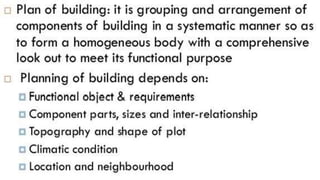
Introduction
• Residential building is one which is used wholly or partly
for considerable time or permanently for human habitation.
• A house give the shelter against weathering elements
like sun, rain, wind, snow.
• Detached house, semi-detached house, Row house, flats
used for residential purpose for long time or life time.
• Hotel and hostel used for residential purpose for short
duration.
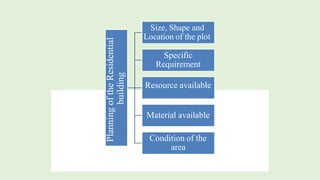
Size, Shape and
Location of the plot
Specific
Requirement
Resource available
Planning
of
the
Residential
building
Material available
Condition of the
area
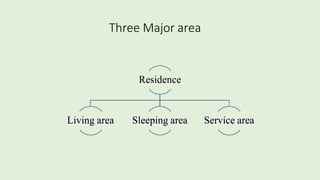
Three Major area
Residence
Living area Sleeping area Service area
• Living area :-
Drawing room, Dining room, Office room, Guest room,
Entrance foyer
• Sleeping area :- Bedroom
• Service area :-
Kitchen, Storeroom, Bathroom, W.C, Garage
Principle of planning
Basic Requirement of a
Building Planning
1. Site Selection
2. Building Bye-Laws
3. Orientation of building
4. Requirements of a Building
5. Functional requirement of a residential Buildings
1. Site Selections
• This is an important phase before planning of any building is
undertaken. Site requirements depend upon the function the building
is intended to serve.
• Factors affecting site selection for residential and factory buildings
will be discussed in the present section.
Site selection for residential Buildings
Following factors play a vital role while selecting site for a residential building:
I. It must be of clear title and in residential zone.
II. As far as possible rectangular plot should be selected.
III. The site must be near to the market, school, hospital, commercial area, transportation hub in
such a way that the residents can avail these facilities within few minutes but the disturbance
from noise and crowd is avoided.
IV. The plot should have a separate approach road.
V. Plots in low-lying areas should be avoided as rainwater may get accumulated in the plot.
VI. The land should be such that hard strata shall be available after minimum excavation.
VII. If the plot is in the vicinity of river then it must be above the high flood level.
VIII. Plots on sloping ground should be avoided as excavation or filling for leveling the plot will be
uneconomical.
IX. Plot below high-tension electrical line should be avoided, as there will be additional restrictions
on number of stores.
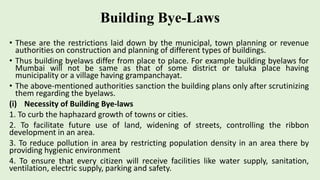
Building Bye-Laws
• These are the restrictions laid down by the municipal, town planning or revenue
authorities on construction and planning of different types of buildings.
• Thus building byelaws differ from place to place. For example building byelaws for
Mumbai will not be same as that of some district or taluka place having
municipality or a village having grampanchayat.
• The above-mentioned authorities sanction the building plans only after scrutinizing
them regarding the byelaws.
(i) Necessity of Building Bye-laws
1. To curb the haphazard growth of towns or cities.
2. To facilitate future use of land, widening of streets, controlling the ribbon
development in an area.
3. To reduce pollution in area by restricting population density in an area there by
providing hygienic environment
4. To ensure that every citizen will receive facilities like water supply, sanitation,
ventilation, electric supply, parking and safety.
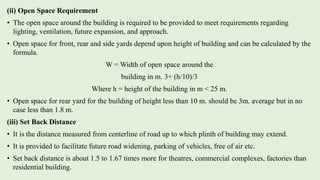
(ii) Open Space Requirement
• The open space around the building is required to be provided to meet requirements regarding
lighting, ventilation, future expansion, and approach.
• Open space for front, rear and side yards depend upon height of building and can be calculated by the
formula.
W = Width of open space around the
building in m. 3+ (h/10)/3
Where h = height of the building in m < 25 m.
• Open space for rear yard for the building of height less than 10 m. should be 3m. average but in no
case less than 1.8 m.
(iii) Set Back Distance
• It is the distance measured from centerline of road up to which plinth of building may extend.
• It is provided to facilitate future road widening, parking of vehicles, free of air etc.
• Set back distance is about 1.5 to 1.67 times more for theatres, commercial complexes, factories than
residential building.
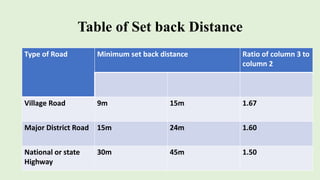
Table of Set back Distance
Type of Road Minimum set back distance Ratio of column 3 to
column 2
Village Road 9m 15m 1.67
Major District Road 15m 24m 1.60
National or state
Highway
30m 45m 1.50
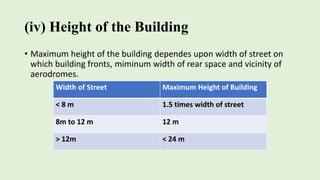
(iv) Height of the Building
• Maximum height of the building dependes upon width of street on
which building fronts, miminum width of rear space and vicinity of
aerodromes.
Width of Street Maximum Height of Building
< 8 m 1.5 times width of street
8m to 12 m 12 m
> 12m < 24 m
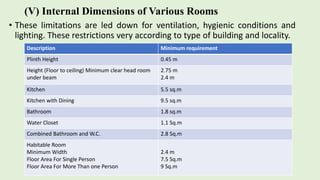
(V) Internal Dimensions of Various Rooms
• These limitations are led down for ventilation, hygienic conditions and
lighting. These restrictions very according to type of building and locality.
Description Minimum requirement
Plinth Height 0.45 m
Height (Floor to ceiling) Minimum clear head room
under beam
2.75 m
2.4 m
Kitchen 5.5 sq.m
Kitchen with Dining 9.5 sq.m
Bathroom 1.8 sq.m
Water Closet 1.1 Sq.m
Combined Bathroom and W.C. 2.8 Sq.m
Habitable Room
Minimum Width
Floor Area For Single Person
Floor Area For More Than one Person
2.4 m
7.5 Sq.m
9 Sq.m
(iv) Lighting and Ventilation
• All habitable rooms including kitchen shall have for the admission of light
and air, one or more openings such as windows opening directly to the
external air or into an open verandah.
• If lighting and ventilation requirements are not met through day lighting and
natural ventilation, the same shall be ensured through artificial lighting and
mechanical ventilation respectively.
• The minimum area of openings for habitable rooms and kitchens excluding
doors shall not be less than 1/8th of floor area.
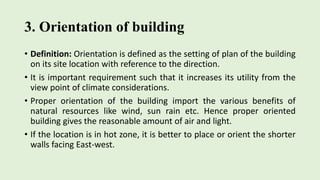
3. Orientation of building
• Definition: Orientation is defined as the setting of plan of the building
on its site location with reference to the direction.
• It is important requirement such that it increases its utility from the
view point of climate considerations.
• Proper orientation of the building import the various benefits of
natural resources like wind, sun rain etc. Hence proper oriented
building gives the reasonable amount of air and light.
• If the location is in hot zone, it is better to place or orient the shorter
walls facing East-west.
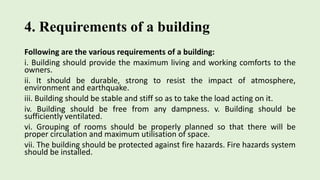
4. Requirements of a building
Following are the various requirements of a building:
i. Building should provide the maximum living and working comforts to the
owners.
ii. It should be durable, strong to resist the impact of atmosphere,
environment and earthquake.
iii. Building should be stable and stiff so as to take the load acting on it.
iv. Building should be free from any dampness. v. Building should be
sufficiently ventilated.
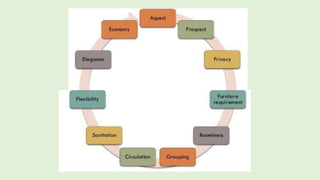
vi. Grouping of rooms should be properly planned so that there will be
proper circulation and maximum utilisation of space.
vii. The building should be protected against fire hazards. Fire hazards system
should be installed.
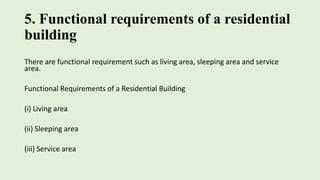
5. Functional requirements of a residential
building
There are functional requirement such as living area, sleeping area and service
area.
Functional Requirements of a Residential Building
(i) Living area
(ii) Sleeping area
(iii) Service area
(i) Living area
Living area is used as general area and it consists of drawing room and living
room. It should be planned near the entrance.
(ii) Sleeping area
This type of area consist of bed rooms for sleeping and for taking rest.
Sleeping area can be or can not be attached to bathroom and W.C. It should
be planned in such way that proper privacy should be maintained.
(iii) Service area
Such type of area consist of kitchen, dining hall, bathroom, W.C. and other
rooms like study room, worship room etc.
Verandah and passages, etc. are should be provided so as to have a easy
access to different rooms by maintaining privacy. Staircases and lifts are
provided to each floor so as to have the vertical circulation.
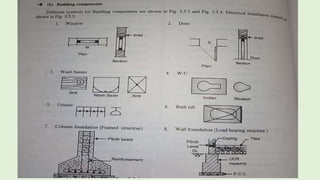
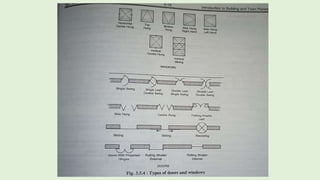
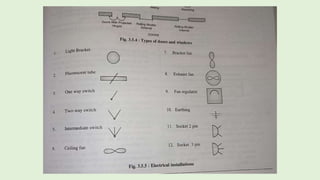
Elements of Building Drawing
Drawing is the language of Engineers. For a civil engineer, the concern is mainly about
drawings of various buildings and various other civil engineering structures such as bridges,
dams, airports, railways, tunnels, roads, atomic power plants, thermal power plants,
harbours and docks, river training structures, coastal structures such as breakwaters, sea-
walls etc. Drawings of all these structures come under Civil Engineering Drawing.
The drawings of residential buildings and public buildings comes under Building Drawing.
Thus. building drawing is a small part of Civil Engineering drawing.
Under the general category of Engineering Drawing. the students have learned various
methods of projection, views of lines, planes and solids, various curves, sections, and
isometric drawing etc. All this knowledge will be of use in the study of Building Drawing.
In India, the Bureau of Indian Standards (BIS) has laid down some norms for various
aspects of Building Drawing. Though these are not strict rules, these norms are used for
the sake of uniformity and convenience. These norms are as conventions of Building
Drawing.
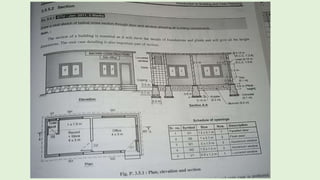
Elevation
• Elevation and Section of a Residential Building
• Elevation is the view of the building from the outside, and from the front side.
Strictly speaking, elevation is the front view, but the term is used flexibly and
terms such as side elevation, left side elevation etc. are also commonly used.
• The elevation should be aesthetically pleasing. The elevation must be drawn to
the same scale as the plan. The elevation is drawn exactly above the developed
plan.
• Dimensions should not be shown on the elevation and the Ground Line should
be extended sufficiently on both sides of the elevation.
• Students are advised to avoid the temptation of doing decorative drawing work
on the elevation and even the main door, parts of decorative sand faced plaster,
stone masonry in plinth, etc. should be kept simple, drawn with light pencil.
• The simplicity gives the drawing its elegance and unnecessary shading or
blackening, not only consumes more time during the exam, but also detracts
from the neatness of drawing, and hence from the marks.
A section line passing through maximum details, i.e. a door, a window,
W.C., bath and stair case is preferred. To accomplish the section line is
turned at 90° at one or more places.
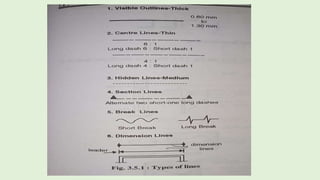
The section line is shown on the plan by one long dash alternating with
two small dashes. If it is a multi-storey building section line must be
shown on each of the ground floor plan and higher floors.
A developed plan, an elevation and section of a building are shown in
Fig. P.3.5.1 to make the things clearer.
Write a short note on site plan.
Site plan shows the plot of land on which construction of the building is
done or will be done. Here the plan of the building is shown by
hatching.
The surrounding roads and a little part of the neighborhood is also
shown in the site plan.
Location Plan
• Location plan or location sketch is drawn so that the site of construction can
be correctly located with respect to the city survey and the plot boundaries
can be fixed by measurements with respect to some permanent and
prominent landmarks around the site.
• Distances from three permanent objects to one or two corners of the plot,
or two distances and one angular measurement are used for the location
plan.
• Location plan as granted by the competent authority is useful in solving any
disputes about land. In the location plan, boundaries towards north, south,
east and west are described, and these when fixed on the ground define the
plot on which the construction is to take place.
• Generally, location sketch of the gate, or one corner of the plot is prepared
along with site plan.
Foundation plan
• Foundation plan shows the excavation that must be done on the site
for laying down the foundation of the building.
• According to the foundation plan, line-out is given on the site by
marking lines with white lime and according to these lines; the
excavation of the foundation trenches or the foundation pits begins.
• Since the two types of structures, viz. the load bearing and the framed
structure differ in their foundation, foundation plans for both the
structures are different from each other.
• Diagonal measurements are given on the foundation plans. These
measurements are used to check the accuracy of the foundation plan.
Fig. 3.5.7 and Fig. 3.5.8 show typical foundation plans for load bearing
as well as framed structure.
F.S.I. (Floor Space Index)
Q. Explain F.S.I. in detail. GTU - May 2018, 4 Marks
Definition: FSI is also called as Floor Area Ratio (F.A.R.). It is defined as the ratio
of total built-up area for the building (taken together) to the total plot area.
• The F.S.I. is different for different area, e.g. F.S.I. for various parts of the same
city may vary. Similarly F.S.I. permitted in cities and in rural / gaothan area may
differ
• F.S.I. is governed by the Development Control (DC) rules, prevailing in that
area.
F.A.R.= Built up area / Plot area
and different F.A.R. is permitted at different places by the competent
authorities.
Principles of Town Planning
According to the town planning acts, the main principles of the town
planning are:
1. Health
2. Zoning
3. Convenience
4. Beauty
(1) Health
To create and promote healthy conditions and environments for all the peoples rich and poor,
to live, to work, to play or relax.
(2) Zoning
To make use of the land for the right purpose by proper division of land called zoning such as
residential, industrial, institutional and recreational etc. in order to avoid future conflicts.
(3) Convenience
The object of convenience is meant in the form of various needs of the community such as
social, economic, cultural and recreational amenities etc.
(4) Beauty
To preserve the beauty of the town by developing it on its most suited natural condition e.g.
preservation of trees, natural greenery, improved types of domestic buildings, temples,
churches, building of cultural and historical importance.
In the past, fortified towns were very popular for safety compare to northern towns. A
military town has to serve different functions than civil town hence it is planned to suit the
changed activities such as training requirement, ammunition etc. Whereas civil town planned
for population employment, functions, housing, social groups, living status, work places.
Following points are considered for planning of town.
(i) Safety of important places, garden, parks, public
buildings.
(ii) Safety of schools colleges, government offices post
offices, temples, churches etc.
(iii) During any natural hazard like, tsunami, earthquake,
bomb blast due to terrorism peoples are to be safe guard
from supporting hands like hospitals, doctors, police,
NGOs, food water suppliers, fire brigade etc.
(iv) Safe drinking water supply, waste water
treatment plants, sanitation facilities are essential
to maintain healthy environment.
(v) Basic services such as proper roads,
transportation facilities, traffic problems, land
grabbing, settlement theft and kidnapping have
ruined city life.
(vi) Some special services like waste collection and
disposal, vermiculture and gas supply through pipe
lines are essential.
For smooth working of the areas, town planning department and municipal
bodies should work together for betterment of areas. The work is distributed by
the department.
Development of any town is planned based on Living, Working and Leisure
utilities/purposes. Also design of all buildings is finalized based on these and the
proportion of human figure.
Living
While planning and designing the buildings more emphasis is given on living, stay
of peoples for specific duration. This is practically to be considered while planning
and designing residential buildings, hospitals, hotels, hostels, etc.
Working
The use of buildings is on hourly basis and hence it proportionately power and
dynamism is expressed through the external appearance of the building e.g.
corporation buildings, corporate office buildings, commercial buildings etc.
Leisure
Sometimes peace, enjoyment, and essence are the objectives of such type of
building hence the design has to reflect all such character e.g. Gymnasiums, Yoga
centers, theaters, Multiplexes etc.
Necessity of Town Planning
Explain town planning necessity?
(i) Increased industrial population has given rise, to the formation of squatter
settlements, slums etc.
(ii) Every road has become a highway, increasing traffic congestion, resulting in
accidents.
(iii) Noisy traffic has almost disturbed the peace of the city.
(iv) Lack of public amenities such as water supply, drainage, sanitation, electricity
etc.
(v) Insufficient open spaces, parks, playgrounds have caused unhealthy conditions
of living.
(vi) The people will have to take long uncomfortable journey from place of
residence to the place of work.
(vii) Safety of each person living, private properties important place etc. from theft.
Origin of Town
Town planning is not new idea or science in India. It is as old as its rich culture and tradition. The following is
the history of town planning at different periods in India.
History of town planning
(1) Indus Valley civilization - (3000 B.C.)
(2) Vedic period - (up to 400 B.C.)
(3) Buddhist period - (up to 320 A.D.)
(4) Medieval period - (up to 14th century)
There was a gradual development of trade and commerce. In this period we have the famous cities such as:
(i) Dhaka for malmal
(ii) Krishnanagar for clay modes
(iii) Agra for marble and perfumery
(iv) Murshidabad for silk
(v) Jaipur
For palatial buildings of artistic excellence.
Origin of Town
(5) Moghul period (1526-1707A.D.): Cities like Agra, Delhi were redeveloped. Fatehpur Bijapur, Lucknow etc.
was entirely planned.
(6) Pre-independence period or British Period
(Till 1947) British introduced street planning and adopted straight roads regardless of the cost or damage to
social structure of the town. In the first decade of 20 century, they took up the outstanding work of building
of New Delhi, the new capital of India.
(7) Post independence period (After 1947): Many
industrial towns were planned after independence
mentioned in below:
(i) Durgapur-West Bengal
(ii) Jamshedpur - Bihar
(iii) Gandhi Nagar - Gujarat (iv) Chandigarh-Punjab etc.
Growth of Town
Definition: Growth of towns is defined as the increase in the proportion of
urban population over time, calculated as the rate of growth of the urban
populations minus that of the total population.
• Growth of town provide many opportunities for development as compared
to more remote area. Land in towns is served by established road network,
water supply, wastewater and sewage disposal infrastructure.
• Electricity and telecommunications can be easily connected established areas
also have community infrastructure such as schools, play grounds, medical
centers, shopping malls, places for workshops etc.
• Town growth may be additionally appropriate locations for future employees,
residents or customers already stay nearby.
Stages in the growth of towns
A town is classified into various categories according to the various stages of
development Sir. Patrick Geddes has given three categories.
Stages in the Growth of Towns
1. Primary town
2. Secondary town
3. Tertiary town
1. Primary town
It is town which produces human requirement and necessities like agricultural village.
2. Secondary town
It is the town which function as entry of exchange such as marketing town.
3. Tertiary town
It is town which provides residential, educational and recreational facilities. It can be
really mentioned that the town is a mixture of all the above mentioned categories.
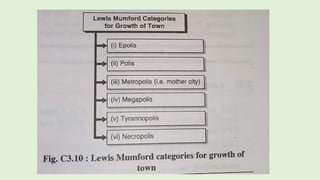
Lewis Mumford has given six categories for growth of town as follows:
(i) Epolis
It is a town one which grows as one entire unit. Its economy depends on
agriculture.
(ii) Polis
It is a town which grows into a small urban unit of self contained community.
It has commerce and industry.
(iii) Metropolis
It is a town which grows to its full stature with high population density and
large potentialities with all facilities such as water supply, drainage, electricity,
transport, commerce and industries etc London, Mumbai and Calcutta are the
example of metropolis.
(iv) Megalopolis
It is a over grown town into mess due to growing expansion of industries, high
rise buildings, multi track roads, mass housing, mass transportation.
(v) Tyrannopolis
The town which shows further decay in all the fields such as trade, commerce,
military power etc.
(vi) Necropolis
It is the town of dead where one can finds disease, famine, economic breakdown
etc.
Growth of town in India varied substantially across time and space.
Firstly, it found that growth and urbanization are tightly linked.
Secondly, migration to towns for work tends to be male-dominated and circular
in nature. For example by creating more women's hostels in towns, to enable
more women to access urban labor markets.
Thirdly, town in India have relatively lower literacy and higher fertility rates.
Fourth, in next two decades town and cities in Northern India will be growing
faster these in South India on account of higher fertility. Hence urbanization can
reduce poverty.
Land Use
Land use planning is planning of a region or a town according to the
use of land. It is very important tool for making development plan or
master plan.
Land use plan shows residential zones, industrial zones, public zones,
open and green spaces, water bodies roads, railway etc.
• Every town has existing land use plan also helps to understand present situation.
• Overall economical transport activity can be analysed from the existing land use plan and
overall life pattern of the people residing in that region can be understood.
Following are the considerations taken into account while preparing a land use plan.
Considerations while preparing a land use plan
1. Area allocation
2. Population and demography
3. Land market
4. Location
5. Natural resources
6. Topography
(1) Area allocation
Area allocation for residential, commercial and industrial areas are decided depending on
the city and its activities.
(2) Population and demography
Population and demography index are important factors while deciding about residential
commercial and industrial areas.
(3) Land market
Land prices are determined from a land use plan. Land plan can be a measure to control land
prices and also a reason to increase land prices.
(4) Location
Location for industry, commercial and residential areas are considered while making a land
use plan.
(5) Natural resources
Rivers, sea, hills, lakes etc. are considered. Also mines, chemical and other resources are
identified before preparing a land use plan.
(6) Topography
Topography of the region i.e. hills slopes etc. are considered.
Zoning
Definition: Zoning is defined as the regulation by law of the use of land and
(or) buildings and of the height and density of buildings in specific areas for
the purpose of securing convenience, health, safety and general welfare of
the community.
• Zoning is the distribution or division of land in town planning into a
particular zones based on certain principles.
• Principle of zoning consists of the following parameters which are given the
importance while zoning the land
Principles of Zoning
1. Concentric growth
2. Boundary
3. Existing towns
4. Flexibility
5. New towns
1. Concentric growth
Definition: When the growth of buildings spreads from a center of town, then it is
termed as concentric growth.
This type of growth is natural and totally unplanned.
In such growth, if population goes on increase, the concentric circles are again
surrounded by people, then such areas are said to be suburbs of the city.
The central area of town is followed by:
i. Developed area
ii. Green area
iii. Undeveloped area
2. Boundary
• It is the important parameter in zoning. Boundaries between two zones can usually
be road, railway line, river or wall or a green belt.
• The existence of boundaries depends upon the rules and law.
3. Existing towns
The planning of zoning of new towns should be done in the convenience of the existing towns without
disturbing the ecosystem.
4. Flexibility
There should be flexibility of making the zoning to provide maximum comfort and convenience to the peoples
living in that zones.
Zoning should be done by considering the new towns in future expansion.
5. New towns
When designing a new town for town areas is planned, the areas needed for
(i) residence
(ii) industries
(iii) business
Complexes are distinctly marked. Then town is split up into suitable zones.
Objects of Zoning
(1) The town planner Gets enough opportunities for designing the future growth and development of the town
due to zoning.
(2) The zoning affords proper co-ordination of various public agencies such as transport facilities, water supply
drainage, electric power etc.
(3) The zoning proves to be an effective instrument in the hands of the town planner for making any town
planning scheme effective and successful.
Advantages of Zoning
Zoning is used for two aspects of planning:
(i) Allocation of land for specific use and
(ii) Control of the use, height and construction of the buildings.
(iii) There is a difference between zoning and reservation. The zoning is applied
to certain types of general uses. The reservation is applied to the uses of
land of specific nature such as gardens, schools, markets, police stations,
fire brigade, stations, parks, playground etc.
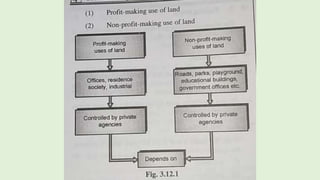
(iv) Uses of Land: The uses of land in town planning can be broadly be
classified into the following two categories:
Introduction to Different Zones of
Land in Town Planning
It is the most important aspect of zoning and it depends on the uses to which various parts
of the town will be put. The zones are usually classified into the following categories:
Different Zones of Land in Town Planning
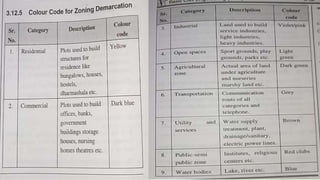
(1) Residential zone (40-50%)
(2) Commercial zone (2 - 5%)
(3) Industrial zone (2-25%)
(4) Public semi public zone (15-20%)
(5) Recreational zone (Remaining %)
(6) Transportation
(1) Residential zone (40-50%)
It is largest occupied area of a town compared to other zones. Its location depends on
neighborhood market, noise and smoke, parks and playground etc. It should be located
windward and upstream with respect to the industrial zone.
The main purpose of this zone is to provide the residents peaceful, healthy, hygienic
surrounding.
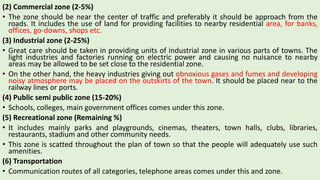
(2) Commercial zone (2-5%)
• The zone should be near the center of traffic and preferably it should be approach from the
roads. It includes the use of land for providing facilities to nearby residential area, for banks,
offices, go-downs, shops etc.
(3) Industrial zone (2-25%)
• Great care should be taken in providing units of industrial zone in various parts of towns. The
light industries and factories running on electric power and causing no nuisance to nearby
areas may be allowed to be set close to the residential zone.
• On the other hand, the heavy industries giving out obnoxious gases and fumes and developing
noisy atmosphere may be placed on the outskirts of the town. It should be placed near to the
railway lines or ports.
(4) Public semi public zone (15-20%)
• Schools, colleges, main government offices comes under this zone.
(5) Recreational zone (Remaining %)
• It includes mainly parks and playgrounds, cinemas, theaters, town halls, clubs, libraries,
restaurants, stadium and other community needs.
• This zone is scatted throughout the plan of town so that the people will adequately use such
amenities.
(6) Transportation
• Communication routes of all categories, telephone areas comes under this and zone.
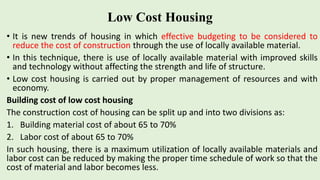
Low Cost Housing
• It is new trends of housing in which effective budgeting to be considered to
reduce the cost of construction through the use of locally available material.
• In this technique, there is use of locally available material with improved skills
and technology without affecting the strength and life of structure.
• Low cost housing is carried out by proper management of resources and with
economy.
Building cost of low cost housing
The construction cost of housing can be split up and into two divisions as:
1. Building material cost of about 65 to 70%
2. Labor cost of about 65 to 70%
In such housing, there is a maximum utilization of locally available materials and
labor cost can be reduced by making the proper time schedule of work so that the
cost of material and labor becomes less.
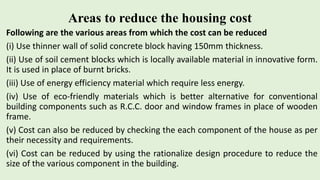
Areas to reduce the housing cost
Following are the various areas from which the cost can be reduced
(i) Use thinner wall of solid concrete block having 150mm thickness.
(ii) Use of soil cement blocks which is locally available material in innovative form.
It is used in place of burnt bricks.
(iii) Use of energy efficiency material which require less energy.
(iv) Use of eco-friendly materials which is better alternative for conventional
building components such as R.C.C. door and window frames in place of wooden
frame.
(v) Cost can also be reduced by checking the each component of the house as per
their necessity and requirements.
(vi) Cost can be reduced by using the rationalize design procedure to reduce the
size of the various component in the building.
Cost reduction using adhoc methods in various
building components
Adhoc Methods in Various Building Components
1. Foundation
2. Lintels and Chajjas
3. Filler slabs
4. Roofing
5. Ferrocement channel or shell unit
6. Jack arch roof or floor
7. Plinth
8. Rat-trap bond wall
9. Concrete block walling
10. Walling
11. Door and windows
12. Soil cement block technology
13. Finishing work
1. Foundation
• It is recommended to adopt a foundation depth of 0.6m for normal soil and use the
uncoursed rubble masonry with the bond stones.
• It is further suggested to adopt arch foundation in ordinary soil for effecting
reduction in construction cost up to 40%.
• For black cotton and other soft soils; it is recommend to use under ream pile
foundation which saves about 20 to 25% in cost over the conventional method of
construction.
2. Lintels and Chajjas
• R.C.C. lintels which are costly use of precast components and brick jelly work also
provide the saving 50% over the window components can be replaced by brick
arches for small spans and save construction cost up to 30 to 40% over the
traditional method of construction.
• Different shapes of arches provides a good architectural pleasing appearance to the
external surface of wall.
3. Filler slabs
• Filler slabs are normal RCC slabs in which bottom half (tension) concrete
portions are replaced by filler materials such as bricks, tiles, cellular concrete
blocks, etc.
• These are safe, sound and provide aesthetically pleasing pattern ceilings. It
does not require plaster. It provides better economy.
4. Roofing
• Use of designed in-situ construction practices such as filler slab and precast
elements reduces construction cost of roofing by about 20 to 25%.
5. Ferrocement channel or shell unit
• Type of unit provide an economic solution to RCC slab and hence provide 30 to
40% cost reduction on floor or roof unit over RCC slabs without compromising
the strength.
• Such units are precasted. There is speedy construction and economical because
shuttering is avoided.
6. Jack arch roof or floor
• Such flow are easy to construct, save on cement and steel, are more
appropriate in hot climates.
• Jack arch roof or floor can be constructed by using compressed earth blocks
and such that it is one of the alternative to bricks hence achieve the economy.
7. Plinth
• It is recommended to adopt 300mm height above 70mm ground level for the plinth and
can be constructed with a cement mortar of 1:6.
• The plinth slab of 70mm to 120mm which is normally adopted and can be prevented and
in its place brick on edge can be used for reducing the cost.
• By adopting this procedure there is reduction in cost by about 35 to 50%. Improving
blanket such as concrete slabs or stone slabs are used to reduce the erosion.
8. Rat-trap bond wall
• It is type of cavity wall construction. It provide the advantage of thermal comfort and
reduction in the quantity of bricks required for masonry work. By adopting rat-trap bond
method, one can create aesthetically pleasing wall surface and plastering can be avoided.
• By using Rat-trap bond wall, it is possible to reduce the bricks cost by 25% and 10 to 15%
in the masonry cost.
9. Concrete block walling
• By using concrete block masonry; the wall thickness can be reduced from 200mm to
150mm. Hollow and solid concrete blocks consumes only of the energy of the burnt bricks
in its production. It saves mortar consumption. It gives speed construction work.
Plastering can be avoided. Hence it provides an overall saving of 10 to 25%.
10. Walling
Wall thickness of 120mm to 150mm is recommended for adoption in the
construction of walls all-round the building and 41/2" for inside walls. It is
recommended to use burnt bricks.
These bricks should be immersed in water for 24 hours and then used for the
construction of wall.
11. Door and windows
It is recommended not to use wood for doors and windows and in its place
concrete or steel section frames which provides saving in cost up to 30 to 40%.
There should be the use available block boards, fibre or wooden boards etc for
making shutters of doors and windows.
It reduces the cost by about 25%. Use of precast components and brick jelly
work also provide the saving 50% over the window components.
12. Soil cement block technology
• It is an energy efficient method of construction into which soil is mixed with 5%
and above cement and pressed in hand operated machine and cured well and
then used in the masonry.
• The overall economy which can be obtained with the soil cement technology is
about 15 to 20% as compared to conventional method of construction.
• It is one of alternative method of construction of walls in which soil cement
blocks are used in place of burnt bricks masonry. Such type of work do not need
plastering on both side of wall.
13. Finishing work
• Finishing work such as sanitary, electricity, painting etc. varies with their cost.
• It depends upon the type and quality of products used and its cost reduction
depends upon the individual choice and liking.
Prevention of Slum
Following are the various measures can be taken so as effectively prevent the slum
formation.
Factors to be Considered in Prevention of Slum
1. Cheap housing
2. Construction of buildings
3. Compulsion to employers
4. Unauthorized construction
5. Rent restrictions
6. Compulsory reservation for low income group
7. Lack of zoning
8. Migrants
1. Cheap housing
There should have cheap housing and hence sufficient number of subsidised cheap
houses should be constructed and made them available to the poor people.
2. Construction of buildings
There should have certain rules and regulation and should be framed and
strictly implemented to restrict the construction of buildings of subnormal
standards.
3. Compulsion to employers
The employers having number of labors working may be forced to provide the
accommodation for their staff.
4. Unauthorized construction
There should be banned for any unauthorized. Construction. Otherwise the
rules and law should be adopted to remove unauthorized construction. Due to
this, there will be control on slum formation.
5. Rent restrictions
Law is ruled out so as to make the provision to restrict the increase of rent and
there by the tenants can be protected.
6. Compulsory reservation for low income group
There should be compulsion to reserve the flat for low income group in
building construction of private sector of residential building.
7. Lack of zoning
If the town is divided into suitable zones and development is not allowed to
take place at random, then there will be control on slum formation.
8. Migrants
The persons migrating from the surrounding region can occupy the vacant
places in or outside the city usually illegally. Hence do not allow the migrated
people to occupy the vacant places, otherwise the colony of squatters may
result into slumps.

MODULE 2 Introduction and Town Planning.pptx

  • 1.
    Prepared by: Asst.Prof. Silas Chaudhari Subject:-BCE Code:-3110004 INTRODUCTION TO BUILDING AND TOWN PLANNING
  • 2.
    Introduction • Residential buildingis one which is used wholly or partly for considerable time or permanently for human habitation. • A house give the shelter against weathering elements like sun, rain, wind, snow. • Detached house, semi-detached house, Row house, flats used for residential purpose for long time or life time. • Hotel and hostel used for residential purpose for short duration.
  • 3.
    Size, Shape and Locationof the plot Specific Requirement Resource available Planning of the Residential building Material available Condition of the area
  • 4.
    Three Major area Residence Livingarea Sleeping area Service area
  • 5.
    • Living area:- Drawing room, Dining room, Office room, Guest room, Entrance foyer • Sleeping area :- Bedroom • Service area :- Kitchen, Storeroom, Bathroom, W.C, Garage
  • 6.
  • 26.
    Basic Requirement ofa Building Planning 1. Site Selection 2. Building Bye-Laws 3. Orientation of building 4. Requirements of a Building 5. Functional requirement of a residential Buildings
  • 27.
    1. Site Selections •This is an important phase before planning of any building is undertaken. Site requirements depend upon the function the building is intended to serve. • Factors affecting site selection for residential and factory buildings will be discussed in the present section.
  • 28.
    Site selection forresidential Buildings Following factors play a vital role while selecting site for a residential building: I. It must be of clear title and in residential zone. II. As far as possible rectangular plot should be selected. III. The site must be near to the market, school, hospital, commercial area, transportation hub in such a way that the residents can avail these facilities within few minutes but the disturbance from noise and crowd is avoided. IV. The plot should have a separate approach road. V. Plots in low-lying areas should be avoided as rainwater may get accumulated in the plot. VI. The land should be such that hard strata shall be available after minimum excavation. VII. If the plot is in the vicinity of river then it must be above the high flood level. VIII. Plots on sloping ground should be avoided as excavation or filling for leveling the plot will be uneconomical. IX. Plot below high-tension electrical line should be avoided, as there will be additional restrictions on number of stores.
  • 29.
    Building Bye-Laws • Theseare the restrictions laid down by the municipal, town planning or revenue authorities on construction and planning of different types of buildings. • Thus building byelaws differ from place to place. For example building byelaws for Mumbai will not be same as that of some district or taluka place having municipality or a village having grampanchayat. • The above-mentioned authorities sanction the building plans only after scrutinizing them regarding the byelaws. (i) Necessity of Building Bye-laws 1. To curb the haphazard growth of towns or cities. 2. To facilitate future use of land, widening of streets, controlling the ribbon development in an area. 3. To reduce pollution in area by restricting population density in an area there by providing hygienic environment 4. To ensure that every citizen will receive facilities like water supply, sanitation, ventilation, electric supply, parking and safety.
  • 30.
    (ii) Open SpaceRequirement • The open space around the building is required to be provided to meet requirements regarding lighting, ventilation, future expansion, and approach. • Open space for front, rear and side yards depend upon height of building and can be calculated by the formula. W = Width of open space around the building in m. 3+ (h/10)/3 Where h = height of the building in m < 25 m. • Open space for rear yard for the building of height less than 10 m. should be 3m. average but in no case less than 1.8 m. (iii) Set Back Distance • It is the distance measured from centerline of road up to which plinth of building may extend. • It is provided to facilitate future road widening, parking of vehicles, free of air etc. • Set back distance is about 1.5 to 1.67 times more for theatres, commercial complexes, factories than residential building.
  • 31.
    Table of Setback Distance Type of Road Minimum set back distance Ratio of column 3 to column 2 Village Road 9m 15m 1.67 Major District Road 15m 24m 1.60 National or state Highway 30m 45m 1.50
  • 32.
    (iv) Height ofthe Building • Maximum height of the building dependes upon width of street on which building fronts, miminum width of rear space and vicinity of aerodromes. Width of Street Maximum Height of Building < 8 m 1.5 times width of street 8m to 12 m 12 m > 12m < 24 m
  • 33.
    (V) Internal Dimensionsof Various Rooms • These limitations are led down for ventilation, hygienic conditions and lighting. These restrictions very according to type of building and locality. Description Minimum requirement Plinth Height 0.45 m Height (Floor to ceiling) Minimum clear head room under beam 2.75 m 2.4 m Kitchen 5.5 sq.m Kitchen with Dining 9.5 sq.m Bathroom 1.8 sq.m Water Closet 1.1 Sq.m Combined Bathroom and W.C. 2.8 Sq.m Habitable Room Minimum Width Floor Area For Single Person Floor Area For More Than one Person 2.4 m 7.5 Sq.m 9 Sq.m
  • 34.
    (iv) Lighting andVentilation • All habitable rooms including kitchen shall have for the admission of light and air, one or more openings such as windows opening directly to the external air or into an open verandah. • If lighting and ventilation requirements are not met through day lighting and natural ventilation, the same shall be ensured through artificial lighting and mechanical ventilation respectively. • The minimum area of openings for habitable rooms and kitchens excluding doors shall not be less than 1/8th of floor area.
  • 35.
    3. Orientation ofbuilding • Definition: Orientation is defined as the setting of plan of the building on its site location with reference to the direction. • It is important requirement such that it increases its utility from the view point of climate considerations. • Proper orientation of the building import the various benefits of natural resources like wind, sun rain etc. Hence proper oriented building gives the reasonable amount of air and light. • If the location is in hot zone, it is better to place or orient the shorter walls facing East-west.
  • 36.
    4. Requirements ofa building Following are the various requirements of a building: i. Building should provide the maximum living and working comforts to the owners. ii. It should be durable, strong to resist the impact of atmosphere, environment and earthquake. iii. Building should be stable and stiff so as to take the load acting on it. iv. Building should be free from any dampness. v. Building should be sufficiently ventilated. vi. Grouping of rooms should be properly planned so that there will be proper circulation and maximum utilisation of space. vii. The building should be protected against fire hazards. Fire hazards system should be installed.
  • 37.
    5. Functional requirementsof a residential building There are functional requirement such as living area, sleeping area and service area. Functional Requirements of a Residential Building (i) Living area (ii) Sleeping area (iii) Service area
  • 38.
    (i) Living area Livingarea is used as general area and it consists of drawing room and living room. It should be planned near the entrance. (ii) Sleeping area This type of area consist of bed rooms for sleeping and for taking rest. Sleeping area can be or can not be attached to bathroom and W.C. It should be planned in such way that proper privacy should be maintained. (iii) Service area Such type of area consist of kitchen, dining hall, bathroom, W.C. and other rooms like study room, worship room etc. Verandah and passages, etc. are should be provided so as to have a easy access to different rooms by maintaining privacy. Staircases and lifts are provided to each floor so as to have the vertical circulation.
  • 39.
    Elements of BuildingDrawing Drawing is the language of Engineers. For a civil engineer, the concern is mainly about drawings of various buildings and various other civil engineering structures such as bridges, dams, airports, railways, tunnels, roads, atomic power plants, thermal power plants, harbours and docks, river training structures, coastal structures such as breakwaters, sea- walls etc. Drawings of all these structures come under Civil Engineering Drawing. The drawings of residential buildings and public buildings comes under Building Drawing. Thus. building drawing is a small part of Civil Engineering drawing. Under the general category of Engineering Drawing. the students have learned various methods of projection, views of lines, planes and solids, various curves, sections, and isometric drawing etc. All this knowledge will be of use in the study of Building Drawing. In India, the Bureau of Indian Standards (BIS) has laid down some norms for various aspects of Building Drawing. Though these are not strict rules, these norms are used for the sake of uniformity and convenience. These norms are as conventions of Building Drawing.
  • 45.
    Elevation • Elevation andSection of a Residential Building • Elevation is the view of the building from the outside, and from the front side. Strictly speaking, elevation is the front view, but the term is used flexibly and terms such as side elevation, left side elevation etc. are also commonly used. • The elevation should be aesthetically pleasing. The elevation must be drawn to the same scale as the plan. The elevation is drawn exactly above the developed plan. • Dimensions should not be shown on the elevation and the Ground Line should be extended sufficiently on both sides of the elevation. • Students are advised to avoid the temptation of doing decorative drawing work on the elevation and even the main door, parts of decorative sand faced plaster, stone masonry in plinth, etc. should be kept simple, drawn with light pencil. • The simplicity gives the drawing its elegance and unnecessary shading or blackening, not only consumes more time during the exam, but also detracts from the neatness of drawing, and hence from the marks.
  • 47.
    A section linepassing through maximum details, i.e. a door, a window, W.C., bath and stair case is preferred. To accomplish the section line is turned at 90° at one or more places. The section line is shown on the plan by one long dash alternating with two small dashes. If it is a multi-storey building section line must be shown on each of the ground floor plan and higher floors. A developed plan, an elevation and section of a building are shown in Fig. P.3.5.1 to make the things clearer.
  • 48.
    Write a shortnote on site plan. Site plan shows the plot of land on which construction of the building is done or will be done. Here the plan of the building is shown by hatching. The surrounding roads and a little part of the neighborhood is also shown in the site plan.
  • 49.
    Location Plan • Locationplan or location sketch is drawn so that the site of construction can be correctly located with respect to the city survey and the plot boundaries can be fixed by measurements with respect to some permanent and prominent landmarks around the site. • Distances from three permanent objects to one or two corners of the plot, or two distances and one angular measurement are used for the location plan. • Location plan as granted by the competent authority is useful in solving any disputes about land. In the location plan, boundaries towards north, south, east and west are described, and these when fixed on the ground define the plot on which the construction is to take place. • Generally, location sketch of the gate, or one corner of the plot is prepared along with site plan.
  • 50.
    Foundation plan • Foundationplan shows the excavation that must be done on the site for laying down the foundation of the building. • According to the foundation plan, line-out is given on the site by marking lines with white lime and according to these lines; the excavation of the foundation trenches or the foundation pits begins. • Since the two types of structures, viz. the load bearing and the framed structure differ in their foundation, foundation plans for both the structures are different from each other. • Diagonal measurements are given on the foundation plans. These measurements are used to check the accuracy of the foundation plan. Fig. 3.5.7 and Fig. 3.5.8 show typical foundation plans for load bearing as well as framed structure.
  • 51.
    F.S.I. (Floor SpaceIndex) Q. Explain F.S.I. in detail. GTU - May 2018, 4 Marks Definition: FSI is also called as Floor Area Ratio (F.A.R.). It is defined as the ratio of total built-up area for the building (taken together) to the total plot area. • The F.S.I. is different for different area, e.g. F.S.I. for various parts of the same city may vary. Similarly F.S.I. permitted in cities and in rural / gaothan area may differ • F.S.I. is governed by the Development Control (DC) rules, prevailing in that area. F.A.R.= Built up area / Plot area and different F.A.R. is permitted at different places by the competent authorities.
  • 52.
    Principles of TownPlanning According to the town planning acts, the main principles of the town planning are: 1. Health 2. Zoning 3. Convenience 4. Beauty
  • 53.
    (1) Health To createand promote healthy conditions and environments for all the peoples rich and poor, to live, to work, to play or relax. (2) Zoning To make use of the land for the right purpose by proper division of land called zoning such as residential, industrial, institutional and recreational etc. in order to avoid future conflicts. (3) Convenience The object of convenience is meant in the form of various needs of the community such as social, economic, cultural and recreational amenities etc. (4) Beauty To preserve the beauty of the town by developing it on its most suited natural condition e.g. preservation of trees, natural greenery, improved types of domestic buildings, temples, churches, building of cultural and historical importance. In the past, fortified towns were very popular for safety compare to northern towns. A military town has to serve different functions than civil town hence it is planned to suit the changed activities such as training requirement, ammunition etc. Whereas civil town planned for population employment, functions, housing, social groups, living status, work places. Following points are considered for planning of town.
  • 54.
    (i) Safety ofimportant places, garden, parks, public buildings. (ii) Safety of schools colleges, government offices post offices, temples, churches etc. (iii) During any natural hazard like, tsunami, earthquake, bomb blast due to terrorism peoples are to be safe guard from supporting hands like hospitals, doctors, police, NGOs, food water suppliers, fire brigade etc.
  • 55.
    (iv) Safe drinkingwater supply, waste water treatment plants, sanitation facilities are essential to maintain healthy environment. (v) Basic services such as proper roads, transportation facilities, traffic problems, land grabbing, settlement theft and kidnapping have ruined city life. (vi) Some special services like waste collection and disposal, vermiculture and gas supply through pipe lines are essential.
  • 56.
    For smooth workingof the areas, town planning department and municipal bodies should work together for betterment of areas. The work is distributed by the department. Development of any town is planned based on Living, Working and Leisure utilities/purposes. Also design of all buildings is finalized based on these and the proportion of human figure. Living While planning and designing the buildings more emphasis is given on living, stay of peoples for specific duration. This is practically to be considered while planning and designing residential buildings, hospitals, hotels, hostels, etc. Working The use of buildings is on hourly basis and hence it proportionately power and dynamism is expressed through the external appearance of the building e.g. corporation buildings, corporate office buildings, commercial buildings etc. Leisure Sometimes peace, enjoyment, and essence are the objectives of such type of building hence the design has to reflect all such character e.g. Gymnasiums, Yoga centers, theaters, Multiplexes etc.
  • 57.
    Necessity of TownPlanning Explain town planning necessity? (i) Increased industrial population has given rise, to the formation of squatter settlements, slums etc. (ii) Every road has become a highway, increasing traffic congestion, resulting in accidents. (iii) Noisy traffic has almost disturbed the peace of the city. (iv) Lack of public amenities such as water supply, drainage, sanitation, electricity etc. (v) Insufficient open spaces, parks, playgrounds have caused unhealthy conditions of living. (vi) The people will have to take long uncomfortable journey from place of residence to the place of work. (vii) Safety of each person living, private properties important place etc. from theft.
  • 58.
    Origin of Town Townplanning is not new idea or science in India. It is as old as its rich culture and tradition. The following is the history of town planning at different periods in India. History of town planning (1) Indus Valley civilization - (3000 B.C.) (2) Vedic period - (up to 400 B.C.) (3) Buddhist period - (up to 320 A.D.) (4) Medieval period - (up to 14th century) There was a gradual development of trade and commerce. In this period we have the famous cities such as: (i) Dhaka for malmal (ii) Krishnanagar for clay modes (iii) Agra for marble and perfumery (iv) Murshidabad for silk (v) Jaipur For palatial buildings of artistic excellence.
  • 59.
    Origin of Town (5)Moghul period (1526-1707A.D.): Cities like Agra, Delhi were redeveloped. Fatehpur Bijapur, Lucknow etc. was entirely planned. (6) Pre-independence period or British Period (Till 1947) British introduced street planning and adopted straight roads regardless of the cost or damage to social structure of the town. In the first decade of 20 century, they took up the outstanding work of building of New Delhi, the new capital of India. (7) Post independence period (After 1947): Many industrial towns were planned after independence mentioned in below: (i) Durgapur-West Bengal (ii) Jamshedpur - Bihar (iii) Gandhi Nagar - Gujarat (iv) Chandigarh-Punjab etc.
  • 60.
    Growth of Town Definition:Growth of towns is defined as the increase in the proportion of urban population over time, calculated as the rate of growth of the urban populations minus that of the total population. • Growth of town provide many opportunities for development as compared to more remote area. Land in towns is served by established road network, water supply, wastewater and sewage disposal infrastructure. • Electricity and telecommunications can be easily connected established areas also have community infrastructure such as schools, play grounds, medical centers, shopping malls, places for workshops etc. • Town growth may be additionally appropriate locations for future employees, residents or customers already stay nearby.
  • 61.
    Stages in thegrowth of towns A town is classified into various categories according to the various stages of development Sir. Patrick Geddes has given three categories. Stages in the Growth of Towns 1. Primary town 2. Secondary town 3. Tertiary town 1. Primary town It is town which produces human requirement and necessities like agricultural village. 2. Secondary town It is the town which function as entry of exchange such as marketing town. 3. Tertiary town It is town which provides residential, educational and recreational facilities. It can be really mentioned that the town is a mixture of all the above mentioned categories. Lewis Mumford has given six categories for growth of town as follows:
  • 63.
    (i) Epolis It isa town one which grows as one entire unit. Its economy depends on agriculture. (ii) Polis It is a town which grows into a small urban unit of self contained community. It has commerce and industry. (iii) Metropolis It is a town which grows to its full stature with high population density and large potentialities with all facilities such as water supply, drainage, electricity, transport, commerce and industries etc London, Mumbai and Calcutta are the example of metropolis. (iv) Megalopolis It is a over grown town into mess due to growing expansion of industries, high rise buildings, multi track roads, mass housing, mass transportation.
  • 64.
    (v) Tyrannopolis The townwhich shows further decay in all the fields such as trade, commerce, military power etc. (vi) Necropolis It is the town of dead where one can finds disease, famine, economic breakdown etc. Growth of town in India varied substantially across time and space. Firstly, it found that growth and urbanization are tightly linked. Secondly, migration to towns for work tends to be male-dominated and circular in nature. For example by creating more women's hostels in towns, to enable more women to access urban labor markets. Thirdly, town in India have relatively lower literacy and higher fertility rates. Fourth, in next two decades town and cities in Northern India will be growing faster these in South India on account of higher fertility. Hence urbanization can reduce poverty.
  • 65.
    Land Use Land useplanning is planning of a region or a town according to the use of land. It is very important tool for making development plan or master plan. Land use plan shows residential zones, industrial zones, public zones, open and green spaces, water bodies roads, railway etc.
  • 66.
    • Every townhas existing land use plan also helps to understand present situation. • Overall economical transport activity can be analysed from the existing land use plan and overall life pattern of the people residing in that region can be understood. Following are the considerations taken into account while preparing a land use plan. Considerations while preparing a land use plan 1. Area allocation 2. Population and demography 3. Land market 4. Location 5. Natural resources 6. Topography
  • 67.
    (1) Area allocation Areaallocation for residential, commercial and industrial areas are decided depending on the city and its activities. (2) Population and demography Population and demography index are important factors while deciding about residential commercial and industrial areas. (3) Land market Land prices are determined from a land use plan. Land plan can be a measure to control land prices and also a reason to increase land prices. (4) Location Location for industry, commercial and residential areas are considered while making a land use plan. (5) Natural resources Rivers, sea, hills, lakes etc. are considered. Also mines, chemical and other resources are identified before preparing a land use plan. (6) Topography Topography of the region i.e. hills slopes etc. are considered.
  • 68.
    Zoning Definition: Zoning isdefined as the regulation by law of the use of land and (or) buildings and of the height and density of buildings in specific areas for the purpose of securing convenience, health, safety and general welfare of the community. • Zoning is the distribution or division of land in town planning into a particular zones based on certain principles. • Principle of zoning consists of the following parameters which are given the importance while zoning the land Principles of Zoning 1. Concentric growth 2. Boundary 3. Existing towns 4. Flexibility 5. New towns
  • 69.
    1. Concentric growth Definition:When the growth of buildings spreads from a center of town, then it is termed as concentric growth. This type of growth is natural and totally unplanned. In such growth, if population goes on increase, the concentric circles are again surrounded by people, then such areas are said to be suburbs of the city. The central area of town is followed by: i. Developed area ii. Green area iii. Undeveloped area 2. Boundary • It is the important parameter in zoning. Boundaries between two zones can usually be road, railway line, river or wall or a green belt. • The existence of boundaries depends upon the rules and law.
  • 70.
    3. Existing towns Theplanning of zoning of new towns should be done in the convenience of the existing towns without disturbing the ecosystem. 4. Flexibility There should be flexibility of making the zoning to provide maximum comfort and convenience to the peoples living in that zones. Zoning should be done by considering the new towns in future expansion. 5. New towns When designing a new town for town areas is planned, the areas needed for (i) residence (ii) industries (iii) business Complexes are distinctly marked. Then town is split up into suitable zones. Objects of Zoning (1) The town planner Gets enough opportunities for designing the future growth and development of the town due to zoning. (2) The zoning affords proper co-ordination of various public agencies such as transport facilities, water supply drainage, electric power etc. (3) The zoning proves to be an effective instrument in the hands of the town planner for making any town planning scheme effective and successful.
  • 71.
    Advantages of Zoning Zoningis used for two aspects of planning: (i) Allocation of land for specific use and (ii) Control of the use, height and construction of the buildings. (iii) There is a difference between zoning and reservation. The zoning is applied to certain types of general uses. The reservation is applied to the uses of land of specific nature such as gardens, schools, markets, police stations, fire brigade, stations, parks, playground etc. (iv) Uses of Land: The uses of land in town planning can be broadly be classified into the following two categories:
  • 73.
    Introduction to DifferentZones of Land in Town Planning It is the most important aspect of zoning and it depends on the uses to which various parts of the town will be put. The zones are usually classified into the following categories: Different Zones of Land in Town Planning (1) Residential zone (40-50%) (2) Commercial zone (2 - 5%) (3) Industrial zone (2-25%) (4) Public semi public zone (15-20%) (5) Recreational zone (Remaining %) (6) Transportation (1) Residential zone (40-50%) It is largest occupied area of a town compared to other zones. Its location depends on neighborhood market, noise and smoke, parks and playground etc. It should be located windward and upstream with respect to the industrial zone. The main purpose of this zone is to provide the residents peaceful, healthy, hygienic surrounding.
  • 74.
    (2) Commercial zone(2-5%) • The zone should be near the center of traffic and preferably it should be approach from the roads. It includes the use of land for providing facilities to nearby residential area, for banks, offices, go-downs, shops etc. (3) Industrial zone (2-25%) • Great care should be taken in providing units of industrial zone in various parts of towns. The light industries and factories running on electric power and causing no nuisance to nearby areas may be allowed to be set close to the residential zone. • On the other hand, the heavy industries giving out obnoxious gases and fumes and developing noisy atmosphere may be placed on the outskirts of the town. It should be placed near to the railway lines or ports. (4) Public semi public zone (15-20%) • Schools, colleges, main government offices comes under this zone. (5) Recreational zone (Remaining %) • It includes mainly parks and playgrounds, cinemas, theaters, town halls, clubs, libraries, restaurants, stadium and other community needs. • This zone is scatted throughout the plan of town so that the people will adequately use such amenities. (6) Transportation • Communication routes of all categories, telephone areas comes under this and zone.
  • 76.
    Low Cost Housing •It is new trends of housing in which effective budgeting to be considered to reduce the cost of construction through the use of locally available material. • In this technique, there is use of locally available material with improved skills and technology without affecting the strength and life of structure. • Low cost housing is carried out by proper management of resources and with economy. Building cost of low cost housing The construction cost of housing can be split up and into two divisions as: 1. Building material cost of about 65 to 70% 2. Labor cost of about 65 to 70% In such housing, there is a maximum utilization of locally available materials and labor cost can be reduced by making the proper time schedule of work so that the cost of material and labor becomes less.
  • 77.
    Areas to reducethe housing cost Following are the various areas from which the cost can be reduced (i) Use thinner wall of solid concrete block having 150mm thickness. (ii) Use of soil cement blocks which is locally available material in innovative form. It is used in place of burnt bricks. (iii) Use of energy efficiency material which require less energy. (iv) Use of eco-friendly materials which is better alternative for conventional building components such as R.C.C. door and window frames in place of wooden frame. (v) Cost can also be reduced by checking the each component of the house as per their necessity and requirements. (vi) Cost can be reduced by using the rationalize design procedure to reduce the size of the various component in the building.
  • 78.
    Cost reduction usingadhoc methods in various building components Adhoc Methods in Various Building Components 1. Foundation 2. Lintels and Chajjas 3. Filler slabs 4. Roofing 5. Ferrocement channel or shell unit 6. Jack arch roof or floor 7. Plinth 8. Rat-trap bond wall 9. Concrete block walling 10. Walling 11. Door and windows 12. Soil cement block technology 13. Finishing work
  • 79.
    1. Foundation • Itis recommended to adopt a foundation depth of 0.6m for normal soil and use the uncoursed rubble masonry with the bond stones. • It is further suggested to adopt arch foundation in ordinary soil for effecting reduction in construction cost up to 40%. • For black cotton and other soft soils; it is recommend to use under ream pile foundation which saves about 20 to 25% in cost over the conventional method of construction. 2. Lintels and Chajjas • R.C.C. lintels which are costly use of precast components and brick jelly work also provide the saving 50% over the window components can be replaced by brick arches for small spans and save construction cost up to 30 to 40% over the traditional method of construction. • Different shapes of arches provides a good architectural pleasing appearance to the external surface of wall.
  • 80.
    3. Filler slabs •Filler slabs are normal RCC slabs in which bottom half (tension) concrete portions are replaced by filler materials such as bricks, tiles, cellular concrete blocks, etc. • These are safe, sound and provide aesthetically pleasing pattern ceilings. It does not require plaster. It provides better economy. 4. Roofing • Use of designed in-situ construction practices such as filler slab and precast elements reduces construction cost of roofing by about 20 to 25%. 5. Ferrocement channel or shell unit • Type of unit provide an economic solution to RCC slab and hence provide 30 to 40% cost reduction on floor or roof unit over RCC slabs without compromising the strength. • Such units are precasted. There is speedy construction and economical because shuttering is avoided.
  • 81.
    6. Jack archroof or floor • Such flow are easy to construct, save on cement and steel, are more appropriate in hot climates. • Jack arch roof or floor can be constructed by using compressed earth blocks and such that it is one of the alternative to bricks hence achieve the economy.
  • 82.
    7. Plinth • Itis recommended to adopt 300mm height above 70mm ground level for the plinth and can be constructed with a cement mortar of 1:6. • The plinth slab of 70mm to 120mm which is normally adopted and can be prevented and in its place brick on edge can be used for reducing the cost. • By adopting this procedure there is reduction in cost by about 35 to 50%. Improving blanket such as concrete slabs or stone slabs are used to reduce the erosion. 8. Rat-trap bond wall • It is type of cavity wall construction. It provide the advantage of thermal comfort and reduction in the quantity of bricks required for masonry work. By adopting rat-trap bond method, one can create aesthetically pleasing wall surface and plastering can be avoided. • By using Rat-trap bond wall, it is possible to reduce the bricks cost by 25% and 10 to 15% in the masonry cost. 9. Concrete block walling • By using concrete block masonry; the wall thickness can be reduced from 200mm to 150mm. Hollow and solid concrete blocks consumes only of the energy of the burnt bricks in its production. It saves mortar consumption. It gives speed construction work. Plastering can be avoided. Hence it provides an overall saving of 10 to 25%.
  • 83.
    10. Walling Wall thicknessof 120mm to 150mm is recommended for adoption in the construction of walls all-round the building and 41/2" for inside walls. It is recommended to use burnt bricks. These bricks should be immersed in water for 24 hours and then used for the construction of wall. 11. Door and windows It is recommended not to use wood for doors and windows and in its place concrete or steel section frames which provides saving in cost up to 30 to 40%. There should be the use available block boards, fibre or wooden boards etc for making shutters of doors and windows. It reduces the cost by about 25%. Use of precast components and brick jelly work also provide the saving 50% over the window components.
  • 84.
    12. Soil cementblock technology • It is an energy efficient method of construction into which soil is mixed with 5% and above cement and pressed in hand operated machine and cured well and then used in the masonry. • The overall economy which can be obtained with the soil cement technology is about 15 to 20% as compared to conventional method of construction. • It is one of alternative method of construction of walls in which soil cement blocks are used in place of burnt bricks masonry. Such type of work do not need plastering on both side of wall. 13. Finishing work • Finishing work such as sanitary, electricity, painting etc. varies with their cost. • It depends upon the type and quality of products used and its cost reduction depends upon the individual choice and liking.
  • 85.
    Prevention of Slum Followingare the various measures can be taken so as effectively prevent the slum formation. Factors to be Considered in Prevention of Slum 1. Cheap housing 2. Construction of buildings 3. Compulsion to employers 4. Unauthorized construction 5. Rent restrictions 6. Compulsory reservation for low income group 7. Lack of zoning 8. Migrants 1. Cheap housing There should have cheap housing and hence sufficient number of subsidised cheap houses should be constructed and made them available to the poor people.
  • 86.
    2. Construction ofbuildings There should have certain rules and regulation and should be framed and strictly implemented to restrict the construction of buildings of subnormal standards. 3. Compulsion to employers The employers having number of labors working may be forced to provide the accommodation for their staff. 4. Unauthorized construction There should be banned for any unauthorized. Construction. Otherwise the rules and law should be adopted to remove unauthorized construction. Due to this, there will be control on slum formation. 5. Rent restrictions Law is ruled out so as to make the provision to restrict the increase of rent and there by the tenants can be protected.
  • 87.
    6. Compulsory reservationfor low income group There should be compulsion to reserve the flat for low income group in building construction of private sector of residential building. 7. Lack of zoning If the town is divided into suitable zones and development is not allowed to take place at random, then there will be control on slum formation. 8. Migrants The persons migrating from the surrounding region can occupy the vacant places in or outside the city usually illegally. Hence do not allow the migrated people to occupy the vacant places, otherwise the colony of squatters may result into slumps.